
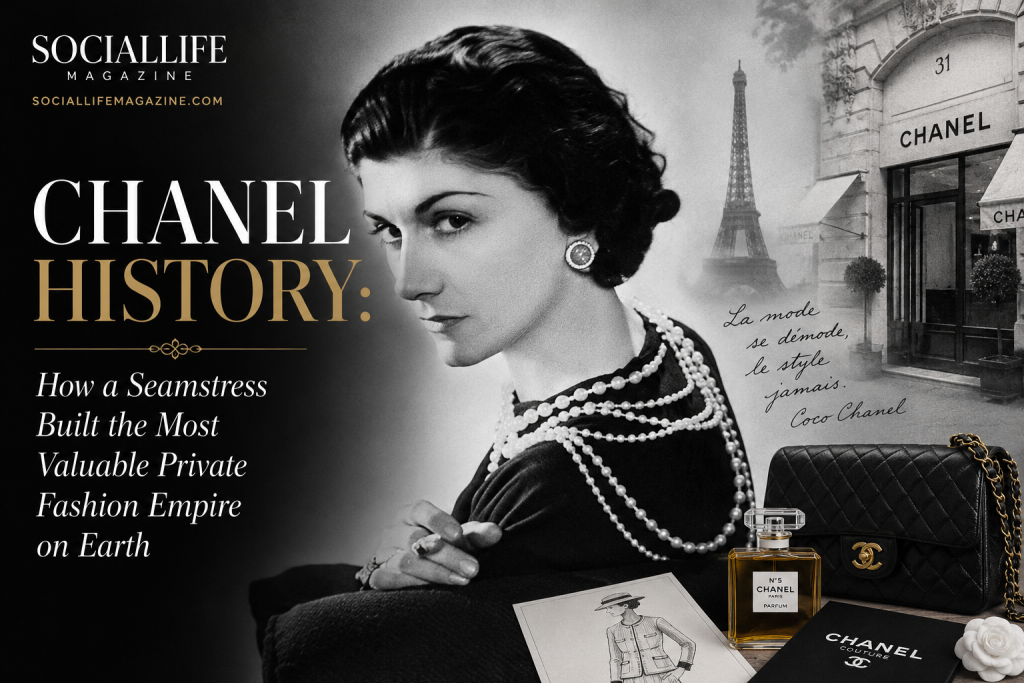
The Orphan Who Rewrote the Rules
In 1910, a woman with no family money, no formal training, and no social connections opened a hat shop at 21 Rue Cambon in Paris. Her name was Gabrielle Bonheur Chanel. Within two decades, she would dismantle the entire vocabulary of Chanel history and rebuild it around a single radical idea: that women’s clothing should let women move.
That idea, born in an orphanage run by nuns in Aubazine, is now worth an estimated $38 billion in brand value alone. The French fashion houses that dominated Paris in 1910 sold corsets, layers, and immobility. Chanel sold freedom. The market made its choice.
Today, Chanel is the most valuable private fashion company in the world. Revenue hit $18.7 billion for 2024. The house has never gone public, never been acquired, and remains controlled by the same family that partnered with its founder over a century ago. In an industry defined by conglomerate warfare and quarterly earnings pressure, Chanel’s independence is its most powerful asset and its most carefully guarded secret.
Aubazine to Rue Cambon
Gabrielle Chanel was twelve when her mother died of tuberculosis and her father abandoned the family. She spent six years at the Aubazine orphanage in central France, where the nuns taught her to sew. The black and white palette she later made famous mirrors the convent’s stone corridors. The interlocking C logo echoes the stained glass windows she passed every day as a child.
Her first shop sold hats. By 1913, she had opened boutiques in Deauville and Biarritz, catering to wealthy women who vacationed on the French coast. She used jersey fabric, a material previously reserved for men’s underwear, to make women’s sportswear. The fashion establishment considered it an insult. Customers considered it a revelation.
By 1920, Chanel had moved to 31 Rue Cambon, the address that remains the company’s spiritual headquarters today. She introduced the Chanel suit (collarless jacket, fitted skirt, braided trim), the little black dress (which Vogue called “a Ford” for its universal accessibility), and the quilted 2.55 handbag named for the date of its creation: February 1955.
The Design Philosophy That Changed Everything
What made Chanel revolutionary was not any single garment. It was the underlying logic. Every design decision she made was a rejection of what the male-dominated couture establishment told women they should want. Corsets restricted breathing. She eliminated them. Ornate embellishment signaled wealth but prevented movement. She stripped it away. Dark colors were reserved for mourning. She made black the uniform of sophistication.
The Chanel suit, introduced in the 1920s and refined over the next four decades, embodied this philosophy perfectly. Its jacket was unlined, making it lighter than anything else on the couture market. The skirt hit just below the knee, allowing a woman to walk at a normal pace instead of taking the mincing steps that floor-length gowns required. Chain weights sewn into the jacket’s hem ensured it hung properly without constricting the wearer. Every functional detail was invisible. The woman wearing the suit looked effortless. The effort was in the construction.
This approach also extended to accessories. The 2.55 bag featured a shoulder chain specifically so women could carry it hands-free. Before Chanel, handbags were clutches that required one hand permanently occupied. Freeing both hands was a practical innovation, but it was also a statement about autonomy. A woman carrying a Chanel bag had both hands available to open doors, shake hands, and signal taxis. These were small freedoms that added up to a different way of moving through the world.
The Perfume That Funded an Empire
Every piece of Chanel history eventually leads to a glass bottle. In 1921, Chanel asked perfumer Ernest Beaux to create something that smelled like a woman, not a flower. He presented her with samples numbered 1 through 24. She chose number 5. The name stuck.
Chanel No. 5 became the best-selling perfume in the world. It also became the financial engine that powered everything else. Fragrance margins in luxury fashion run between 80 and 90 percent. When Marilyn Monroe told a reporter in 1952 that she wore nothing to bed but Chanel No. 5, she converted a perfume into cultural mythology. That mythology still sells roughly $1 billion worth of fragrance annually.
But perfume also created the ownership split that defines the house to this day. In 1924, Chanel partnered with Pierre Wertheimer to manufacture and distribute the fragrance. Wertheimer received 70 percent of the perfume business. Chanel received 10 percent. She spent the next thirty years fighting to reclaim what she believed was stolen from her.
The Wartime Reckoning and the Comeback
Chanel closed her couture house in 1939 when France entered World War II. During the occupation, she lived at the Ritz Paris (the German military headquarters requisitioned the other half of the hotel). Her relationship with German officer Hans Günther von Dincklage has been documented extensively. After the liberation, she was interrogated but never charged, reportedly protected by connections that reached Winston Churchill. The wartime years remain the most uncomfortable chapter in Chanel history, one the company neither denies nor addresses with any specificity.
She spent the next decade in Swiss exile. The fashion world moved on. Dior launched the New Look in 1947. Balenciaga reinvented the silhouette. Givenchy dressed Audrey Hepburn. Chanel seemed finished. Paris couture had moved toward the elaborate and the ornamental, exactly the direction she had spent her career fighting against.
Then, in 1954, at age 71, she reopened her couture house. The French press savaged the first collection. American buyers loved it. Life magazine ran a spread. Within two years, the Chanel suit was the most copied garment in fashion, adopted by everyone from Jacqueline Kennedy to department store knockoff lines. Comeback is not the right word. Resurrection is closer. She worked until the day she died, fitting models in her salon on a Sunday afternoon in January 1971, the evening before her body was found at the Ritz.
The Wertheimer Dynasty
Coco Chanel died on January 10, 1971, in her suite at the Ritz Paris. She was 87 years old and still working on her next collection. Pierre Wertheimer’s grandson Alain and his brother Gérard inherited full control of the company. They have held it ever since, rejecting every outside approach with the same quiet firmness.
The Wertheimer family operates with a level of discretion that borders on pathological. Interviews are almost nonexistent. Financial results appear only because UK law requires them (Chanel Limited is registered in England). Every acquisition approach, every IPO pitch, every attempt by Bernard Arnault or François Pinault to bring Chanel into a conglomerate portfolio has been rejected.
This independence is not sentimental. The strategy is deliberate. Chanel’s refusal to go public means the house never faces quarterly earnings pressure. That freedom allows a $1.8 billion investment year (as it did in 2024) without explaining the decision to shareholders. Price increases of 60 percent over three years happen without worrying about same-store sales comparisons.
What Privacy Buys
Consider what public luxury companies must do. LVMH reports earnings every quarter. Kering justifies every creative director hire to analysts. Tapestry’s attempted acquisition of Capri Holdings collapsed under regulatory scrutiny that played out in public filings for months.
Chanel does none of this. When it appointed Matthieu Blazy as artistic director in December 2024, replacing Virginie Viard, the decision appeared fully formed. No leaks to Women’s Wear Daily. Analyst calls to justify the choice were unnecessary. Stock price reactions did not exist to manage. Blazy, who previously led Bottega Veneta at Kering, walked into a house where the creative timeline runs on decades, not seasons.
The Wertheimers’ combined net worth exceeds $90 billion. Forbes consistently ranks them among the five richest families in France. Yet most people who buy Chanel could not name a single Wertheimer. That anonymity is not a failure of branding. It is the brand’s final product.
Karl Lagerfeld’s Resurrection
By 1983, Chanel history had stalled. Coco had been dead for twelve years. The house survived on fragrance revenue and licensing deals that diluted the brand’s meaning. Ready-to-wear felt stuck in a museum. Alain Wertheimer made what most fashion historians now consider the single greatest hiring decision in luxury fashion. He recruited Karl Lagerfeld.
Lagerfeld was 50 years old, German-born, and famously difficult. He was also the only designer in Paris who understood that heritage was raw material, not a constraint. Over 36 years, he took every Chanel signature (the tweed, the camellia, the pearls, the double C) and ran them through a centrifuge of contemporary culture.
He staged shows inside a recreated supermarket, a rocket launch pad, a Parisian brasserie, and a functioning airport terminal. Every set cost millions. Every set generated hundreds of millions in press coverage. Lagerfeld understood before anyone in fashion that the show was the advertising, and the advertising was the product.
The Revenue Machine
Under Lagerfeld, Chanel grew from a respected but dormant house into a commercial juggernaut. Revenue climbed from roughly $2 billion in the early 2000s to $11 billion by 2018. When Lagerfeld died in February 2019, the house he rebuilt was generating more annual revenue than most publicly traded luxury conglomerates.
Virginie Viard, Lagerfeld’s closest collaborator for thirty years, succeeded him. Her tenure (2019 to 2024) was quieter, more personal, and commercially successful. Revenue reached $19.7 billion in 2023 before pulling back slightly to $18.7 billion in 2024. Viard proved the house could operate without Lagerfeld’s outsized personality. But the Wertheimers wanted a new chapter, not a continuation.
The Three Pillars of Revenue
Chanel history is often told as a fashion story, but the financials tell a different tale. The house operates across three major divisions, and fashion is not the largest. Fragrance and beauty generate the highest volume, accounting for roughly 40 percent of total revenue. Chanel’s cosmetics line (anchored by the Le Teint foundation and Rouge Allure lipstick ranges) competes directly with Dior Beauty, Estée Lauder, and YSL Beauty for counter space at department stores worldwide. The margin on a $45 lipstick approaches 90 percent.
Fashion and leather goods compose the second pillar. This is where the cultural prestige lives. The Métiers d’art collections showcase the specialized workshops (feather makers, embroiderers, milliners, shoemakers) that Chanel has acquired over the past two decades to protect the artisanal supply chain. Acquiring Lesage (embroidery), Desrues (buttons and costume jewelry), and Massaro (shoes) was not philanthropy. It was vertical integration disguised as heritage preservation.
Watches and fine jewelry form the third pillar, growing faster than either of the other two. The J12 ceramic watch, introduced in 2000, proved that Chanel could compete with Swiss watch houses on technical merit, not just brand cachet. The high jewelry collections, shown annually in Paris, now include pieces priced above $1 million. For a brand founded on simplicity, the jewelry division reveals an appetite for maximalism that Coco herself might have resisted.
The Matthieu Blazy Era Begins
Blazy’s appointment represents the first true creative reset since Lagerfeld arrived in 1983. Born in Paris in 1984 (the year after Lagerfeld started at Chanel), Blazy trained under Raf Simons, worked on Maison Margiela’s Artisanal line, served as senior women’s designer under Phoebe Philo at Celine, and then led Bottega Veneta to critical acclaim with trompe l’oeil leather work and an intellectual approach to craft.
His Spring-Summer 2026 debut at the Grand Palais transformed the space into a solar system. The collection balanced Chanel’s codes with a tactile, material-first sensibility that felt entirely new. He is only the fourth artistic director in the house’s history. Coco, Lagerfeld, Viard, Blazy. Four names across 115 years.
What makes the Blazy appointment strategically significant is the competitive context. At Bottega Veneta, he proved that a luxury brand could generate intense cultural heat without relying on logos or monograms. His trompe l’oeil leather pieces (shirts that looked like flannel, jeans that were actually calfskin) went viral precisely because they rewarded close inspection rather than distant recognition. That philosophy aligns with Chanel’s founding principle: luxury that reveals itself to the wearer, not the observer.
The Forty-Year Bet
Blazy’s hiring also represents a generational bet. At 41, he is young enough to lead the house for three decades or more. Lagerfeld proved that continuity at Chanel creates compound returns. Every year the same designer interprets the codes, the interpretation deepens, the audience grows, and the brand’s cultural authority strengthens. The Wertheimers are not looking for a three-year sensation. They are looking for the next forty-year partnership.
Chanel invested $1.8 billion in 2024, a 43 percent increase over the prior year, to expand its global boutique network into India, Mexico, and deeper into mainland China. Over 38,400 employees now work for the house. Brand Finance valued it at $38 billion in 2025, making it the most valuable luxury brand on earth, ahead of Louis Vuitton at $33 billion.
The Hamptons Calculation
Walk through East Hampton village on a Saturday in July and you will see Chanel on every other arm. The Classic Flap bag in black caviar leather retails for over $10,000 now, up from roughly $6,500 three years ago. Nobody is complaining. Scarcity is the point.
Chanel’s pricing strategy is the most aggressive in luxury fashion. Between 2019 and 2024, the house raised prices on its core leather goods by approximately 60 percent. The Classic Flap has tripled in price since 2010. Each increase triggers a wave of panic buying that clears existing inventory and generates press coverage that functions as free advertising. Social media accounts devoted entirely to tracking Chanel price increases have followings in the hundreds of thousands. The outrage cycle is the marketing strategy.
Chanel does not operate a freestanding Hamptons boutique. That absence is intentional. The French fashion houses that opened East End locations (Gucci, Zimmermann, Veronica Beard) play the visibility game. Chanel plays the gravity game. You go to Chanel. Chanel does not come to you. The nearest boutique is on Madison Avenue, a two-hour drive from Montauk, which only increases the perceived effort required to acquire the product.
For a certain kind of woman walking down Newtown Lane, the bag is not a purchase. It is a credential. Cultural capital transmitted through quilted lambskin and a gold turnlock. Coco Chanel, who understood social positioning better than any sociologist, would recognize the gesture immediately. She designed for exactly this woman. She just never imagined the bag would cost five figures.
Where the Conversation Continues
Chanel history is the story of one woman’s defiance turned into a family’s fortune. From an orphanage in Aubazine to a $38 billion valuation that answers to no stock exchange and no board of directors. Every price increase is a bet that the brand’s gravitational pull will outlast the economy’s volatility. So far, the Wertheimers have been right every single time.
Social Life Magazine covers the brands, families, and power plays that shape luxury culture from Manhattan to Montauk. Reach our editorial team to discuss features, partnerships, or story leads. Explore Polo Hamptons 2026 for the summer’s defining luxury event. Subscribe to the print edition for coverage delivered to your door. Join the email list for weekly insider intelligence. And if this piece sharpened your understanding of how luxury actually works, a $5 contribution keeps independent journalism alive.
Author

Written by
Recent Posts
Vanderbilt & Seewald
Alberto Luzzi Opening of Fine Jewelry Room
The Victor dE Souza 2027 Spring Summer Collection
Malan Breton Presents “Garden of a Thousand Tomorrows”
What to Wear to a Summer Wedding as a Guest: A Hamptons Dress Code Guide
Categories
- Art
- Articles
- Business of Luxury
- Celebrities
- Culture
- Entertainment
- Events
- Faces of Summer 2026
- Fashion
- Fashion & Style
- Featured
- Finance
- Food, Spirits, Wine
- Hamptons
- Hamptons Celebrities
- Health
- Health & Beauty
- Lifestyle
- Luxury Lifestyle
- Press
- Profiles
- Real Estate
- Technology
- The Chronicles
- Travel
- Uncategorized
- Weddings