
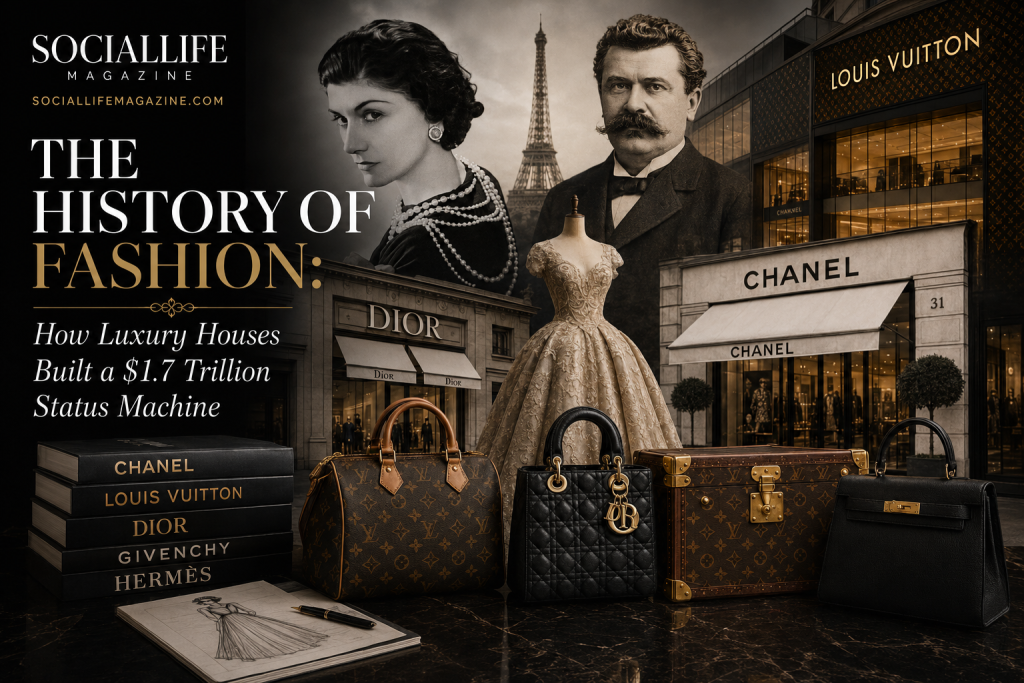
In 1858, an English-born dressmaker named Charles Frederick Worth did something no one in the clothing trade had ever attempted. He sewed his name into the garments. Not onto a tag hidden inside a collar. Into the fabric itself, where the client and everyone at her dinner party could see it. That single act of ego turned a craftsman into a brand, a dress into a status symbol, and an industry now worth $1.7 trillion into existence. Because the history of fashion is not really about hemlines or silhouettes. It is about power, capital, and the remarkably consistent human desire to announce one’s position in the room without saying a word.
What follows is the complete arc of that transformation. From Worth’s atelier at 7 Rue de la Paix to Bernard Arnault’s $233 billion personal fortune, from Coco Chanel’s ruthless simplicity to Virgil Abloh’s quotation marks, this is the story of how a small number of houses in a small number of cities built the architecture of modern status. Every brand name you recognize today exists because someone understood a specific truth about money and desire. Although the details change by generation, the mechanism does not. Scarcity creates value. Value creates aspiration. Aspiration creates revenue. And revenue, eventually, creates empires.
Consider this your field guide to those empires. Each section links to deeper profiles of the individual houses, designers, and conglomerates that shaped what you wear, what you want, and what you are willing to pay for the privilege of being seen. Together, they form the most comprehensive account of the history of fashion available anywhere online.
The Man Who Invented the Designer
Before Worth, clothing was a transaction. A woman went to a dressmaker, described what she wanted, selected fabric, and waited. Consequently, the dressmaker had no name recognition, no creative authority, and no pricing power beyond the cost of materials and labor. Worth reversed the entire dynamic when he opened his salon in Paris in 1858. Instead of asking clients what they wanted, he told them. He showed finished designs on live models, which was another first. He set the prices without negotiation. And he created the concept of seasonal collections, which forced wealthy women to return every few months or risk wearing last season’s silhouette to the opera.
His client list quickly read like a diplomatic registry. Empress Eugénie of France became his primary patron, and her endorsement triggered an immediate cascade throughout European aristocracy. If the Empress wore Worth, then every noblewoman on the continent needed Worth too. This was the first recorded instance of what the industry would later call “top-down adoption,” although Worth himself simply called it good business. By the 1870s, the House of Worth employed over 1,200 workers and generated revenues that rivaled those of small Parisian banks.
The Philosophical Innovation
However, the real breakthrough was not commercial but philosophical. Worth established that a designer’s taste carried more authority than a client’s personal preference. That idea, genuinely radical in 1858, remains the operating principle of every major fashion house today. When a creative director at Chanel or Dior presents a collection, the audience does not vote on the designs. Instead, they observe. Approval comes through purchase. Rejection comes through silence. Worth built that social contract from nothing, and despite 166 years of cultural upheaval, no one has successfully renegotiated it since. For that reason alone, any serious account of the history of fashion begins at 7 Rue de la Paix.
Paris Between the Wars
The next major inflection arrived sixty years later, when two women in Paris rebuilt the rules that Worth had established for men. Coco Chanel and Elsa Schiaparelli approached fashion from opposite directions but ultimately arrived at the same conclusion. Clothing was not about decoration. Instead, it was about identity, and identity was a weapon that women had barely begun to use.
Chanel stripped everything away. She took jersey, a fabric previously reserved for men’s underwear, and turned it into daywear for women who wanted to move, work, and smoke without corsets. Her little black dress (1926) was not merely an aesthetic choice. Rather, it was a class argument disguised as simplicity. Previously, black was reserved for mourning or servants. Chanel made it the uniform of women who were too interesting to need color. By 1935, she employed 4,000 workers and her annual revenues exceeded 120 million francs, making her the wealthiest self-made woman in France.
Schiaparelli’s Counterargument
Across town, Schiaparelli pursued the opposite strategy with equal conviction. Where Chanel subtracted, Schiaparelli added. She collaborated with Salvador Dalí on the Lobster Dress (1937) and the Shoe Hat. She introduced shocking pink as a signature color. Furthermore, she treated fashion as fine art with buttons, and her salon at 21 Place Vendôme became the gathering point for surrealists, poets, and aristocrats who found Chanel’s minimalism intellectually boring.
Neither woman liked the other. Chanel reportedly called Schiaparelli “that Italian artist who makes clothes.” Schiaparelli never responded publicly, which was its own kind of power move. Nevertheless, together they established the two poles that still define luxury fashion today: reduction versus maximalism, quiet money versus loud taste, Bottega Veneta versus Versace. Every designer since has positioned themselves somewhere on that axis, whether they acknowledge the debt or not. In this way, two rivals who despised each other became collaborators in defining the century.
The New Look and the Old Money
On February 12, 1947, Christian Dior showed his first collection at 30 Avenue Montaigne in Paris. The “New Look” used 20 yards of fabric per dress at a time when wartime rationing still limited most women to three yards. Harper’s Bazaar editor Carmel Snow named the collection on the spot, telling Dior his dresses had “such a new look.” Within six months, the House of Dior accounted for 75% of France’s total fashion exports and an astonishing 5% of the country’s overall export revenue.
Dior understood something that would take competitors decades to replicate. Specifically, the dress was the advertisement, but the perfume was the actual product. Miss Dior launched the same year as the New Look, and its sales funded every other creative endeavor. By 1949, Dior operated in 15 countries with 28 licensed product categories. This licensing model subsequently became the financial backbone of every major house that followed, because it solved the fundamental problem of couture: beautiful garments do not scale, but brand prestige does.
The Master of Them All
Simultaneously, Cristóbal Balenciaga was working two blocks away from Dior, producing garments so architecturally precise that Dior himself called Balenciaga “the master of us all.” Yet Balenciaga never licensed his name. He never gave interviews either. When a journalist asked about his creative process, he simply closed the door. That refusal became its own form of cultural currency. While Dior sold millions of lipsticks to women who could not afford the dresses, Balenciaga sold only to those who could afford everything. Both strategies worked commercially. Both are still in active use today among the major houses. However, the difference between them is not quality. It is audience. And choosing your audience, as the history of fashion demonstrates repeatedly, matters more than choosing your fabric.
Italy Crashes the Party
For nearly a century, Paris held an undisputed monopoly on fashion authority. Italian houses existed, but they functioned primarily as skilled manufacturers rather than creative leaders. Florence had its leather artisans, and Milan had its textile mills, but neither city claimed the cultural authority to tell wealthy women what to wear. Worth, Chanel, Dior, and Balenciaga had made that a French prerogative, and the Italian industry largely accepted the hierarchy. Tailors in Naples produced the finest suits in the world, yet they remained anonymous craftsmen working for Savile Row labels and Parisian houses that took the credit. That comfortable arrangement changed abruptly on February 12, 1951, when Marchese Giovanni Battista Giorgini organized the first Italian fashion show at his private residence, the Villa Torrigiani, in Florence. Buyers from Bergdorf Goodman and B. Altman attended expecting fine craftsmanship. Instead, they discovered something more commercially valuable: prices 30% below Paris with comparable quality and significantly faster production timelines.
Florence opened the door, and Milan walked through it with characteristic confidence. By the 1970s, Giorgio Armani, Gianni Versace, and the Gucci family had collectively relocated Italian fashion’s center of gravity north. Armani deconstructed the power suit in 1975, removing the lining and softening the shoulders until a $3,000 jacket moved like a sweater. In contrast, Versace went the opposite direction entirely, covering everything in Medusa heads, gold chains, and unapologetic sexuality. Both approaches worked because both designers understood their specific customer with forensic precision.
The Gucci Implosion
Gucci contributed the most dramatic chapter to this period. Founded in Florence in 1921, the house spent sixty years as a family business before collapsing into a decade of lawsuits, tax evasion convictions, and ultimately a murder. Maurizio Gucci was shot four times on the steps of his Milan office in March 1995, on orders from his ex-wife Patrizia Reggiani. She hired the hitman through her psychic for $365,000. At the time of his death, the brand was valued at approximately $4 billion.
Tom Ford arrived shortly after, rebuilt the house into a $10 billion enterprise, and proved conclusively that Italian fashion could match Paris for cultural authority. Today, under Kering ownership, Gucci generates €7.65 billion annually. No family member owns a single share. As a result, the Gucci story has become the most frequently cited example of how fashion dynasties create value and then lose control of it entirely.
The American Rewrite
American fashion never seriously tried to compete with European craftsmanship. Instead, it invented an entirely different game called lifestyle branding. Ralph Lauren, born Ralph Lifshitz in the Bronx in 1939, understood that Americans did not want French couture. They wanted an idealized version of themselves. His polo player logo, introduced in 1971, did not represent a sport. Rather, it represented membership in a class that most of his customers could not otherwise access. By 1997, Ralph Lauren Corporation generated $5 billion annually selling that aspiration across clothing, home goods, restaurants, and eventually coffee shops.
Calvin Klein took a parallel approach through transgression rather than aspiration. His 1980 jeans campaign featuring a 15-year-old Brooke Shields generated $2 million in formal complaints and $200 million in retail sales. Klein consequently understood, earlier than almost anyone, that controversy functioned as a distribution channel. Each banned advertisement moved more product than ten approved ones ever could. Similarly, Donna Karan and Oscar de la Renta transformed Seventh Avenue from a manufacturing district into a creative address that could command international respect.
The Tom Ford Bridge
Tom Ford deserves particular attention in the history of fashion because he bridged the American and European systems more completely than anyone before or since. Born in Austin, Texas, and trained at Parsons School of Design in New York, Ford moved to Milan in 1990 with no connections and no safety net. He joined Gucci as a womenswear designer when the house was generating only $230 million in revenue and hemorrhaging credibility. By the time he left in 2004, Gucci Group was valued at over $10 billion, and Ford had become the most commercially successful creative director in the industry’s modern history.
He then built his own label from scratch, launching with menswear, expanding into eyewear and fragrance, and eventually adding womenswear. Tom Ford Beauty alone generates over $1 billion annually. His career consequently proved something important about the late twentieth century: a designer’s nationality had entirely ceased to matter. What mattered instead was the ability to manipulate desire across cultural boundaries. An American could therefore run an Italian house with more success than the Italian family that founded it. A Brit could run a French one and reinvent its identity. Cultural passports had effectively expired, and talent became the only visa the industry recognized.
London Burns It Down
British fashion operates by a fundamentally different logic than its French or Italian counterparts. London does not produce luxury goods at scale. Instead, it produces ideas, provocations, and designers who eventually leave for better-funded houses in Paris and Milan. Central Saint Martins, one art school in King’s Cross, has produced more creative directors per square foot than any institution in the industry’s recorded history.
Alexander McQueen graduated from there in 1992. His MA collection was purchased entirely by the legendary editor Isabella Blow for £5,000. Within four years, he was creative director of Givenchy in Paris. His runway shows featured robots spraying paint on models, glass boxes filled with live moths, and a holographic Kate Moss dissolving into vapor. Because McQueen treated fashion as performance art with a price tag, his Spring 1999 collection remains arguably the most analyzed and written-about show in the medium’s entire history.
Westwood and Burberry
Vivienne Westwood arrived earlier and stayed longer than almost any British designer. From her shop at 430 King’s Road in London (originally and provocatively called SEX), she built punk fashion into an intellectual framework connecting clothing to politics, history, and environmental activism. Meanwhile, Burberry took a completely different path. Founded in 1856, it was the oldest of the major British houses but nearly collapsed in the 1990s when its signature check pattern became primarily associated with football hooligans rather than aristocrats.
Under Christopher Bailey and later Daniel Lee, Burberry rebuilt itself into a £2.8 billion enterprise by reclaiming the heritage narrative. Consequently, British fashion is best understood not as an industry but as an export pipeline. London cultivates raw creative talent. Paris and Milan harvest it, package it, and sell it to the world. Although this dynamic frustrates British designers and critics alike, it has proven remarkably durable across multiple generations.
The Conglomerate Swallow
Bernard Arnault changed the history of fashion more than any designer who ever lived, and he never sketched a single garment. In 1984, the son of a French construction magnate acquired Financière Agache, a textile group that happened to own a controlling stake in Christian Dior. Within five years, he had engineered a hostile takeover of LVMH (Moët Hennessy Louis Vuitton). By 1990, he controlled the largest luxury conglomerate on Earth, and he was only 41 years old.
Arnault’s central insight was structural rather than creative. Individual fashion houses are inherently volatile businesses. A creative director leaves, a collection flops, and revenues can consequently drop 30% in a single season. However, a portfolio of 75 brands across fashion, wine, jewelry, hotels, and retail absorbs individual failures while compounding collective growth. Louis Vuitton alone generates over €20 billion in annual revenue. LVMH as a whole surpassed €86 billion in 2023. As a result, Arnault’s personal fortune reached $233 billion, making him briefly the richest person alive.
The Three Kingdoms
François-Henri Pinault responded to Arnault’s dominance by building Kering around Gucci, Saint Laurent, Balenciaga, and Bottega Veneta. Similarly, Johann Rupert assembled Richemont around Cartier, Van Cleef & Arpels, and Montblanc. Together, these three conglomerates now control approximately 40% of the global luxury market. Their competition is therefore no longer about clothing in any meaningful sense. Instead, it is about real estate (Tiffany’s $500 million Fifth Avenue flagship renovation), hospitality (LVMH’s Cheval Blanc hotel collection), and cultural positioning (the Louis Vuitton Foundation museum in Paris, designed by Frank Gehry for a reported $143 million).
For independent designers, the conglomerate era creates a specific and largely inescapable paradox. Creative freedom requires capital. Capital comes from conglomerates. Conglomerates require commercial results. Therefore, creative freedom is contingent on commercial performance, which inevitably limits creative freedom. Every designer who has accepted a creative director role at a conglomerate-owned house has confronted this tension directly. Some, like Tom Ford and Nicolas Ghesquière, thrived within the constraints. Others, like Raf Simons at Calvin Klein and Riccardo Tisci at Burberry, did not survive them. Nevertheless, the tension itself is the feature of the modern system, not the bug.
The New Guard
Since 2010, a generation of designers has emerged that operates by rules the old houses never anticipated and could not have imagined. Virgil Abloh founded Off-White in 2013 with a concept borrowed directly from contemporary art: put quotation marks on everything. A jacket labeled “JACKET” in Helvetica was either genius commentary or expensive parody, depending on your position. Abloh understood that in a post-internet culture, irony and sincerity had become the same gesture. Before his death in 2021 at age 41, he had been appointed artistic director of Louis Vuitton menswear, which is widely considered the most powerful creative role in the entire fashion industry.
Simon Porte Jacquemus built his brand from a bedroom in Paris at 19 years old, naming it after his mother’s maiden name. His Le Chiquito bag, smaller than a smartphone, became the most viral accessory of 2019 purely through Instagram. No advertising budget was required. No department store placement either. Just a photograph of a tiny bag that made millions of people feel something they wanted to feel again. In contrast, Mary-Kate and Ashley Olsen built The Row into the definitive quiet luxury brand, with cashmere coats priced above $8,000 and absolutely zero social media presence. Their deliberate refusal to participate in the attention economy consequently became their most effective marketing strategy.
The Saturated Landscape
These designers share one trait that fundamentally separates them from every previous generation in the history of fashion. They were born into a world where the entire archive was already searchable, streamable, and infinitely referenced. Abloh cited everything openly. Jacquemus romanticized everything instinctively. The Olsen twins rejected everything strategically. Although all three approaches differ dramatically in execution, they share the same underlying assumption: the landscape is saturated, and the only way to stand out is to have a clear, unwavering point of view about what saturation means.
Furthermore, this generation treats collaboration as a default mode rather than an exception. Abloh collaborated with Nike, IKEA, Mercedes-Benz, and Evian before his appointment at Vuitton. Jacquemus partnered with Nike on a sportswear line that sold out in minutes. Even The Row, despite its aversion to publicity, has quietly collaborated with Oliver Peoples on eyewear. Because the boundaries between fashion, art, music, technology, and commerce have dissolved completely, the new guard does not recognize them as boundaries at all.
The $1.7 Trillion Question
The global fashion industry generated approximately $1.7 trillion in total revenue in 2024, according to McKinsey’s annual State of Fashion report. Luxury’s share of that figure exceeded $380 billion. Yet the actual number of houses that matter, that set prices and dictate taste for the rest of the market, remains remarkably small. Fewer than thirty brands control the global conversation. Fewer than three conglomerates control those brands.
What does that concentration mean for the future of the industry? Currently, two forces are pulling in opposite directions with increasing intensity. Consolidation continues aggressively, as LVMH, Kering, and Richemont acquire anything with margin potential and recognizable brand heritage. Arnault alone has completed over 30 acquisitions in the past decade, including Tiffany & Co. for $15.8 billion in 2021, the largest luxury deal in history. Simultaneously, direct-to-consumer brands, resale platforms like The RealReal and Vestiaire Collective, and AI-generated design tools are eroding the scarcity that luxury fundamentally depends on. If everyone can access the aesthetic through dupes and algorithms, then the aesthetic stops working as a status signal. That contradiction is consequently the central tension in fashion right now, and no one, not even Arnault with his $233 billion, has resolved it.
Nevertheless, the history of fashion suggests that this tension is not new. It is merely the latest version of the same problem. Worth charged more because he could say no to clients. Chanel charged less than her competitors but sold to more people. Dior sold the dream through perfume so the dress itself could remain unattainable. Each generation solved the scarcity problem differently, and the next generation inevitably will too. The only constant is the problem itself: how to make something feel exclusive while selling as much of it as possible.
Where The Conversation Continues
This pillar article is your entry point to the complete architecture of the series. Below, you will find links to every sub-hub and brand profile, organized by geography and era. Each piece goes deeper into the specific founders, fortunes, and failures that built the houses you see on every red carpet, every Hamptons lawn party, and every front row from Paris to Milan.
The Sub-Hubs:
- French Fashion Houses: The Original Power Corridor
- Italian Fashion Houses: Craft, Crime, and Conquest
- American Fashion Designers: The Lifestyle Rewrite
- British Fashion Houses: Ideas for Export
- Contemporary Disruptors: Irony, Instagram, and the End of Rules
- Jewelry and Watch Houses: The Hardest Currency
- The Conglomerates: Who Owns What You Wear
Social Life Magazine covers the intersection of fashion, wealth, and culture across the East End every summer and beyond. For features, events, and the stories behind the names that matter, explore our Luxury Lifestyle section or follow the full Chronicles archive for the complete collection.
Author

Written by
Recent Posts

Planning an Arizona Road Trip? Practical Details to Handle Before You Leave

Short Homecoming Dresses That Feel Polished, Not Overdone
Men’s Health After 40: Important Changes to Pay Attention To
What You Need to Know About Spray Tanning

Simple Ways to Upgrade Your Summer Drink Routine
Categories
- Art
- Articles
- Business of Luxury
- Celebrities
- Culture
- Entertainment
- Events
- Faces of Summer 2026
- Fashion
- Fashion & Style
- Featured
- Finance
- Food, Spirits, Wine
- Hamptons
- Hamptons Celebrities
- Health
- Health & Beauty
- Lifestyle
- Luxury Lifestyle
- Press
- Profiles
- Real Estate
- Technology
- The Chronicles
- Travel
- Uncategorized
- Weddings