
The Sixteen-Year-Old Who Walked to Paris
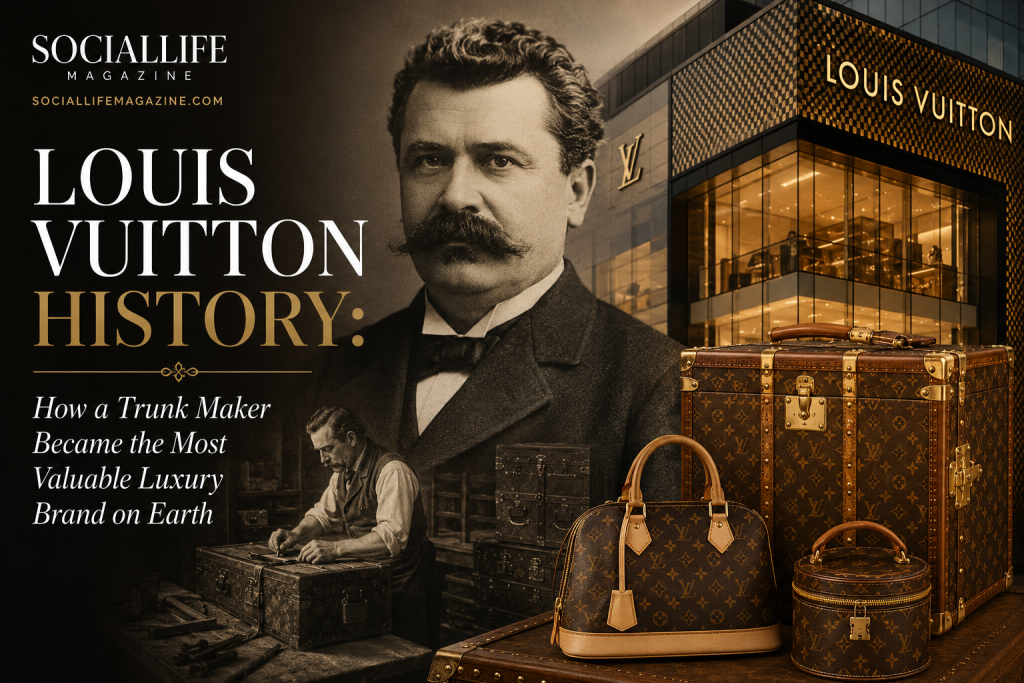
In 1837, a boy named Louis Vuitton left his village of Anchay in the Jura mountains and walked 292 miles to Paris. He was sixteen years old. He had no money, no contacts, and no plan beyond arriving. The journey took two years because he stopped along the way to work odd jobs (woodcutter, stable hand, whatever paid enough for bread). By the time he reached Paris in 1839, he had learned something that would define Louis Vuitton history forever: travel is hard, expensive, and full of problems that nobody had bothered to solve.
He apprenticed with Monsieur Maréchal, a layetier-emballeur (trunk maker and packer) who served the French aristocracy. For fifteen years, Louis learned how wealthy people traveled: what broke, what got stolen, what fell apart on trains and steamships. In 1854, he opened his own shop at 4 Rue Neuve-des-Capucines. His innovation was simple. He made trunks with flat tops instead of rounded ones. Flat tops could be stacked. Stacked trunks fit on trains. Trains were the future.
That 1854 trunk shop is now a $130 billion brand, the most valuable luxury brand on earth by a comfortable margin. Among the French fashion houses, Louis Vuitton is not just the biggest. It is the proof of concept that every other luxury conglomerate is trying to replicate.
The Monogram Revolution
Louis Vuitton died in 1892. His son, Georges Vuitton, inherited a thriving trunk business and immediately faced the problem that plagues every successful luxury brand: counterfeits. Knockoff Vuitton trunks were flooding the market. Georges needed a pattern so distinctive that copies would be obvious.
In 1896, he created the LV monogram canvas. The interlocking L and V, surrounded by flowers and geometric shapes, was inspired by Japanese mon (family crests) that were fashionable in late 19th-century Parisian design circles. The pattern was not just decorative. It was a trademark woven into the physical product, making counterfeiting harder and authenticity verification instantaneous.
That monogram is now the most recognizable pattern in luxury goods. It appears on handbags, luggage, clothing, sneakers, furniture, and (briefly, controversially) Supreme streetwear. Every iteration reinforces the same idea: this object has a history, a pedigree, and a price commensurate with both.
Counterfeiting remains the monogram’s greatest compliment and biggest expense. LVMH spends tens of millions annually on anti-counterfeiting litigation, employing a legal team that files more trademark suits than most law firms handle in a decade. Customs agencies worldwide seize millions of fake Vuitton products every year. The company has argued, successfully, that the monogram is so famous it deserves enhanced legal protection. Counterfeiters keep trying because the monogram’s recognizability is precisely what makes fakes profitable. It is a paradox that Georges Vuitton created and his descendants have never solved.
From Trunks to Travel Culture
Georges Vuitton also turned the company into a culture machine. He sponsored expeditions, outfitted explorers, and created custom trunks for maharajas, opera singers, and heads of state. The Vuitton trunk became the accessory of adventure capitalism. If you were rich enough to cross an ocean, you were rich enough for a Vuitton trunk.
Gaston-Louis, the third generation, continued the strategy through World War II. He collaborated with the Vichy government during the German occupation (a chapter the company does not feature in its museum displays). After the war, the family rebuilt the brand’s reputation through artisanal excellence and strategic licensing that expanded the monogram into leather goods, handbags, and small accessories.
By the 1970s, Louis Vuitton was the premier leather goods brand in the world. But it was still a family business with a single product category. The transformation from artisan house to global empire required someone with an entirely different set of ambitions.
The Streetwear Gambit
One of the most consequential decisions in modern Louis Vuitton history was the 2017 collaboration with Supreme, the New York skateboard brand. Within LVMH, the partnership was controversial. Luxury purists argued that associating with streetwear would dilute the monogram’s prestige. Arnault overruled them. The collaboration sold out instantly, generated billions of dollars in media impressions, and proved that the monogram could move between social registers without losing its power.
That experiment paved the way for Virgil Abloh’s appointment as men’s creative director in 2018. Before Abloh, the idea of a streetwear designer leading a heritage French house would have been considered absurd. After Supreme, it was logical. The monogram had demonstrated that it could absorb influences from skateboard culture, hip-hop, and youth fashion without suffering the brand erosion that executives had feared. Scarcity and pricing discipline protected the core business. Cultural range expanded the addressable market.
Bernard Arnault’s Master Move
In 1987, Louis Vuitton merged with Moët Hennessy (the champagne and cognac conglomerate) to form LVMH. The merger was supposed to create a stable luxury holding company. Instead, it created a power vacuum that Bernard Arnault exploited with the precision of a private equity tactician.
Arnault had acquired Christian Dior in 1984. By 1988, he was buying LVMH shares on the open market. By 1989, he had secured enough voting rights to take control. The Vuitton family and the Hennessy family both fought the takeover. They lost. Louis Vuitton history became Bernard Arnault history, and the luxury industry has operated in his shadow ever since.
The takeover was not a polite acquisition. Arnault exploited a power struggle between LVMH’s two existing shareholders (Moët Hennessy’s Alain Chevalier and Louis Vuitton’s Henry Racamier) by allying with one against the other, then turning on his ally once he had accumulated enough shares to control the board. The French press compared it to a corporate coup. Arnault’s defenders called it visionary. Both were correct. The end result was a single entity under one man’s control, with the financial resources to acquire dozens of additional brands over the next three decades.
Under Arnault’s control, LVMH grew from a handful of French luxury brands into a portfolio of 75 houses spanning fashion, wines, spirits, jewelry, watches, cosmetics, and retail. The group posted €80.8 billion in revenue for 2025. Louis Vuitton alone is estimated to generate between €20 and €25 billion annually (LVMH does not break out individual brand revenues, but analysts consistently place Vuitton at roughly 60 percent of the Fashion and Leather Goods division).
The Numbers Behind the Monogram
Louis Vuitton’s brand value hit $129.9 billion in 2024, according to Brand Finance. Second place: Hermès at $93.7 billion. Third place: Chanel at $38 billion. The gap between first and second is larger than most luxury brands’ entire valuations.
That dominance rests on a margin structure that most consumer goods companies would consider science fiction. The Fashion and Leather Goods division operates at a 35 percent operating margin. A Vuitton Neverfull tote that costs roughly $100 to manufacture retails for $2,030. A Keepall travel bag with the monogram canvas runs $2,340. Leather goods account for approximately 75 percent of Vuitton’s revenue, and the margins on canvas goods (which use coated cotton, not leather) are even higher.
Price increases have averaged roughly 10 percent per year over the last half decade. Vuitton has raised prices faster than inflation, faster than wages, and faster than competing brands. Each increase functions as a demand test. So far, every test has passed.
The Manufacturing Paradox
What sustains those margins is a manufacturing model that balances industrial scale with artisanal storytelling. Louis Vuitton operates approximately 20 workshops across France and Spain, each employing between 300 and 1,000 artisans. A single Capucines bag requires roughly 250 individual steps and eight hours of handwork. The company does not outsource to third-party factories, which gives it total control over quality, cost, and (critically) the narrative that every product is “made in the workshops of Louis Vuitton.”
That narrative matters because it justifies the price premium. A Vuitton Neverfull costs roughly 10 times what a comparable unbranded canvas tote would cost. The functional difference is modest. The perceived difference, rooted in 170 years of brand-building, is enormous. Customers are not paying for canvas. They are paying for provenance, and provenance requires a factory you can photograph and a craftsman you can film for a YouTube documentary.
Vuitton has expanded its workshop network aggressively in recent years, opening new ateliers in rural France where labor costs are lower and local governments offer tax incentives for job creation. Each new workshop is announced with the same reverence that competitors reserve for store openings. The message is consistent: while other luxury brands quietly move production to lower-cost countries, Louis Vuitton is investing in French craftsmanship. Whether every Vuitton product is entirely handmade is a matter of degree. That the company wants you to believe it is a matter of strategy.
Pharrell, Ghesquière, and the Culture Engine
Louis Vuitton’s creative architecture is unique among French fashion houses. Most luxury brands employ a single creative director. Vuitton employs two. Nicolas Ghesquière has led women’s collections since 2013. Pharrell Williams was appointed men’s creative director in 2023, following the death of Virgil Abloh in November 2021.
Abloh’s tenure, though tragically brief, changed what a luxury creative director could be. He was the first Black designer to lead a major French fashion house. He came from architecture and DJ culture, not fashion school. His debut show at the Palais-Royal gardens in June 2018 opened with a rainbow-gradient runway and ended with Abloh weeping in Kanye West’s arms. Over three years, he brought a generation of young Black consumers into a brand that had previously coded as European old money. Revenue for the menswear division surged. The cultural conversation around Louis Vuitton shifted permanently.
Pharrell expanded Abloh’s blueprint. He is a cultural omnivore (musician, producer, brand builder) whose appointment signaled that Vuitton’s menswear strategy would prioritize cultural magnetism over traditional design credentials. His shows are concerts, parties, and spectacles that generate social media impressions measured in the billions.
Ghesquière, a fashion purist who previously spent fifteen years at Balenciaga, designs women’s collections that reference science fiction, brutalist architecture, and historical costume with equal fluency. His shows feel like museum installations. They sell because the commercial team translates every runway piece into a commercially viable product within weeks.
The Shanghai Statement
In 2025, Louis Vuitton opened The Louis in Shanghai, a museum-like space built in the form of a cruise ship. The building embodies the brand’s “spirit of travel” positioning, drawing visitors who may never buy a bag but who leave understanding that Vuitton is not merely a leather goods company. It is a cultural institution that happens to sell leather goods.
This is the same strategy that Arnault perfected with the Fondation Louis Vuitton in Paris (designed by Frank Gehry, opened in 2014, visited by over 11 million people in its first decade). Architecture as advertising. Cultural investment as brand equity. Every visitor who walks through the Fondation is a potential customer, and every customer who carries a Vuitton bag is a walking advertisement for the Fondation.
LVMH also launched La Beauté Louis Vuitton in 2025, a new cosmetics universe led by legendary makeup artist Dame Pat McGrath. Fragrance, skincare, and color cosmetics under the Vuitton monogram represent a strategic expansion into the highest-margin category in luxury (beauty margins routinely exceed 85 percent). For a brand already generating an estimated $25 billion in annual revenue, the beauty launch opens a new revenue stream that could add billions within five years. The trunk maker from Anchay is becoming an everything company, one carefully chosen product category at a time.
The East End Signal
Louis Vuitton opened its Hamptons boutique on Main Street in East Hampton in 2019. Unlike Chanel and Dior, which maintain strategic absence, Vuitton chose visibility. The store sits on the most trafficked luxury retail strip east of Fifth Avenue, next to the Ralph Lauren flagship and within walking distance of Gucci and Zimmermann.
The strategic logic is straightforward. Vuitton is a volume brand at the top of the luxury pyramid. It sells more units at higher average prices than any competitor. Physical retail in a high-traffic luxury destination converts tourist spending, captures impulse purchases from summer residents, and reinforces the monogram’s ubiquity in the one zip code where ubiquity matters most.
On a Saturday in August, the East Hampton Vuitton store processes hundreds of thousands of dollars in transactions. Many purchases are entry-point items (card holders at $360, pochettes at $800) that introduce new customers to the brand. This is not accident. It is the Louis Vuitton history playbook operating in real time: start with a practical object (a flat-top trunk, a canvas tote, a $360 card holder) and build a lifetime of spending from there.
The store also serves as a social signifier for the neighborhood itself. When Vuitton commits to a seasonal location, it validates the surrounding retail ecosystem. Other brands follow. Rents increase. The monogram, as always, creates gravity. Smaller brands orbit around it, and the entire commercial district benefits from the traffic that a name like Louis Vuitton generates on a summer weekend.
Where the Conversation Continues
From a two-year walk across France to a $130 billion valuation, Louis Vuitton history is the story of luxury’s most successful bet on a single idea. Travel is aspiration. Aspiration is commerce. Commerce, done well enough for long enough, becomes culture. The boy from Anchay could not have imagined a cruise-ship-shaped museum in Shanghai. But he would have understood the impulse behind it. Build something that moves, and the world will pay to carry it.
The Durability Thesis
What separates Louis Vuitton from every other luxury brand is durability in its most literal sense. The original flat-top trunks were built to survive transatlantic voyages, monsoon seasons, and the negligence of hotel porters. That engineering philosophy persists. A vintage Vuitton trunk from the 1920s, properly maintained, is still functional today. A Keepall from 2005 still holds its shape. The products last because lasting was the original design brief. Everything else (the runway shows, the museum spaces, the celebrity creative directors, the $360 card holders) is built on the foundation of an object that was never meant to break.
That foundation, laid by a sixteen-year-old who walked to Paris with nothing, is why the French fashion houses continue to orbit around the monogram. Louis Vuitton did not become the most valuable luxury brand on earth through marketing. It became the most valuable luxury brand on earth through survival. One hundred and seventy-two years of not breaking.
Social Life Magazine covers the brands, families, and power plays that shape luxury culture from Manhattan to Montauk. Reach our editorial team to discuss features, partnerships, or story leads. Explore Polo Hamptons 2026 for the summer’s defining luxury event. Subscribe to the print edition for coverage delivered to your door. Join the email list for weekly insider intelligence. And if this piece sharpened your understanding of how luxury actually works, a $5 contribution keeps independent journalism alive.
Author

Written by
Recent Posts

Planning an Arizona Road Trip? Practical Details to Handle Before You Leave
Short Homecoming Dresses That Feel Polished, Not Overdone
Men’s Health After 40: Important Changes to Pay Attention To
What You Need to Know About Spray Tanning

Simple Ways to Upgrade Your Summer Drink Routine
Categories
- Art
- Articles
- Business of Luxury
- Celebrities
- Culture
- Entertainment
- Events
- Faces of Summer 2026
- Fashion
- Fashion & Style
- Featured
- Finance
- Food, Spirits, Wine
- Hamptons
- Hamptons Celebrities
- Health
- Health & Beauty
- Lifestyle
- Luxury Lifestyle
- Press
- Profiles
- Real Estate
- Technology
- The Chronicles
- Travel
- Uncategorized
- Weddings