
The Horse as Social Architecture
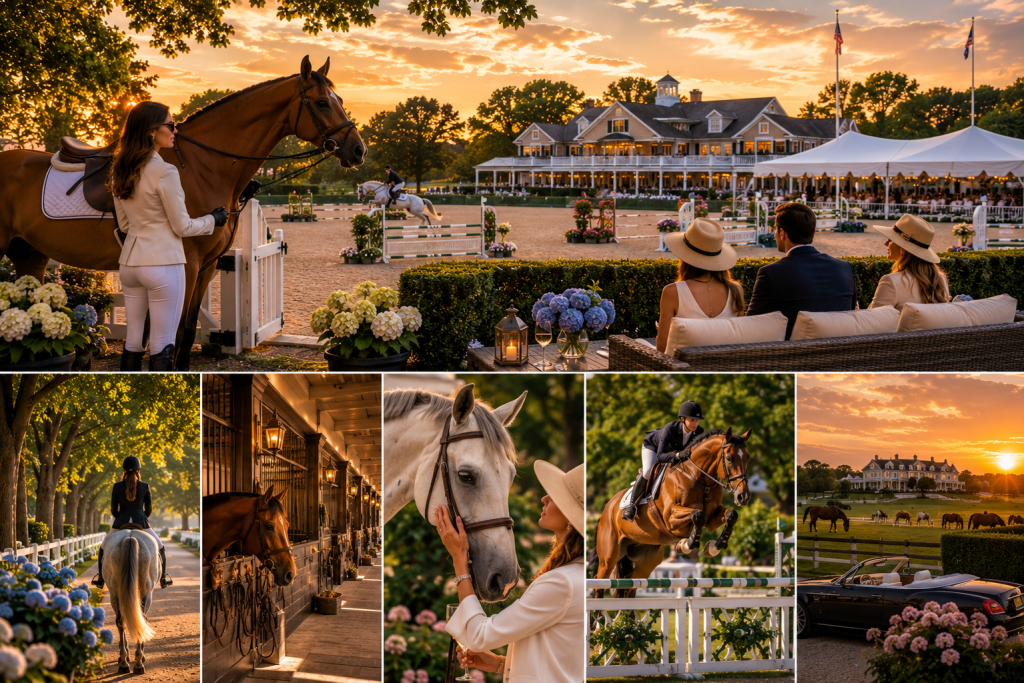
The Hamptons were built on whaling, farming, and the railroad. But the thing that transformed this stretch of the South Fork was, in many ways, the horse. Specifically, the early 1900s horse shows on First Neck Lane in Southampton established the template that defines the East End’s equestrian calendar to this day. Competition as social performance. Sport as networking infrastructure. The horse as the most elegant credential a family can maintain.
The tradition persisted through world wars. It disappeared briefly in the 1950s when the Southampton Riding and Hunt Club dissolved, then returned in 1976 as the Hampton Classic Horse Show. Today, the Southampton equestrian world encompasses polo, hunter-jumper competition, private stables, and riding schools. Overall, it connects the finance executives on Meadow Lane to the fashion brands on Main Street. The connection runs through an animal that costs more per year to keep than most Americans earn.
She bought the horse for her daughter. That is what she tells people. The horse is boarded at a facility in Bridgehampton that charges $3,500 per month. The trainer costs $200 per session, three sessions per week. The tack, the farrier, the vet, the supplements, the show entry fees, the transport to the Hampton Classic: the total annual cost exceeds $90,000. Her daughter is eleven years old and rides beautifully and does not know what any of this costs. The mother knows exactly what it costs. She also knows that the other mothers at the barn include a private equity partner’s wife, a fashion designer, and the woman who chairs the Parrish Midsummer Gala. The horse is not an expense. It is an introduction.
Polo Hamptons: The Event That Starts Everything
July 18 and 25, 2026
Polo Hamptons 2026 runs two Saturdays in July at 900 Lumber Lane, Bridgehampton, with BMW North America as title sponsor and Christie Brinkley hosting. Essentially, it is the equestrian event that opens the peak of Hamptons summer. It sits in a strategically brilliant calendar position: three weeks after the U.S. Open at Shinnecock Hills and five weeks before the Hampton Classic.
The Ninety-Day Corridor
The timing is not accidental. The U.S. Open audience (corporate executives, finance professionals, brand leaders) arrives in mid-June. Polo Hamptons catches them in mid-July, when they have settled into the rhythm of summer. Then the Hampton Classic catches them again in late August. Together, the three events create a ninety-day equestrian corridor that concentrates the East End’s most valuable audience.
Polo Hamptons is not a polo tournament that happens to have a social scene. Rather, it is a social scene that happens to feature polo. Cabana packages and VIP tables place brands in proximity to an audience that reads Social Life Magazine because they are in it. The guest list spans every village and every tax bracket above a certain floor. In particular, Bathing Corporation members from Gin Lane sit alongside Sebonack members, medspa owners, fashion founders, and VC partners.
Cabana packages, VIP tables, and sponsorship opportunities are available at polohamptons.com. If your brand belongs on the East End, this is where the introduction happens.
For over two decades, Social Life Magazine has covered Polo Hamptons. Every iteration of the event, every sponsor rotation, every summer when the field at Lumber Lane becomes the most photographed acreage in Bridgehampton.
The Hampton Classic: The Grand Finale
August 23 to 30, 2026
The Hampton Classic Horse Show is the East End’s other equestrian pillar, and in many ways its opposite number to Polo Hamptons. Where polo is fast, social, and built around the cabana, the Hampton Classic is precise, technical, and built around the ring. The show runs for eight days at its permanent home on Snake Hollow Road in Bridgehampton.
The numbers are substantial. More than 1,400 horses compete across 170 to 200 separate classes. These range from leadline riders (children on ponies) to Olympic-level jumpers clearing fences at breathtaking speed. The Sunday Grand Prix, held under Longines title sponsorship, carries a purse in the high six figures.
Beyond the Ring
Yet the Hampton Classic’s significance extends beyond the competition ring. The vendor village transforms Bridgehampton farmland into a temporary luxury retail district: gourmet food, designer boutiques, automotive displays, jewelry, and art. Celebrity sightings are frequent. The fashion is serious. In fact, the Classic is one of the few East End events where the audience dresses as carefully as the riders.
Historically, the Hampton Classic’s roots trace to the early 1900s. An annual horse show was held in Southampton on First Neck Lane overlooking Agawam Lake. The event ran until World War I, returned in the 1920s at the Southampton Riding and Hunt Club, and ended in the 1950s. In 1976, the show was formally reconstituted as the Hampton Classic. It moved to its permanent Bridgehampton site in 1982.
Tickets: General admission, reserved grandstand, and VIP hospitality packages available at hamptonclassic.com. The Sunday Grand Prix is the event’s marquee day.
The Equestrian Calendar: A Three-Month Corridor
| Event | Dates (2026) | Location | Character |
|---|---|---|---|
| U.S. Open at Shinnecock Hills | June 18 to 21 | Southampton | Golf, corporate hospitality, 150,000 spectators |
| Polo Hamptons | July 18 and 25 | Bridgehampton | Polo, cabanas, VIP tables, BMW, Christie Brinkley |
| Hampton Classic | August 23 to 30 | Bridgehampton | Hunter-jumper, 1,400 horses, Longines, Grand Prix |
The three events create a corridor that covers the full arc of the Hamptons summer. June is arrival. July is peak. August is culmination. Consequently, a brand that activates across all three maintains continuous visibility from the longest day of the year to Labor Day.
The Stables: Where the Private Equestrian Life Lives
Bridgehampton and Water Mill
The concentration of equestrian facilities in and around Bridgehampton is not coincidental. Essentially, the agricultural land that once grew potatoes now grows infrastructure for a sport that requires space and grass. Proximity to wealth is the final ingredient.
Campbell Stables (Bridgehampton) is recognized as one of the finest luxury equestrian facilities on the East End. Bob Campbell (BBC International) developed it in 2015 on 20 acres of prime agricultural land south of the highway. Naturally, the facilities are state-of-the-art and the address is prestigious.
Two Trees (849 Hayground Road, Bridgehampton) hosts multiple training operations. These include Gray Horse Farm, which offers lesson packages, sale and lease horses, pony camps, and beginner polo lessons. Conveniently, the location is around the corner from the Hampton Classic showgrounds.
Firefly Farm and Swan Creek Farm (both Bridgehampton) are likewise among the privately run facilities that cater to high-end clientele.
Southampton
Rosewood Farm at Southampton Riding Club is the premier hunter-jumper school in Southampton proper. Founder Bobby Ginsberg trained in the 1980s with Olympic medalists Conrad Homfeld and Joe Fargis. In addition, Rosewood hosts the A-rated North Fork Horse Series. These three weekend shows in August prepare riders for the Hampton Classic.
Sea Horse Stables similarly offers year-round boarding and a rigorous training schedule.
The Cost of Entry
Boarding a horse on the East End runs $2,500 to $4,500 per month depending on the facility. Training sessions cost $150 to $250 each. Show entry fees, transport, tack, veterinary care, farrier, and supplements can add $30,000 to $60,000 annually. A competitive junior rider’s annual budget (horse purchase or lease, boarding, training, shows, equipment) can exceed $100,000.
These numbers are not obstacles for the audience that populates Meadow Lane and Gin Lane. Instead, they are investments in a social infrastructure that parallels the private club system. The barn is the club. The trainer is the gatekeeper. And the other parents are the membership you are auditioning for.
Why Fashion Brands Should Care
The Equestrian-Luxury Overlap
The overlap between the equestrian world and the luxury consumer is not approximate. Indeed, it is near-total. The woman who boards a horse in Bridgehampton is the same woman who shops on Main Street in Southampton. She sits on the board of the Parrish Art Museum, holds a cabana at Polo Hamptons, and reads Social Life Magazine because her photo is in it.
The equestrian lifestyle signifies in ways that other luxury categories do not. A Range Rover communicates wealth. A boat communicates leisure. A horse, on the other hand, communicates discipline, tradition, and generational aspiration. It signals a willingness to invest in something that produces no financial return and requires daily attention. For the fashion brand seeking East End credibility, alignment with the equestrian world creates a durable brand association. Specifically, sponsoring the Hampton Classic vendor village works. So does activating at Polo Hamptons or securing editorial coverage in Social Life Magazine.
Horse Haven (a Hamptons tack shop) has expanded beyond equine finery. Notably, it now carries fine antiques, handbags, jewelry, accessories, and housewares. In essence, the shop understands what the smartest fashion brands understand: the equestrian customer does not segment her spending by category. She buys the bridle and the bag from the same kind of place, because both signal the same thing.
The Calendar Play for Brands
July 18 and 25 (Polo Hamptons): Cabana sponsorship, VIP table activation, brand visibility alongside BMW North America. The polo field is the widest-aperture brand moment of the summer.
August 23 to 30 (Hampton Classic): Vendor village booth, hospitality tent, Grand Prix sponsorship. The Classic’s vendor village is the most concentrated luxury retail environment on the East End, and the audience shops with intention.
Between the two: Editorial coverage in Social Life Magazine (five summer issues, 25,000 copies each) bridges the gap and maintains brand visibility across the full equestrian corridor.
The Meaning of the Horse
What the Equestrian World Reveals About Southampton
The history of Southampton is a history of things that were built to last: saltbox houses, town records, hedgerows, institutions. The equestrian tradition fits this pattern. Of course, a horse is not a seasonal investment. It is a year-round commitment that requires daily care, professional expertise, and the kind of sustained attention that the modern attention economy has made increasingly rare.
In a village where the private clubs sort residents by lineage and the real estate market sorts by net worth, the equestrian world sorts by something harder to quantify. It values the willingness to show up every morning, in every season, for an animal that does not care about your portfolio. Ultimately, the horse is Southampton’s most honest institution. It does not read the Blue Book, and it does not know which side of the highway you live on. It knows whether you showed up.
She is at the Hampton Classic on a Sunday in late August. Her daughter is in the ring. The horse clears the final fence by three inches. The crowd applauds politely. The judge scores an 87. Her daughter does not smile because smiling in the ring is not done. She smiles later, in the stable, when she is brushing the horse and no one is watching except her mother, who is watching from behind a stall door and thinking about the $90,000 and wondering if it was worth it. The horse turns its head. Her daughter presses her forehead against its neck. The mother stops wondering.
Where the Conversation Continues
For over two decades, Social Life Magazine has covered the Southampton equestrian world. From the polo fields of Bridgehampton to the rings of the Hampton Classic, coverage extends to the private stables where the next generation learns to ride. The Southampton Village Dossier is the definitive guide to the village that anchors this equestrian landscape.
If your brand serves the equestrian audience (fashion, luxury goods, automotive, wellness, real estate), Social Life Magazine can help. Our paid feature program places your story in front of 25,000 copies per issue.
Polo Hamptons 2026 (July 18 and 25, 900 Lumber Lane, Bridgehampton) is where the equestrian season reaches its social peak. BMW North America sponsors. Christie Brinkley hosts. Cabana packages and VIP tables are available. The field is the stage. The audience is the market. The horse is the credential that money cannot buy and time cannot fake.
To receive Social Life Magazine delivered to your door, visit our subscription page.
The Hamptons were built on whaling and farming. Yet the horse changed the story. Since the first shows on First Neck Lane in the early 1900s, the equestrian world has connected Southampton’s agrarian past to its luxury present. The horse does not care about the connection. It cares about the morning feeding, the afternoon ride, and the moment in the ring when everything else falls away. That moment is worth more than any cabana, any hedgerow, any address south of the highway. The horse knows this. The rider is learning.
Author

Written by
Recent Posts

5 Mindful Wellness Trends Redefining Modern Self-Care This Season
What to Look for in a Hairdresser on the Gold Coast
hiTechMODA Season 16
How to Keep Your Personal Number Private When Booking Events, Rentals and Services
Understanding Compensatory Damages in a Personal Injury Case
Categories
- Art
- Articles
- Business of Luxury
- Celebrities
- Culture
- Entertainment
- Events
- Faces of Summer 2026
- Fashion
- Fashion & Style
- Featured
- Finance
- Food, Spirits, Wine
- Hamptons
- Hamptons Celebrities
- Health
- Health & Beauty
- Lifestyle
- Luxury Lifestyle
- Press
- Profiles
- Real Estate
- Technology
- The Chronicles
- Travel
- Uncategorized
- Weddings