
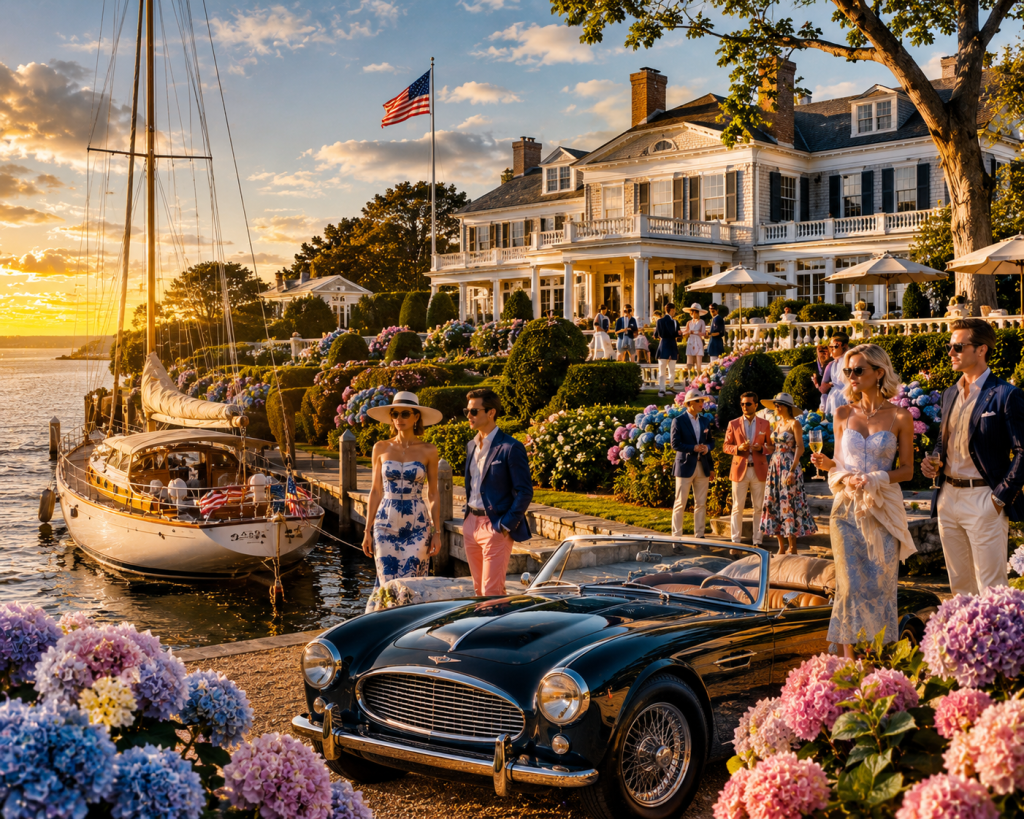
The Arrival
Southampton Village announces itself through hedgerows. Certainly not the ornamental kind you find at a Connecticut garden party, but twelve-foot walls of privet that function as architectural statements, privacy screens, and (if you understand the grammar of East End real estate) declarations of net worth per linear foot. You can drive the full length of Gin Lane in four minutes and never see a single house. That is the point.
She arrives on the Thursday Jitney. The one that leaves 40th and Lex at 2:15, which means she left the office at 1:45, which means she told her managing director she had a dentist appointment. Everyone on the 2:15 has a dentist appointment. By Manorville the cabin goes quiet. By Water Mill the hedgerows start. She presses her face to the glass like a child, though she is forty-three and manages $800 million in growth equity. The privet does not care about her AUM.
This is Southampton Village, the oldest English settlement in New York State, founded in 1640 by Puritans from Lynn, Massachusetts who landed at Conscience Point with nothing but a land grant from the Earl of Southampton and a talent for building things that last. Nearly four centuries later, the village still operates on the same foundational principle: restraint performed at a very high cost.
What Sag Harbor Whispers, Southampton Codifies
If you have read the Sag Harbor Village Dossier, you know the thesis: Sag Harbor is the village that makes powerful people quiet down. Conversation over hierarchy. Harbor over ocean. Cultural capital traded in bookshops and at Bay Street Theater over glasses of something French and inexpensive.
Southampton is the complement, not the opposite. Where Sag Harbor rewards the interesting, Southampton rewards the established. Where Sag Harbor’s social currency is the well-timed reference (you have read the new Rachel Kushner, haven’t you?), Southampton’s is the well-maintained membership. Both are valid answers to the question of what a life on the South Fork looks like at its apex. Social Life Magazine covers both villages because the range of the East End is the range of the magazine itself.
Southampton is ocean, not harbor. Hierarchy, not conversation. Establishment, not enterprise. Here, the hedgerows do the talking. And they say: you may look, but only if you already know what you are looking at.
Thursday: The Estate Section After Hours
South of the Highway
Every Hamptons village has a dividing line that functions as a socioeconomic border. In Southampton, that line is Montauk Highway (Route 27), and the distinction it creates is so deeply encoded that real estate listings rarely need to specify which side. Essentially, “south of the highway” means oceanfront proximity, estate-section addresses, and a property tax bill that would cover a mortgage in most American cities. North of the highway is where the people who work in Southampton live.
In fact, the estate section unfolds in a grid of lanes and roads named with the understatement of people who have never needed to impress anyone: First Neck Lane, Halsey Neck Lane, Ox Pasture Road. Properties here start at $3 million for something that needs work and climb past $100 million for the oceanfront compounds on Gin Lane and Meadow Lane where the hedgerows reach their full architectural expression.
Meadow Lane and the Billionaires Row Question
Meadow Lane earned its nickname (“Billionaires Row”) honestly. In fact, this five-mile oceanfront strip concentrates more financial firepower per linear foot than any residential address in America. Ken Griffin of Citadel bought Calvin Klein’s modernist compound here for $84 million in 2020. Leon Black of Apollo Global lives here. Robert Kraft of the New England Patriots paid $43 million for his place. Henry Kravis of KKR is a neighbor. Combined net worth of the lane’s residents likely exceeds $50 billion, which is roughly the GDP of Luxembourg, except Luxembourg has restaurants.
He helicopters in on Thursday evening. The Sikorsky touches down on the private pad at the south end of Meadow Lane at 6:47 PM, exactly two hours and twelve minutes after the markets closed. His portfolio is up fourteen basis points. Meanwhile, his wife is at the Meadow Club. His children are with the au pair. The ocean is two hundred yards from his kitchen and he will not look at it until Saturday morning, because Thursday is for spreadsheets and Friday is for the call with London. The ocean will wait. It always does.
Gin Lane: The Address That Needs No Introduction
Gin Lane may be the most prestigious residential street in America that most Americans have never heard of, which is, of course, exactly how its residents prefer it. Originally named not for the spirit but for a colonial-era corruption of an old English word, the lane runs along the oceanfront south of Agawam Lake and has been synonymous with the apex of East End real estate since the Gilded Age.
In 2024, the two most expensive Hamptons sales both occurred on Gin Lane. Specifically, La Dune, an oceanfront estate, sold at auction for $88.48 million (split between 376 and 366 Gin Lane). Properties here trade between $20 million and $100 million with the regularity of a bond desk, and roughly 70% of the transactions above $50 million happen off-market, which means you will never see them on Zillow, which means you were never supposed to.
Friday: The Social Architecture
The Private Clubs
Southampton’s private clubs are not amenities. Rather, they are institutions. To be sure, understanding their hierarchy is understanding the village itself.
The Bathing Corporation, founded in 1923 on Gin Lane, is the most exclusive beach club on the East End and possibly in America. Members call it “The Beach Club” with the definite article doing all the work. Notably, the club has no website. It sent women home for wearing bikinis in the 1950s. The waiting list is measured not in years but in decades, and the surest path to membership is inheritance: your grandmother held a cabana, your mother held a cabana, and now you hold a cabana. Members are listed in The Blue Book, a Southampton society directory sold each Memorial Day. Rejected applicants have included David Koch, Richard LeFrak, and the Noel family (of Madoff adjacency). If you need to apply, the club has already made its decision.
The Meadow Club, where tennis whites are not a suggestion, focuses on racquet sports and social events that define the younger tier of Southampton summer life. Initiation fees reportedly reach $150,000, with annual dues layered on top. Similarly, membership passes through families with the same hereditary logic as the Bathing Corporation. Social Life Magazine has observed how the Meadow Club’s summer calendar functions as a cultural vetting system, where new members prove they are fluent in more than cap tables and IRR waterfalls.
Shinnecock Hills and the 2026 U.S. Open
Shinnecock Hills Golf Club is the oldest incorporated country club in the United States, founded in 1891. The course, designed by William Flynn in 1931, consistently ranks among the top five in America. Stanford White designed the original clubhouse. The club was a founding member of the USGA in 1894. Initiation reportedly costs well into six figures, with annual dues adding significantly more.
And this summer, Shinnecock hosts its sixth U.S. Open (June 18 to 21, 2026), making it the only venue in history to host the national championship in three different centuries: 1896, the twentieth century (1986, 1995, 2004, 2018), and now the twenty-first. Expect 150,000 visitors, a temporary LIRR station, and a week when Southampton becomes, briefly, visible to people who were never supposed to see it.
The Social Calendar as Status Infrastructure
Southampton’s social calendar is not entertainment. In reality, it is infrastructure. The charity galas at the Southampton Arts Center, the summer series at the Rogers Memorial Library, the benefit dinners at private estates along First Neck Lane: each event functions as a sorting mechanism, separating those who attend from those who donate from those who chair from those who host.
The hierarchy is legible to anyone who has studied it. Board membership at Southampton Hospital Foundation gets you in rooms where Bathing Corporation members serve on committees. A $50,000 donation to the right cause gets your name in the right program. In other words, philanthropy on the East End is the audition that never calls itself an audition.
Social Life Magazine has covered Southampton’s social architecture for twenty-three years, across five summer issues (25,000 copies each, Memorial Day through Labor Day, Westhampton to Montauk) and fall/winter issues distributed to Upper East Side doorman buildings. The magazine’s distribution network (restaurants, hotels, coffee shops, bookstores, theaters, marinas, beach clubs) mirrors the social infrastructure of the village itself.
Saturday: The Village Proper
Main Street and Jobs Lane
Southampton Village proper occupies a walkable grid centered on Main Street and Jobs Lane, where the commercial life of a $100 million zip code plays out in boutiques, galleries, and restaurants that manage to be both polished and (mostly) unpretentious.
Sant Ambroeus (30 Main Street) imports the café culture of Milan’s intelligentsia directly to the East End. Since 1936, the name has signified Milanese elegance, and the Southampton outpost maintains that standard with ivory leather banquettes, black-and-white striped chairs, and a vine-covered outdoor patio that functions as the village’s most reliable stage for the Thursday-through-Sunday performance of casual affluence. Naturally, regulars describe the cacio e pepe as among the finest they have tasted outside of Rome, which, given that many of these regulars own apartments near the Spanish Steps, is not nothing.
75 Main, Zach Erdem’s flagship, occupies the intersection of Mediterranean cuisine and people-watching that no other East End restaurant quite replicates. Indeed, award-winning chef Mark Militello (James Beard Award, Food and Wine’s “10 Best Chefs in America”) runs the kitchen. The restaurant stays open year-round, which in Southampton signals a confidence that most seasonal operators cannot afford.
Where the Chefs Are Staying
FENIKS (75 Jobs Lane) represents the new chapter from Chef Douglas Gulija, who spent 28 years as the defining presence at The Plaza Café before opening this ambitious fusion of Greek, Asian, and Croatian influences. The fact that Gulija chose to stay in Southampton rather than follow the eastward drift toward Montauk tells you something about the village’s gravitational pull.
Le Charlot (36 Main Street) brings casual Parisian brasserie energy to a street that can handle it. Steak frites, escargot, crème brûlée. No surprises, no Instagram theatrics, just a French restaurant that knows what it is and serves accordingly.
For the full breakdown of the Southampton dining landscape, from fine dining institutions to the lobster roll that justifies the drive, see the Best Restaurants in Southampton spoke (coming soon).
She orders the linguine alle vongole at Sant Ambroeus on a Saturday at 1 PM. The table next to hers is discussing a property on Ox Pasture Road. Across from her, another table is negotiating a cabana at a club she cannot name. The waiter calls her “signora” even though she is thirty-one and wearing sneakers. She tips 30% because she has learned that in Southampton generosity is a form of camouflage.
The Cultural Layer
Southampton’s cultural institutions carry a weight that goes beyond programming. They are arguments for the village’s intellectual seriousness, counterpoints to the assumption (held by people who have never spent a winter here) that the East End is all hedgerows and no substance.
The Parrish Art Museum, founded in 1898, originally occupied a Grosvenor Atterbury building on Jobs Lane before moving in 2012 to a Pritzker Prize-winning facility designed by Herzog and de Meuron in Water Mill. The new building, a 34,400-square-foot horizontal prism of concrete and glass, houses work by artists who have defined American art on the East End: William Merritt Chase, Fairfield Porter, Willem de Kooning, Chuck Close. Chase, who founded his plein air painting school at Shinnecock in the 1890s, essentially invented the idea of the Hamptons as an artists’ colony. Every gallery opening, every studio tour, every collectors’ dinner traces back to those Shinnecock summers.
The Southampton Arts Center, housed in the former Parrish building on Jobs Lane, hosts exhibitions, performances, film screenings, and educational programs that serve both the summer population and the year-round community. Notably, the building itself (a 1897 Italianate structure) carries the kind of historic weight that newer cultural spaces spend decades trying to manufacture.
The Southampton History Museum preserves the village’s colonial heritage, including the Halsey Homestead (circa 1648), believed to be the oldest English saltbox house in New York State. A walk through the Halsey rooms is a reminder that the people who settled Southampton in 1640 were building for centuries, not seasons.
For a deeper exploration of the Parrish and Southampton’s broader cultural landscape, see the Parrish Art Museum and Southampton’s Cultural Scene spoke (coming soon).
Saturday Afternoon: The Beach
Cooper’s Beach
Cooper’s Beach is the number one beach in America. Not metaphorically. In 2025, Dr. Stephen Leatherman (the coastal scientist known as “Dr. Beach”) gave Cooper’s the top spot in his annual national ranking, which evaluates over 50 criteria including water cleanliness, sand quality, dune preservation, safety, and scenic beauty. Previously, Cooper’s took the title in 2010, climbed back from number eight in 2016, and has been in the top five every year since 2017. It is the best beach in the United States, and it happens to be a seven-minute walk from Main Street.
The beach itself is hundreds of yards wide, composed of grainy white quartz sand, backed by American beach grass and dunes that rise high enough to frame the oceanfront mansions behind them. This is the essential Southampton paradox: the nation’s best public beach sits directly in front of some of the most expensive private real estate on earth. In effect, you can spread your towel on sand that has been rated by a Florida scientist and look up at a house that sold for $45 million.
Parking at Cooper’s costs $50 per day in peak season, which functions less as a parking fee and more as a cover charge. The Hamptons Free Ride (an electric shuttle from downtown Southampton) offers a workaround, though riding a six-person electric cart past $80 million hedgerows is its own kind of theater.
For the complete guide to Southampton’s oceanfront life, see the Southampton Beaches spoke (coming soon).
Saturday Evening: Dining as Declaration
The Restaurant as Social Sorting Mechanism
In Sag Harbor, dinner is a conversation. You sit at the bar at Murf’s and talk to whoever is next to you. In Southampton, dinner is a declaration. Specifically, where you eat signals who you are, and your reservation says as much about your social fluency as the car you arrived in.
The essential distinction is between restaurants that are scenes and restaurants that are institutions. 75 Main is a scene: beautiful people, a DJ on weekends, the kind of energy that pulls celebrities and their photographers. Sant Ambroeus is an institution: you go because the food is excellent and the room is civilized, not because you will be photographed.
Dopo Argento, on Main Street, operates at the intersection of both categories, essentially offering an Italian menu with enough ambition to satisfy the food-driven diner and enough atmosphere to satisfy the one who is here to be here.
Southampton Publick House represents a different species entirely: a brewpub with housemade ales and the kind of unpretentious energy that reminds you this village was, not so long ago, a farming community where duck-raising and potato cultivation were the predominant industries. In short, one of the few entirely unpretentious restaurants on the East End, per regulars who have tried them all.
Shippy’s Pumpernickel Restaurant has been serving wiener schnitzel, king crab legs, and sizzling steaks to Southampton since 1980. German restaurants are rare on the East End. Shippy’s existence is a quiet argument against the assumption that the Hamptons only accommodate French and Italian cuisine.
The Capri Hotel’s NAIA recently elevated the boutique hotel’s dining program with Chef Pavlos Davarakis, bringing a global menu to a property that already occupies the intersection of boutique hospitality and Southampton’s social calendar.
Sunday: The Departure
The Sunday Scaries, Southampton Edition
Sunday in Southampton has its own particular texture. The weekend guests begin their migration back toward the LIE around 2 PM, earlier if they have children and later if they have a reason to stay (a club commitment, a dinner, a reluctance to face what Monday represents). Slowly, the village exhales.
In turn, the year-round residents (population roughly 4,000) re-emerge. They walk their dogs along Main Street without navigating Range Rovers. On weeknights, they eat at Shippy’s without a reservation. By September, they swim at Cooper’s Beach, when Dr. Beach says the ocean water is still warm and the summer tourists are gone.
He stays through Sunday night. Always does. His wife left on the noon Jitney, which means she is sitting in traffic on the LIE right now, which means he has three hours alone with the ocean. He walks to Cooper’s Beach in bare feet, which he would never do in Manhattan, because in Manhattan he is a managing partner and in Southampton he is just another man whose hedge fund is up fourteen basis points. The sand does not know the difference. He is starting to understand that the sand is right.
The 386-Year Argument
Southampton’s thesis is not complicated. It is simply old. Founded twenty years before the Restoration of Charles II, thirty-six years before the Bathing Corporation would colonize its oceanfront, 251 years before Shinnecock Hills Golf Club would become the oldest incorporated country club in America, 372 years before Herzog and de Meuron would build a concrete poem in Water Mill to house the art that began with William Merritt Chase painting in the fields. Ultimately, the village has been making the same argument since 1640: build well, maintain what you build, and the rest follows.
Sag Harbor makes the case for reinvention. Southampton makes the case for continuity. Both are covered by Social Life Magazine. Both attend Polo Hamptons. The magazine’s range is the village’s range.
The Real Estate Landscape: A Primer
Southampton real estate operates on a tier system that is understood intuitively by anyone who has spent time here and, consequently, baffling to anyone who has not.
Tier 1: Oceanfront trophy ($30M to $175M+). Gin Lane, Meadow Lane, First Neck Lane. Properties at this level trade off-market with the discretion of a private bank transaction. In 2024, the top two Hamptons sales were both on Gin Lane, totaling nearly $89 million. Meadow Lane’s record is $112.5 million (the Mylestone estate, 2023).
Tier 2: Estate section south of the highway ($5M to $30M). Ox Pasture Road, Halsey Neck Lane, Wickapogue Road. Substantial properties with pool, tennis court, and enough hedgerow to filter out the neighbors. The entry price for respectability in Southampton.
Tier 3: Village proper ($2M to $5M). Walkable to Main Street, within biking distance of Cooper’s Beach. Smaller lots, older houses, the kind of charming Shingle Style or Colonial Revival that photographs well and requires constant maintenance.
Tier 4: North of the highway ($800K to $2M). Where the year-round community lives. Where the teachers, the firefighters, the restaurant workers who make Southampton function actually own property.
For the complete analysis, see the Southampton Real Estate spoke (coming soon). For a cross-village comparison, see Sag Harbor Real Estate.
Where to Stay
The 1708 House (126 Main Street) is a bed and breakfast whose cellar dates to approximately 1648, making it older than most European governments. Following an extensive restoration that commenced in 1993, the inn opened in 1996. As a result, the central location puts you within walking distance of shops, galleries, restaurants, and Cooper’s Beach.
Southampton Inn (91 Hill Street) offers a larger property with pool, restaurant, and bar. It is the East End’s most reliable middle ground between the intimacy of a B&B and the anonymity of a hotel chain.
The Capri Southampton (281 County Road 39A) occupies the boutique hotel category with a Tudor-style property, pool scene, and the NAIA restaurant that has elevated its dining credentials. Thirteen rooms, renovated in 2005, walking distance to everything that matters.
For the full hotel and lodging guide, see the Where to Stay in Southampton spoke (coming soon). For Sag Harbor options, see Sag Harbor Hotels.
The U.S. Open: Southampton’s 2026 Moment
In less than a month, Shinnecock Hills Golf Club will host the 126th U.S. Open (June 18 to 21, 2026), its sixth time hosting the championship and the only venue to have done so in three different centuries. Altogether, the USGA has accepted over 10,200 entries. Expect 150,000 spectators across championship week, a temporary LIRR station near the course, and a moment when the village that prefers to stay behind its hedgerows becomes, briefly, the center of American sports.
Previous Shinnecock Open champions include James Foulis (1896), Raymond Floyd (1986), Corey Pavin (1995), Retief Goosen (2004), and Brooks Koepka (2018). The course, William Flynn’s 1931 masterpiece enhanced by Bill Coore and Ben Crenshaw in 2012, overlooks Great Peconic Bay and plays as a links-style test that the USGA considers one of the “cathedrals of golf.”
For the polo-and-golf crossover crowd: Polo Hamptons 2026 runs July 18 and 25 at 900 Lumber Lane, Bridgehampton, with BMW North America as title sponsor and Christie Brinkley hosting. Two weekends of equestrian spectacle, VIP cabanas, and the kind of crowd that reads Social Life Magazine because they are in it.
Where the Conversation Continues
Social Life Magazine has covered the East End for twenty-three years, across every village from Westhampton to Montauk, through real estate cycles and cultural shifts and five-hundred-dollar parking fees at Cooper’s Beach. The Southampton Village Dossier is the second chapter in a series we are calling The Modern Culture Hamptons Bible: A Narrative Luxury Guide to the Villages That Quietly Run New York Summer. The Sag Harbor Village Dossier is the first.
If your brand serves the audience that reads this kind of guide (and if you have read this far, it does), Social Life Magazine’s paid feature program puts your story in front of 25,000 copies per issue, distributed across the restaurants, hotels, coffee shops, and beach clubs where Southampton’s decisions get made.
Polo Hamptons 2026 (July 18 and 25, Bridgehampton) offers cabana packages, VIP tables, and sponsorship opportunities alongside BMW North America and a guest list curated by Christie Brinkley. If your brand belongs on the East End, this is where the introduction happens.
To receive Social Life Magazine delivered to your door, visit our subscription page.
Southampton wrote the rules in 1640. The rest of the East End has been responding ever since. The only question is which side of the hedgerow you are standing on.
Author

Written by
Recent Posts

hiTechMODA Season 16
How to Keep Your Personal Number Private When Booking Events, Rentals and Services
Understanding Compensatory Damages in a Personal Injury Case

When Online Family Therapy Makes Sense for Modern Families

Carrier Oils, Essential Oils, and Oil Blends: What Beauty Brands Need to Know
Categories
- Art
- Articles
- Business of Luxury
- Celebrities
- Culture
- Entertainment
- Events
- Faces of Summer 2026
- Fashion
- Fashion & Style
- Featured
- Finance
- Food, Spirits, Wine
- Hamptons
- Hamptons Celebrities
- Health
- Health & Beauty
- Lifestyle
- Luxury Lifestyle
- Press
- Profiles
- Real Estate
- Technology
- The Chronicles
- Travel
- Uncategorized
- Weddings