
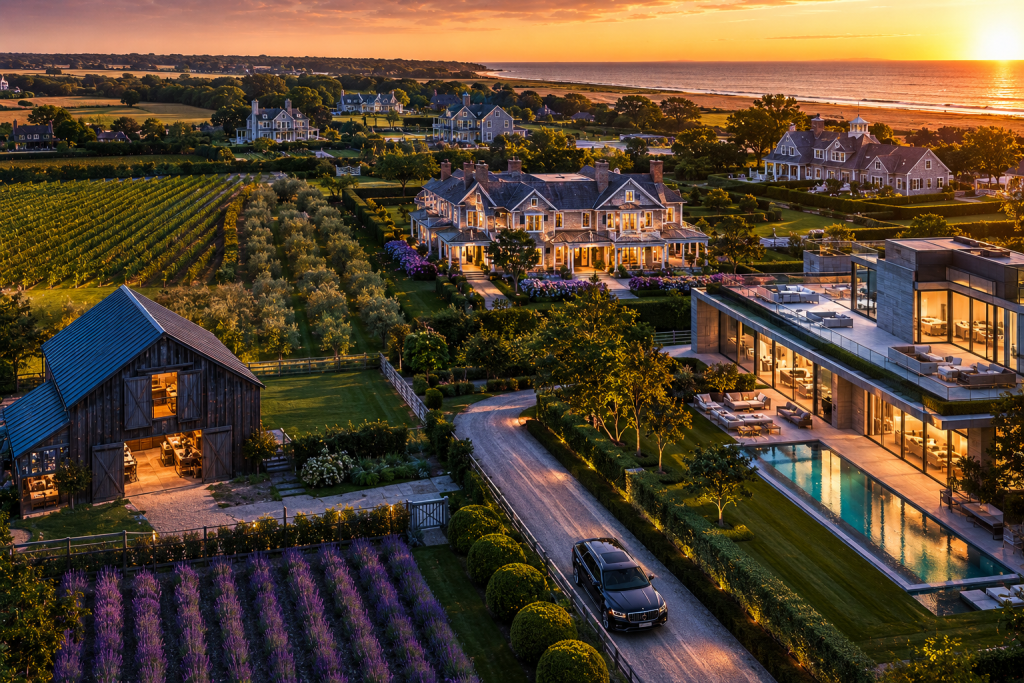
A Billion Dollars in One Village
Bridgehampton real estate crossed a threshold in 2025 that nobody predicted a decade ago. The broader Bridgehampton market (including Water Mill and Sagaponack) closed over $1.16 billion in home sales, up 29 percent from the prior year. Seven transactions exceeded $20 million, tying East Hampton Village for the most in that bracket on the South Fork. Developer Joe Farrell sold an oceanfront spec house for $58 million, one of the priciest deals on the East End in 2025. Hamptons median home prices crossed $2 million for the first time in history.
These numbers describe a market that has moved beyond luxury into a category that does not have a polite name. Bridgehampton is no longer the quiet agricultural village between Southampton and East Hampton. It is the geographic center of the most expensive residential real estate concentration outside California, and the buyers arriving from Manhattan are not the same buyers who arrived ten years ago. Wall Street bonuses hit record levels in 2025. Hedge fund managers, private equity partners, and venture capital investors joined the traditional banking class in a buying spree that pushed inventory down and prices up. By early 2026, inventory had risen approximately 30 percent year-over-year, but demand absorbed the increase.
The Price Map: Three Zip Codes, Three Markets
Bridgehampton 11932: The Core
Bridgehampton proper posts a median around $3 million, though the range stretches from cottage-scale properties north of the highway under $2 million to oceanfront estates above $20 million. PropertyShark ranked 11932 at number 31 nationally in 2024. The zip code’s strength is its breadth: entry-level buyers, mid-market upgraders, and trophy buyers all operate here simultaneously, which gives the market a depth that more concentrated villages lack.
Sagaponack 11962: The Trophy Tier
Sagaponack approaches $6 million median and has ranked among the three most expensive zip codes in the country for over a decade. Agricultural reserve overlays protect farmland from development, paradoxically increasing the value of existing properties by guaranteeing permanent views. Peter Brant’s estate anchors the top. Listings at $25 million and $34.95 million have appeared in recent years. Sagaponack sells emptiness at a premium.
Water Mill 11976: The Quiet Competitor
Water Mill posted a $5.5 million median in 2025, making it the second most expensive zip code in the Northeast after Sagaponack. Culturally adjacent to Bridgehampton, geographically adjacent to Southampton, Water Mill occupies a sweet spot for buyers who want Bridgehampton’s accessibility without Sagaponack’s price ceiling. The Parrish Art Museum sits in Water Mill, as does Duck Walk Vineyards.
South of the Highway vs North: The $5 Million Line
Montauk Highway (Route 27) divides Bridgehampton into two markets that share a zip code and little else. South of the highway means closer to the ocean. Larger parcels. Estate-scale construction. Reserve views. Access to Mecox Beach and Sagg Main Beach. Properties south of the highway start around $4 million and climb without a visible ceiling. The $58 million Farrell spec house was south of the highway. So is every property that sells for $20 million or more.
North of the Highway: Where Value Lives
North of the highway means closer to Sag Harbor, closer to the Bridgehampton-Sag Harbor Turnpike, and closer to the equestrian corridor that runs along Lumber Lane and Scuttle Hole Road. Properties here start under $2 million for older cottages and climb to $5 million for renovated homes on acreage. Hayground Road, which connects to Sagaponack, attracts artists and creatives who convert barns into studios. The Bridge and Atlantic Golf Club both sit north of the highway on Noyack Hills.
The Dumbo creative director bought north of the highway in 2019 for $1.8 million. Market value today: approximately $2.9 million. She works remotely from May through October, walks to Wolffer, bikes to the Wine Stand, and drives to Almond on Wednesdays. Her Bridgehampton is not the Bridgehampton of the $20 million estates. It is the Bridgehampton of the cottage, the garden, and the quiet. Both Bridgehamptons exist simultaneously, separated by the highway and about $18 million.
What the Money Buys: Four Price Tiers
Under $3 Million: The Entry
Older homes and cottages north of the highway. Two to four bedrooms. Modest lots by Bridgehampton standards. Buyers tend to be creatives, remote workers, and young families making a permanent move from Brooklyn or lower Manhattan. At this price point, Bridgehampton competes with Sag Harbor and parts of East Hampton for first-time Hamptons buyers. Inventory moves quickly when it appears.
$3 Million to $7 Million: The Core Market
Renovated or newer construction. Four to six bedrooms. Pools. Some reserve or field views. This is where the median sits and where the volume concentrates. Buyers are typically finance professionals, founders post-liquidity-event, and Manhattan families committing to year-round residence. Properties at this tier average 40 to 115 days on market. The Tribeca fund manager who wants a house on Lumber Lane near Polo Hamptons is shopping here.
$7 Million to $20 Million: The Prestige Band
Estate-scale properties south of the highway. Six to eight bedrooms. Gunite pools. Tennis courts. Reserve or ocean proximity. Buyers at this level are choosing between Bridgehampton and comparable properties in Southampton or East Hampton. What Bridgehampton offers that its neighbors do not: proximity to the equestrian corridor, newer private clubs (The Bridge, Atlantic Golf Club), and a village identity built on events rather than inherited institutions.
A 3.7-acre parcel on Ocean Road sold in November 2025 for $15.1 million. In February 2026, a nearly 10,000-square-foot estate in the equestrian corridor closed at $10 million. Classic village estates from 1910 on over an acre have sold for $5.375 million. Each sale tells a story about what Bridgehampton buyers value: scale, land, and location relative to the field.
Above $20 Million: The Trophy Market
Seven Bridgehampton transactions exceeded $20 million in 2025. Farrell’s $58 million oceanfront spec house topped them all. Buyers at this level are not comparing Bridgehampton to other Hamptons villages. They are comparing oceanfront square footage to Aspen, Palm Beach, and the Cote d’Azur. What Bridgehampton wins on is proximity: 90 miles from Manhattan, versus a flight to Colorado or Florida.
The Park Avenue family looked at Meadow Lane in Southampton ($35 million), Georgica Pond in East Hampton ($28 million), and Ocean Road in Bridgehampton ($22 million). They chose Bridgehampton. Asked why, he said: “Same ocean, same sand, fewer rules.” She said: “The Hampton Classic is three minutes away and the children ride.” Both answers pointed to the same conclusion: Bridgehampton offers the asset without the institutional gatekeeping.
The Conversion Premium
What makes Bridgehampton real estate structurally different from Southampton or East Hampton is the conversion dynamic. Potato farms became estates. Barns became studios. A racetrack became The Bridge golf club (initiation: $1.5 million). A firehouse became Dia Bridgehampton. Agricultural reserves became the mechanism that guarantees views. Every significant property in Bridgehampton sits on land that was something else first, and the conversion from agricultural to residential created value that Southampton’s Gilded Age estates never needed to create. They inherited theirs.
Agricultural Reserve as Value Engine
Protected farmland cannot be developed. A buyer purchasing a $12 million house adjacent to an agricultural reserve is paying for the permanent guarantee that nobody will build next door. This is the Bridgehampton-Sagaponack premium distilled: you are not buying land. You are buying the absence of what will never be built on the land beside you. In a market where new construction constantly threatens to block views and reduce privacy, the reserve overlay functions as an invisible wall more effective than any hedgerow.
The Rental Market: $700,000 for Two Weeks
Summer rentals in Bridgehampton range from $30,000 for a modest house for the month of July to $700,000 for two weeks in a nine-bedroom, 11,000-square-foot oceanfront estate. The rental market functions as a try-before-you-buy mechanism. Families rent for one or two summers, learn the village, identify the street they want, and then purchase. Brokers report that a significant percentage of Bridgehampton buyers rented in the area first.
The Carroll Gardens couple who rented on Parsonage Lane for $45,000 in July 2024 bought on Hayground Road for $3.8 million in 2025. Renting taught them that north of the highway suited their lifestyle better than the oceanfront. Renting taught them that Almond on Wednesday was more important to their weekly rhythm than Cooper’s Beach on Saturday. Real estate decisions in Bridgehampton are not made from listing photos. They are made from rental summers that reveal which version of the village fits.
Where the Conversation Continues
Social Life Magazine has covered Hamptons real estate for 23 years. Five summer issues, 25,000 copies each, distributed to the restaurants, hotels, and beach clubs where buyers, sellers, and brokers intersect. Our power rankings track the market across every village on the South Fork.
If your brand serves the Bridgehampton real estate audience (luxury brokerage, interior design, architecture, landscape, construction, or property management), editorial positioning in Social Life Magazine places you in front of the people writing the checks. Submit a Paid Feature here.
Polo Hamptons 2026 runs July 18 and July 25 at 900 Lumber Lane. More listing conversations happen at equestrian events than at open houses. Cabanas and sponsorship packages at polohamptons.com.
Subscribe to Social Life Magazine here.
Over $1 billion in sales. Seven transactions above $20 million. A $58 million spec house. And a four-block Main Street where a chocolate malt still costs $8.50 at a cash-only diner that opened in 1925. That is Bridgehampton real estate: the most expensive contradiction on the South Fork.
Related Reading
- Bridgehampton: The Village That Turned Farmland Into a Stage
- Sagaponack: The Most Expensive Zip Code in America
- Hamptons Real Estate Guide 2026
- Hamptons Real Estate Power Rankings 2026
- Best Restaurants in Bridgehampton 2026
- The Bridgehampton Equestrian Corridor
- The History of Bridgehampton
- Gin Lane and Meadow Lane Southampton
- Hamptons Mansions 2026
- Southampton Real Estate Guide
Author

Written by
Recent Posts

hiTechMODA Season 16
How to Keep Your Personal Number Private When Booking Events, Rentals and Services
Understanding Compensatory Damages in a Personal Injury Case

When Online Family Therapy Makes Sense for Modern Families

Carrier Oils, Essential Oils, and Oil Blends: What Beauty Brands Need to Know
Categories
- Art
- Articles
- Business of Luxury
- Celebrities
- Culture
- Entertainment
- Events
- Faces of Summer 2026
- Fashion
- Fashion & Style
- Featured
- Finance
- Food, Spirits, Wine
- Hamptons
- Hamptons Celebrities
- Health
- Health & Beauty
- Lifestyle
- Luxury Lifestyle
- Press
- Profiles
- Real Estate
- Technology
- The Chronicles
- Travel
- Uncategorized
- Weddings