
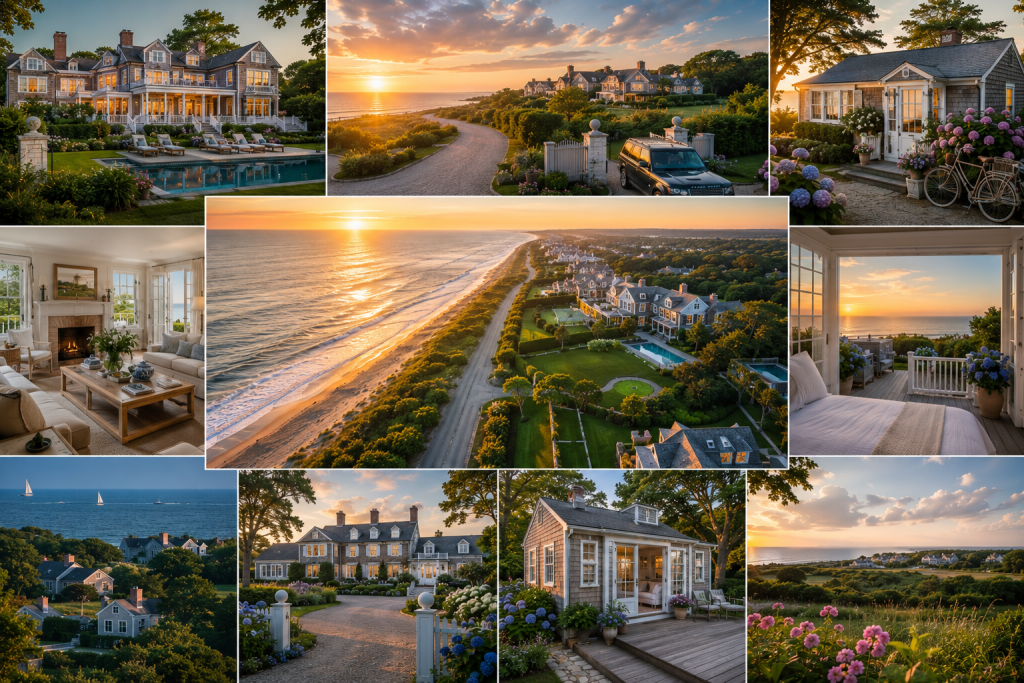
A Market That Refuses to Be One Thing
The Amagansett real estate market in 2026 is, like the hamlet itself, a collection of contradictions that nobody asks to resolve. The same zip code contains Len Blavatnik’s $115 million oceanfront parcel on Further Lane, Jerry Seinfeld’s $32 million estate with a private baseball diamond, and a two-bedroom cottage on a quarter-acre side street listing for $1.2 million. As of May 2026, the median listing price is $2.34 million (Movoto), the Zillow Home Value Index stands at $3.27 million, and the Redfin median sale price runs approximately $2.7 million. These numbers describe Amagansett the way an average temperature describes a year. Technically accurate. Practically meaningless.
What makes this market distinct from every other Hamptons real estate market is its range. Southampton is narrow and tall: institutional density, consistent quality, high floor. Bridgehampton sorts neatly into agricultural-conversion estates and village properties. Sag Harbor rarely exceeds $20 million for a single property. By contrast, Amagansett’s market stretches from entry-level cottages to nine-figure oceanfront without any visible seam between them. Ultimately, the range is the feature. Understanding it is the buyer’s first assignment.
The Neighborhoods: Four Markets in One Hamlet
Amagansett’s real estate breaks into four distinct neighborhoods, each with its own price architecture, buyer profile, and relationship to the ocean.
Further Lane: The $50 Billion Road
Further Lane runs parallel to the Atlantic from East Hampton Village into Amagansett, and its Amagansett section holds the hamlet’s most valuable properties. Blavatnik’s $115 million purchase of 408 Further Lane in July 2025 set the record. It remains the highest price ever paid for a single Hamptons parcel. Seinfeld’s 12-acre estate (purchased from Billy Joel for $32 million in 2000) sits nearby. Larry Gagosian, the world’s most powerful art dealer, maintains a Further Lane residence. Combined resident wealth exceeds $50 billion. Entry point for meaningful oceanfront on this road is approximately $30 million. Notably, most significant transactions occur off-market, meaning the supply is invisible to anyone without a broker who operates by invitation.
The Amagansett Dunes: Community Over Compound
The Dunes neighborhood sits oceanfront with a community boardwalk connecting shingle-style cottages to the beach. Lots are small by Hamptons standards. Architecture is modest, family-oriented, and governed by a culture of restraint that predates the hedge fund era. Properties here rarely hit the open market. When they do, they move through community networks that favor continuity over bidding wars. Pricing generally falls well below Further Lane levels. Smaller lot sizes and the communal beach access model explain the difference. For the buyer who values proximity to neighbors over privacy from them, the Dunes is the play.
Devon Colony: Soap Hill and the Highlands
Devon Colony occupies the Amagansett Highlands, a ridge 90 feet above sea level between Gardiners Bay and the Atlantic. Founded in 1908 by four Cincinnati businessmen (including William Cooper Procter of Procter and Gamble), the colony sits on land originally purchased at 1,000 acres. Grand stucco mansions, preserved farmland, horse farms, and the Devon Yacht Club define the neighborhood. The elevation provides views unavailable elsewhere in the hamlet. Consequently, Devon Colony appeals to the buyer who wants Amagansett’s character without Amagansett’s flatness: the bay on one side, the ocean on the other, and a century of quiet money in between.
The Village Core and Side Streets
The fourth market is the one most buyers encounter first: the cottages, ranch houses, converted farmhouses, and newer construction along the side streets radiating from Amagansett’s Main Street crossroads. This is where the $1.2 million to $4 million market lives. Cranberry Hole Road. Abraham’s Path. Windmill Lane. These properties lack oceanfront and Further Lane prestige, but they provide walking distance to restaurants, the Roundtree hotel, and The Stephen Talkhouse. For the buyer entering the Amagansett market for the first time, the village core is the gateway. Indeed, many of the hamlet’s most devoted year-round residents live on these unassuming streets rather than on the oceanfront.
The Numbers: What $2 Million to $100 Million Buys
Amagansett’s price tiers map directly to the four neighborhoods, but the relationship between price and experience is not always linear.
The Tier Structure
At the $1.2 million to $3 million level, buyers get village-core cottages and side-street homes within biking distance of the beach. Architecture ranges from postwar ranch houses to renovated shingle-style cottages. Generally, lot sizes are modest (typically a quarter to half acre). Still, the lifestyle access is identical to a $50 million Further Lane estate: the same Indian Wells Beach, the same farm stands, the same weekend rhythms. Amagansett’s democratic institutions (beach, farm stand, Talkhouse) don’t price-discriminate.
At the $3 million to $10 million level, buyers access larger lots, ocean proximity, and either newer construction or significantly renovated historic homes. The Dunes neighborhood enters the frame. Similarly, select Devon Colony properties occasionally appear in this range. At $10 million to $30 million, properties gain direct beach access and larger acreage. Hedgerows begin to provide real privacy. Above $30 million, you are on Further Lane or its immediate adjacency, competing with billionaires for parcels that rarely appear on any listing.
The FiDi portfolio manager opens Zillow at 11 p.m. on a Tuesday in February.
He types “Amagansett.” Sort by price: low to high.
A three-bedroom cottage on Abraham’s Path. $1.4 million. Half-acre lot.
>He clicks. He scrolls. He imagines Saturday mornings at Amber Waves.
Then he sorts by price: high to low. Further Lane. $38 million. Eight acres.
Both addresses are “Amagansett.” Both share a zip code and a farm stand line.
He closes the laptop. He texts his broker at 7 a.m.
“Show me the cottage first. Then show me what I’m living next to.”
Why Buyers Choose Amagansett Over Neighboring Markets
The comparison to neighboring markets is inevitable, and Amagansett wins on a specific set of criteria that matter to a specific buyer.
Versus East Hampton Village
East Hampton Village offers institutional density (Maidstone Club, Guild Hall, Newtown Lane shopping) and the full apparatus of a self-governing municipality. For buyers who want social infrastructure, the village is the obvious choice. However, Amagansett offers something the village cannot: the absence of that apparatus. There is no village government reviewing your plans and no historic district commission weighing in. Similarly, there is no social hierarchy enforced by club membership. For the buyer who has already achieved institutional validation elsewhere, Amagansett’s thinness is the product.
Versus Bridgehampton and Sag Harbor
Bridgehampton offers event proximity (Polo Hamptons, the Hampton Classic) and agricultural-estate scale. Sag Harbor offers harbor culture, walkable dining, and cultural programming. Certainly, both are excellent markets. Amagansett offers neither events nor harbor, but it offers something increasingly rare on the East End: a hamlet that still feels like a hamlet. The farm stand economy, the single crossroads, the absence of a gala calendar. For the buyer who measures value in quiet rather than in square footage, the equation changes. Amagansett reprices everything.
The Rental-to-Purchase Pipeline
Amagansett’s real estate market is fed by a pipeline that begins not with a broker’s listing but with a summer rental. The hamlet’s near-total lack of hotel inventory (the Roundtree, the Sea Crest, and a handful of alternatives constitute the entire supply) means most first-time visitors are renters. Renters unpack. They learn the coffee line at Jack’s. They develop routines at the beach. After two or three rental summers, many transition from visitor to buyer.
Essentially, the pipeline works because Amagansett sells a rhythm, not a property. The rhythm includes the Thursday arrival, the Friday farm stand run, the Saturday beach-to-dinner arc, and the Sunday departure. Once a family has lived inside that rhythm for two or three summers, the rental starts to feel temporary and the hamlet starts to feel permanent. Brokers in Amagansett have learned to treat rental inquiries as the top of a purchase funnel. As a result, the conversion rate is remarkably high. Amagansett doesn’t need to sell itself. It just needs you to spend a weekend.
Practical Considerations for Buyers
Amagansett falls under the Town of East Hampton’s jurisdiction for zoning, building permits, and property taxes. There is no separate village tax (unlike East Hampton Village, which levies its own). Consequently, the tax burden in Amagansett can be lower than in the incorporated village next door, a detail that matters at every price point but especially at the top.
Zoning in the hamlet prevents the McMansion construction that transformed other East End neighborhoods. Miss Amelia’s Cottage (built 1725, National Register) and the broader architectural character of the hamlet’s historic district set a tone that new construction absorbs. Naturally, this doesn’t prevent modern homes from being built. It does, however, prevent them from dominating. The zoning code is a floor. The Dunes and Devon culture is the ceiling. Between the two, Amagansett’s residential character holds.
Where the Conversation Continues
Social Life Magazine has covered East End real estate for 23 years. Five summer issues, 25,000 copies each, in the hands of the buyers and sellers who move this market. When a record breaks, we’re the publication that puts it in context.
If your real estate brand serves the Amagansett market (luxury brokerage, mortgage, title, architecture, interior design, landscape architecture), a feature in Social Life Magazine places you where the decisions happen. Learn more at sociallifemagazine.com/submit-a-paid-feature.
Polo Hamptons 2026 returns to Bridgehampton on July 18 and July 25. BMW North America sponsors. Christie Brinkley hosts. Reservations at polohamptons.com.
Subscribe at sociallifemagazine.com/subscription for every issue.
A $115 million parcel and a $1.4 million cottage share a zip code, a farm stand line, and a beach. Only in Amagansett does that sentence make sense. Only in Amagansett does it not need to.
Author

Written by
Recent Posts

hiTechMODA Season 16
How to Keep Your Personal Number Private When Booking Events, Rentals and Services
Understanding Compensatory Damages in a Personal Injury Case

When Online Family Therapy Makes Sense for Modern Families

Carrier Oils, Essential Oils, and Oil Blends: What Beauty Brands Need to Know
Categories
- Art
- Articles
- Business of Luxury
- Celebrities
- Culture
- Entertainment
- Events
- Faces of Summer 2026
- Fashion
- Fashion & Style
- Featured
- Finance
- Food, Spirits, Wine
- Hamptons
- Hamptons Celebrities
- Health
- Health & Beauty
- Lifestyle
- Luxury Lifestyle
- Press
- Profiles
- Real Estate
- Technology
- The Chronicles
- Travel
- Uncategorized
- Weddings