
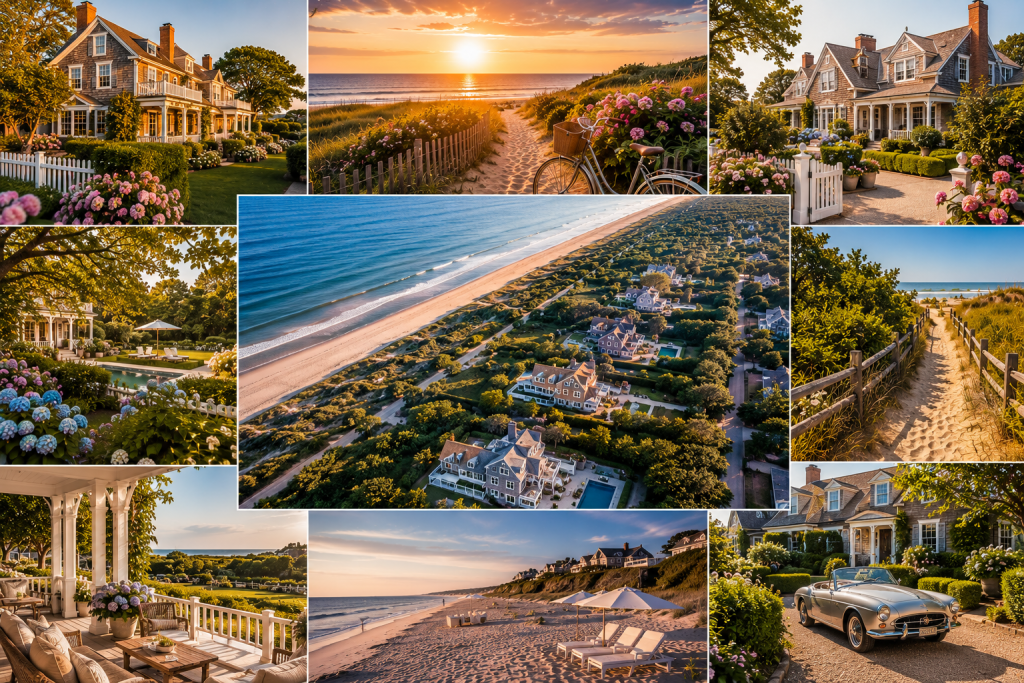
Before the Nine-Figure Sales, There Were Family Compounds
Long before Len Blavatnik paid $115 million for a single parcel on Further Lane, long before the hedge fund era rewrote the real estate map of the East End, Amagansett had its summer colonies. The Amagansett Dunes and Devon Colony represent a style of Hamptons living that predates the McMansion, the fully staffed estate, and the concept of a summer house as an investment vehicle. These are family compounds. Shingle-style cottages built close together, shared paths to the beach, children walking barefoot between houses. In 2026, the old guard colonies still exist, still function, and still operate on a set of values that the nine-figure market has not managed to replace.
Understanding the Dunes and Devon is essential to understanding why Amagansett feels different from every other Hamptons village. Southampton‘s character was shaped by its private clubs. Sag Harbor‘s character was shaped by its harbor and its literary community. Bridgehampton‘s character was shaped by its events calendar. Amagansett’s character was shaped by these colonies: quiet, family-oriented, architecturally restrained, and deeply resistant to display. The Dunes and Devon are the DNA. Everything else is expression.
The Amagansett Dunes: Oceanfront Without Ostentation
The Amagansett Dunes neighborhood sits on the oceanfront, south of the hamlet’s Main Street crossroads, with a community boardwalk providing direct beach access. The neighborhood’s architectural character is defined by what it chooses not to do. Lots are small by current Hamptons standards. Houses are shingle-style, modest in footprint, and built close together in a manner that recalls a New England fishing village more than a luxury resort community. Zoning restrictions have prevented the kind of McMansion construction that transformed other East End neighborhoods during the building boom of the 2000s.
The Community Boardwalk
The boardwalk is the neighborhood’s signature feature, and it operates as a social institution. Every morning in summer, Dunes residents walk to the beach along shared wooden paths that connect the community’s cottages to the sand. Notably, the paths are narrow. You pass your neighbors at arm’s length. Conversations happen not in dining rooms or clubhouses but on a boardwalk two feet wide. For the Greenwich financier who bought in the Dunes because his wife’s family has summered there since the 1960s, the boardwalk is where relationships are maintained. Consequently, the real estate doesn’t just include a house. It includes a community that is physically built into the infrastructure.
Compare the Dunes boardwalk to the private beach access on Further Lane, where individual properties have their own dune crossings and interaction with neighbors is optional. On Further Lane, privacy is the product. In the Dunes, proximity is the product. After all, both are oceanfront. Both are Amagansett. They represent two fundamentally different theories of what summer living should accomplish.
The Darien grandmother walks the boardwalk at 7:30 a.m. on a Tuesday in July.
She has been doing this since 1978. The planks have been replaced three times.
Her cottage has four bedrooms. Her grandchildren sleep in the same rooms their parents slept in.
A new family from the Upper West Side bought two doors down last September.
She introduced herself with a plate of cookies. That is how it works here.
No welcome committee. No application process. Just cookies on a boardwalk.
Further Lane has hedgerows. The Dunes has two-foot-wide planks.
Both accomplish the same thing. The Dunes just accomplishes it louder.
Devon Colony: Soap Hill and the Cincinnati Founders
Devon Colony’s origin story reads like a chapter from an Edith Wharton novel set in the wrong state. In 1906, four prominent businessmen from Cincinnati, Ohio traveled to the East End for a hunting trip. After discovering the Amagansett Highlands (a ridge 90 feet above sea level between Gardiners Bay and the Atlantic), they made a decision that would shape the hamlet for the next century. In 1908, they purchased 1,000 acres and founded the Devon Colony.
The Four Founders
The founders were William Cooper Procter of Procter and Gamble, Richmond Levering of Lever Brothers, Joseph Rawson Jr., and William Stanhope Rowe. Together, they built four grand stucco mansions and one shingle-style home between 1909 and 1910. They also established what is now the Devon Yacht Club (originally the Gardiners Bay Boat Club), which includes a small private marina and has remained largely unchanged since 1908. The colony was one of the first gated communities in the Hamptons. However, because Procter and Gamble’s soap sales funded the homes, the local Bonackers (the term for generational East End residents) gave the neighborhood a contemptuous nickname: “Soap Hill.”
Indeed, the nickname is instructive. It reveals a class tension that still hums beneath the surface of Hamptons life. In the early 20th century, the Hamptons establishment (centered in Southampton and East Hampton Village) looked down on manufactured-goods wealth the way it would later look down on hedge fund wealth. Procter and Gamble sold soap. Lever Brothers sold soap. Ultimately, this was commerce, not inheritance. The “Soap Hill” label was a status judgment disguised as geography. Naturally, Devon Colony thrived anyway. Of course, status judgments lose their power when the people being judged own 1,000 acres and a yacht club.
The Colony Today
In 2026, Devon Colony sits within the Amagansett Highlands, surrounded by thickets of forest, horse farms, and preserved farmland. The elevation provides far-reaching views of Gardiners Bay to the north and the ocean to the south. In addition, homes are regularly featured on the East Hampton House and Garden Tour. The Devon Yacht Club remains the colony’s social anchor, and its members prefer it that way: small, private, unchanged. Unlike Southampton’s Meadow Club or the Maidstone in East Hampton Village, the Devon Yacht Club does not function as a social sorting mechanism for the broader community. Instead, it serves its members and asks nothing of anyone else. In Devon Colony, the institution exists for the residents. In Southampton, the residents exist for the institution. That is a meaningful difference.
What the Old Guard Colonies Tell Us About Amagansett
The Dunes and Devon, taken together, explain something about Amagansett that no single real estate transaction can capture. They explain the hamlet’s relationship with display, which is to say, its refusal to display. The Dunes are oceanfront property where the houses don’t announce themselves from the road. Devon is a 1,000-acre colony where the founders chose stucco over shingle because they came from Cincinnati and didn’t know (or didn’t care) what a Hamptons house was supposed to look like.
The Restraint Principle
Both colonies operate on a principle of architectural and social restraint that has influenced Amagansett’s broader character. When a developer proposes a 10,000-square-foot modern house on a half-acre lot in the hamlet, the response from the existing community is not organized opposition (there is no village government to organize opposition through). Rather, it is ambient disapproval. The Dunes families and Devon residents set a tone that new construction absorbs by osmosis. Essentially, the message is: build modestly. Live quietly. Keep the hedgerows low enough that the neighbors can wave. This isn’t a rule. It is a culture. And cultures, unlike zoning codes, cannot be appealed.
Compare this to Gin Lane in Southampton, where the architectural statement IS the point. Or to Sagaponack, where agricultural-conversion estates compete for scale. In Amagansett’s old guard colonies, the architecture is deliberately secondary to the landscape. Ocean is the view from the south. Bay is the view from the north. And the house is just the thing you sleep in between them.
Buying Into the Old Guard: What It Means Today
Properties in the Amagansett Dunes and Devon Colony rarely appear on the open market. When they do, they sell quickly and often off-market, through networks that privilege existing community ties over bidding wars. Typically, the buyer profile is specific: someone who values community architecture over individual expression, who prefers a boardwalk to a private dune crossing, and who understands that the $2 million cottage in the Dunes provides something the $30 million estate on Further Lane cannot: neighbors who remember your children’s names.
The Old Money Proposition
Old money in Amagansett doesn’t perform. It composts. It turns into gardening habits, walking routines, boardwalk conversations, and a generational knowledge of which beach entrance has the fewest crowds at 8 a.m. on a Saturday. For the new buyer considering the Dunes or Devon, the value proposition is not financial (these are not investment properties in the conventional sense). Instead, the value is temporal. You are buying into a community that has existed in recognizable form for over a century. Indeed, you are buying time that has already been lived, and agreeing to live it the same way.
The West Hartford heir looks at the Devon Colony listing for the third time.
Four bedrooms. Gardiners Bay views. The Devon Yacht Club down the lane.
His family sold Ivory soap. Different company, same industry, same century.
“Soap Hill,” his broker says, smiling. “That’s what the Bonackers called it.”
He laughs. His great-grandfather would have understood perfectly.
Wealth made from things people use every day, spent on a place nobody needs.
That is the old money paradox. And Devon Colony is its permanent address.
He makes the offer before lunch. Some decisions need exactly zero analysis.
Where the Conversation Continues
Social Life Magazine has covered the East End’s communities for 23 years. Five summer issues, 25,000 copies each, distributed in the restaurants, hotels, and bookstores from Westhampton to Montauk. When the story is old money, we understand the grammar.
If your brand serves the old guard audience (estate planning, private banking, heritage architecture, preservation, fine art, family office), a feature in Social Life Magazine positions you inside the conversation that matters most. Learn more at sociallifemagazine.com/submit-a-paid-feature.
Polo Hamptons 2026 returns to Bridgehampton on July 18 and July 25. BMW North America sponsors. Christie Brinkley hosts. Reservations at polohamptons.com.
Subscribe at sociallifemagazine.com/subscription for every issue.
The Bonackers called it Soap Hill. The founders called it home. A century later, the soap is gone but the hill remains. So does the yacht club. So do the families. Old money doesn’t need a new name.
Author

Written by
Recent Posts

AI for personal finance: where PennyGuard fits

How to Pick a Homecoming Dress for Your Body Type (and Feel Amazing in It)

World Cup Injury Attorney for Vancouver Events
What a 3-Carat Engagement Ring Actually Costs in 2026: The Real Numbers
The Skincare Habits That Make a Real Difference Over Time
Categories
- Art
- Articles
- Business of Luxury
- Celebrities
- Culture
- Entertainment
- Events
- Faces of Summer 2026
- Fashion
- Fashion & Style
- Featured
- Finance
- Food, Spirits, Wine
- Hamptons
- Hamptons Celebrities
- Health
- Health & Beauty
- Lifestyle
- Luxury Lifestyle
- Press
- Profiles
- Real Estate
- Technology
- The Chronicles
- Travel
- Uncategorized
- Weddings