
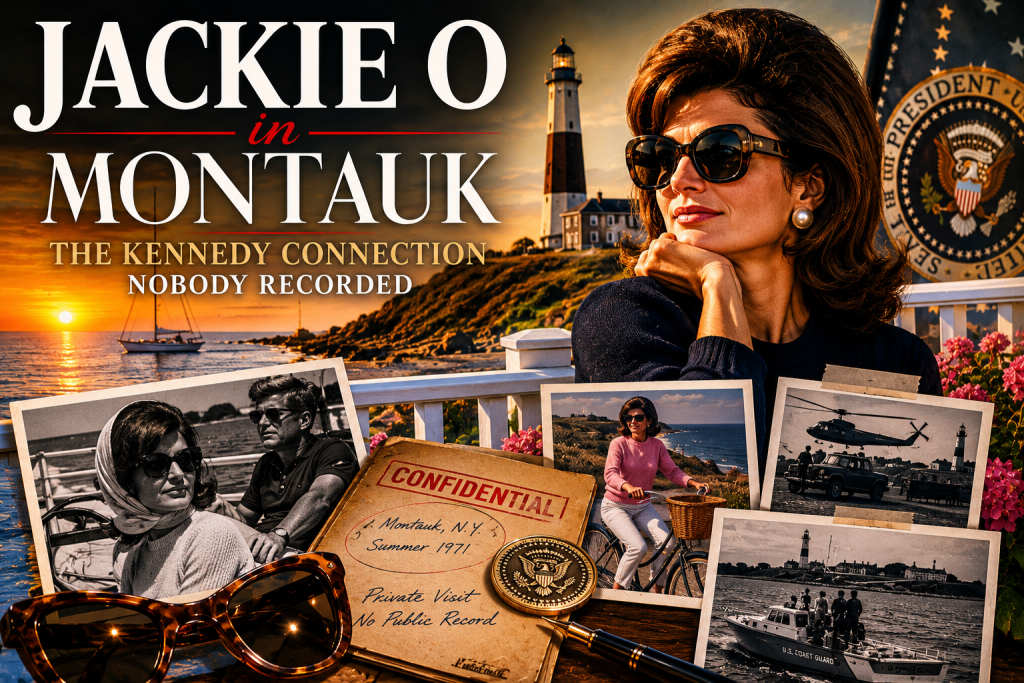
The Former First Lady at the End of the World
In the summer of 1972, Jacqueline Kennedy Onassis, the most famous woman in America and arguably the most photographed person on Earth, spent several weeks at a compound in Montauk that most people had never heard of. The compound was called Eothen. It belonged to Andy Warhol. And it sat two miles west of a military installation. At that very moment, the U.S. government was conducting classified operations there. Their nature would not become public for another two decades.
Jackie Kennedy in Montauk is a story about proximity. Celebrity alongside secrecy. Cultural power alongside military power. The most public life in America alongside one of its most private landscapes. It is also a story about the specific quality of invisibility that Montauk offered in the early 1970s, before the Surf Lodge and Gurney’s and the $40 lobster rolls, when the town at the end of the road was genuinely remote and a former First Lady could spend a summer there without a single paparazzi photograph being taken.
That last detail is worth pausing on. Because in 1972, Jackie Onassis could not walk through the lobby of the Carlyle Hotel without being photographed. She could not eat lunch at La Grenouille without it appearing in print. She could not attend a ballet at Lincoln Center without tabloids documenting her outfit and her companion. Yet she spent weeks at Eothen, and nobody recorded it in real time. Montauk in 1972 was, for a woman who had spent the previous decade as the most surveilled private citizen in the Western world, something close to freedom.
How She Got There
The connection was her sister. Princess Caroline Lee Radziwill, born Lee Bouvier, was Jackie’s younger sibling and a figure of considerable social influence in her own right. Lee had married Prince Stanislaw Albrecht Radziwill of Poland in 1959 (they divorced in 1974). Her title, combined with her beauty and her sister’s fame, gave her access to social circles that overlapped with Warhol’s orbit.
Warhol and his film collaborator Paul Morrissey had purchased Eothen in 1972 for $225,000. The compound comprised five white clapboard cottages on roughly 20 acres of oceanfront moorland at the eastern end of Montauk. Warhol’s solution to the property’s mortgage was characteristically efficient: he rented the main house to Lee Radziwill for the summer. The rental income covered his costs. Warhol retreated to one of the smaller cottages on the property, maintaining proximity to his tenant (and her famous guests) without the expense of occupying the main house himself.
Lee invited Jackie to bring her children, Caroline and John Jr., for an extended stay. Jackie accepted. And so the scene at Eothen in the summer of 1972 assembled itself with the kind of improbable density that Montauk would become known for: the former First Lady sunbathing on the cliffs, her children playing on the lawn, her sister hosting in the main house, the most important living American artist working 50 yards away, and a classified military installation operating two miles to the east.
The Children on the Lawn
Caroline Kennedy was 14 in the summer of 1972. John F. Kennedy Jr. was 11. Of course, their presence at Eothen adds a dimension to the story that becomes uncomfortable when placed alongside the Montauk Project conspiracy.
According to Preston Nichols, the Montauk Project allegedly used children from surrounding communities as test subjects during the late 1970s and early 1980s, programming them through electromagnetic frequency experiments in underground laboratories beneath Camp Hero. The Montauk Boys allegation, while completely unverified, describes children being taken to a facility two miles from the compound where the Kennedy children spent their summer.
There is, it should be stated clearly, absolutely no connection between the Kennedy children’s visit to Eothen and the Montauk Project conspiracy. The timeline doesn’t align (the Montauk Boys program allegedly operated later in the decade). No one has ever suggested that the Kennedy children were involved in any way. But the geographic proximity creates a narrative resonance that the conspiracy community has not failed to notice. The children of the most famous political assassination of the twentieth century, playing on a lawn two miles from a facility where, if you believe the conspiracy, other children were being subjected to government experiments. The juxtaposition is almost too heavy for the story to bear, which is precisely why it keeps getting repeated.
Jonas Mekas and the Camera
The summer of 1972 at Eothen was partially documented by Jonas Mekas, the Lithuanian-born filmmaker who is widely regarded as the godfather of American avant-garde cinema. Mekas had been a friend and collaborator of Warhol’s since the 1960s. His presence at the compound was not unusual. What was unusual was that he brought his camera.
Mekas filmed Jackie, Lee, Caroline, and John Jr. at Eothen. The footage captures the family in casual, unguarded moments. It surfaced publicly in 2017 as part of a documentary called That Summer, directed by Göran Hugo Olsson. The film uses Mekas’ footage alongside audio recordings and contemporary interviews to reconstruct the atmosphere of the 1972 summer.
That Summer is significant for multiple reasons, but one stands out in the context of the Montauk Dossier. Notably, the documentary shows the Kennedy children at Eothen in a way that emphasizes the compound’s isolation. Its landscape is windswept, the moors are empty, the Atlantic crashes against the bluffs in the background. The footage makes Montauk look like the end of the world, which in 1972 it essentially was. Mekas captured a place that, three years later, would host the Rolling Stones and, two decades after that, would become the center of the most influential conspiracy theory in American pop culture.
The Radziwill Gift
One of the more charming details to emerge from accounts of the 1972 summer involves a gift from Lee Radziwill to Andy Warhol. According to Bob Colacello, the editor of Warhol’s Interview magazine and a frequent visitor to Eothen, Lee gave Warhol a flagpole. The flagpole was installed on the compound’s property line, visible from Dick Cavett’s adjacent estate. Its purpose, according to Colacello, was to serve as a signal system: when the flag was raised, Cavett was welcome to visit. When it was down, he was not.
This detail is worth lingering on because it encapsulates the social physics of Eothen with remarkable economy. A princess gives an artist a flagpole to regulate the access of a television host. The flag becomes a binary signal: yes or no, in or out, welcome or unwelcome. And the television host, one of the most famous faces in America, accepts the terms. He walks to the property line, checks the flag, and either proceeds or turns back. The power dynamics at play are so specific, so granular, so precisely calibrated that they could only have been designed by someone (Warhol, almost certainly) who understood that social control is most effective when it operates through symbols rather than rules.
What Jackie Saw
Jackie Onassis at Eothen in 1972 would have seen more or less what a visitor to the area sees today, minus the development. Atlantic bluffs, 75 feet above the water. The Montauk Lighthouse, visible from the compound’s eastern edge. And the Old Montauk Highway, a two-lane road running through scrub oak and bayberry. And, two miles to the east, the radar tower at Camp Hero, standing 90 feet tall with its 40-foot dish pointed at the ocean.
There is no indication that Jackie paid any attention to the military base. Why would she? In 1972, Camp Hero was simply part of the landscape, a Cold War installation that had been there for decades and showed no signs of being unusual. The conspiracy mythology didn’t exist yet. Preston Nichols was an unknown electronics technician who wouldn’t publish his book for another 20 years. The Montauk Monster wouldn’t wash ashore for another 36 years. Stranger Things was more than four decades in the future.
What Jackie saw was a military base. What the world would later see was the seed of a mythology. Both views were, in their own way, accurate. The difference is time.
The Legacy of the 1972 Summer
Jackie Kennedy in Montauk matters for the same reason the Rolling Stones in Montauk matters and Eothen matters: because these stories establish Montauk as a place where cultural history and conspiracy mythology occupy the same geographic space. The former First Lady and the radar tower. The Kennedy children and the sealed bunkers. Warhol’s art and the government’s secrets. All of it within walking distance of each other, happening simultaneously, documented by one of the most important filmmakers of the twentieth century.
The Template of Invisibility
The 1972 summer also established the template for how Eothen would function for the next 15 years: as a space where people of extraordinary fame and influence came to be invisible. Jackie came to not be photographed. Warhol came to observe without being observed. Lee came to be Lee rather than Jackie’s sister. And all of them came to a place that, despite being only 120 miles from Manhattan, felt as remote as another country. Montauk gave its visitors something rare: the gift of not being seen. Which is, when you consider the town’s subsequent history of government secrecy and conspiracy allegations, a deeply ironic gift to offer.
There is a broader observation to make here about the way Montauk functioned as a space in the early 1970s, before the real estate boom and the celebrity culture and the Netflix franchise transformed it into a destination. In 1972, Montauk was a place where things happened that nobody documented. Not because the things were secret (although some of them were) but because the infrastructure for documentation hadn’t reached that far east. Paparazzi hadn’t discovered Montauk. Nor had gossip correspondents. No society photographers were positioned at the Montauk Yacht Club or the Memory Motel. The cultural surveillance apparatus that made Jackie’s life in Manhattan a perpetual performance simply didn’t extend to the end of the peninsula. She could be a person rather than a symbol. For a woman who had been a symbol since November 22, 1963, that was worth more than the ocean view.
The Anti-Factory
Warhol, who understood surveillance and performance better than anyone alive, must have appreciated the paradox. He had built his entire career on the collapse of the boundary between public and private life. The Factory was a machine for making private lives public. And yet his summer compound at Montauk operated on the opposite principle. At Eothen, public lives became private. Jackie became invisible. The Stones rehearsed without cameras. Capote drank without being quoted. The compound was, in effect, an anti-Factory. A place where the most documented people in America came to be undocumented. That this happened two miles from a military base conducting classified operations is, in retrospect, the kind of coincidence that makes Montauk feel less like a real place and more like a novel that someone is writing in real time.
Where the Conversation Continues
Jackie Kennedy in Montauk is one chapter in a story that runs from Warhol’s compound to Camp Hero’s radar tower to Netflix’s writers’ room. Social Life Magazine has covered the East End for 23 years. The stories that define this place land here before they land anywhere else.
If you have a story, a brand, or a project that belongs in these pages, reach out at sociallifemagazine.com/contact.
For brands looking for premium editorial placement, our paid feature submission portal is open at sociallifemagazine.com/submit-a-paid-feature/.
Stay in the loop with our weekly email blast covering events, openings, and who’s doing what Out East. Sign up at enflyer.sociallifemagazine.com.
Polo Hamptons 2026 returns to Bridgehampton on July 18 and July 25 with BMW as title sponsor. For event details and sponsorship opportunities, visit polohamptons.com.
Never miss a feature, a profile, or a party recap. Subscribe to Social Life Magazine at sociallifemagazine.com/subscription.
If the work we do matters to you, you can support independent East End journalism directly via PayPal.
Author

Written by
Recent Posts
hiTechMODA Season 16
How to Keep Your Personal Number Private When Booking Events, Rentals and Services
Understanding Compensatory Damages in a Personal Injury Case

When Online Family Therapy Makes Sense for Modern Families

Carrier Oils, Essential Oils, and Oil Blends: What Beauty Brands Need to Know
Categories
- Art
- Articles
- Business of Luxury
- Celebrities
- Culture
- Entertainment
- Events
- Faces of Summer 2026
- Fashion
- Fashion & Style
- Featured
- Finance
- Food, Spirits, Wine
- Hamptons
- Hamptons Celebrities
- Health
- Health & Beauty
- Lifestyle
- Luxury Lifestyle
- Press
- Profiles
- Real Estate
- Technology
- The Chronicles
- Travel
- Uncategorized
- Weddings