
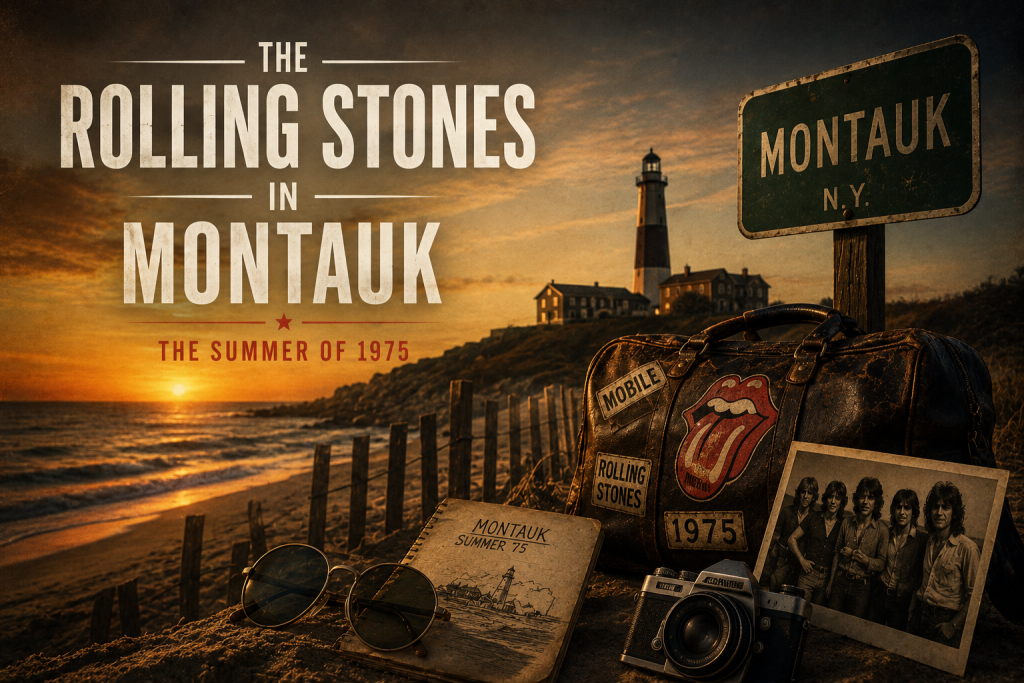
The Summer the Biggest Band in the World Came to The End
In the summer of 1975, the Rolling Stones needed somewhere to rehearse. Their upcoming tour, the first with Ronnie Wood replacing Mick Taylor, required weeks of preparation. They needed to get away from the press, the fans, and the chaos. Isolation was essential. So was space. And they needed a place where nobody would think to look.
They chose Eothen, Andy Warhol’s compound on the cliffs of Montauk. Five white clapboard cottages on 20 acres of oceanfront moorland, two miles west of Camp Hero, the decommissioned Air Force station that would later become the center of the Montauk Project conspiracy and the foundation for Netflix’s Stranger Things. While Mick Jagger and Keith Richards worked out arrangements in the main house, the military base down the road was still operational. Its radar tower was still scanning the Atlantic. And whatever was happening inside the fenced perimeter was still classified.
But the Rolling Stones in Montauk didn’t know about any of that. They were there for the music. And the summer they spent at The End produced one of rock and roll’s most enduring legends.
How They Got to Eothen
Andy Warhol had purchased Eothen in 1972 for $225,000, along with his film collaborator Paul Morrissey. The compound had been built in the 1930s by heirs to the Arm and Hammer fortune. By the mid-1970s, Warhol was using it as a summer social laboratory, hosting guests whose names read like a cultural index of the era: Jackie Onassis, John Lennon, Halston, Truman Capote, Liza Minnelli, Elizabeth Taylor.
When the Stones needed rehearsal space, the connection came through Warhol’s network. The band rented the main house at Eothen for several weeks. Warhol retreated to one of the smaller cottages on the property, observing from a comfortable distance. Photographer Ken Regan was given access to document the sessions. The resulting images show the band sprawled across Warhol’s furniture. Instruments and amplifiers are scattered through rooms designed for quiet weekends. They are among the most intimate photographs of the Stones in their prime.
Charlie Watts, Mick Jagger, Keith Richards, Ronnie Wood, Bill Wyman, and Billy Preston occupied the property. Rehearsals were intensive. The band was preparing material that would eventually appear on Black and Blue, their 1976 album. The recording sessions for the album took place later in Munich, but the arrangements and structures were developed at Eothen, in rooms overlooking the Atlantic, at the end of a peninsula, with nobody around but Warhol, a few staff members, and an increasingly overwhelmed caretaker.
The Chaos at The End of the World
The Stones’ presence at Montauk did not remain secret for long. Despite the compound’s isolation, word traveled fast. Groupie networks and music press channels operated with remarkable efficiency even in the pre-internet era. Within days of the band’s arrival, the motels of Montauk began filling with fans, hangers-on, and women hoping to get close to Jagger or Richards.
Warhol documented the scene in his diaries. He noted that “two girls with no hair and black cats on leashes followed them all the way to Montauk.” The image is almost too perfectly Warholian to be real, but Warhol was a compulsive recorder of specific details, and his diaries have been corroborated as reliable accounts by multiple biographers. The bald women with cats on leashes stood at the edge of the compound and refused to leave.
Mr. Winters, the estate’s caretaker, found fans hiding in the bushes on the property. Not near the property. In the bushes. A man whose job was to maintain 20 oceanfront acres was physically pulling groupies out of the hedgerows because the biggest rock band in the world was rehearsing in the living room. The compound’s long private driveway, which normally served as a buffer between Eothen and the outside world, became a gathering point for people who had traveled from New York City, from Connecticut, and in some cases from other states to be near the Stones.
Dick Cavett, the talk-show host and Warhol’s next-door neighbor, maintained his customary restraint. According to Bob Colacello, the longtime editor of Warhol’s Interview magazine, Cavett “usually walked on the beach to the edge of Andy’s property and waited until he was invited in.” Even with the Rolling Stones next door, Cavett stood at the property line. In the hierarchy of Eothen, proximity was not the same as access.
The Memory Motel
The band’s after-hours life centered on the Memory Motel, a bar on the Old Montauk Highway that had been a local fixture since 1969. The bar sits in a building that also contains a small motel. It was, and remains, a working-class establishment in a town that has since become one of the most expensive destinations on the East End. In 1975, it was exactly the kind of place where a rock band could drink without being bothered by anyone who cared about celebrity.
The Song
Jagger and Richards reportedly spent multiple evenings at the Memory Motel during their time at Eothen. According to local lore and music press accounts, the two wrote the track “Memory Motel” during or shortly after their Montauk residency. The song appeared on Black and Blue in 1976. It is a slow, piano-driven ballad about a woman met and lost during a night at a bar. The lyrics reference a coastal setting that fans have long identified as Montauk.
“Memory Motel” is not among the Rolling Stones’ best-known songs. It has never been a concert staple. But it occupies a particular place in the band’s catalog as one of the most autobiographically specific tracks they ever recorded. The motel is real. The bar is real. And the night is, presumably, real too. In a catalog built largely on swagger and abstraction, “Memory Motel” is a postcard from a specific place and time. That place was Montauk. That time was the summer of 1975.
The Memory Motel is still open. The jukebox still works. Nobody has renovated it into a boutique hotel or a craft cocktail bar. It remains what it was when the Stones walked in: a bar at the end of the road. For visitors who know the history, ordering a drink at the Memory Motel is one of the few experiences on the East End where the past is still physically present and hasn’t been polished into something it wasn’t.
Two Miles from Camp Hero
Here is the detail that makes the Rolling Stones in Montauk story relevant to the Montauk Dossier. In the summer of 1975, Camp Hero was still an active military installation. The AN/FPS-35 radar tower was still operational, scanning the Atlantic for Soviet threats. The base would not be decommissioned until 1981. Whatever was happening inside the fenced perimeter of the Montauk Air Force Station was happening two miles east of the room where Mick Jagger was singing into a microphone.
There is no evidence that the Rolling Stones knew about or were interested in the military base down the road. The Montauk Project conspiracy hadn’t been articulated yet. Preston Nichols wouldn’t publish his book until 1992. The Philadelphia Experiment mythology existed but hadn’t been connected to Camp Hero. In 1975, the base was simply a military facility that happened to be at the end of the same road as Warhol’s compound.
But the geographic coincidence remains one of the most striking details in Montauk’s cultural history. Consider the scene: the world’s most famous rock band, rehearsing at the compound of the world’s most famous pop artist, two miles from a military installation that would later become the subject of the world’s most influential conspiracy theory, which would in turn inspire the world’s most successful streaming franchise. All of it happening simultaneously, at the end of Long Island, in the summer of 1975. Nobody knew what it would all become. That, of course, is how the best stories always start.
Where the Conversation Continues
The Rolling Stones in Montauk left behind a song, a legend, and a bar that still pours the same drinks. Social Life Magazine has covered the East End for 23 years. Five summer issues from Memorial Day through Labor Day. The stories that define this place land here before they land anywhere else.
If you have a story, a brand, or a project that belongs in these pages, reach out at sociallifemagazine.com/contact.
For brands looking for premium editorial placement, our paid feature submission portal is open at sociallifemagazine.com/submit-a-paid-feature/.
Stay in the loop with our weekly email blast covering events, openings, and who’s doing what Out East. Sign up at enflyer.sociallifemagazine.com.
Polo Hamptons 2026 returns to Bridgehampton on July 18 and July 25 with BMW as title sponsor. For event details and sponsorship opportunities, visit polohamptons.com.
Never miss a feature, a profile, or a party recap. Subscribe to Social Life Magazine at sociallifemagazine.com/subscription.
If the work we do matters to you, you can support independent East End journalism directly via PayPal.
Author

Written by
Recent Posts

Powerful Strategies to Stay Ahead in a Fast-Moving Real Estate Market
How Latino Players Have Helped Shape Modern Basketball Culture
10 Best Designer iPhone 18 Pro Cases to Choose From

AI for personal finance: where PennyGuard fits

How to Pick a Homecoming Dress for Your Body Type (and Feel Amazing in It)
Categories
- Art
- Articles
- Business of Luxury
- Celebrities
- Culture
- Entertainment
- Events
- Faces of Summer 2026
- Fashion
- Fashion & Style
- Featured
- Finance
- Food, Spirits, Wine
- Hamptons
- Hamptons Celebrities
- Health
- Health & Beauty
- Lifestyle
- Luxury Lifestyle
- Press
- Profiles
- Real Estate
- Technology
- The Chronicles
- Travel
- Uncategorized
- Weddings