
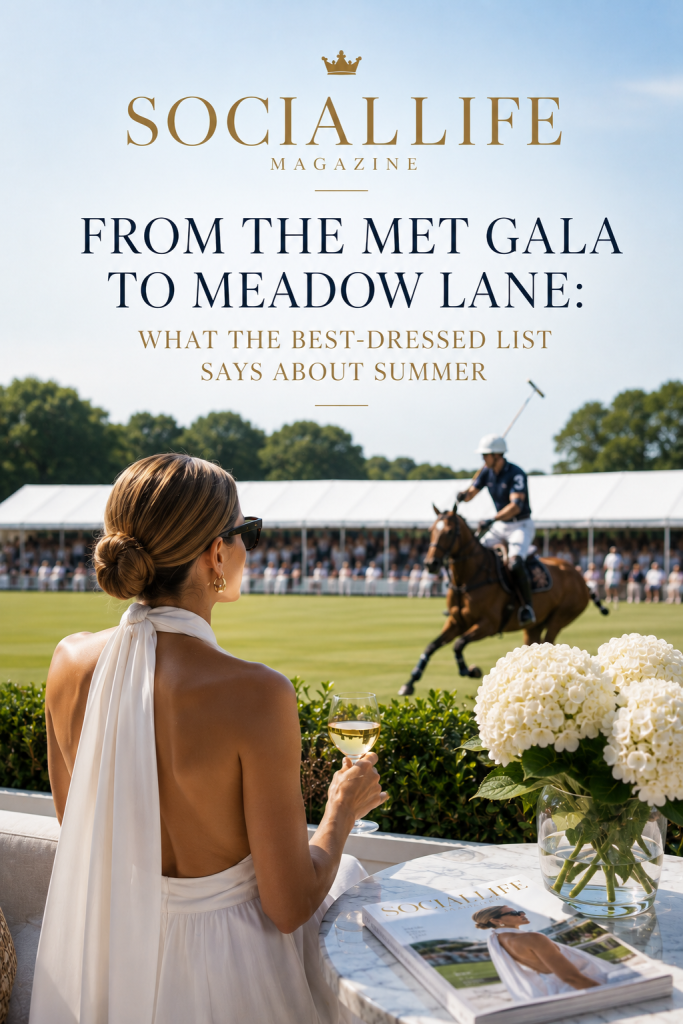
The summer fashion trends Hamptons crowds actually adopt are decided months earlier and miles away, on a red carpet. The Met Gala happens in May. Cannes follows. The award-season looks linger in the feed all spring. By the time June arrives on the East End, the season’s thesis has already been written, stress-tested, and quietly edited down to whatever survives a salt breeze. Reading that edit is the whole skill.
Most people watch the red carpet for the spectacle. The fluent watch it for instructions. They are looking past the gowns nobody could wear to the small signals that will reach Meadow Lane by July, sanded smooth and made livable. The carpet is a casting call. The Hamptons decide who actually gets the part.
The Red Carpet Is the Casting Call
A red carpet is not real life, and everyone knows it. The looks are loud on purpose, built for a camera at thirty feet. Yet inside every impossible gown sits a smaller, quieter idea that can travel.
Take a sheer, heavily beaded moment on a step-and-repeat. Nobody wears that to a clambake. But the underlying idea, a little skin, a little shimmer after dark, migrates into a slip dress at a Water Mill dinner by August. The carpet exaggerates so the rest of us can borrow in moderation.
This is the lens a smart reader brings to every awards season. Ignore the costume and find the thesis. A color that keeps recurring, a neckline that keeps returning, a silhouette three designers showed in the same month. Those repetitions are the real forecast, and they reach the Hamptons long before any trend report admits it.
The Filter Between the Met and Montauk
Between the red carpet and the beach club sits a filter, and the filter is brutal. It strips out anything impractical, anything too try-hard, anything that photographs better than it lives. What comes out the other side is wearable, and wearable is the only currency that spends out here.
The filter has rules. It kills the fussy and keeps the easy. It kills the loud logo and keeps the clean line. Above all it kills anything that looks like it took three hours to assemble, because effortlessness is the regional religion.
So a trend has to pass a test the carpet never imposed. Can you wear it to lunch and still get in a boat? Can it survive sand, wind, and a glass of rosé tipped at golden hour? The looks that answer yes get adopted. The looks that answer no stay trapped on the carpet where they were born.
What Survives the Translation
Certain things always make it through, because they were built to. The translation favors a particular kind of look, and knowing that look is knowing the summer in advance.
Ease survives. A relaxed trouser, a softly tailored linen, a Prada midi skirt in a quiet tone, a dress you could nap in: all of it survives every single time. Quiet color survives, the creams and washed pastels that flatter a tan. Good basics survive, elevated by fabric rather than by flash, because the fluent buyer rewards the upgrade nobody else can see.
Drama survives only in small doses. A single bold accessory, one sculptural earring, a sandal with an interesting heel. The drama has to be portable and singular, never head to toe. One loud note in a quiet song reads as confidence. A whole loud song reads as a tourist who watched too much red carpet and learned the wrong lesson.
The Accessories Travel Fastest
The gowns rarely make the trip, but the small things do, and they do it quickly. An accessory is light enough to cross the county line in a week. A shoe, a bag, a single earring carries the carpet’s idea without the carpet’s drama.
This is why accessory trends move faster than clothing trends. The fluent buyer can adopt a sculptural sandal or a pair of Bottega Veneta sunglasses with no visible logo at all, with almost no risk. If it flops, the loss is small. If it lands, she was early, and early is its own quiet status out here.
For a brand, the accessory is the smartest point of entry, because it is the lowest-commitment way into a new customer’s summer. So lead with the piece she can try without overthinking, the shoe or the bag that whispers this year rather than shouting it. Win the accessory and you have a foot in the door for everything else she buys.
The Looks That Die at the County Line
For every trend that survives, several die at the county line, and watching them die is instructive. The casualties are predictable, and they repeat every June with grim reliability.
The head-to-toe logo look dies first. It reads as a billboard, and the Hamptons do not rent that space. Hyper-trendy silhouettes die next, the ones so of-the-moment they will look dated by Labor Day. Anything that requires constant adjustment dies too, because fussing with a hemline all afternoon broadcasts effort, and effort is the cardinal sin.
Then there is the most common death of all. The look that is simply too much, too new, too obviously expensive, too clearly chosen to be noticed. It arrives shouting, and the room answers with a polite silence that is somehow louder. The county line is not a road. It is a standard, and the standard is unforgiving.
The Color of the Summer Is Chosen in Spring
Every summer has a color, and the color is chosen long before summer arrives. It surfaces first on the spring carpets, then on the runways, then in the feed, until one shade quietly wins. By June the Hamptons have ratified it.
The winning color is never the loudest one. Rather it is the shade that flatters a tan, photographs well in golden light, and plays nicely with cream and navy. A butter yellow, a washed terracotta, a particular soft blue. The carpet auditions a dozen. The East End keeps exactly one.
A brand that calls the color early owns a real edge. Stock the shade the fluent will want before they know they want it, and you meet the demand at the precise moment it forms. Guess wrong and the inventory sits all season. Reading the color forecast off the carpet is not a parlor trick. Instead it is merchandising, and out here it is worth a fortune.
The Beach Club Dress Code, Reverse-Engineered
Run the whole process backward and a usable code appears. The beach club uniform is not random. It is the red carpet, filtered and translated, arriving as something a person can actually live in for a Saturday.
Start with the foundation, a great swimsuit and a cover-up that could pass for a dress. Add the easy linen, the quiet sandal, the one good accessory. Then subtract everything else, because subtraction is the final and hardest step. The fluent look is mostly about what got left at home.
This reverse-engineering is exactly what a brand should study. The customer is not buying a single statement piece. Rather she is assembling a livable summer from a handful of perfect, low-effort components. Sell her those components, the ones that survive the filter, and you have sold her the whole season instead of one forgettable look.
Menswear Has Its Own Carpet
The men’s red carpet runs a quieter parallel, and it translates to the Hamptons just as directly. A tuxedo idea becomes the unstructured linen suit. The patent shoe softens into suede. Everything in the vocabulary relaxes on its way east.
Men watch the carpet less, but the signals reach them anyway, filtered through the same editors and the same feed. A relaxed shoulder shows up at the awards, and by July it is the cut every fluent man wants in his blazer. The translation runs slower for menswear, yet it is just as real.
This is an opening few brands exploit. Menswear out here stays underserved, and the man who wants to dress correctly often does not know where to look. So make the translated piece for him too, the easy jacket, the perfect trouser, the shoe that ages well. The market is hungry, and the competition is mostly asleep.
Why Timing Decides the Winner
In this market, timing beats budget. A trend reaches the Hamptons on a schedule, and the brands that read the schedule win the summer before it starts.
The looks that land in June were chosen on a carpet in May, by editors and stylists watching the same signals. So a brand that waits for the trend to be obvious has already lost, because by then the fluent have moved on. The move is to read the carpet early, place the right piece into the right hands before the season opens, and arrive at the beach club already approved.
This is the Hamptons version of being early to a stock. The reward goes to whoever saw the pattern first and acted before the crowd. Watch the red carpet like a forecast, not a highlight reel, and the summer’s winning look stops being a guess. It becomes something you helped decide.
The Hamptons Has Its Own Carpet Now
Here is the twist the rest of the country misses. The Hamptons no longer just receive the trends. They stage their own carpet now, and the looks that win it travel back the other way.
A summer gala under a tent in Water Mill is a runway. The polo at Bridgehampton is a runway. A charity benefit on the ocean is a runway, photographed and posted and studied by people who were never there. The difference is that these carpets demand wearability, so the looks that triumph are already filtered for real life.
This flips the old direction of influence. A look that lands at Polo Hamptons in July can seed a trend that reaches the feed for everyone else by fall. So the East End has become a source, not only a destination. For a brand, that makes a single well-placed summer look doubly valuable, because it wins the room in person and then travels far past it on a screen.
The Designers Who Win the Summer
Here is the lesson for any ready-to-wear house plotting an East End season. Winning the Hamptons is not about the splashiest campaign. It is about understanding the filter and designing for the far side of it. A house like Prada builds the wearable midi the season actually adopts, while Bottega Veneta wins the accessory race with a logo nobody needs to see.
The designers who win make the translated piece on purpose. They take the red carpet idea and build the wearable version before anyone asks, so the customer finds it waiting when she needs it. They keep the branding quiet, the fabric exceptional, the silhouette easy. And then they place it where the fluent gather and let the recommendation spread.
That word of mouth is the prize. A dress seen on the right back at the right dinner outperforms a season of paid posts, because it arrives as a friend’s endorsement instead of an ad. The designers who grasp this own the summer quietly and completely. We spend our days making exactly these introductions, between the brands that get it and the rooms worth getting into.
Where The Conversation Continues
The carpet sets the thesis, but the Hamptons write the final draft. To read the whole language, start with our pillar on the Hamptons summer style codes money can’t fake, then go deeper on decoding quiet luxury in the Hamptons and the watch that says Hamptons without saying a word. This summer’s winning look is already being decided. The only question is whether your house is the one that helped decide it, or the one still waiting to find out.
Author

Written by
Recent Posts
Best House Cleaning Services in Alpharetta, GA
The Ultimate Guide to Moving into New York’s Most Exclusive Neighborhoods

Medical Malpractice Cases Chicago: Understanding Your Legal Rights

Legal Rights and Remedies Following Sexual Assault by a Police Officer
Choosing the Best Drunk Driving Victim Lawyer for Justice for the Injured
Categories
- Art
- Articles
- Business of Luxury
- Celebrities
- Culture
- Entertainment
- Events
- Faces of Summer 2026
- Fashion
- Fashion & Style
- Featured
- Finance
- Food, Spirits, Wine
- Hamptons
- Hamptons Celebrities
- Health
- Health & Beauty
- Lifestyle
- Luxury Lifestyle
- Press
- Profiles
- Real Estate
- Technology
- The Chronicles
- Travel
- Uncategorized
- Weddings