
The Granddaughter Who Did Not Want the Job
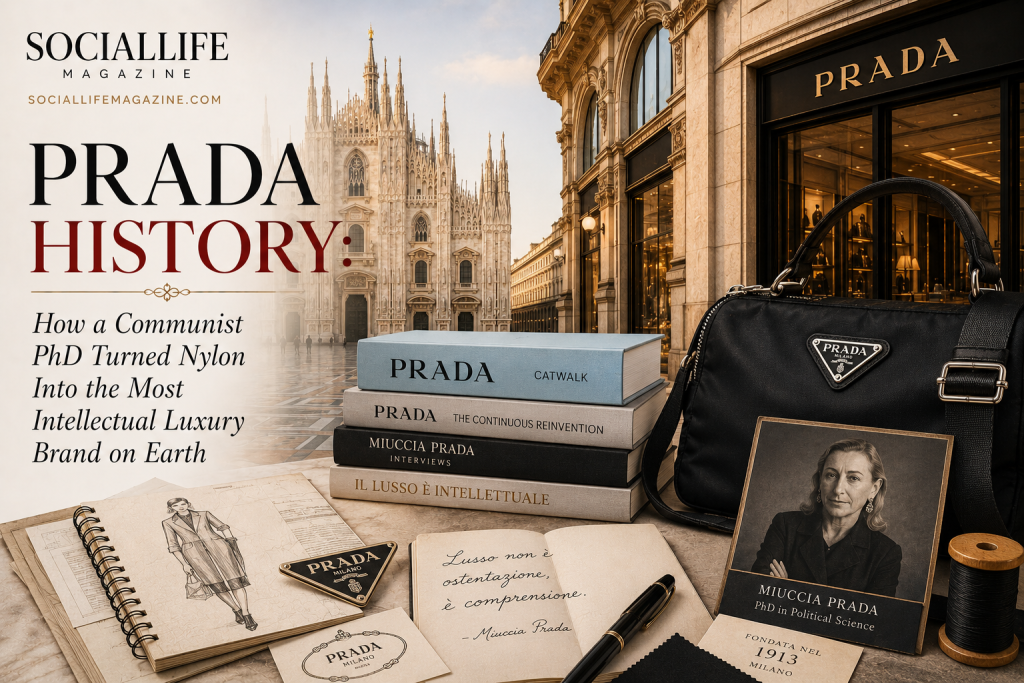
In 1978, a woman with a PhD in political science, five years of mime training at the Piccolo Teatro in Milan, and a membership card from the Italian Communist Party inherited a leather goods shop that sold steamer trunks to aristocrats. She did not want it. Fashion struck her as frivolous, beneath the political commitments she had cultivated through the 1970s. But she took the job anyway, and within a decade she had redefined what luxury meant, what it looked like, and who it was for. Her name was Miuccia Prada, and the Prada history she wrote from that point forward is the most intellectually ambitious project in modern fashion.
The company she inherited had been founded in 1913 by her grandfather Mario Prada and his brother Martino. Their shop, Fratelli Prada, occupied a prime location inside the Galleria Vittorio Emanuele II, Milan’s glass-roofed arcade and the spiritual center of Italian fashion. Mario sold imported English leather goods, Hartman luggage from America, silver from London, and crystal accessories. By 1919, the shop had earned an appointment as Official Supplier to the Italian Royal Household, incorporating the House of Savoy’s coat of arms into its logo.
Mario Prada believed women had no place in business. His son had no interest in the company. So it passed to Mario’s daughter Luisa, who ran it for twenty years before passing it to Miuccia. The irony is architecturally perfect. A man who excluded women from commerce created a company that would be saved, reinvented, and transformed into a €5.7 billion empire by two generations of women he never anticipated.
The Nylon Revolution
Miuccia Prada’s first significant design decision was also her most radical. In 1979, she began making handbags and backpacks from Pocono nylon, a tough, waterproof fabric used in military tents and parachutes. The fashion industry, which had spent decades establishing leather as the material of luxury, found the idea absurd. Nylon was industrial. It was cheap. It was what soldiers used, not socialites.
That was precisely the point. Miuccia Prada was not interested in selling status through expensive materials. She was interested in selling intelligence through unexpected materials. Her nylon bags, priced at $450 (more than many leather alternatives), proposed a simple question: what if luxury was defined by the idea behind the object rather than the cost of the raw material? Her answer took six years to arrive. Initial sales were modest until Miuccia redesigned the bags in 1985 with a gold chain strap and the triangular enamel logo that would become the brand’s trademark.
The Triangle That Changed Everything
That triangular logo, derived from the brand’s royal warrant heritage, transformed the nylon bag from a curiosity into a status symbol. By the late 1980s, the Prada nylon backpack was the accessory of choice for fashion insiders, art world figures, and the particular kind of wealthy woman who wanted to signal taste without signaling wealth. The bag was anti-status status. It communicated that its owner was sophisticated enough to reject the obvious (a Chanel quilted flap, a Louis Vuitton monogram) in favor of something that required explanation.
This is the core intellectual proposition of Prada history. Where other luxury brands make recognition effortless (you see the monogram, you know the brand), Prada makes recognition an act of knowledge. You have to know what the triangle means. Understanding that nylon, in Prada’s hands, is more expensive than leather is a prerequisite. Literacy in the codes is the entry requirement. That literacy requirement is the brand’s moat, and it has protected Prada’s pricing power for four decades.
Ready-to-Wear and the Ugly Beautiful
In 1988, Miuccia Prada showed her first ready-to-wear collection. Milan Fashion Week did not know what to do with it. The clothes were simple, almost severe. Muted colors. Clean lines. Fabrics that looked unremarkable until you touched them. No sequins, no shoulder pads, no sex appeal in any conventional sense. The collection baffled editors who had spent the decade covering Versace’s maximalism and Armani’s power shoulders.
New York understood before Milan did. American editors and buyers recognized that Prada’s minimalism was not the absence of design. It was design with the scaffolding removed. Every garment was precisely cut, meticulously finished, and priced to reflect the labor that went into achieving simplicity. Simple, it turns out, is the most expensive thing to get right.
The Ugly Chic Proposition
By the mid-1990s, Miuccia had developed her signature move: making conventionally ugly things beautiful through context and confidence. Her 1996 collection used avocado greens, muddy browns, and prints borrowed from 1950s suburban tablecloths. Fashion critics called it “ugly chic.” Consumers who understood the reference bought it immediately. Consumers who did not understand the reference were not the target audience.
This willingness to alienate is Prada’s competitive advantage and its commercial limitation. Gucci under Alessandro Michele generated over €10 billion by being as inclusive and recognizable as possible. Prada has never pursued that scale. The brand’s aesthetic demands that its customer possess a certain cultural vocabulary. That requirement caps the addressable market but creates intense loyalty among those who qualify. A Prada customer does not switch to Dior when the seasons change. Switching would be an admission that fashion, not intellect, is driving the purchase.
Patrizio Bertelli and the Business Engine
No account of Prada history is complete without Patrizio Bertelli, the man Miuccia met in 1977 and married in 1989. Bertelli had started his own leather goods business at age 24. Where Miuccia was cerebral, political, and instinctively anti-commercial, Bertelli was operational, aggressive, and commercially ruthless. Together they formed a partnership where creative and commercial authority were genuinely equal. Miuccia designed. Bertelli built the business around her designs.
Bertelli’s contribution was structural. He brought manufacturing in-house, giving Prada control over its supply chain at a time when most luxury brands outsourced production. Wholesale accounts with upscale department stores worldwide followed. He opened retail locations in every major luxury market. And he pursued an acquisition strategy that, for a period in the late 1990s and early 2000s, attempted to build Prada into a conglomerate that could rival LVMH.
The Empire That Almost Was
Between 1999 and 2003, Prada acquired stakes in Jil Sander, Helmut Lang, Church’s (the English shoemaker), Azzedine Alaïa, and a significant share of Fendi. The strategy was to build an Italian luxury group that could compete with the French conglomerates on their own terms. It almost worked. But the acquisitions strained Prada’s balance sheet. The company repeatedly delayed its IPO (originally planned for 2001, eventually completed in Hong Kong in 2011). Prada sold its Fendi stake to LVMH for $265 million and divested Jil Sander and Helmut Lang at losses.
The failed conglomerate experiment taught Bertelli a lesson that shaped the next two decades. Prada would grow, but it would grow organically, through its own brands (Prada and Miu Miu) rather than through acquisitions. That discipline held until December 2025, when Prada acquired Versace from Capri Holdings. The Versace deal, twenty years after the failed empire-building phase, suggests that Bertelli’s ambition to build an Italian luxury conglomerate never died. It just waited for the right moment.
Miu Miu: The Daughter Label
In 1993, Miuccia launched Miu Miu, named after her childhood nickname. If Prada was the mother (intellectual, restrained, challenging), Miu Miu was the daughter (playful, youthful, instinctive). The brand targeted a younger consumer who wanted the Prada sensibility at a lower price point and with more color, more pattern, and more overt fun.
For most of its existence, Miu Miu operated in Prada’s shadow. It was profitable but not culturally dominant. That changed spectacularly in the 2020s. Miu Miu’s revenue surged 35 percent in 2025, making it the fastest-growing luxury brand on earth by percentage. Its micro-mini skirts, low-rise waistbands, and deconstructed preppy aesthetic captivated Gen-Z consumers who found Prada too austere and Gucci too loud.
The Growth Engine
Miu Miu’s acceleration is strategically significant for the Italian fashion houses because it demonstrates that a legacy luxury company can capture younger demographics without diluting its parent brand. Miuccia designs both Prada and Miu Miu personally, ensuring that the two labels share a creative DNA while addressing different consumer registers. Prada serves the woman who reads Proust. Miu Miu serves the woman who quotes Proust on TikTok. Both customers are welcome. Neither is confused about which brand is for her.
Prada Group posted €5.7 billion in revenue for 2025, up 8 percent year-over-year. Net profit reached €852 million. The group ranked 21st among global fashion companies, up from 31st in 2019. Much of that ascent is attributable to Miu Miu, but the parent brand also demonstrated resilience in a luxury market where competitors like Gucci (down 25 percent in Q1 2025) were contracting sharply.
The Versace Bet
In December 2025, Prada Group completed its acquisition of Versace from Capri Holdings (the American parent of Michael Kors and Jimmy Choo). Versace generated €684 million in revenue but was still operating at a loss under American management. For Bertelli, the deal was both commercial and patriotic. An Italian brand, sold to an American company in 2018, was coming home. The fashion industry read the acquisition as a statement: Prada Group intended to become Italy’s answer to LVMH and Kering, a luxury conglomerate built on Italian soil and governed by Italian ownership.
Whether Prada can successfully integrate Versace remains an open question. The two brands could not be more different in aesthetic DNA. Prada whispers intellectual credibility. Versace screams Mediterranean glamour. Managing both sensibilities within a single corporate structure will test Bertelli’s operational skills and Miuccia’s willingness to oversee a house whose design philosophy is the opposite of everything she has spent forty years building.
The Succession Question
Miuccia Prada is 77. Patrizio Bertelli is 78. Together they control a company that has never operated without them. In 2023, they appointed Andrea Guerra (former CEO of Luxottica) as group CEO, a clear signal that professional management would eventually replace family control at the executive level. Their elder son, Lorenzo Bertelli, a former rally car driver who joined the company in his twenties, now serves as group marketing director and is widely regarded as the heir apparent on the brand side.
Unlike the Gucci family, which destroyed itself through internal warfare, and the Armani empire, which has no succession plan at all, Prada appears to be managing its generational transition with characteristic discipline. Guerra runs operations. Lorenzo learns the brand. Miuccia keeps designing. The plan is methodical, which is very Prada. Whether it survives contact with the reality of a post-founder luxury house is the question that every Italian fashion dynasty eventually faces.
Fondazione Prada and the Art of Credibility
In 1993, the same year Miu Miu launched, Miuccia and Bertelli established Fondazione Prada, a contemporary art institution. Originally a traveling exhibition program, it became permanent in 2015 when the couple opened a 19,000-square-meter campus in a former gin distillery in Milan’s Largo Isarco neighborhood. The architect was Rem Koolhaas, who had also designed Prada’s “epicenter” stores in New York (SoHo, 2001) and Los Angeles (Beverly Hills, 2004).
Fondazione Prada is not a vanity project. It is a brand-building machine disguised as cultural philanthropy. Every exhibition (Damien Hirst, Jeff Koons, Wes Anderson’s “Bar Luce” café) reinforces the idea that Prada operates in the same intellectual register as contemporary art, architecture, and cinema. When a woman carries a Prada bag, she is not just carrying a fashion accessory. She is carrying an association with Koolhaas, Hirst, and the entire apparatus of contemporary high culture. That association justifies prices that material cost alone cannot.
The Raf Simons Partnership
In 2020, Prada made a move that no other luxury house had attempted. Rather than hiring Raf Simons to replace Miuccia as creative director, the brand named him co-creative director, sharing equal responsibility with the founder. The partnership produced collections that combined Miuccia’s intellectual provocation with Simons’ Belgian minimalism and youth culture references. Their runway shows became dialogues rather than monologues, with each designer contributing distinct elements that produced something neither could have created alone.
Simons departed in 2025 after five years, leaving Miuccia once again as sole creative director at age 77. Whether the co-creative director model was a success depends on the metric. Critically, the Prada-Simons collections were among the most discussed in fashion. Commercially, Prada’s revenue grew consistently during the partnership. Structurally, it proved that luxury creative direction does not require a single auteur. Prada can function as a platform for collaboration, which may prove essential as Miuccia begins planning for the next chapter of the brand’s creative leadership.
The East End Intellectual
Prada operates a seasonal boutique on Newtown Lane in East Hampton. It sits on the same luxury corridor as Gucci, Zimmermann, and Veronica Beard, but it attracts a different consumer. Where Gucci’s Newtown Lane store buzzes with logo-seeking foot traffic, Prada’s location is quieter, more deliberate, more curated. The consumer who walks in knows what she is looking for. She does not need the triangle explained to her.
In the Hamptons social landscape, Prada communicates something specific. It says the wearer has moved beyond the need for recognition. A Prada nylon bag at a benefit dinner is a refusal to compete on the same terms as the woman carrying a Chanel Classic Flap or a Dior Book Tote. Both of those bags announce themselves. Prada whispers. The whisper is deliberate, and it is very expensive.
Where the Conversation Continues
Prada history is the story of what happens when the person least likely to run a fashion brand ends up running one of the most influential fashion brands in the world. Miuccia Prada did not study design. Her degrees were in political science and mime. The family business held no appeal until her mother’s request made refusal impossible. Nylon was never meant to be luxury. She made it luxury anyway. At 77, she still designs every collection personally, still challenges the industry’s assumptions about beauty, and still runs a company that just posted €5.7 billion in revenue and bought Versace as an afternoon transaction. The Communist who made capitalism look smarter than it has any right to be.
Social Life Magazine covers the brands, families, and power plays that shape luxury culture from Manhattan to Montauk. Reach our editorial team to discuss features, partnerships, or story leads. Explore Polo Hamptons 2026 for the summer’s defining luxury event. Subscribe to the print edition for coverage delivered to your door. Join the email list for weekly insider intelligence. And if this piece sharpened your understanding of how luxury actually works, a $5 contribution keeps independent journalism alive.
Author

Written by
Recent Posts

Planning an Arizona Road Trip? Practical Details to Handle Before You Leave
Short Homecoming Dresses That Feel Polished, Not Overdone
Men’s Health After 40: Important Changes to Pay Attention To
What You Need to Know About Spray Tanning

Simple Ways to Upgrade Your Summer Drink Routine
Categories
- Art
- Articles
- Business of Luxury
- Celebrities
- Culture
- Entertainment
- Events
- Faces of Summer 2026
- Fashion
- Fashion & Style
- Featured
- Finance
- Food, Spirits, Wine
- Hamptons
- Hamptons Celebrities
- Health
- Health & Beauty
- Lifestyle
- Luxury Lifestyle
- Press
- Profiles
- Real Estate
- Technology
- The Chronicles
- Travel
- Uncategorized
- Weddings