
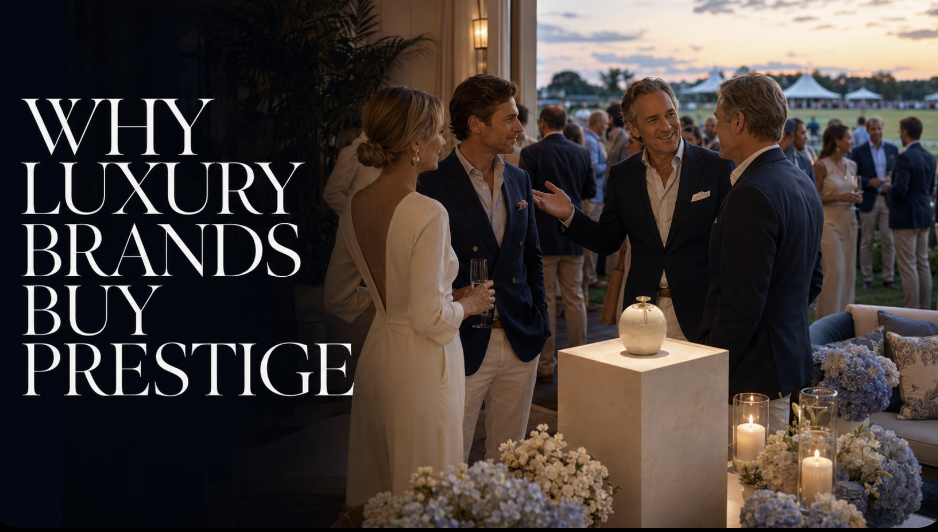
Picture the media plan every luxury CMO sees in March. Option one buys two million impressions across the usual platforms. Option two buys one lawn in Bridgehampton, a cabana, and a page in a magazine. The spreadsheet says take option one. Yet the corner office keeps signing option two, and the spreadsheet never understands why. Option two also keeps getting renewed, which is the tell. So here is the answer, spelled out: luxury brands buy prestige, not reach, because prestige is the one thing their customers cannot already buy for themselves.
The logic is invisible to performance marketing, but it is not soft. It is the hardest math in the category. A person who can afford the product is not the target. The target is a person who can afford it and needs a reason to choose yours. In fact, reasons at this altitude are social. That is the entire business case, and the rest of this piece unpacks it.
The Problem With Impressions
Impressions were built for products that win by being everywhere. Luxury wins by being somewhere specific. A campaign that reaches two million people mostly reaches people who will never buy, and the ones who might buy discount whatever they see advertised too often. Ubiquity is the category’s poison, because scarcity is the product underneath every product. Luxury CFOs hate this argument right up until the third quarter proves it.
The numbers make it worse, not better. Digital reach gets cheaper every year, so cheapness is now the signal it sends. By contrast, the expensive room keeps its meaning precisely because it cannot scale. We run the full teardown in the death of impressions, but the short version fits in a sentence. Reach tells the market you need customers, while presence tells the market you choose them. Even the platforms know it, which is why their own launch parties are invitation-only.
What Prestige Actually Is
Prestige is recognition granted by someone whose judgment carries weight. The definition matters, because it names the one thing a brand cannot manufacture alone. You can declare quality, and you can declare heritage. Recognition, though, has to arrive from outside, or it is just advertising with better fonts. Put plainly, luxury brands buy prestige because it is the only currency their customers respect more than money.
The full map lives in the economy of prestige, our field guide to how status actually trades out east. The short version: four currencies circulate here, and money is the weakest one alone. Fluency, access, and recognition do the real work, especially for brands. A sponsorship is ultimately a currency exchange, which is why the smart houses read the four currencies of status before wiring anything.
The Borrowing Mechanism
Here is the mechanism underneath every luxury sponsorship that works. Old institutions accumulate meaning the way estates accumulate hedges, slowly and in public. A brand cannot grow that meaning on its own timeline. It can, however, rent it, and rented well, the symbolism eventually stops feeling rented. Attach the name to the right field, and generations of accumulated symbolism transfer by association.
Polo is the cleanest example in the portfolio, because polo means aristocracy, land, and lineage. Golf means a good career, while polo means a good bloodline, and no media buy closes that gap. So BMW is not sponsoring horses in Bridgehampton. It is borrowing what horses mean and parking a sedan next to it. The full history is in why polo beats golf, including which symbols still transfer and which wore out.
The Persona Test
Different houses buy prestige to solve different problems, and naming yours sharpens everything downstream. The medspa founder is buying legitimacy, because premium pricing needs a story that outranks a discount. For her, editorial does the heavy lifting, since a feature justifies the number on the menu. The event is proof of company, while the page is proof of standing.
The fashion or design house is buying residency. East End relevance cannot be claimed from a showroom in the city, so the brand needs to be seen living here, summer after summer. Events and rooms matter most, with editorial as the receipt. Notably, residency is the most expensive problem to fake, because locals can smell a single-summer brand from the far side of the field.
The spirits or hospitality brand is buying ritual. It wins when a specific pour or property becomes what the season simply does, and only repetition inside the right rooms builds that. Three problems, one market. In every case, luxury brands buy prestige because the alternative is explaining themselves, and explaining is the one thing this audience never rewards.
Where Prestige Is Sold
Prestige trades through three channels out east, and only three. Editorial confers it, events stage it, and rooms compound it. Everything a partnerships deck offers you is one of these three wearing different packaging. Judge every proposal by which channel it opens, because a proposal that opens none of them is decoration.
The next three sections take the channels in order, with the honest mechanics of each. Notably, the brands that win entire summers buy all three at once, but we will get to bundling.
The Editorial Channel
Anyone with a card on file can buy an ad tonight. Coverage is different, because coverage is a judgment made by an institution with something to lose. That asymmetry is the entire value. A brand praising itself is noise. A magazine with a 23-year archive putting you in the record is evidence.
Editorial also outlasts everything else on this list. The party ends and the banner comes down, yet the page keeps working, in archives, in searches, on coffee tables along Further Lane. Print is the settlement layer of this whole market. For the skeptics, one test settles it: nobody has ever framed a banner ad. The complete argument, with the math, lives in editorial vs. advertising.
The Event Channel
Events are where prestige gets staged in front of witnesses, and witnesses are the point. Recognition requires an audience of the right people, ideally photographed. A July afternoon at Polo Hamptons supplies a few thousand of them, pre-curated, with the cameras already working. By contrast, a festival crowd of the wrong hundred thousand photographs beautifully and converts nothing.
Inside the event, the cabana is the actual product. It is social architecture: semi-private territory that manufactures introductions and then becomes a landmark. People remember where they met, and the memory keeps a sponsor’s name attached to it. Hästens understood this early, which is why guests still narrate the field cabana by cabana. The floor plan logic is in the cabana as a status machine.
The Room Channel
The third channel is the private room: the estate dinner, the sharehouse activation, the fifteen-person tasting. Rooms trade lower reach for total conversion, because everyone present was chosen. A brand that hosts inherits the host’s standing for a night, and standing transfers faster over dinner than over media. The Sag Harbor dinner that seats twelve routinely outperforms the gala that seats four hundred. Léoube pours at the right tables for exactly this reason.
This is the channel most marketing plans miss entirely, since no vendor sells it off a rate card. It has to be built through property, relationships, and a host who knows the list. The mechanics live in the Hamptons house as social infrastructure. Founders run the same play in reverse, and converting success into status shows how.
The Bundle Rule
Bought separately, the three channels underperform, and the reason is structural. An event without coverage evaporates by Tuesday. Coverage without presence reads as distant admiration. A room without documentation helps the twelve people in it and nobody else. Each channel supplies what the others lack, so the unit of purchase should be the bundle, never the piece. This is also why luxury brands buy prestige in seasons rather than dates.
Run the flywheel instead of the line item. The event creates the moment, then editorial makes the moment permanent, and the record makes next year’s room easier to fill. After one full cycle, a brand stops renting prestige and starts holding some. That compounding is what a retainer actually buys, and it is why the smart houses sign before Memorial Day.
A Season, Modeled
Here is how one cycle runs when it is built correctly. In June, the brand appears in the issue, positioned inside a story rather than beside one. By July, the cabana stands on the field at Polo Hamptons, and the introductions start compounding. In August, an estate dinner converts the best twenty conversations into relationships. After Labor Day, the recap enters the archive, and the archive works the off-season. Meanwhile, the 82,000-subscriber list carries each beat to the readers who could not attend.
Nothing in that sequence is exotic, yet almost nobody runs it whole. Most budgets buy one piece, measure it with the wrong ruler, and conclude the market is soft. The market is not soft. It simply pays out to sequences, because prestige is a stock, not a flow. One season builds the position, and the second season is when the position starts paying. Specifically, that is when the sales team stops cold-calling and starts returning calls.
How to Buy It Well
Before signing anything this season, ask five questions. Who exactly is in the room, named, not modeled? What institution documents the moment, and where does that record live? Which symbols is the property lending, and are they still transferring? What does category exclusivity cost, and who inherits it if you pass? Finally, what happens in year two, because prestige compounds or it decays. Ask them in writing, because the answers age interestingly.
Notice what is missing from the list: impressions, followers, and CPM. Those metrics measure distribution, but prestige is not distributed. It is conferred, staged, and compounded, specifically in that order. When luxury brands buy prestige well, they buy the order, not the exposure. A partner who leads with reach is politely selling you the wrong product.
The Measurement Problem
Prestige resists dashboards, but it is not unmeasurable. The honest indicators are behavioral. Watch inbound quality: who calls after the issue, and whether they open with your name or a discount question. Price tolerance is the second gauge, because prestige shows up as the absence of negotiation. Then watch invitations, since being asked to host, judge, or pour is the market marking you up.
Equally telling is who mentions you unprompted in a room you did not pay for. That is the metric with no line item and the most value. None of these fit a monthly report neatly, and that is the point. The numbers that matter here move quarterly and compound annually. A house demanding weekly attribution is asking prestige to behave like performance media. It will not, and forcing the frame just buys the wrong things faster.
What Saying No Costs
Category exclusivity is the quiet clause that makes this market unforgiving. Every field has one automaker, one champagne, one bed, one rosé. When a brand passes, the slot does not sit empty. A competitor takes it, enters the record, and starts compounding a year ahead. In this market, no is not neutral. No is a donation to the brand you like least. Exclusivity also explains the calendar pressure, because the deadline was never ours to set. It belongs to whoever calls first.
The July issue makes this concrete every summer. Somebody’s name is on the tent, and everyone inside the tent notices whose. Eventually the archive remembers it too, which is the part that stings.
Where The Conversation Continues
Social Life builds these bundles for a living: the page, the lawn, and the room, priced as one position. Categories are exclusive by design, and several are already spoken for this season. If your house is deciding where prestige comes from, start with the pillar, then ask the partnerships desk what remains open. The bundle conversation takes twenty minutes. Your competitor set has read this far too. That is rather the point.
Author

Written by
Recent Posts
Jetsetter Style: Castello del Sole

The First Decision After a Collision Can Be the Most Important One
Two Weeks in Rome and Beyond: Turkish Airlines Itineraries from Boston, Chicago and Onward to India

Top 10 Hair Transplant Clinics in Turkey 2026
Artist Alley to Online Store: How Convention Artists Can Keep Selling After the Event
Categories
- Art
- Articles
- Business of Luxury
- Celebrities
- Culture
- Entertainment
- Events
- Faces of Summer 2026
- Fashion
- Fashion & Style
- Featured
- Finance
- Food, Spirits, Wine
- Hamptons
- Hamptons Celebrities
- Health
- Health & Beauty
- Lifestyle
- Luxury Lifestyle
- Press
- Profiles
- Real Estate
- Technology
- The Chronicles
- Travel
- Uncategorized
- Weddings