
Quick Summary
Nox Peptides has set a new standard for biomedical research in Canada, offering research-grade peptide derivatives backed by thorough third-party purity verification. Using double-HPLC/LC-MS purity checks with domestic cold chain transportation, this brand eliminates any risk of cross-border logistics and provides consistent batch-to-batch sequence integrity for all research facilities nationwide.
The Analytical Standard: Why Compound Purity Drives Research Integrity
In today’s modern life science world, small molecules and peptides are totally dependent on molecular accuracy. The purity of a synthesized peptide chain defines the accuracy of the sequence. In solid-phase peptide synthesis (SPPS), a small amount of impurity through side reactions gives truncated, deletion sequences, or protecting group residues. When researchers source Peptides Canada institutions trust, eliminating these hidden impurities becomes a paramount prerequisite for experimental success.
When non-target impurities enter an assay, they compete with the target sequence for receptor binding sites or alter the target’s physical properties in solution. For example, a deletion sequence lacking a single lipophilic amino acid may fail to fold correctly, while residual trifluoroacetic acid (TFA) salts can exert unintended cytotoxic effects in vitro.
| Impurity Type | Origin in Synthesis | Experimental Consequence |
| Truncated Sequences | Incomplete coupling steps during SPPS | Competitive inhibition; false-negative binding assays |
| Deletion Peptides | Failure of amino acid addition | Altered tertiary structure and reduced target affinity |
| Residual TFA/Solvents | Cleavage and purification process | Unintended cellular toxicity; shifted pH balance |
| Diastereomers | Enantiomeric racemization | Altered biological activity and enzymatic stability |
Unpacking the Dual-Testing Protocol: HPLC and Mass Spectrometry
Confirming the purity of research-grade compounds demands thoroughness beyond superficial quality tests. A quality assurance protocol for research peptides requires a double-checking process involving both High-Performance Liquid Chromatography (HPLC) and Liquid Chromatography-Mass Spectrometry (LC-MS) analysis.
1. High-Performance Liquid Chromatography (HPLC)
HPLC technique detects the composition of the sample by separating the desired peptide from the synthesis by-products and degradant peaks. As the sample passes through the reverse-phase column under high pressure, different chemical species move at different speeds depending on their hydrophobic interactions. The absorbance detection at wavelengths of 214 or 220 nm (where peptide bonds have maximum absorption) produces an elution profile. The Area Under the Curve (AUC) of the main peak provides the percentage purity of the target molecule relative to all UV-absorbing molecules.
2. Mass Spectrometry (MS)
While HPLC allows one to detect only the presence of a single peak, MS allows detection of whether the peak corresponds to the desired peptide by calculating the mass-to-charge ratio (m/z) of the ionized sample. The molecular weight of the compound should match the theoretical monoisotopic or average molecular mass to define the identity of the compound.
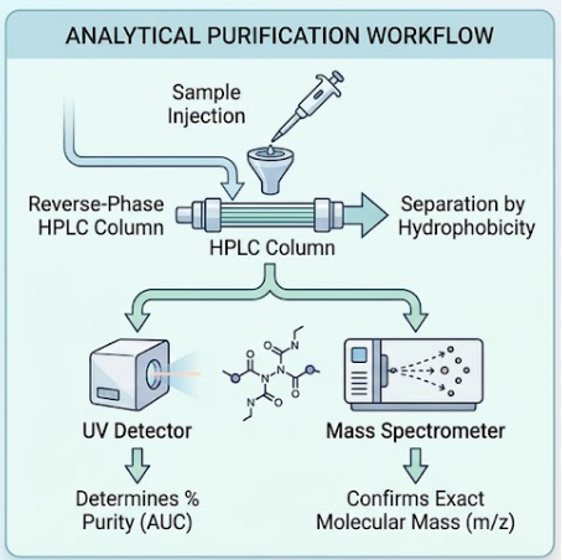
Through this rigorous two-tiered testing framework, Nox Peptides delivers compounds accompanied by batch-specific Certificates of Analysis (COAs), verifying that every vial meets strict purity thresholds (typically ).
Domestic Cold-Chain Integrity vs. Cross-Border Sourcing
Importing synthetic peptides internationally involves various risks of compromising the stability of the compounds. Lyophilized peptides can be affected by thermal degradation, moisture uptake, and mechanical agitation due to prolonged transit time. Cross-border shipments usually experience delays at Canada Border Services Agency (CBSA) checkpoints, where packages may lie under ambient or elevated temperatures for days.
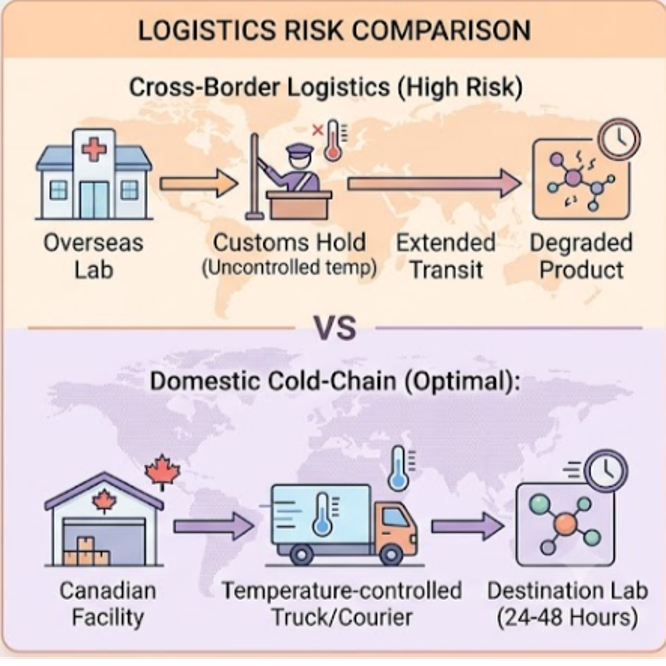
Working with a dedicated domestic supplier ensures that Peptides Canada laboratories avoid customs barriers. Domestic fulfillment ensures products remain within strict temperature ranges from the storage vault directly to the benchtop.
- Prevention of Hydrolysis: Lyophilized peptides, experiencing temperature fluctuations, take up moisture, which results in accelerated hydrolysis and peptide chain
- Preservation of Secondary Structure: Heat exposure throughout the period of long transit disrupts the delicate disulfide bridges and secondary structure of the compounds.
- Rapid Delivery: Local delivery of products in Canada cuts down the transit time to 24-48 hours, ensuring the stability of the compound.
Through strict control of its domestic distribution chain, Nox Peptides ensures that the temperature-sensitive peptides arrive with their chemical structure and biological activity intact.
Comparative Benchmark: Standard Industry Practices vs. NØX Standards
The difference between basic market standards and research-grade quality control directly impacts scientific outcome reliability.
| Feature / Metric | Industry Baseline | NØX Peptides Standard |
| Purity Verification | Single-run HPLC or theoretical estimates | Dual-stage HPLC + LC-MS for every batch |
| Documentation | Generic or non-batch-specific COAs | Fully traceable, batch-specific COAs |
| Counter-Ion Content | High residual TFA levels | TFA removal and counter-ion optimization |
| Shipping & Logistics | Standard cross-border postal shipping | Dedicated domestic cold-chain packaging |
| Net Peptide Content | Not routinely measured | Calculated to ensure precise mass dosing |
Frequently Asked Questions
How does net peptide content differ from peptide purity percentage?
Peptide purity is a measure of how much of the desired peptide sequence is present compared to sequence impurities. Net peptide content is a measure of how much the peptide weighs relative to non-peptide materials such as counter ions (TFA, acetate) and moisture. Both need to be known in order to calculate correct molar concentrations of the material.
Why is third-party testing required for the synthesized compounds?
The reason for third-party analysis is to have an objective analysis of the purity and identity of the compound. Testing is objective because it is not done by the manufacturer, and it confirms that the provided COA corresponds to the particular lot that is received at the research laboratory.
What is the best method for storing lyophilized peptides?
The lyophilized peptides should be stored either dried or desiccated and away from light. Before reconstitution, vials should be warmed to room temperature in order to avoid formation of condensation.
How does Nox Peptides ensure batch-to-batch consistency?
Every synthesis lot undergoes standardized solid-phase synthesis protocols followed by identical HPLC/LC-MS testing procedures. Lots that fall below the designated purity baseline () are rejected before distribution.
Conclusion: Eliminating Variables in Biochemical Research
Scientific development requires reproducibility. Minimizing experimental variables allows scientists to accurately identify cause-and-effect relationships. The integration of analysis testing procedures, batch clarity, and local cold chain distribution systems enables lab personnel to devote themselves to collecting accurate data without being concerned about the quality of the reagents. Prioritizing verifiable purity safeguards research investments and advances scientific discovery across Canadian research institutions.
Author

Written by
Recent Posts

The Greek Islands, the Luxurious Way: Villa Escapes for Couples

Where Golf Meets the Good Life: Scotland’s Most Exclusive Golf Escapes

Luxury in the French Alps: Family Ski Resorts Worth the Journey
How to Improve Security at Large Social Events

Examining Truck Position After a Crash
Categories
- Art
- Articles
- Business of Luxury
- Celebrities
- Culture
- Entertainment
- Events
- Faces of Summer 2026
- Fashion
- Fashion & Style
- Featured
- Finance
- Food, Spirits, Wine
- Hamptons
- Hamptons Celebrities
- Health
- Health & Beauty
- Lifestyle
- Luxury Lifestyle
- Press
- Profiles
- Real Estate
- Technology
- The Chronicles
- Travel
- Uncategorized
- Weddings