
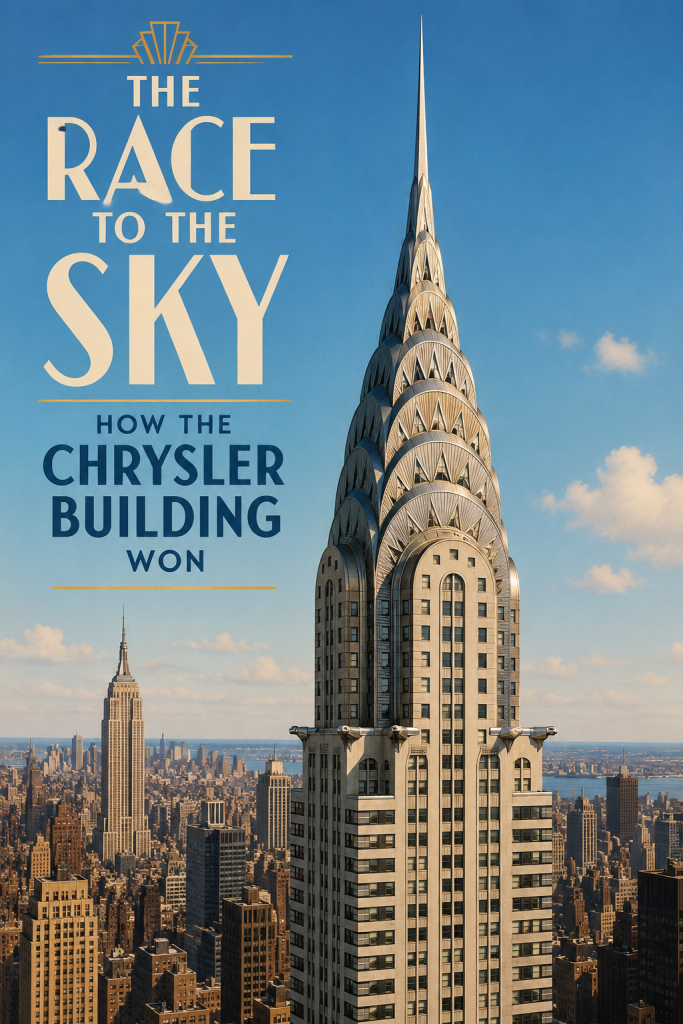
On a quiet morning in October 1929, a 185-foot spire rose out of the top of the Chrysler Building in about ninety minutes, and a former friend lost a race he thought he had already won. The trick was secret. The stakes were the title of tallest building on earth. And the timing, as it turned out, could not have been crueler, because the stock market began its collapse within days.
This is the story of how the cathedral of Art Deco got built, and of the two men who turned a skyline into a duel. It is also a perfect lesson in a truth the East End understands well. Ambition is a contact sport, and the winner is usually the one willing to hide the last card.
Two Partners, One Skyline
William Van Alen and H. Craig Severance had been partners. Then they split, and the split was bitter. By the late 1920s each man had a tower rising in Manhattan, and each wanted the same crown.
Van Alen drew the Chrysler Building for the car magnate Walter P. Chrysler. Severance, meanwhile, designed 40 Wall Street downtown. Both projects raced upward through 1929, and the press loved every inch of it. Reporters called it the race to the sky, and the city watched the numbers climb like a stock ticker.
Walter Chrysler did not want a polite office block. He wanted a monument to himself and to the machine that made him rich. So Van Alen gave the building automobile bones. Stylized hubcaps, radiator caps, and steel eagle gargoyles still jut from the upper floors, because the tower is, at heart, a 1,046-foot advertisement.
The Secret Spire
Severance believed he had won. His 40 Wall Street topped out near 925 feet in late 1929, and that looked like the finish line. But Van Alen had a card he never showed.
Inside the Chrysler’s crown, hidden from the street and from his rival, Van Alen had his crews assemble a slender spire in sections. When the moment came, they hoisted the whole thing up through the top of the building and bolted it into place. In roughly an hour and a half, the Chrysler shot past 40 Wall Street and kept going.
The Chrysler Building claimed the title of world’s tallest in May 1930. It also dethroned the Eiffel Tower as the tallest structure anywhere. For a brief, glittering moment, a New York office tower stood at the top of the world.
The Crown That Still Defines the Skyline
That crown is the part everyone knows. Seven arched tiers of stainless steel, fanned with triangular windows, catch the light like a sunburst frozen mid-explosion. It was modern, geometric, and gorgeously controversial. Critics were not always kind, yet the public adored it, and the public was right.
Won by a Year, Famous Forever
The victory was short. The Empire State Building opened in 1931 and took the height record almost immediately, because its developers had quietly added floors to beat the Chrysler. Still, the Chrysler kept something the Empire State never matched, which is romance.
One tower is taller. The other is beautiful. Ask anyone who loves New York which building they would rather own, and watch how fast they answer.
The Architect Who Won and Lost
Van Alen’s triumph did not pay him. Walter Chrysler refused to honor the architect’s fee, which ran to roughly $840,000, an enormous sum then. Van Alen had to sue his own client, and he won in court. But the lawsuit, plus the Depression that killed new skyscraper work, left his career in ruins. The man who built the most romantic tower in America barely built again.
What the Race Teaches the Ambitious
Here is why this matters to anyone building a name today. The Chrysler did not win on height alone, since the Empire State erased that within a year. It won on nerve, on the hidden spire, on the willingness to make a permanent statement instead of a safe one.
That is the lesson the new money on the East End keeps relearning. Safe buildings, safe parties, and safe brands disappear. The bold ones become landmarks. Walter Chrysler spent a fortune to be remembered, and almost a century later, we are still talking about his tower.
The same instinct built the Hamptons we know. Our pillar on why Art Deco was the last future we agreed on tells the fuller story of that decade and how it crowned a culture before the crash. The glamour that filled rooms like these belongs to Radio City and café society, and the East End version of the same gamble plays out in Carl Fisher’s Montauk.
Where The Conversation Continues
The Chrysler Building still stands at Lexington and 42nd, a monument to the idea that the future belongs to whoever dares to build it first. That is also the idea behind every issue Social Life Magazine has published for twenty-three summers. We cover the people willing to make the permanent statement, not the safe one.
Join the readers who get inside these stories before the rest of the room, and keep the archive standing tall at sociallifemagazine.com. Become a patron here. A yes puts you on the list that knows. A no is a spire you never saw coming.
Author

Written by
Recent Posts

Sculpting Chic

Inside the Year-Round Hot Yoga Spot Quietly Becoming the Hamptons’ Real Club

How to Choose Useful Tech Gifts for Employees and Clients in 2026
The Garage Question: Which Car Goes South for the Season?
VandS Clinic Review Treatment: How Seoul Injectable and Laser Options Compare for US Patients
Categories
- Art
- Articles
- Business of Luxury
- Celebrities
- Culture
- Entertainment
- Events
- Faces of Summer 2026
- Fashion
- Fashion & Style
- Featured
- Finance
- Food, Spirits, Wine
- Hamptons
- Hamptons Celebrities
- Health
- Health & Beauty
- Lifestyle
- Luxury Lifestyle
- Press
- Profiles
- Real Estate
- Technology
- The Chronicles
- Travel
- Uncategorized
- Weddings