
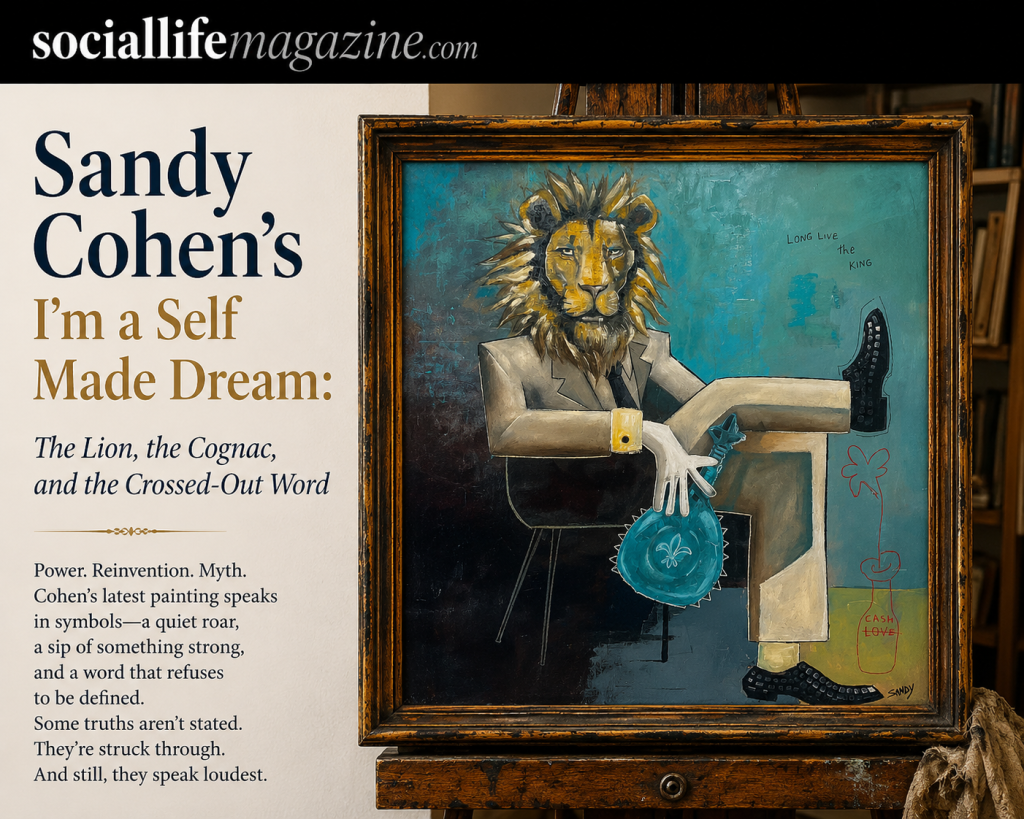
The lion sits the way men sit when they have already won. One leg crossed over the other, the crossed leg extended at an angle that takes up more room than it needs to. The body occupies the chair the way money occupies a room: completely and without apology. He wears a suit the color of old money. His shoes are black and thick-soled, the kind of shoe that costs what a month’s rent cost in the city where he made his first dollar. He holds a bottle of Louis XIII Cognac, which retails at around $4,000. It is the specific bottle that people buy when they want to signal that the conversation about price is over. Price is no longer a variable they track. They have crossed the meridian beyond which the cost of things is not information but atmosphere.
On the wall behind him, in handwriting that is casual in the way that only very confident things are casual, the words: LONG LIVE THE KING. In the lower right corner, drawn in red outline, a flower grows from a jar. The jar says CASH where LOVE has been crossed out.
Sandy Cohen painted this. She called it I’m a Self Made Dream. Oil and pastel on canvas, seventy-two by sixty inches, $55,000. In fact, it is the most significant piece in the current available collection.
The Light That Is Both Beautiful and Wrong
There is a specific quality of light in paintings that tell the truth about power. The light is neither warm nor cold but both simultaneously, the way the light in Hemingway’s Pamplona is both beautiful and wrong. Everything Jake Barnes loves about the world is inseparable from everything that is killing him about it. Cohen’s light here is that light. The teal background carries some of the quality of seawater and some of the quality of a hotel bar at three in the afternoon. Golden light catches the lion’s mane in a way that is genuinely magnificent. The magnificence is real, not performed, not ironic, not a critique of magnificence.
Also, the LOVE has been crossed out on the jar, and the flower is growing from cash, and the cognac is $4,000, and the white glove holding the bottle belongs to someone who has decided that certain textures are no longer his problem. This is the painting’s central act of honesty: it does not make the lion ugly. It does not ask you to disapprove. Splendid and undeniably himself, the lion earned his posture. His gaze is the gaze of someone who has won so many times that winning has become the baseline rather than the event. The painting admires him. Then it shows you the jar.
How the Jar Gets Relabeled
Here is how it happens, which Cohen knows and which the lion perhaps suspects but cannot afford to examine too closely while the winning is still ongoing. You start with nothing, or close enough to nothing that the distance from nothing to something feels like the only distance worth crossing. In that early stretch, you learn what actually fuels you, and what fuels you is not the money, because there is no money yet. What fuels you is the love, the love of the work or the love of the people or the love of the specific dream you are chasing. Love requires nothing in return because it is not yet transactional. Transaction requires two parties with real power to negotiate, and in the beginning you have none, so love is pure. Love is the only currency available. Love is what you put in the jar.
Then the winning starts. It was real. The lion did not fake his way here, and his mane is not a prop. The Louis XIII is not a loan. Yet the jar says what it says. The painting holds both truths in the same frame without resolving the tension into a lesson you can file away and stop thinking about.
The collector who buys this painting is buying a mirror. Cohen is generous enough to make it a very beautiful one. For the digital-age companion to this power portrait, Magnus Canis asks what happens to the power suit when the suit starts pixelating at the edges. For the version of this story where the soul arrives at the end having shed everything including the suit, see Many Lives, Many Masters. The full collector context for Cohen’s work lives at Sandy Cohen: The Hamptons Artist Whose Collectors Are Already the Canon.
What Grows From the Jar
A lone flower, Cohen says, fed not by love but by cold exchange. It grows anyway. Things grow from money. Children are fed. Schools are funded. Art is bought. The flower is real, and the growth is real. Only the nourishment is different from what it was. Only someone who remembers what it was can tell the difference from looking at the flower.
The lion remembers. You can see it in the gaze, slightly bored, yes, and something else, something that is not quite grief but is in the same neighborhood, the same teal-and-gold neighborhood where everything magnificent and everything lost live together without resolution. Still, the king sits. The flower grows. Cognac gets poured. Somewhere beneath CASH, if you look, the word LOVE is still there. It was always there. Now it costs something.
The city version of this same substitution is painted in It Was All a Dream, where ONLY LOVE IS REAL is hidden in the brushstrokes of a Doberman reading fake news on a park bench. Both paintings ask the same question and arrive at the same answer. Cohen keeps hiding it in plain sight until you find it.
Where to Find the Work
I’m a Self Made Dream is available at SandyCohenArt.com. Follow Cohen at @sandycohensart. To feature your collection, practice, or brand in Social Life Magazine, visit sociallifemagazine.com/submit-a-paid-feature. Twenty-five thousand print copies, Westhampton to Montauk, Memorial Day through Labor Day.
Author

Written by
Recent Posts

AI for personal finance: where PennyGuard fits
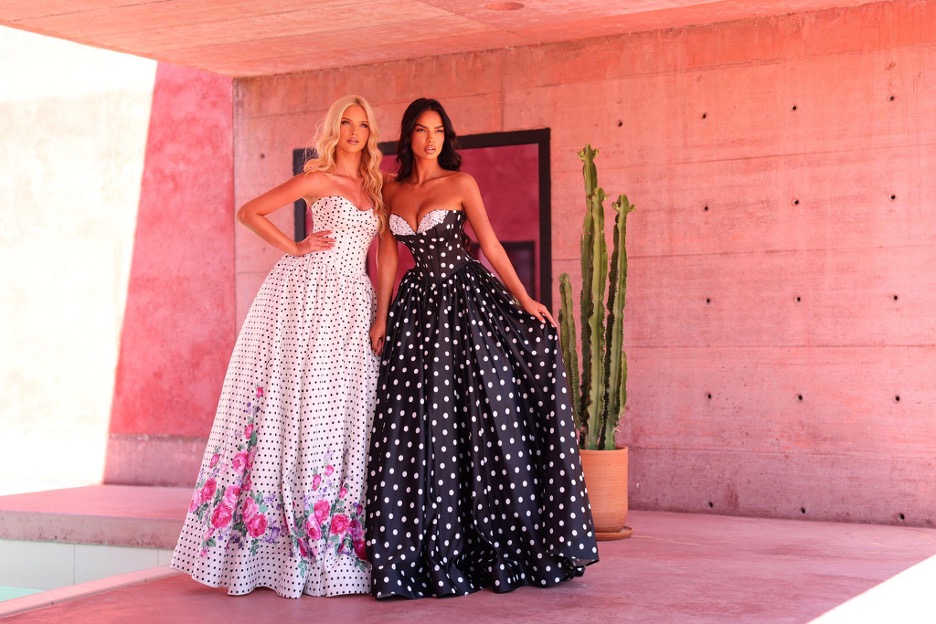
How to Pick a Homecoming Dress for Your Body Type (and Feel Amazing in It)

World Cup Injury Attorney for Vancouver Events
What a 3-Carat Engagement Ring Actually Costs in 2026: The Real Numbers
The Skincare Habits That Make a Real Difference Over Time
Categories
- Art
- Articles
- Business of Luxury
- Celebrities
- Culture
- Entertainment
- Events
- Faces of Summer 2026
- Fashion
- Fashion & Style
- Featured
- Finance
- Food, Spirits, Wine
- Hamptons
- Hamptons Celebrities
- Health
- Health & Beauty
- Lifestyle
- Luxury Lifestyle
- Press
- Profiles
- Real Estate
- Technology
- The Chronicles
- Travel
- Uncategorized
- Weddings