
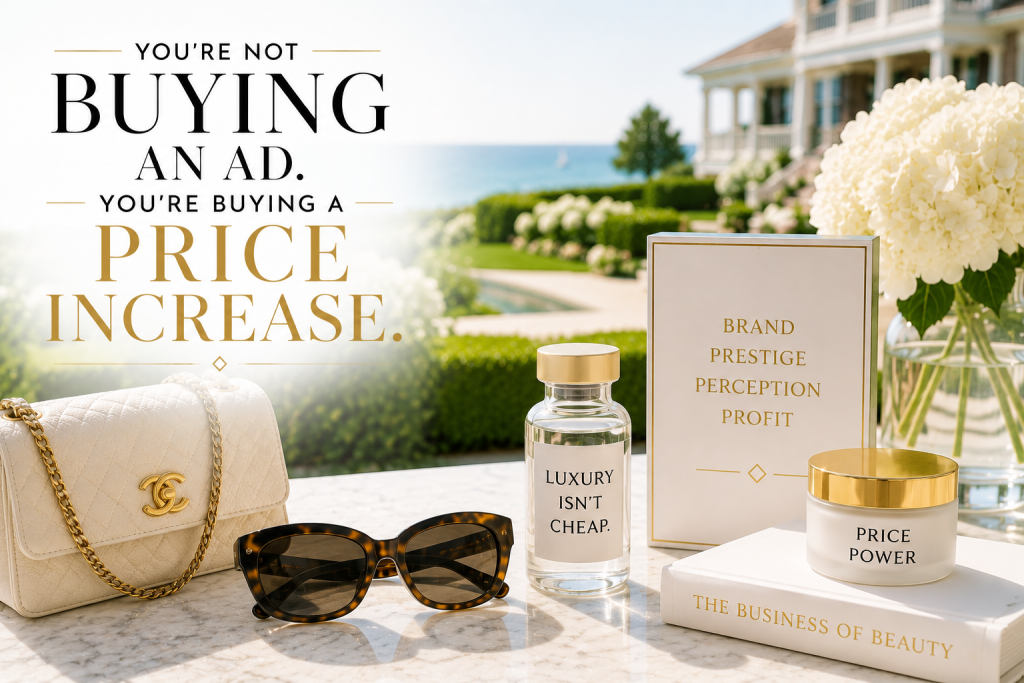
Most brands think about a sponsorship the way they think about an ad. They count the impressions, divide by the cost, and decide whether the math works. That is the wrong calculation entirely. Luxury brand sponsorship is not an advertising buy. It is the purchase of a permanent price increase.
An ad rents attention for a moment. A sponsorship in the right room buys something that stays, since it changes who your brand gets to stand beside. The first is an expense. The second is an asset.
So before you judge a placement by its reach, ask a better question. Will this make people willing to pay more for me afterward? Because that, not impressions, is what actually moves a luxury business.
Why Impressions Are the Wrong Metric
Reach is easy to measure, which is exactly why brands overvalue it. A million cheap impressions feel like progress, but they rarely change what anyone is willing to pay. Counting eyeballs tells you almost nothing about the price you can command.
Luxury does not run on volume. It runs on belief, since a premium only holds when the right people believe you belong at the top. One association with the correct room can do more for that belief than a million banner views ever will.
What You Are Actually Buying
A real sponsorship buys proximity, proof, and permission. Proximity puts you beside the names that confer status. Proof gives buyers third-party evidence that you matter. Permission lets you raise your price without losing the room.
None of those three show up in an impression count. Yet each one is worth far more, because each one lifts the ceiling on what you can charge. That lift is the entire return, and it compounds long after the event ends.
The Price Increase Is the Point
Here is the reframe that changes everything. You are not paying to be seen. Rather, you are paying to be repriced, since the right context lets a brand charge more and keep charging it. A banana on the right plinth proved the principle, which we cover in the $175 banana lesson.
How to Buy a Price Increase
Start by choosing the room before the reach. The question is not how many people will see it, but which people, and whether their attention changes your standing. A small room full of the right names beats a stadium of strangers.
Then attach a story, not just a logo. A placement without a narrative is just decoration, while a placement woven into a real story becomes proof. We break down that mechanism in why narrative is the margin, and the wider market shift in the death of the middle.
Fashion brands run this exact play every summer, turning one season into years of pricing power. You can see how in how a fashion brand wins the Hamptons. The smartest ones never call it advertising, because they know what they are really buying.
Why the Cheapest Placement Is Usually the Most Expensive
The bargain placement is tempting precisely because it is cheap. But cheap reach often sits in the wrong rooms, beside the wrong names, sending the wrong signal about where you belong. So you pay a little and lose a lot, since the wrong context can quietly lower your price.
Status is contagious in both directions. Stand beside the right names and their standing rubs off on you. Stand beside the wrong ones and theirs does too, which is why a discount placement can cost more than it ever saved.
The expensive-looking room is often the cheaper choice over time. It lifts your price and protects it, while the bargain quietly erodes both. So judge a placement by what it does to your standing, not by what it does to your budget.
The Question That Settles It
So the next time a placement lands on your desk, skip the impression math. Ask whether it will let you raise your price and make it stick. If the answer is yes, the cost is not an expense. It is the cheapest price increase you will ever buy.
An ad is gone by the next morning. A price increase is permanent, and permanence is the only thing worth paying a premium for. You are not buying an ad. Instead, you are buying the right to charge more, for years.
Where The Conversation Continues
Social Life Magazine has spent twenty three summers putting brands beside the names that let them charge more. That is the price increase, packaged, because proximity and proof are exactly what a premium is built on. Sponsorship inventory is limited by design, since scarcity is the product, and the brands that commit early are the ones still being repriced upward at Labor Day.
If you would rather buy a price increase than rent an impression, the desk is open now, though the season fills fast. Join the list to see who gets in before the rest of the market catches on. And if this sharpens how you think about your own spend, you can support the work here.
Author

Written by
Recent Posts

AI for personal finance: where PennyGuard fits
How to Pick a Homecoming Dress for Your Body Type (and Feel Amazing in It)

World Cup Injury Attorney for Vancouver Events
What a 3-Carat Engagement Ring Actually Costs in 2026: The Real Numbers
The Skincare Habits That Make a Real Difference Over Time
Categories
- Art
- Articles
- Business of Luxury
- Celebrities
- Culture
- Entertainment
- Events
- Faces of Summer 2026
- Fashion
- Fashion & Style
- Featured
- Finance
- Food, Spirits, Wine
- Hamptons
- Hamptons Celebrities
- Health
- Health & Beauty
- Lifestyle
- Luxury Lifestyle
- Press
- Profiles
- Real Estate
- Technology
- The Chronicles
- Travel
- Uncategorized
- Weddings