
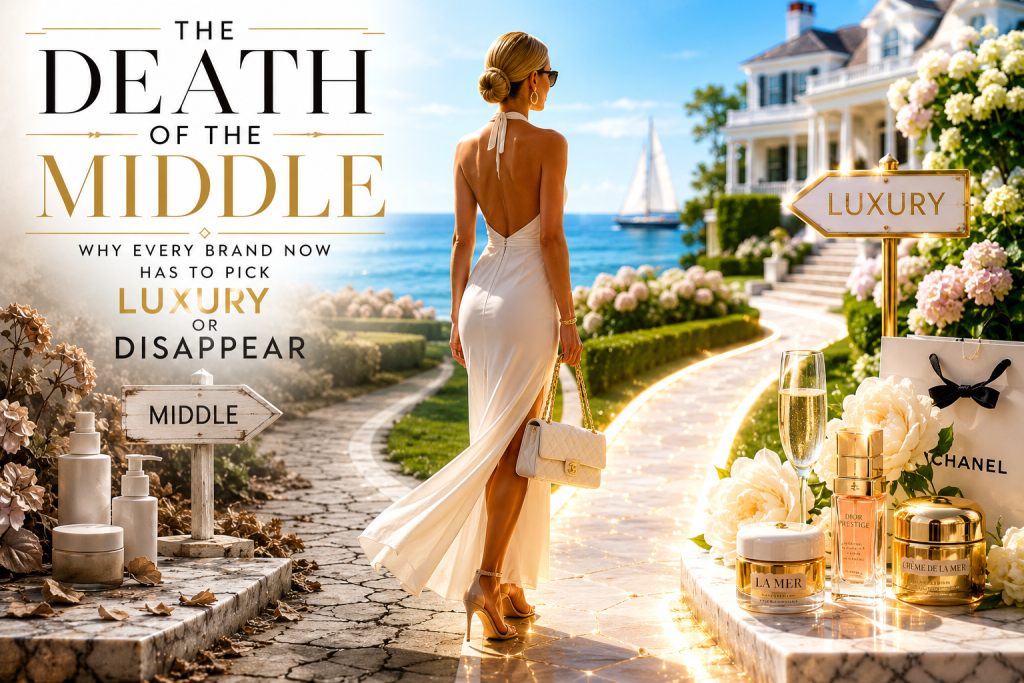
For a hundred years, the consumer economy ran on the middle. Middle incomes, middle tastes, middle brands aimed squarely at people who wanted a little more than they had. That engine is now stalling, and the death of the middle is the single biggest shift in how status gets bought and sold today. The market is splitting into two camps, luxury and value, with almost nothing safe left in the center.
All PostsThis matters far beyond marketing decks. It decides which brands get to charge a premium and which get ground down on price. It decides which medspa fills a waitlist and which one runs a coupon. Above all, it decides who gets to stand inside the rooms that confer status, and who is left explaining why they should.
So strap in. The next decade is going to be a brutal sort, and the Hamptons is where the sorting happens in public.
The Middle Is Where Brands Go to Die
A middle brand used to be a safe bet, because it caught the largest slice of buyers. That slice is hollowing out fast. Shoppers now either trade down to the cheapest option that works or trade up to the version that confers a story, so the comfortable center is starving from both sides.
You can see it everywhere this year. The mid-tier department store fades while the value warehouse and the luxury boutique both thrive. The reliable mid-price label loses ground to a cheaper clone and a costlier icon at the same time. Being fine is no longer a position. It is a slow exit.
For any brand caught in that center, the choice is stark. Drift down and compete on price forever, or climb up and learn to sell meaning. Most owners have not yet admitted that the middle ground beneath them is already gone.
Status Anxiety Is the Engine
The middle was never just an income band. It was an emotional state, caught between two pulls that never quite resolve. One pull is self-actualization, the wish to become your best self. The other is status anxiety, the fear that everyone can see you have not arrived.
That tension is the real engine of spending. People buy to close the gap between who they are and who they fear being seen as, so the most powerful brands sell relief from that exact fear. A great brand does not sell a product. It sells a quieter, more certain version of you.
Where the New Money Feels It Most
Nobody feels this pull harder than the newly rich. They have cleared the money problem, but the belonging problem is wide open, and money cannot close it directly. So they spend, and they keep spending, on anything that promises to place them. We map that fear in detail in Hamptons status anxiety and the new money problem.
Why Luxury Messaging Is Usually Terrible
Climbing up sounds simple until a brand tries to actually do it. Luxury messaging carries a heavy burden, since it has to keep confirming that the buyer is rare and right to justify the margin. That burden produces some of the dullest creative in the business.
You know the look already. The slow-motion silk, the empty mansion, the voiceover whispering about heritage to nobody in particular. It is luxury as wallpaper, expensive and forgettable, and it often tips into the faintly embarrassing. The brand is so busy flattering the buyer that it forgets to say anything.
Here is the opening inside that failure. Because most luxury content is boring, the brand that makes status legible and genuinely fun to read wins outsized attention. That is a craft problem, not a budget problem, and it is exactly the craft a great title sells.
The $175 Banana Proof
The clearest proof of the whole thesis was a banana. At a recent skincare pop-up, The Ordinary sold a plain banana for one hundred and seventy five dollars to mock how marketing language justifies obscene beauty margins. The joke landed because it was true.
A banana is a banana. The story around it is the entire price, and that rule runs every premium category on earth. We break down what it means for beauty brands and medspas in the $175 banana and the medspa marketing lesson.
Strip the story and a luxury product becomes a commodity instantly. Keep the story and an ordinary product holds a remarkable price. The death of the middle simply means there is no longer a comfortable spot between those two outcomes.
Brand Is Now Politics
As the middle empties, what you buy stops being a preference and becomes a position. Your brands now signal your tribe, your values, and the rung you claim, so consumption reads like a vote. That is why brand has quietly turned into politics.
People are not just choosing products anymore. They are choosing sides, and they want everyone around them to read the choice correctly. A label is now a flag, planted to say exactly who you belong with and who you do not.
For a brand, that raises the stakes well past taste. You are no longer asking people to like you. You are asking them to be seen with you in public, which is a far bigger thing to earn.
Why the War Is Being Fought in the Hamptons
Every theory about status eventually needs a proving ground, and the Hamptons is the most concentrated one in America. A few square miles hold more new fortunes, old names, and status-anxious buyers than almost anywhere else, so the death of the middle plays out here first and loudest.
It is also the rare market where a brand can leap the gap in one season. The right feature, the right tent, the right summer rooms can move a label from invisible to inevitable by Labor Day. Fashion brands run this exact play, and we walk through it in how a fashion brand buys its way into the Hamptons.
The middle is dead, but the top is wide open to anyone who understands the sort. Brands that pick a side and commit will own the next decade. Those still hoping the center holds will spend the decade competing on price.
How the Sort Plays Out, Sector by Sector
The same split shows up wherever status is sold. In beauty, it decides whether a clinic prices on prestige or bleeds out on discounts, a choice we cover in how luxury medspa pricing works. Underneath all of it sits one mechanism, the reason a story sets a price at all, which we map in why narrative is the margin.
For brands weighing where to spend, the split reframes the whole question. A placement is really a price increase in disguise, as we explain in why you are not buying an ad. For people, the same forces run quieter, through the Hamptons social codes and the long contest of old money versus new money. And every summer it all comes to a head in public, which is the story of the brands photographed in July.
Where The Conversation Continues
Social Life Magazine has spent twenty three summers writing the names that get said out loud in the Hamptons. That is the climb up the ladder, packaged, because a feature is the story that lets you stop competing on price. Summer placement is limited by design, since scarcity is the entire point, and the brands moving now are the ones still being talked about in September.
If you would rather be the icon than the wallpaper, the desk is open, but the season fills early. Join the list to see who makes the cut before the rest of the East End catches on. And if this way of thinking sharpens your own play, you can support the work here.
Author

Written by
Recent Posts

AI for personal finance: where PennyGuard fits
How to Pick a Homecoming Dress for Your Body Type (and Feel Amazing in It)

World Cup Injury Attorney for Vancouver Events
What a 3-Carat Engagement Ring Actually Costs in 2026: The Real Numbers
The Skincare Habits That Make a Real Difference Over Time
Categories
- Art
- Articles
- Business of Luxury
- Celebrities
- Culture
- Entertainment
- Events
- Faces of Summer 2026
- Fashion
- Fashion & Style
- Featured
- Finance
- Food, Spirits, Wine
- Hamptons
- Hamptons Celebrities
- Health
- Health & Beauty
- Lifestyle
- Luxury Lifestyle
- Press
- Profiles
- Real Estate
- Technology
- The Chronicles
- Travel
- Uncategorized
- Weddings