
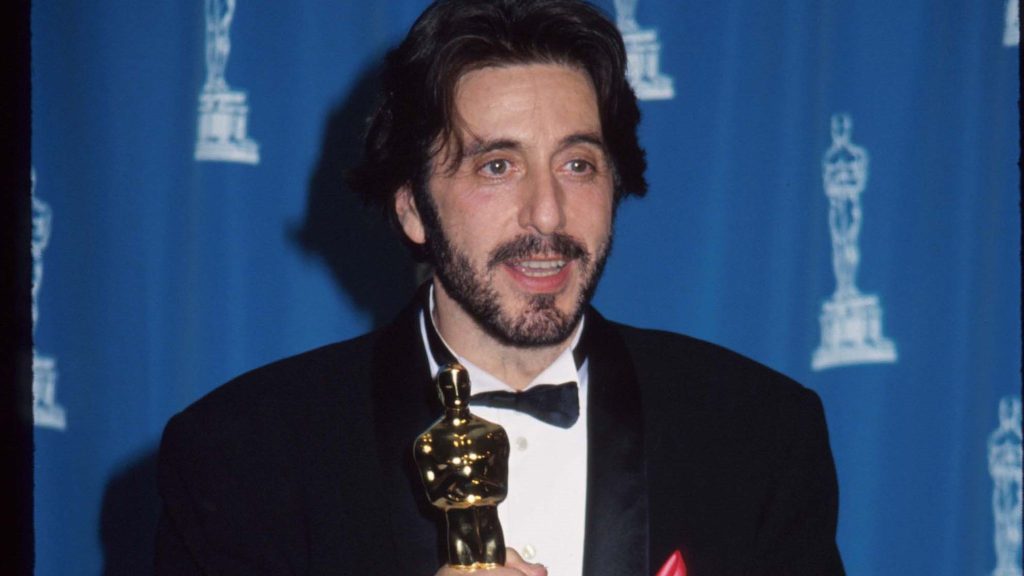
South Bronx, 1948. A five-year-old Alfredo James Pacino watches his mother work double shifts as a movie theater usher. The babysitter cost more than the ticket, so Rose snuck him in. Forty years later the same kid would command $5 million a picture, plus a back-end deal on a movie called Scarface that Hollywood thought was a flop. Al Pacino net worth in 2026 sits at roughly $120 million. The fortune got built less on box office than on a stubborn refusal to take work for the wrong reasons. He is, depending on who you ask, the last great American actor. Or a man trapped inside a single syllable. Both readings are correct. Both miss the larger story.
A Five-Foot-Six Kid From The South Bronx
The tenement at 2250 Bryant Avenue had no father in it. Sal Pacino left when Al was two. Rose raised him alongside her Sicilian parents in a railroad apartment where the windows looked onto the elevated 6 train. He skipped school to act out scenes from movies he had memorized after a single viewing. By twelve he had earned the nickname Sonny the Actor on the block. The designation, in South Bronx street economics, meant something between “weird kid” and “small-time hustler.” Neither tracked. The kid was just rehearsing.
Asthma kept him out of the Army. A part-time job at the New York Times mail room kept him in cigarettes. Every dollar he could spare went to a school called the Herbert Berghof Studio on Bank Street. A teacher there named Charlie Laughton took one look at him. The verdict: already a working actor, just needed someone to pay him for it. That kind of permission, granted by an adult who knew what he was looking at, is the rarest form of cultural capital a poor kid from the Bronx can receive. Pacino received it at sixteen.
The geography mattered. Bryant Avenue in the 1950s sat at the bleeding edge of a borough that had not yet been written off, but soon would be. Rose worked the matinees because she had to. Her son watched the matinees because he was being constructed by them. By the time he could afford a bus ticket downtown, he knew every Brando frame, every Cagney walk, every Bogart pause. The training that would later be called Method had begun, informally, in a tenement before anyone gave it a name.
HB Studio, Strasberg, And The Method That Made Him
HB Studio in 1962 was a downtown waiting room for actors who could not yet afford rejection. Tuition ran $2 a class. Pacino took every class he could and slept on the studio floor when his mother could not pay the rent on Bryant Avenue. Laughton became less a teacher than a surrogate father, the first man in his life who treated his obsession as legitimate work.
By 1966 he had graduated upward to the Actors Studio, where Lee Strasberg presided over the Method like a one-room rabbinical court. Strasberg admitted maybe twenty actors a year out of a thousand auditions. Pacino was rejected the first time. He kept showing up at the door anyway. Then he got in. Strasberg’s reading of the Method was not a technique. It was a way of refusing every shortcut the industry would later offer.
What this meant practically: by twenty-six Pacino was playing leads off-Broadway in plays nobody had heard of, for $80 a week, in roles that demanded he disassemble himself in front of strangers. The Indian Wants the Bronx opened in 1968 at the Astor Place Theatre. He played a Puerto Rican street kid who terrorizes an East Indian immigrant at a bus stop. Reviews were the kind New York Times critics save for actors they think might matter. He won an Obie. Then he won a Tony, for Does a Tiger Wear a Necktie, in his Broadway debut. Most actors take a decade to assemble those credits. Pacino took eighteen months.
The Panic In Needle Park Audition That Changed Everything
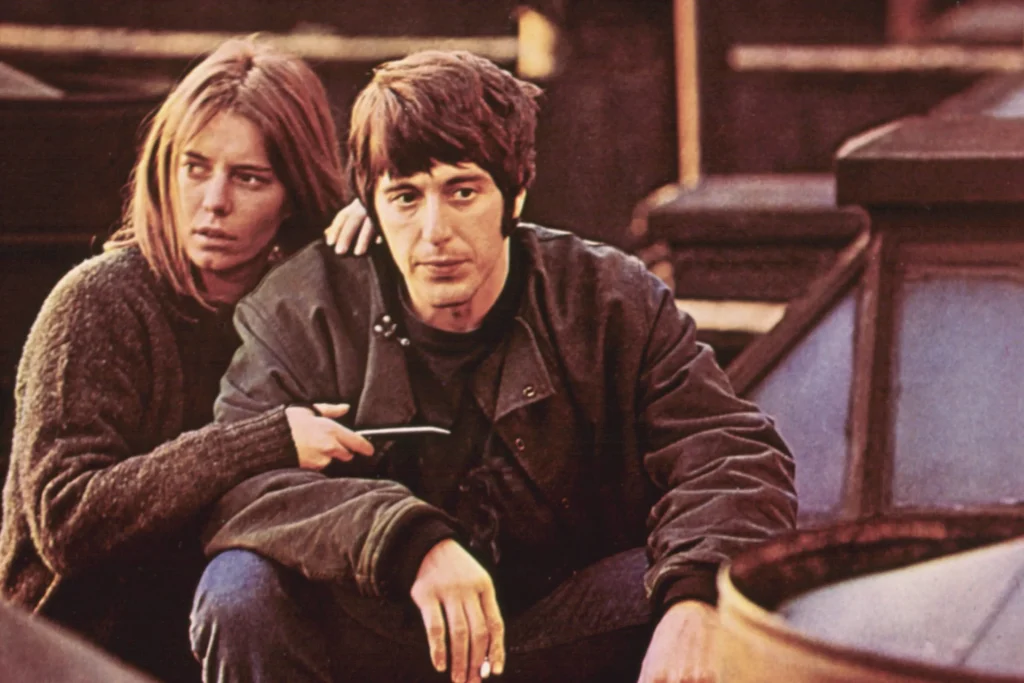
A 1971 audition tape exists. You can find it. A twenty-nine-year-old Pacino reads with Kitty Winn for a movie about Manhattan junkies in love. Director Jerry Schatzberg already wanted him. The studio wanted someone bigger. Studios always want someone bigger.
Schatzberg won. The Panic in Needle Park premiered at Cannes that May, where a Paramount executive named Robert Evans was in the audience hunting for an unknown to play a quiet middle son in an adaptation of a Mario Puzo novel nobody at the studio thought would work. Evans watched Pacino on screen for ninety minutes and understood, with the kind of certainty that builds Hollywood careers, that this short Italian kid from the Bronx was Michael Corleone.
Coppola, who had been hired to direct The Godfather under conditions that amounted to studio probation, had reached the same conclusion six months earlier. He had also been told no, repeatedly, by every Paramount executive above Evans. Robert Redford was the studio pick. Ryan O’Neal was the second pick. Warren Beatty got a meeting. Martin Sheen tested seriously. What the studio did not want was Pacino, whose screen tests they kept describing in internal memos as “the runt” and “midget” and (this one quoted in a 1991 Coppola interview) “a fucking five-foot-six unknown.”
The Godfather Casting War: When Paramount Tried To Fire Him Twice
Inside the Coppola cluster the casting fight is canonical and exhaustively documented (see Francis Ford Coppola’s Godfather empire for the director’s side of the story, including the Vanity Fair oral history that broke open the internal Paramount memos). From Pacino’s side it looked different. He had not yet become Al Pacino. He was a stage actor who had been given a part he did not understand and then told, on day one of shooting, that he was about to be fired.
Coppola shot the restaurant scene out of sequence specifically because he needed dailies to defend his casting. The director understood, where the studio did not, that Pacino’s stillness was the entire point. Michael Corleone is the one Corleone who does not perform. Every other character in the movie acts. Michael, alone, simply is. Pacino had been training for that part since HB Studio. In some sense he had been training for it since the Bryant Avenue tenement, where watching from the fire escape was its own form of survival.
The casting war eventually included a parallel battle over Kay Adams. Evans wanted Ali MacGraw. Coppola wanted an unknown Broadway actress named Diane Keaton whose comic timing he had clocked in Play It Again, Sam. The studio held the line on Keaton longer than they held it on Pacino. When both holdouts won, the final cast was the one we now consider obvious. (For the full Keaton arc, from Coppola holdout to Oscar winner to ninety-million-dollar real estate flipper, see her upcoming profile in this cluster.)
The 1970s Run That Made Him The Actor’s Actor
Between 1971 and 1976 Pacino made The Godfather, Serpico, The Godfather Part II, and Dog Day Afternoon. He was nominated for four Oscars and won zero. By way of explanation, the Academy gave the 1972 Best Actor statue to Marlon Brando for the same movie. Then Art Carney won for Harry and Tonto. Then Jack Nicholson won for Cuckoo’s Nest.
Pacino kept working. Serpico (1973) earned him his first Best Actor nomination and the moral authority that would shadow his career for the next decade. Frank Serpico was a real cop. Pacino had spent weeks riding with him in the Bronx, picking up the hunched posture and the slightly nasal Brooklyn cadence, the wariness that comes from being correct about something corrupt that nobody else will admit. The performance became the template for every honest-cop movie that followed.
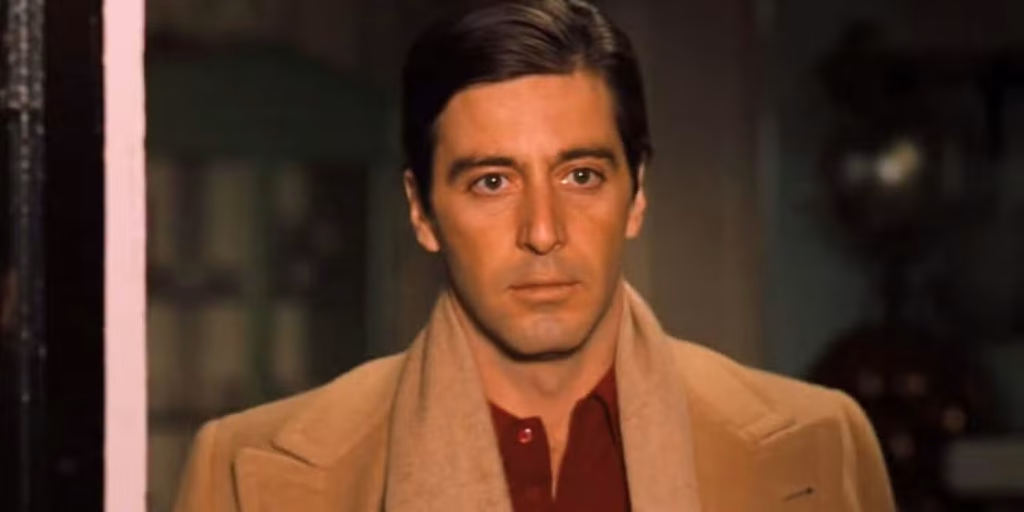
The Godfather Part II (1974) is where the partnership with Robert De Niro began, though they never share a frame in the movie. They play the same man at different ages. (The Heat collaboration twenty-one years later is the one fans cite, and it gets its own deep dive in this cluster.) What matters in 1974 is that two of the greatest American screen actors of the postwar era are inside the same Coppola movie playing the same character. Six Oscars including Best Picture. Pacino loses Best Actor.
Dog Day Afternoon (1975) is the peak. Sidney Lumet, a Brooklyn bank, a botched stickup, the chant of “Attica! Attica!” that became a cultural meme thirty years before memes existed. Pacino plays Sonny Wortzik with a tenderness Hollywood had never quite seen in a heist movie. He lost Best Actor again, this time to Nicholson.
Scarface, The 1980s Wilderness, And The Pfeiffer Pivot
The 1980s nearly broke him. Cruising (1980) was a disaster and a scandal in equal measure. Author! Author! (1982) was a Neil Simon comedy that played, in the words of one critic, like a man impersonating Al Pacino. Then came Scarface.
Brian De Palma’s 1983 remake of the 1932 gangster picture was, on release, a critical and commercial disappointment. Roger Ebert gave it four stars. Almost nobody else did. The movie grossed $66 million on a $25 million budget, decent but not the breakout Universal expected. Pacino, who had taken the role on a back-end deal that pegged his upside to long-tail success, walked away with a paycheck that looked small in 1983 and a residual stream that looks like an annuity now.
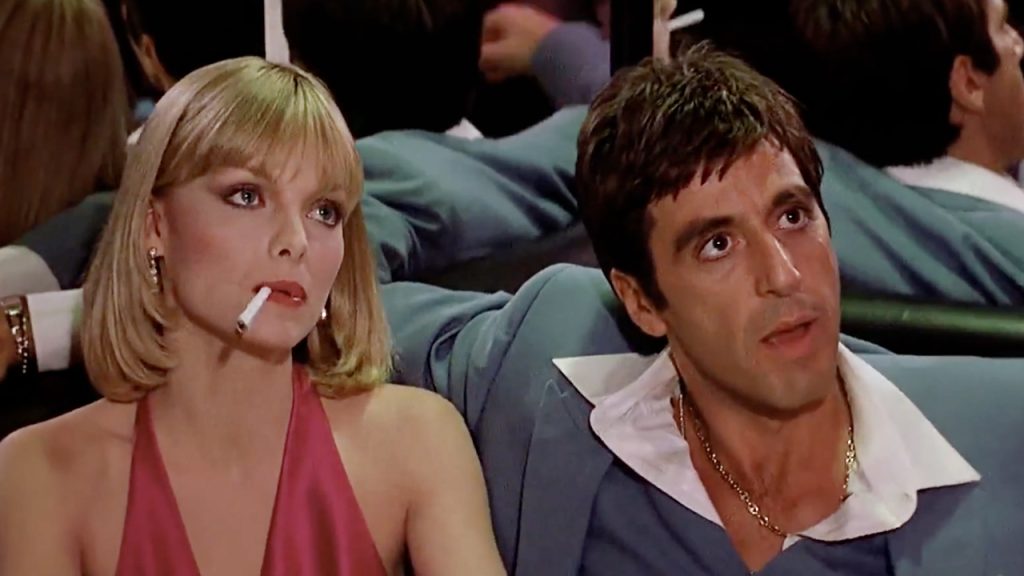
Scarface is one of the most quoted films in American hip-hop history. Home video and cable revenue, accumulating across forty years, has made Pacino’s back-end on that single picture worth more than several of his contemporaries’ entire careers. Michelle Pfeiffer, twenty-five when the movie shot, played Elvira with a glassiness that became its own meme. (Their second collaboration, eight years later in Frankie and Johnny, is the one critics underrate, and it gets its own piece in this cluster.)
After Scarface he made Revolution (1985), one of the most public flops of the decade, and then stopped working for four years. Hollywood does not technically blacklist. Hollywood just stops calling. Between 1985 and 1989 the phone did not ring. He went back to the stage. He directed The Local Stigmatic off-Broadway, a play almost nobody saw, on his own dime.
The 1990s Comeback And The Oscar Curse
Sea of Love (1989) ended the wilderness. The cop thriller did not deserve the comeback. Pacino’s performance did. He played Frank Keller, a New York detective hunting a serial killer who finds her victims through the personal ads, with the same haunted intelligence he had brought to Serpico fifteen years earlier. The movie grossed $110 million. The phone started ringing again.
What followed was the second-densest run of his career. Dick Tracy (1990) won him a fifth Oscar nomination. The Godfather Part III (1990) divided critics but kept the Corleone residual machine running. Frankie and Johnny (1991) reunited him with Pfeiffer in a Garry Marshall romance that critics dismissed and audiences quietly loved. Glengarry Glen Ross (1992) earned him a sixth nomination. Then, in 1993, the Academy finally relented.
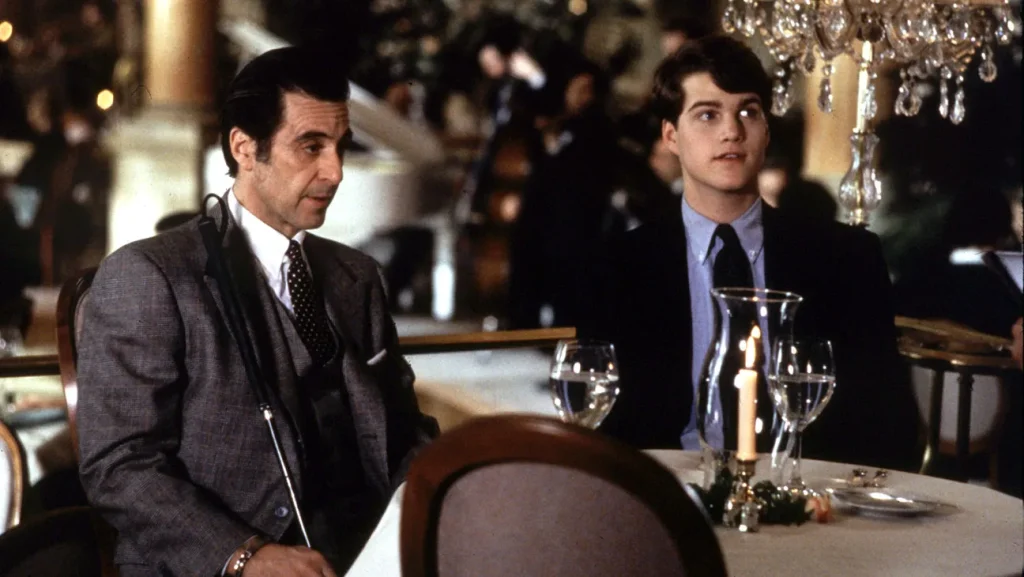
Scent of a Woman (1992) is, by most honest accounts, not Pacino’s best work. The “HOO-AH” is what people remember. His performance won Best Actor on what the trade press at the time openly called a career achievement vote. Chris O’Donnell, twenty-two and just out of Boston College, played the prep-school boy opposite him. (O’Donnell’s arc from Scent of a Woman through Batman & Robin and into the CBS procedural afterlife is its own status anthropology, covered in this cluster.)
Heat, Donnie Brasco, And The Devil’s Advocate
Then came Heat (1995). Michael Mann put Pacino and De Niro on screen together for the first time, in a diner, in a four-minute scene that film schools still teach. (That scene, and the twenty-one-year buildup behind it, gets the full treatment in the De Niro spoke.) Two years later, Mike Newell’s Donnie Brasco paired Pacino with a twenty-five-year-old Johnny Depp as the FBI agent who infiltrates the Bonanno crime family, and Pacino played Lefty Ruggiero with a tenderness nobody saw coming. (The Depp piece is the one to read on how Brasco rewired both careers.)
The Devil’s Advocate (1997), released that same year, put Pacino opposite a thirty-three-year-old Keanu Reeves as Satan running a Manhattan law firm. The role was pure id. Pacino played it that way, gleefully chewing the marble in scenes that critics either loved or hated, with no middle position available. (The Devil’s Advocate spoke in this cluster reads the Keanu performance against Pacino’s, and finds Keanu more interesting than the 1997 reviews allowed.)
The 2000s Decline And The Jack And Jill Problem
The 2000s are the era nobody wants to talk about. Insomnia (2002), directed by a not-yet-Batman Christopher Nolan, was the last critically loved Pacino performance before a stretch of paycheck movies that even his admirers struggle to defend. Gigli (2003). Two for the Money (2005). 88 Minutes (2007). Righteous Kill (2008), which finally put him on screen with De Niro for ninety minutes and was the kind of disappointment that makes a fan reconsider every prior partnership.
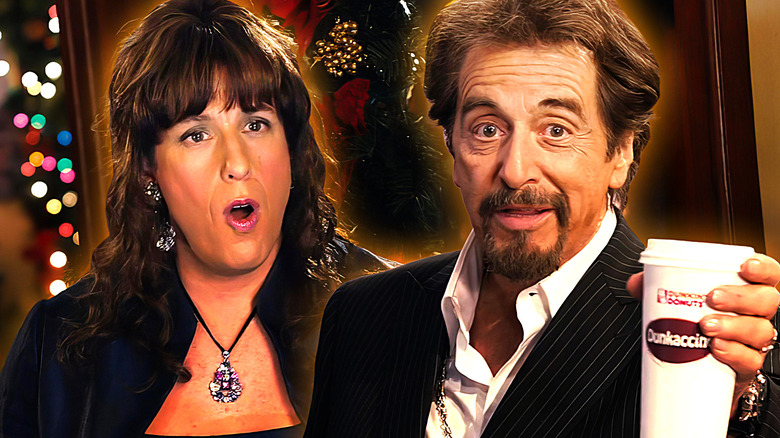
Then in 2011 came Jack and Jill. Adam Sandler in drag. Pacino, playing himself, opposite Sandler-as-Jill in a Dunkin’ Donuts commercial-within-the-movie that may be the strangest five-minute stretch in his filmography. The movie swept the Razzies. (The Sandler-Pacino dynamic, and the financial logic that put one of the great American actors inside a Happy Madison production, is its own piece in this cluster.)
What the public did not know in 2011 was that Pacino was, by his own later admission, broke. Not poor. Broke. He had trusted a financial advisor named Kenneth Starr (no relation to the prosecutor) who would eventually be sentenced to seven and a half years for running a Ponzi scheme through which Pacino and several other celebrity clients lost most of their liquid wealth. The Jack and Jill paycheck, which had looked like a lapse in taste, was actually working capital. Pacino was sixty-eight, in personal bankruptcy proceedings in everything but name, taking the work that paid.
The Reinvention: Sorkin, Scorsese, Tarantino
Recovery began with HBO. You Don’t Know Jack (2010) won him an Emmy and a Golden Globe and reminded the industry that he could still do precision work. Phil Spector (2013) earned another Emmy nomination. The Hollywood that had stopped calling in 2008 was now writing him checks again. Then came the trilogy of late-career legitimation pieces.
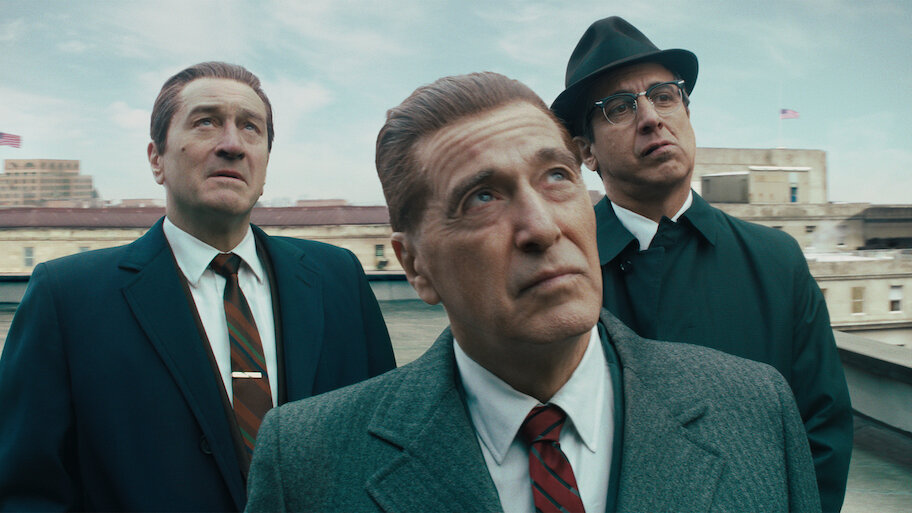
The Irishman (2019) put him in Scorsese’s three-and-a-half-hour gangster opera as Jimmy Hoffa, and won him his ninth Oscar nomination. Once Upon a Time in Hollywood (2019) put him in Tarantino’s love letter to 1969 Los Angeles as a cigar-smoking agent who exists primarily to deliver one perfect speech to Leonardo DiCaprio. House of Gucci (2021) put him in Ridley Scott’s prestige melodrama as Aldo Gucci, a casting choice that on paper read as a joke and on screen registered as something closer to inevitability.
In late 2023, Pacino welcomed his fourth child at the age of eighty-three. He is currently with Noor Alfallah, fifty-three years his junior. By his own acknowledgment, the arrangement is unusual. He has also said, in interviews and in person, that he does not particularly care what anyone thinks about it. This is the Pacino of 2026: a man with nothing left to prove, doing what he wants, taking the work that interests him, refusing the work that does not.
Al Pacino Net Worth In 2026: The Real Number
Al Pacino net worth in 2026 stands at approximately $120 million. The figure gets reconstructed from public divorce filings, residual disclosures from the Pacino-Starr litigation, real estate records, and the kind of triangulation any honest celebrity wealth estimate requires. Four sources of capital underwrite it.
First, the Godfather residual stream. Pacino’s participation in the original Paramount deal was not lavish by 1972 standards. Decades of cable, home video, streaming, and the Restoration reissues have made the residuals on those three films, collectively, the largest single line item in his net worth. Industry estimates place his cumulative Godfather earnings at $20-25 million. For the complete financial architecture of the ensemble Coppola assembled, read our Godfather Cast Net Worth hub.
Second, the Scarface back-end. A 1983 deal that looked underwhelming in 1983 has, in the four decades since, produced what people in the business call a long-tail annuity. Estimates put his Scarface-only cumulative income at $15-18 million, most of it earned after 1995, most of it earned without him doing anything except having said yes to the wrong-looking movie in 1982.
The Late-Career Paycheck Cycle
Third: the late-career run. The Irishman, Once Upon a Time in Hollywood, House of Gucci, and various HBO projects pay scale plus residuals, and across the 2010-2024 period these contributed an estimated $35-40 million.
Fourth: real estate. Pacino owns a Beverly Hills home, a Palisades property, and an apartment on the Upper West Side held since the 1970s. The Manhattan unit alone is now worth, by conservative comp analysis, $4-6 million. California holdings add another $10-12 million.
Subtracting the Ken Starr losses (estimated at $9 million in directly stolen funds plus another $20-25 million in opportunity cost) and the various settlements from his three prior relationships, the working figure for Al Pacino net worth in 2026 sits in the $115-125 million band. He earns, conservatively, $4-6 million annually from passive sources alone. That figure does not make him Bezos. By any meaningful measure of the actor’s actor metric, he is also not anyone but Al Pacino. Which has always been the entire point.
Where The Conversation Continues
Social Life Magazine covers the intersection of wealth, culture, and influence from the Hamptons to Manhattan. Our celebrity net worth coverage traces the economics, the leverage, and the decisions that built the fortune.
Our readers are family office principals, exit founders, fashion executives, and the advisors who serve them. For premium editorial placement and integrated advertising across print and digital, submit a paid feature or contact our business development team.
Want insider access to the events, launches, and gatherings that define the Hamptons social calendar? Sign up for Event Invites & Specials and never miss a moment.
Social Life Magazine. Twenty-three years of covering the people and places that define luxury in America.
Author

Written by
Recent Posts

He’s Got Millions. He Still Flinches at the Bill.

Streamlining Ground Station Data Pipelines for Deep Space Missions

The Coordination Problem That Kills Growing Marketing Teams
Why Personalized Skincare Is Replacing One-Size-Fits-All Beauty Products
The Return of the Transatlantic Crossing
Categories
- Art
- Articles
- Business of Luxury
- Celebrities
- Culture
- Entertainment
- Events
- Faces of Summer 2026
- Fashion
- Fashion & Style
- Featured
- Finance
- Food, Spirits, Wine
- Hamptons
- Hamptons Celebrities
- Health
- Health & Beauty
- Lifestyle
- Luxury Lifestyle
- Press
- Profiles
- Real Estate
- Technology
- The Chronicles
- Travel
- Uncategorized
- Weddings