
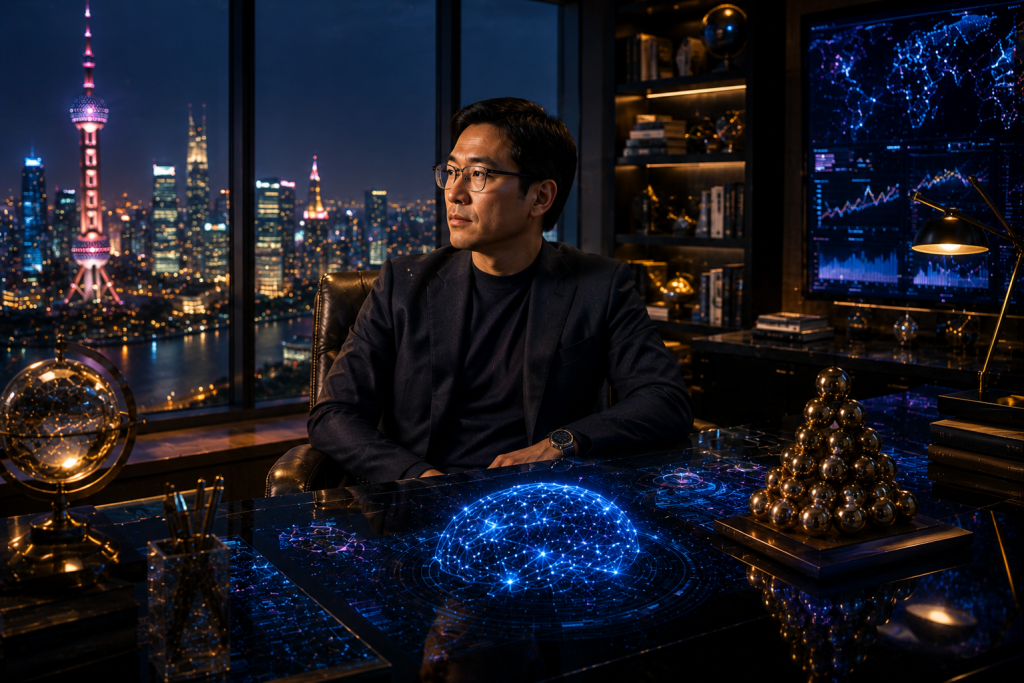
Edwin Chen Net Worth 2026: $18 Billion and Nobody Knows His Name
Edwin Chen net worth 2026 is approximately $18 billion according to Forbes, making him the richest new AI billionaire on the 2026 list and one of the youngest members of the Forbes 400. Owning roughly 75% of Surge AI, a data labeling company he founded in 2020 that generated over $1.2 billion in revenue by 2024. His clients include Google, Meta, Microsoft, Anthropic, and Mistral. His models train Gemini and Claude. He raised zero dollars in venture capital. He has almost no public profile. Eighteen billion dollars and near-total invisibility make him the most improbable character in the AI billionaires story.
Crystal River to MIT to the Invisible Empire
Chen was born to Taiwanese immigrant parents who ran a Chinese-Thai-American restaurant in Crystal River, Florida, a town of approximately 3,400 people. He showed early aptitude for mathematics and linguistics, earned admission to MIT, and graduated with degrees in math, linguistics, and computer science. After MIT, he worked as a machine learning engineer at Google, Facebook, Twitter, and Dropbox, where he observed a structural problem: even the world’s largest technology companies were constrained by the quality of their labeled training data.
In 2020, Chen founded Surge AI to solve that problem. While Alexandr Wang’s Scale AI had pioneered the data labeling category, Chen built something leaner and more profitable. Surge AI reached $1 billion in annual revenue with just 110 full-time employees, compared to Scale’s 1,000+ employees generating $870 million. Zero venture capital raised. Profitable almost from inception. The company employs professors from Stanford, Princeton, and Harvard alongside a network of over one million gig workers from more than 50 countries. Chen’s quote to Forbes was characteristically understated: “Without us, AGI simply won’t happen.”
The Bootstrap Billionaire
Chen’s fortune is structurally different from every other AI billionaire profiled in this empire. He did not raise venture capital. He did not sell equity to SoftBank or Meta or Sequoia. A profitable company, 75% ownership retained, and let the market come to him. Reports indicate Surge is in talks to raise a $1 billion Series A at a $24 to $30 billion valuation. If that round closes, Chen’s stake would be worth $18 to $22.5 billion. He would remain the majority owner of a company that trains the AI models powering the products used by billions of people.
The Economics of Invisible Scale
Consider what bootstrapping means at the scale Chen achieved, because the word “bootstrap” typically conjures images of a two-person startup running on credit card debt and determination, not a company generating $1.2 billion in annual revenue with clients including every major AI lab on earth. Chen’s bootstrap was not the romantic kind. It was the ruthlessly efficient kind, the kind that treats every dollar of revenue as both fuel and discipline, because when you have no investors to cover your mistakes, you do not make the kind of mistakes that venture-backed companies treat as learning experiences and write off against their Series C.
The Discipline of Self-Funded Growth
Surge AI reached profitability early because it had to. Each payroll was funded by revenue. Expansion was self-financed. Each hiring decision carried the weight of an owner who retained 75% of the company and therefore absorbed 75% of every bad outcome.
See also: data barons of AI.
That discipline produced something venture capital structurally cannot: a company whose founder’s incentives are perfectly aligned with the company’s financial health because they are, in the most literal sense, the same thing. When Chen decides to hire a Stanford professor to lead a data quality team, the cost comes from revenue he generated and the benefit accrues to equity he owns. There is no board to persuade, no governance committee to navigate, no investor update to write explaining why the hire was strategic. The decision cycle is compressed to the point of near-instantaneity, which in a market where AI model training timelines are measured in weeks rather than quarters, constitutes a structural competitive advantage that no amount of venture funding can replicate.
TIME named Chen to its 100 Most Influential People in AI list in 2025. Forbes made him the youngest member of the 400. And yet, when journalists dug into his LinkedIn profile, they found a single sentence: “Building Surge AI.” The venture capital world was, by multiple accounts, collectively stunned. The most valuable AI company nobody had heard of was run by the richest new billionaire nobody had heard of, and he preferred it that way.
The Bootstrapper’s Advantage in the Age of Unlimited Capital
There is a particular irony in the fact that the richest new AI billionaire on the Forbes list built his fortune without any of the capital that the investor class deployed in service of the AI boom. Andreessen raised $20 billion. Son deployed $180 billion. Khosla managed $15 billion. Chen raised $0. No venture capital. Zero growth equity. No strategic investment from Meta or Microsoft or Amazon. He built Surge AI to $1.2 billion in revenue with 110 employees and a business model so efficient that it generated profit almost from inception, which in the current AI landscape, where companies burning $150 million a year are celebrated as “high-growth,” is the financial equivalent of bringing a bicycle to a Formula One race and winning.
The bootstrapper’s advantage in an era of unlimited capital is counterintuitive but structurally sound. When venture-backed competitors raise billions, they also accept billions in dilution, billions in governance obligations, and billions in expectations about growth rates that may or may not align with the actual market.
Revenue Per Employee as Competitive Moat
Scale AI raised $1.5 billion and employed 1,000+ people to generate $870 million in revenue. Surge raised nothing and employed 110 people to generate $1.2 billion. The revenue-per-employee ratio is not even in the same category. The capital efficiency is not comparable. And because Chen retained 75% ownership, the value that accrues to the company accrues overwhelmingly to him, without the dilution tables and preference stacks and liquidation waterfalls that reduce founder ownership in venture-backed companies to fractions of the headline valuation.
The Capital Efficiency Equation
The Deeper Read
Chen grew up in a family restaurant in Crystal River, Florida. His parents were Taiwanese immigrants. The restaurant taught him something that MIT and Google and Facebook did not: how a small operation with minimal overhead and maximum efficiency can outperform larger competitors by focusing on quality rather than scale. Surge AI employs professors from Stanford, Princeton, and Harvard alongside its gig worker network. Quality of the data labeling is the product differentiator. The quality is why Google and Anthropic and Microsoft pay Surge instead of building the capability in-house. And the quality is why Chen, with 110 employees and no investors, is worth $18 billion while his venture-backed competitors are worth less despite employing ten times as many people. The family restaurant lesson, adapted for the AI economy, produced the largest new fortune on the Forbes list. Nobody at Crystal River’s Chinese-Thai-American restaurant could have predicted that. But the lesson was always there.
The Insider Angle: The Invisible $18 Billion
In an economy where attention is currency, Chen represents something the market does not have a category for: extreme wealth without corresponding visibility. Jensen Huang has the leather jacket. Lucy Guo has the Shein wardrobe. Sam Altman has the congressional testimony. Chen has a LinkedIn bio with six words and $18 billion in equity.
For related coverage, explore new status codes of AI wealth.
The Crystal River Principle
There is a principle embedded in Chen’s trajectory that venture capital ideology cannot accommodate, and the principle is this: the most valuable company in a category might be the one that never asked for permission to exist. Every venture-backed competitor in the data labeling space presented to investors, accepted their terms, diluted their ownership, and gained access to capital that came with expectations about growth rates, board composition, and exit timelines.
The Simplicity Advantage
Chen skipped all of it. He built a product, sold it to the largest technology companies on earth, collected the revenue, and retained the equity. The simplicity is almost offensive to an industry that has spent two decades constructing elaborate financial instruments to justify its own existence. Chen did not need the instruments. He needed clients, and the clients needed his data, and the data was good enough that the clients paid market rate without the intermediation of a single venture partner.
His data labels train the models that generate the headlines that make other AI billionaires famous. He is the infrastructure beneath the infrastructure. The person who trains the AI that everyone else takes credit for building. Whether Chen’s invisibility is strategic, temperamental, or simply the natural state of a man who grew up in a restaurant in Crystal River, Florida, and never developed a taste for performance, is unclear. What is clear: $18 billion buys a lot of silence, and Edwin Chen appears to have purchased exactly that.
Where the Conversation Continues
If your brand, property, event, or company belongs in this conversation, reach us through our contact page. For premium editorial visibility, explore our paid feature submission process. Subscribe at sociallifemagazine.com/enflyer. Polo Hamptons returns July 18 and 25. BMW is title sponsor. Details at polohamptons.com. Subscribe at sociallifemagazine.com/subscription.
Author

Written by
Recent Posts

AI for personal finance: where PennyGuard fits

How to Pick a Homecoming Dress for Your Body Type (and Feel Amazing in It)

World Cup Injury Attorney for Vancouver Events
What a 3-Carat Engagement Ring Actually Costs in 2026: The Real Numbers
The Skincare Habits That Make a Real Difference Over Time
Categories
- Art
- Articles
- Business of Luxury
- Celebrities
- Culture
- Entertainment
- Events
- Faces of Summer 2026
- Fashion
- Fashion & Style
- Featured
- Finance
- Food, Spirits, Wine
- Hamptons
- Hamptons Celebrities
- Health
- Health & Beauty
- Lifestyle
- Luxury Lifestyle
- Press
- Profiles
- Real Estate
- Technology
- The Chronicles
- Travel
- Uncategorized
- Weddings