
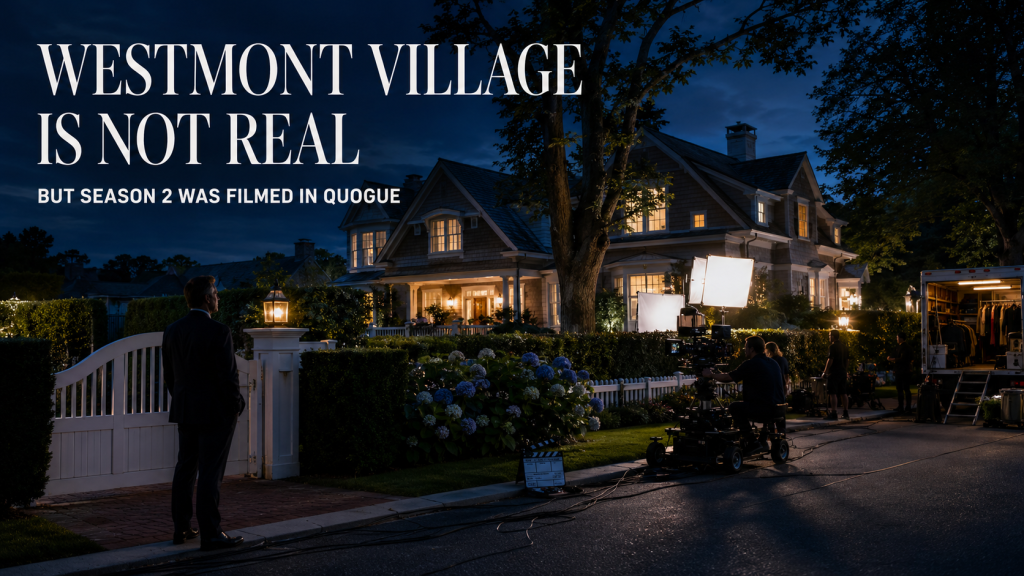
Westmont Village does not exist. The houses do, the clubs do, and in season two one of them is in Quogue.
Apple’s series is set in a fictional suburb somewhere north of the city. Production built it out of real Westchester streets, then expanded onto Long Island for season two. That expansion is the part nobody wrote about, and it is the reason the show suddenly reads so differently to an East End audience.
Here is every location, what it stands in for, and what each choice says about the people who live there.
Westmont Village Is Six Towns in a Coat
The core of Westmont is Westchester County. Purchase, Harrison and West Harrison supply most of the residential streets, while Briarcliff Manor fills in the rest.
Village exteriors come from Rye, Tuckahoe and Yonkers. Interiors and stages run out of Great Point Studios in Yonkers, with base camps at Manhattanville University and Purchase College.
So the neighborhood you watch is stitched from at least six municipalities. That is standard practice, but it produces something strange. Westmont feels coherent precisely because no real town is that consistent.
Yonkers Public Library and Westchester County Airport also turn up, the airport in the way airports always appear in shows about this income bracket. Briefly, and without anyone waiting in a line.
Season Two Came to the Hamptons
Here is the detail that should interest anyone reading this from east of the canal. Owen Ashe’s Hamptons house was shot in Quogue.
Production designer Anu Schwartz built it as a modern property reflecting what she described as Ashe’s eclectic and impulsive taste. Which is a generous way of saying the billionaire bought whatever he liked, quickly, and did not consult anyone.
Nick Brandes also gets a Long Island mansion in season two, considerably bigger than his original house, with a bowling alley and a basketball court. The upgrade is the plot point. Nothing announces a man managing his own money like a private bowling alley.
So the show’s second season quite literally moved east as the money got louder. That is not a coincidence any East End reader will need explained.
The Clubs Are Real Clubs
Four names carry the country club scenes. Sleepy Hollow Country Club, Old Oaks Country Club, Westchester Country Club and The Belvedere Estate.
These are not sets. They are functioning clubs with functioning membership lists, which means the production had to be invited in. Somebody made calls.
Watch how the club scenes are staged. The camera stays at table height, never wide enough to admire the room, because the show is not interested in the architecture. It is interested in who is looking at whom across it.
Anyone who has sat through a Memorial Day lunch out here will recognize the blocking immediately. The room is a seating chart with a bar attached.
The Streets Were Chosen for One Reason
Location scout Shane Haden said something about the selection process that explains the whole series.
They deliberately avoided neighborhoods where the houses sit behind gates, long drives and heavy screening. The story required properties close enough together that neighbors could actually see each other.
That single constraint is the difference between Westchester money and East End money. Westchester is proximity, so surveillance is passive and constant. Out here we bought the hedges specifically to end that.
Still, the hedges do not work. Word travels faster on Ocean Road than on any Rye cul-de-sac, because the population is smaller and the season is short. We simply pay more for the illusion.
Mel’s House Is the Best Casting in the Show
Mel Cooper’s house sits in Harrison, and Schwartz chose a craftsman specifically to keep her out of the McMansion category the rest of the neighborhood occupies.
Classic lines. Good finishes. Nothing shouting. In a show where every other property is performing, Mel’s house is the only one that appears to have taste rather than a decorator.
Read that as characterization, because it is. Mel is the one person in Westmont whose social position does not depend on a recent transaction.
The East End version of this house is in the village, not on the ocean. Shingle, mature plantings, bought before the road became a road. Nobody who owns one will tell you what it cost.
Sam Levitt’s House Tells On Her
Sam’s house is in Purchase, and Schwartz was direct about the design brief. The decor runs almost garish, with leopard accessories offset by genuinely good furniture.
Sam grew up in South Boston. Everything in that house is a negotiation between where she came from and where she now needs to appear to belong.
That is the most sympathetic thing the show does for her, and it does it entirely through objects. No dialogue required.
Because the tell is never the money. It is the ratio of confidence to reference material, and Sam’s house has too much of one and not enough of the other.
Ashe’s Walls Are Worth More Than the House
Owen Ashe’s Westmont property was dressed with museum-quality reproductions. Schwartz has said the implied values run from $30 million and $40 million up past $100 million.
Reproductions, obviously. Nobody hangs a real one on a set. But the decision to imply nine figures of art in a suburban living room is a deliberate character note about a man who buys certainty rather than pleasure.
Notably, art is the one asset class the show treats as genuinely smart. We wrote about why in the painting he steals.
His house is also where the season ends badly, on a marble floor, which is the sort of joke a good production designer sets up months in advance.
The Quogue Choice Was Not Random
Of every village on the South Fork, Quogue is the least obvious place to put a billionaire, which is exactly why it works.
Quogue is old, small and deliberately quiet. No scene, no strip of restaurants competing for a Saturday, no interest whatsoever in being photographed. Families have summered there for generations without ever announcing it.
So dropping Owen Ashe into that village is a joke with a very specific punchline. He is the loudest possible man in the most understated possible place, and the house they built for him is modern and impulsive in a village that is neither.
Anyone who has watched a new arrival buy west of the canal and immediately install something the neighbors describe as “interesting” understands the dynamic. Quogue absorbs him. But Quogue does not become him.
Compare that to what would have happened if production had put Ashe on Meadow Lane. He would have blended in, and the joke would have died.
What These Houses Actually Cost
Run the two markets side by side and the comparison gets uncomfortable.
A serious house in Purchase or Harrison, the kind Westmont is built from, trades in the low to mid seven figures. Handsome, large, walkable to nothing, and priced like a primary residence because that is what it is.
Move the same square footage to Water Mill or Bridgehampton and the number multiplies several times over. Put it near the ocean and it multiplies again. Yet almost nobody sleeps in it after October.
That is the whole East End premium in one sentence. We pay a multiple for a house we occupy a third of the year, then carry it through the other two thirds at full cost.
Coop’s crisis is a Westchester crisis at Westchester prices. Run the same job loss against a Sagaponack carry and the math gets considerably worse, considerably faster.
Do the Drive: A Half-Day Westmont Tour
For anyone who wants to see it, the route is manageable in an afternoon.
Start in Rye for the village exteriors, then push north through Harrison and West Harrison for the residential streets. Purchase comes next, since Sam’s neighborhood and several base camp locations sit within a few minutes of each other.
After that, Briarcliff Manor fills out the quieter stretches. Finish in Yonkers, where Great Point Studios handled the stage work and the public library turns up on screen.
Do not attempt the clubs. Sleepy Hollow, Old Oaks and Westchester Country Club are private, and arriving unannounced with a camera is the fastest way to confirm every stereotype the show is built on.
Where to Eat If You Do the Tour
Several real establishments appear as themselves or under new names.
- The Brazen Fox, playing The Tap Ale House
- Aurora Restaurant
- Ruby’s Oyster Bar and Bistro
- Saigon Table
- Sunshine Coffee Roasters
None of these are grand, and that is the point. The show puts its characters in ordinary places constantly, because the drama is never about the venue. It is about who walks in.
Jon Hamm was also spotted getting coffee in Westchester during production, which locals handled with the restraint you would expect, meaning none at all.
Anu Schwartz Is the Real Author of Westmont
Credit where it belongs. The production designer did more character work than most of the scripts did.
Schwartz has described the goal as building aspirational spaces that reflect a culture of competitive wealth display. Every house in the series is arguing with the house next door, and the argument is conducted entirely in finishes.
Look at what she withholds. Mel gets restraint. Sam gets slightly too much. Nick gets amenities that only make sense as proof of purchase. Ashe gets art valued in an implied nine figures and no discernible point of view.
Because in this world, a room is a resume. Anyone reading it correctly can tell you when the money arrived, from where, and whether the owner had help choosing.
That skill is not fictional. Walk into four houses on the same East End lane and you will date each fortune within a decade, purely from the kitchen. The full status reading is in quiet luxury is over.
What Westchester Has That We Do Not
Watching Westmont from the East End produces one persistent envy, and it is not about houses.
Westchester is populated year round. Neighbors are home in February. Somebody notices an unfamiliar car. The social fabric that makes the show’s plot possible also makes it harder to rob those houses than to rob ours.
Out here the season ends and the road empties. Nine months of darkness, with a published calendar telling anyone who cares exactly when it starts. That vulnerability is examined in nine months empty.
So the show is set in the safer version of our neighborhood. Season two moving east was not just a production decision, it was an escalation, and the full read on why this series lands so hard out here is in the Westmont Village files.
Where The Conversation Continues
Social Life Magazine covers the East End the way this show covers Westmont. From inside the room, with the seating chart memorized.
The summer issue reaches 25,000 homes between Southampton and Montauk. The list runs 82,000 deep. On July 24 and July 31, 2027, it converges on a lawn in Bridgehampton for Polo Hamptons.
Brokerages, architects, landscape designers and privacy specialists all sell into the exact anxiety this article names. If that is your category, the conversation starts now. Season partners are placed through the fall and winter, long before a tent goes up.
Author

Written by
Recent Posts

How to Choose Useful Tech Gifts for Employees and Clients in 2026
The Garage Question: Which Car Goes South for the Season?
VandS Clinic Review Treatment: How Seoul Injectable and Laser Options Compare for US Patients
Before Buying a View Home: What a Sloped Lot Means for the Purchase

Powerful Strategies to Stay Ahead in a Fast-Moving Real Estate Market
Categories
- Art
- Articles
- Business of Luxury
- Celebrities
- Culture
- Entertainment
- Events
- Faces of Summer 2026
- Fashion
- Fashion & Style
- Featured
- Finance
- Food, Spirits, Wine
- Hamptons
- Hamptons Celebrities
- Health
- Health & Beauty
- Lifestyle
- Luxury Lifestyle
- Press
- Profiles
- Real Estate
- Technology
- The Chronicles
- Travel
- Uncategorized
- Weddings