
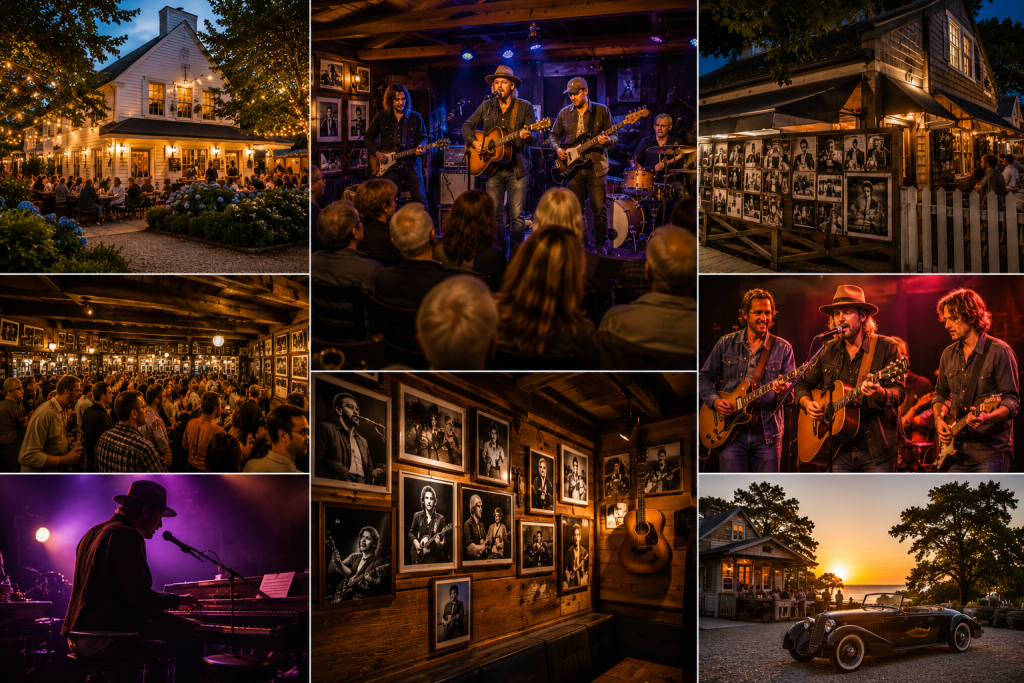
A Man, a Bar, and 50 Rock and Roll Hall of Famers
At 161 Main Street in Amagansett, there is a room roughly 20 feet by 20 feet. It has a bar at one end, a stage at the other, and a large photograph of a Montaukett Native American man as the permanent backdrop. His name is Stephen Taukus “Talkhouse” Pharaoh, born around 1819, a Montaukett who walked 25 to 50 miles a day between Montauk and Sag Harbor delivering letters and selling scrub brushes until he died on a trail in 1879. This room is the Stephen Talkhouse Amagansett, and in its 55 years of existence, over 50 Rock and Roll Hall of Fame artists have performed beneath that photograph. Paul McCartney. Billy Joel. Paul Simon. Sting. The Rolling Stones. Van Morrison. Jimmy Buffett. Ed Sheeran. The room holds maybe 200 people on a packed night. After all, most of those performers could fill Madison Square Garden.
Yet they chose this instead.
That choice is the whole story. In a hamlet with no village government, no gala circuit, no private club, and no event calendar, the Stephen Talkhouse functions as Amagansett‘s town hall, its cultural institution, and its social equalizer. To understand this venue, you first have to understand the man it’s named for. Then you have to understand the building. Then you have to understand why, on a random Tuesday night in July, a billionaire from Further Lane and a line cook from Montauk Highway are standing shoulder to shoulder in the dark, holding beers, watching the same band.
The Walker: Stephen Taukus Pharaoh (1819-1879)
Stephen Talkhouse was born around 1819 in a wigwam at Accabonac, in what is now Springs, a hamlet within the Town of East Hampton. He was a Montaukett, a descendant of Chief Wyandanch, the leader who had greeted the first English settlers on Long Island in the mid-17th century. Amagansett’s founding families arrived in 1680 on land the Montaukett had occupied for centuries. Talkhouse inherited a bloodline that predated every deed, every hedgerow, and every Further Lane transaction by generations.
The Walk, the War, and the Circus
During the Civil War, Talkhouse served his country. Afterward, he hunted whales in the Pacific. By some accounts, he panned for gold in California. However, what made him famous was walking. Every day, he covered 25 to 50 miles on foot between Montauk, East Hampton, and Sag Harbor, delivering letters and packages to households along the route. Additionally, he carried hand-carved scrub brushes to sell to housewives. His speed was legendary. He could deliver a message to someone in Sag Harbor and return the same day with a reply. In an era before telephones, Talkhouse was the telecommunications infrastructure of eastern Long Island.
P.T. Barnum, ever alert to exploitable spectacle, hired Talkhouse for his circus. Barnum billed him as “The Last King of the Montauks” and staged races against horse-drawn wagons. Naturally, Talkhouse was neither a king nor the last Montaukett. Barnum’s commitment to accuracy was, characteristically, nonexistent. Still, the circus exposure cemented Talkhouse’s reputation beyond the East End. He became a regional celebrity, though the celebrity mattered less to him than the walking did.
Death on the Trail
Talkhouse died on August 30, 1879, reportedly of tuberculosis, while walking one of his trails. He was approximately 60 years old. Today, he rests in Indian Fields, a small burial ground on Talkhouse Lane off East Lake Drive in Montauk, within Theodore Roosevelt County Park. A government military headstone marks his grave. The remains of his home are located nearby. Part of his walking route has been commemorated as a section of the Paumanok Path, a 125-mile trail that crosses Long Island from Rocky Point to Montauk Point. In death, Talkhouse still walks the island. The path bears his footprints even if the sand has long forgotten them.
The Building: From Whaler’s Boarding House to Rock Venue
The structure at 161 Main Street was built in 1834 by a local whaler named Erastus Barnes. (Some sources say 1832, but the consensus points to 1834.) Originally a boarding house for whalers, it served the men who launched boats from Amagansett’s shores in pursuit of right whales and sperm whales migrating along the South Fork coast. At the time, whaling was a primary industry in the hamlet during the early 19th century, and the Barnes boarding house provided lodging, meals, and community for men whose work was brutal and seasonal.
The Incarnations
Over the next 150 years, the building cycled through multiple identities. It became an Italian restaurant. By the 1970s, it had become a jukebox bar and dance club. In 1970, Albert “Buddy” Pontick Jr. and Terry Butler opened it as the Stephen Talkhouse, naming it after the Montaukett walker whose legend still circulated through East End oral history. The bar featured a jukebox, a dance floor, and the photograph of Talkhouse that would become the permanent backdrop. Subsequently, for 17 years the Talkhouse operated as a local dive with occasional live music and a reputation for late-night energy.
Then, in 1987, Peter Honerkamp changed everything. Pontick’s partnership had dissolved and the bar sat shuttered. Honerkamp, who had no formal music industry experience but a deep love for venues like My Father’s Place (the legendary Roslyn club), bought the Talkhouse on what he later described as a whim. He went to his father and his in-laws for the money. Essentially, he had the financing within a week. He kept the name and the photograph. Then he removed the dance floor and installed a proper stage. The Stephen Talkhouse became a live music venue, and it has been one ever since.
The Performers: A Partial Inventory
The list of artists who have performed at the Stephen Talkhouse reads like a deliberate provocation against the concept of venue size determining artistic significance. Over 50 Rock and Roll Hall of Fame inductees have played in this 20-by-20-foot room. A partial inventory includes Paul McCartney, Billy Joel, Paul Simon, Sting, Jimmy Buffett, Jon Bon Jovi, Ed Sheeran, Van Morrison, Roger Waters, Crosby Stills and Nash, the Allman Brothers, Metallica, Judy Collins, the Wailers, Southside Johnny, Jimmy Cliff, the Killers, and Gary Clark Jr.
Why They Come
The explanation is partly geographic. Nearly all of these musicians own or rent homes on the East End. Paul McCartney has a long history in the Hamptons. Billy Joel is a Sag Harbor resident. Sting, Bon Jovi, and Ed Sheeran have all spent significant time on the South Fork. When you live 20 minutes from a venue where the audience is 200 people and the sound is intimate, the temptation to play is enormous. What the Talkhouse offers is something no arena can: proximity. Performers are close enough to see individual faces. And the audience is close enough to feel the vibration of the bass in their chest.
But geography alone doesn’t explain it. Plenty of East End venues have stages and proximity. What the Talkhouse has, uniquely, is the photograph. Stephen Taukus Pharaoh stares out from behind the stage, and every performer who stands in front of that image is implicitly performing under the gaze of a Montaukett man who walked 50 miles a day and died on a trail. Consequently, the room carries a weight that no amount of lighting design or sound engineering can replicate. It is the weight of a place that was something long before it was a music venue, and will be something long after.
First Night at the Talkhouse
The East Village guitarist arrives for his first Talkhouse gig on a Saturday in August.
CBGBs (before it closed). The Bowery Ballroom. Berlin basements.
He walks through the door and sees the room. Twenty by twenty. Maybe.
He sees the photograph behind the stage. A Montaukett man with a walking stick.
“Who’s that?” he asks the bartender.
“That’s the man they named the place for. Walked fifty miles a day.”
So the guitarist plugs in. The room fills. That photograph watches.
His best set ever. Nobody knows why. The photograph does.
The Audience: Amagansett’s Great Equalizer
In a hamlet without a village government, without a private club, without a charity gala circuit, the Talkhouse fills a structural role that extends beyond entertainment. It is Amagansett’s common room. For instance, on any given Saturday night in July, the audience includes Further Lane residents whose combined net worth exceeds the GDP of some Caribbean nations, year-round Amagansett locals who work in construction or landscaping, summer renters from Brooklyn who discovered the hamlet three years ago, and tourists who wandered in because they heard music from the street.
No VIP Section
The room is too small for tiers. There is no VIP section because there is no room for one. The bar is too narrow for bottle service. The music is too loud for networking. What remains, after you subtract every mechanism that typically sorts a Hamptons crowd into hierarchies, is the thing itself: live music, cold beer, and the residual energy of a building that has been a gathering place since 1834. Bill and Hillary Clinton have been in the audience. So has Mick Jagger. So has Benazir Bhutto, the former prime minister of Pakistan (who, according to Peter Honerkamp, ordered skim milk). In the Talkhouse, nobody is more important than the music. That is the rule, and the rule is enforced by the dimensions of the room.
Peter Honerkamp and the Next Generation
Peter Honerkamp has operated the Talkhouse since 1987. His son Max grew up behind the bar. One of Max’s earliest memories is watching Sting perform for a VH1 recording in 1996, when Max was seven years old, sitting behind the bar because the camera rig took up all the floor space. Currently, Max serves as general manager, and the venue has expanded its cultural footprint: Ruby Honerkamp, Peter’s daughter, created Talkhouse Encore, a line of beverages that pays homage to the bar her father built.
The Institution Endures
The Talkhouse has survived trends, recessions, pandemics, and the general entropy that claims most independent music venues within a decade. It has outlasted CBGBs (closed 2006), Wetlands Preserve (closed 2001), and countless other rooms that once seemed permanent. The explanation is simple: the Talkhouse is not just a venue. It is a community institution in a community that has very few institutions. Bridgehampton has Polo Hamptons and the Hampton Classic. Sag Harbor has Bay Street Theater. Southampton has its private clubs. Amagansett has a 20-by-20-foot room with a photograph of a Montaukett walker on the wall. That is enough. Indeed, that has always been enough.
The Williamsburg songwriter walks out of the Talkhouse at 1:30 a.m. on a Sunday.
Ears ringing. Shirt smells like beer. Voice gone.
She stands on Main Street. Amagansett is silent. One streetlight. Zero cars.
She thinks about the photograph behind the stage. The Montaukett who walked fifty miles a day.
She walked twelve blocks to the L train this morning. She was tired.
He walked from Montauk to Sag Harbor and back. Every day. For decades.
She starts the car. The ringing fades. The silence stays.
Some places make music. The Talkhouse remembers it.
Where the Conversation Continues
Social Life Magazine has covered the East End’s cultural scene for 23 years. Five summer issues, 25,000 copies each, distributed in the restaurants, hotels, and venues from Westhampton to Montauk. When the Talkhouse books a surprise headliner, the story often lands here first.
If your brand serves the Amagansett audience (music, spirits, lifestyle, hospitality, nightlife, audio equipment), a feature in Social Life Magazine puts you in the room. Learn more at sociallifemagazine.com/submit-a-paid-feature.
Polo Hamptons 2026 returns to Bridgehampton on July 18 and July 25. BMW North America is title sponsor. Christie Brinkley hosts. After the polo, the Talkhouse. That’s the Saturday. Reservations at polohamptons.com.
Subscribe at sociallifemagazine.com/subscription for every issue.
Stephen Talkhouse walked 50 miles a day and died on a trail. The bar named for him has outlived every trend for 55 years. Some things don’t need to be loud to last.
Author

Written by
Recent Posts

Powerful Strategies to Stay Ahead in a Fast-Moving Real Estate Market
How Latino Players Have Helped Shape Modern Basketball Culture
10 Best Designer iPhone 18 Pro Cases to Choose From

AI for personal finance: where PennyGuard fits

How to Pick a Homecoming Dress for Your Body Type (and Feel Amazing in It)
Categories
- Art
- Articles
- Business of Luxury
- Celebrities
- Culture
- Entertainment
- Events
- Faces of Summer 2026
- Fashion
- Fashion & Style
- Featured
- Finance
- Food, Spirits, Wine
- Hamptons
- Hamptons Celebrities
- Health
- Health & Beauty
- Lifestyle
- Luxury Lifestyle
- Press
- Profiles
- Real Estate
- Technology
- The Chronicles
- Travel
- Uncategorized
- Weddings