
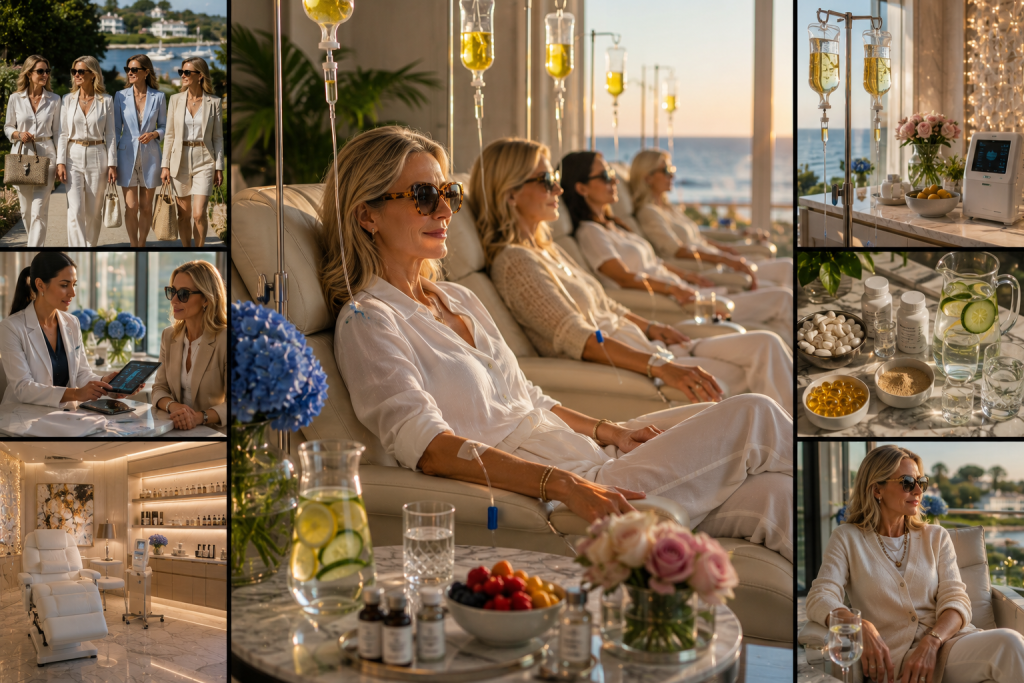
Daymond John’s wife introduced him to biohacking. He was the one who got the Fortune cover. That dynamic, woman discovers the protocol, man receives the credit, captures something essential about the women biohacking longevity trend that the industry is only now beginning to acknowledge. The Global Wellness Summit’s 2026 report named it a defining shift: “Women finally getting their own lanes in longevity.” That same spring, the Biohacking Index dedicated its March 2026 edition entirely to female founders, clinicians, and innovators. After decades of longevity research built on male data and protocols designed for male biology, the era of extrapolation is ending. And on the East End, the women who have been quietly driving the spending all along are stepping into view.
The longevity market is tacitly male. Bryan Johnson is the face. Peter Attia wrote the bestseller. Bezos and Thiel write the checks. But in households across the South Fork, the person researching clinics, booking appointments, managing supplement schedules, and introducing the family to new wellness practices is overwhelmingly female. The longevity billionaires fund the science. East End women fund the adoption.
The Invisible Majority
Women control approximately 80% of household healthcare spending decisions in the United States. On the East End, where dual-income households routinely allocate $10,000 to $50,000 annually to wellness services, that decision-making authority translates directly into clinic bookings, supplement purchases, and treatment adoption. The woman who schedules a Prenuvo full-body MRI scan for herself books one for her husband the following month. Her friend who tries NAD+ infusions at Hamptons BioMed tells three more friends at the next dinner party. The adoption curve for longevity services on the East End runs through female networks.
Yet the industry’s marketing, its media coverage, and its public figures are predominantly male. Johnson, Attia, Sinclair, Huberman. Podcast hosts, supplement brand founders, and conference keynote speakers are overwhelmingly men talking to what they assume is a male audience. The women biohacking longevity trend has been invisible not because women are absent but because the category was built without looking at who was actually buying.
The Global Wellness Summit’s research confirms what East End providers already know: women age differently, respond to interventions differently, and have health priorities (hormonal cycling, perimenopause, menopause, bone density, autoimmune risk) that male-designed protocols do not address. A supplement stack calibrated for a 48-year-old male tech founder is not optimized for a 52-year-old woman navigating perimenopause. The market that serves both with the same product is leaving value on the table and failing half its customers.
The Hormone Conversation That Changed Everything
Hormone replacement therapy was taboo for nearly two decades after the Women’s Health Initiative study in 2002 linked HRT to increased cancer and cardiovascular risk. That finding, later challenged by reanalysis showing the risks applied primarily to older women starting HRT years after menopause, caused a generation of women to suffer through symptoms that had a clinical solution. By 2026, HRT has been rehabilitated. Practitioners now frame it as a proactive longevity tool when initiated during the perimenopause window.
For East End women, the rehabilitation of HRT opened a door to the broader longevity conversation. Testosterone optimization (yes, for women, at much lower doses than male protocols) supports energy, libido, cognitive function, and muscle maintenance. Progesterone and estradiol manage the symptoms that make perimenopause and menopause the primary health disruption of midlife. Once a woman engages with hormone optimization, the path to NAD+ infusions, peptide therapy, and comprehensive biomarker tracking is short. HRT is the gateway treatment for the women biohacking longevity trend on the South Fork.
Dedicated women’s health programs are emerging at luxury wellness resorts and telehealth platforms, addressing the full arc of female biology from the twenties through the nineties. These programs apply the same sophistication previously reserved for cardiac or metabolic health to reproductive aging, bone density, autoimmune management, and cognitive preservation. For the first time, the longevity industry is building protocols that start with female biology rather than adapting male protocols after the fact.
What East End Women Actually Spend On
Gwyneth Paltrow’s Instagram wellness dumps are not aspirational fiction for the East End audience. They are shopping lists. Clearlight infrared sauna. Prenuvo scan. Longevity colostrum. Sakara protein powder. The woman reading that post in Water Mill does not need convincing. She needs a local provider who stocks the same products and offers the same services.
The spending profile of the East End female longevity client looks like this. Monthly: NAD+ infusion ($500 to $750), supplement stack ($200 to $400), fitness programming with longevity metrics ($300 to $500). Quarterly: comprehensive bloodwork and hormone panel ($500 to $1,500), peptide therapy consultation ($300 to $750). Annually: Prenuvo full-body MRI ($2,500), longevity retreat or intensive assessment ($5,000 to $20,000). The annual total ranges from $12,000 to $40,000. For a household spending $150,000 on a summer rental, $30,000 on longevity is not a stretch. It is a reallocation from categories that deliver diminishing returns (another handbag, another renovation) to a category that compounds (additional healthy years).
The spending is not performative in the way that longevity status signaling can be for men. East End women tend to share protocols privately, in group chats and at small dinners, rather than posting biological age scores on social media. The network effect is quieter but arguably more powerful. A recommendation from a trusted friend converts at a higher rate than a celebrity endorsement. And on the East End, where social networks are dense and trust is high, a single enthusiastic client can fill a clinic’s summer roster.
Why Providers Are Finally Paying Attention
Hamptons BioMed at 223 Hampton Road in Southampton was built to serve a mixed-gender client base, but the early booking patterns tell a specific story. Women book first. They book for their partners second. Friends get referred third. Tapp Francke, the clinic’s clinical nutritionist and co-founder, built the practice with an understanding that the female client is not just a customer. She is the distribution channel.
Medspas transitioning to longevity have a structural advantage in serving the women biohacking longevity trend because their existing client base is predominantly female. The woman who has been coming in for Botox and laser treatments for five years already trusts the practice, already has a relationship with the clinical staff, and is already spending at premium price points. Adding hormone consultations, NAD+ drips, and peptide protocols to her treatment plan is an expansion of an existing relationship, not a cold acquisition. For medspa operators reading this, the female longevity client is not a new customer to find. She is the existing customer you have not yet served fully.
Social Life Magazine reaches this audience directly. Our readership skews female, affluent, and health-conscious, precisely the demographic that drives longevity adoption on the East End. For wellness brands, clinics, and product companies building for the female longevity market, editorial visibility in SLM is not a media buy. It is a placement inside the conversation where purchasing decisions are made.
What Comes Next for Women in Longevity
The Biohacking Index’s March 2026 report, dedicated entirely to women in the space, signals a structural shift. Female founders are building longevity clinics, formulating supplements calibrated for female biology, and designing protocols that address the health priorities women have been told to manage with less data and fewer options than their male counterparts. That gap is closing, and the speed of closure will determine which brands capture the female longevity market as it scales.
For the East End, the implications are commercial and immediate. The supplement brands that formulate specifically for women (perimenopause support, bone density, hormonal balance, iron and B12 optimization) will outperform the brands selling unisex stacks. The clinics that hire female practitioners, design consultation experiences with female patients in mind, and build referral networks through the social channels women actually use will capture disproportionate market share.
Women did not discover longevity in 2026. They have been practicing it, funding it, and spreading it for years, without the magazine covers, the podcast empires, or the social media followings. What changed is that the industry finally noticed. For Social Life Magazine, the women biohacking longevity trend is not a new story. It is the story we have been covering for 23 years under different names: wellness, beauty, health, self-care. Longevity is just the latest vocabulary for what East End women have always understood: that investing in yourself is the highest-returning asset class.
Where The Conversation Continues
Women built the longevity market. Social Life Magazine covers it. For 23 years, SLM has served the audience that defines the culture of the East End, and that audience has always been led by the women who set the table.
If you build products, deliver services, or create content for women in the longevity space, reach out at [email protected].
For brands seeking premium placement, explore our Paid Feature options.
Stay current at sociallifemagazine.com.
Polo Hamptons returns July 18 and 25, 2026, at 900 Lumber Lane, Bridgehampton. BMW is the title sponsor. For sponsorship inquiries, visit polohamptons.com.
Already a reader? Subscribe to Social Life Magazine for five summer issues and Fall/Winter editions.
Support independent East End journalism via PayPal.
Frequently Asked Questions
Are women driving the longevity trend?
Yes. Women control approximately 80% of household healthcare spending decisions and are overwhelmingly responsible for researching clinics, booking treatments, managing supplement schedules, and introducing families to longevity practices. The Global Wellness Summit’s 2026 report identified women in longevity as a defining trend, noting that the industry has been “tacitly male” with protocols extrapolated from male data. Women are both the primary adopters and the primary referral network for longevity services on the East End.
What longevity treatments are specifically relevant for women?
Key treatments include hormone replacement therapy (estradiol, progesterone, and low-dose testosterone), which has been rehabilitated as a proactive longevity tool during perimenopause. NAD+ infusions support cellular energy during hormonal transitions. Comprehensive bloodwork should include female-specific markers (estrogen, progesterone, FSH, thyroid panel, iron, B12, bone density indicators). Peptide protocols can be calibrated for female-specific goals. Full-body MRI scans (such as Prenuvo) provide early detection for cancers that disproportionately affect women.
How much do East End women spend on longevity?
Annual longevity spending for East End women typically ranges from $12,000 to $40,000. Monthly costs include NAD+ infusions ($500 to $750), supplement stacks ($200 to $400), and fitness programming ($300 to $500). Quarterly expenses include bloodwork and hormone panels ($500 to $1,500) and peptide consultations ($300 to $750). Annual investments include full-body MRI scans ($2,500) and longevity retreats or intensive assessments ($5,000 to $20,000).
Why has the longevity industry been male-focused?
The most visible longevity figures (Bryan Johnson, Peter Attia, David Sinclair) are men, and much longevity research has been conducted on male subjects with results extrapolated to women. Women age differently, respond to interventions differently, and have distinct health priorities including hormonal cycling, perimenopause, menopause, bone density, and autoimmune risk. The Global Wellness Summit and the Biohacking Index both identified 2026 as the year women are “finally getting their own lanes in longevity.”
Author

Written by
Recent Posts
Periorbital Biorevitalization: Top Methods for Combating Dark Circles
Why a Natural-Looking Hairline Matters More Than a Perfect Haircut

Melanotan 2 and the Regulatory Grey Zone: What Research Buyers Should Understand
Discovering the Elegance and Durability of Slate Roof Tiles
Montauk Calls Itself The End Of The Road But Ushuaia Actually Is
Categories
- Art
- Articles
- Business of Luxury
- Celebrities
- Culture
- Entertainment
- Events
- Faces of Summer 2026
- Fashion
- Fashion & Style
- Featured
- Finance
- Food, Spirits, Wine
- Hamptons
- Hamptons Celebrities
- Health
- Health & Beauty
- Lifestyle
- Luxury Lifestyle
- Press
- Profiles
- Real Estate
- Technology
- The Chronicles
- Travel
- Uncategorized
- Weddings