
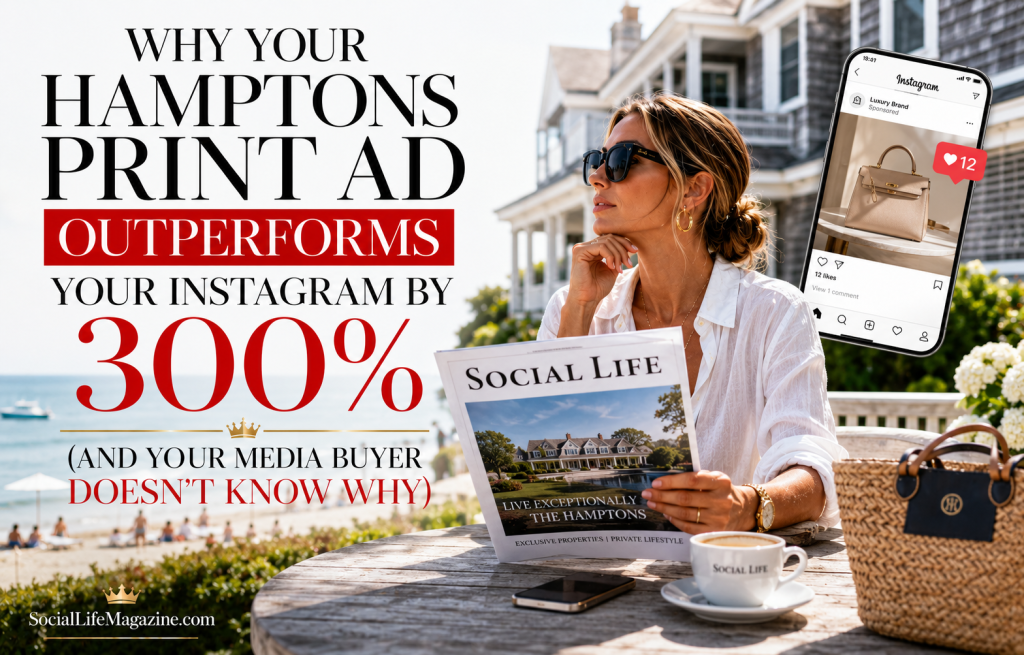
Every August, a certain kind of meeting happens in a certain kind of office in Midtown Manhattan. A media buyer pulls up a dashboard. The Instagram campaign ran all summer, served 4.2 million impressions, achieved a 0.4 percent click-through rate, and cost $38 per thousand. Social Life Magazine ran in three issues, reached an estimated 75,000 readers across the South Fork, and cost considerably more per impression by every conventional metric.
The media buyer recommends cutting the print budget.
She is not wrong about the numbers. In fact, she is wrong about what the numbers mean.
The gap between what luxury print advertising in the Hamptons actually does and what a standard media audit captures is not a measurement problem.
It is a perception problem. And it is one that costs luxury brands real money every summer, in the specific form of misallocated budgets that optimize for the metric that is easy to count rather than the outcome that actually drives purchase behavior.
Hamptons print advertising for luxury brands is not a nostalgic choice. It is a neurologically distinct form of brand communication that operates on a different register than any digital channel — and the behavioral science behind why is specific, well-documented, and almost entirely absent from agency media planning conversations.
The Neuroscience of Holding Something
There is a body of research in consumer psychology called “haptic cognition” — the study of how physical touch affects judgment, memory, and valuation. The core finding, replicated across dozens of studies, is consistent: people who physically hold an object assign it higher value than people who view the same object on a screen.
This is not a marginal effect. A 2014 Journal of Consumer Psychology study found tactile contact increased willingness to pay by 22 percent on average. University of Sussex research found that print readers retain information at significantly higher rates than digital readers. Some studies show recall advantages of up to 70 percent for print.
The mechanism is not complicated. When a reader holds a physical magazine, her brain processes the experience through multiple sensory channels simultaneously. That simultaneity is the mechanism. The weight of the object. Paper texture registers next. There is a slight resistance to turning a page. These sensory inputs are processed in the neural regions associated with ownership and value. As a result, the reader partially owns the experience before reading a word. The reader, in a measurable neurological sense, partially “owns” the experience of reading the publication before she has registered a single word of content.
When she encounters a luxury brand inside that experience, the brand inherits the ownership signal. Specifically, it is not just seen. It is held.
No digital placement produces this effect. A served ad on Instagram sits in a sensory environment associated with passive consumption and rapid scrolling. The thumb moves before the creative loads. The perceptual register is different. No creative excellence closes that gap, because the gap is architectural, not aesthetic.
Why the CPM Comparison Is the Wrong Comparison
The standard media planning objection to luxury print is cost-per-thousand impressions. Print is expensive on a CPM basis. Instagram is cheap. The math, on a spreadsheet, is not close.
But CPM measures the cost of an eyeball passing over a surface. It does not measure the quality of the cognitive state at the moment of encounter. It does not measure dwell time, return visits, or whether the encounter creates a memory that influences behavior months later.
Specifically in the Hamptons, the CPM comparison breaks down further because the print audience is not a proxy for the luxury consumer. It is the luxury consumer, in her natural habitat, in a self-selected state of engagement. A woman who picks up a copy of Social Life Magazine from the counter of a boutique on Jobs Lane in Southampton is not a member of a lookalike audience. She is the person your lookalike audience was modeled on.
The Memory Differential
Because she is already in the boutique, already in the summer, already in the perceptual state of a curation decision, her encounter with a brand in those pages is not an interruption. It is a discovery. And discoveries, in behavioral economics, are processed entirely differently than interruptions.
Sutherland notes in Alchemy that context determines whether information is categorized as signal or noise. An ad encountered mid-scroll on a phone is almost always noise. It gets ignored. An ad encountered inside a trusted editorial object, in a physical environment that has already been pre-selected for quality, has a significantly higher probability of being categorized as signal. Signal gets remembered. Noise gets ignored.
The luxury brand perception architecture that Social Life Magazine provides is not available on a CPM basis. It is available on an environment basis. And the price of the environment is what the CPM comparison systematically fails to capture.
The Dwell Time Nobody Is Measuring
Instagram’s average dwell time per post is 1.7 seconds. That is not a knock on Instagram, because the platform is built for volume. It is the architecture of the platform, optimized for volume and velocity rather than depth and retention.
Social Life Magazine’s average reader spends 35-45 minutes with each issue. Not all of that time is spent with any given ad or feature. But the cumulative effect of spending 40 minutes inside a curated editorial environment that contains your brand is categorically different from a 1.7-second encounter.
The difference is what behavioral scientists call “context contamination” — the transfer of an environment’s emotional and perceptual qualities to the content encountered within it. A reader who has spent 40 minutes in the company of editorial content she finds credible, aspirational, and aligned with her self-image is in a perceptual state that is unusually receptive to the brands that share that environment.
This is also why timing matters more than most media plans acknowledge. A reader who encounters a brand in a summer Social Life issue in late June is assembling her summer life at that exact moment. She is making decisions about what products belong in her summer. She is in an active curation mindset. The print placement hits her at the decision window — not during a random scroll at 11pm.
Digital retargeting can follow her from Southampton to SoHo in September, but the initial perception architecture But the initial perception architecture, the one that determines whether the retargeting ad lands as a reminder or as an irrelevant interruption, was built in June, on Jobs Lane, in a boutique, by a physical magazine she held in her hands.
The Frequency Effect That Print Creates
There is another dimension that almost never appears in media planning conversations: organic frequency within a single issue.
A reader who carries a Social Life issue in her beach bag for a weekend in Bridgehampton does not encounter the brands inside it once. She encounters them every time she opens the magazine — at breakfast on Saturday morning, waiting for a friend at the pool, on the ferry back to North Haven. Each encounter refreshes brand memory. No additional media spend required.
This organic frequency is not measurable by a dashboard. Yet it is precisely the mechanism behavioral psychologists identify as most effective for brand building. It does not show up in impression counts. But it is precisely the kind of repeated, low-intensity brand exposure that behavioral psychologists identify as the most effective mechanism for building the “mere exposure effect” — the well-documented phenomenon by which familiarity, produced by repeated encounters, converts into positive affect and purchase preference.
By contrast, digital frequency is a double-edged mechanism. Initial frequency builds familiarity, but the window is narrow. Excessive frequency produces ad fatigue — a measurable deterioration in brand sentiment that accelerates past a certain threshold. The optimal frequency window for digital ads is narrow and platform-specific. Exceed it, and sentiment erodes. Print does not produce ad fatigue. A reader does not resent the ad in the magazine she chose. She does not feel followed. The brand’s presence feels like part of the editorial world she opted into. That distinction, in the context of luxury brand building, is not a small thing.
What Your Media Buyer Should Be Measuring Instead
The question is not “what is the CPM of this print placement?” The right question is: what is the value of a brand encounter inside a trusted, curated, tactile environment, delivered to a self-selected luxury audience during the peak decision window of their summer?
That question does not have a tidy dashboard answer. But it has a real one.
Specifically, brands with consistent Social Life Magazine presence consistently report that their Hamptons market recognition outperforms digital-only counterparts by a margin reach alone cannot explain. The difference is not in the number of people who saw the brand. The difference is in the number of people who remembered it when it mattered.
For luxury brands evaluating their 2026 Hamptons strategy, the practical implication is direct: treat print as the perception architecture that makes every other channel work better. Retargeting ads work better when the reader already has a quality brand memory to activate. An influencer post lands better when the audience has already seen the brand in a context that confirmed its legitimacy. The event activation converts better when the guest already knows who you are.
Print is not the whole strategy. But in the Hamptons luxury market, it is almost always the foundation.
Submit a paid feature or full-page placement at sociallifemagazine.com/submit-a-paid-feature. Summer editorial closes earlier than most planning calendars expect.
Where The Conversation Continues
The print advantage is one dimension of a larger argument about how perception environments determine luxury brand outcomes in the Hamptons. The full framework lives in the hub: The Perception Economy: What Hamptons Luxury Brands Are Really Selling.
For the behavioral science behind why placement environment — not creative quality — determines whether a luxury brand gets remembered, see: The Lobby Test: How Luxury Brands Hack Status Perception Without Spending More (FUTURE).
The full pillar on luxury brand psychology in the Hamptons: Why Luxury Brands That Ignore Psychology Lose the Hamptons Every Summer.
Author

Written by
Recent Posts
Getting the Size Right on a Valley Dreams Zip Hoodie
The Traffic Patterns Hiding Inside the Accident Data
The Smart Way to Give Your Unused Jewelry a Second Life

Katsuya Brentwood and Haute Living Honor NBA Star Kawhi Leonard at Private Dinner

The Accountability System Quietly Protecting Your Parents’ Care
Categories
- Art
- Articles
- Business of Luxury
- Celebrities
- Culture
- Entertainment
- Events
- Faces of Summer 2026
- Fashion
- Fashion & Style
- Featured
- Finance
- Food, Spirits, Wine
- Hamptons
- Hamptons Celebrities
- Health
- Health & Beauty
- Lifestyle
- Luxury Lifestyle
- Press
- Profiles
- Real Estate
- Technology
- The Chronicles
- Travel
- Uncategorized
- Weddings