
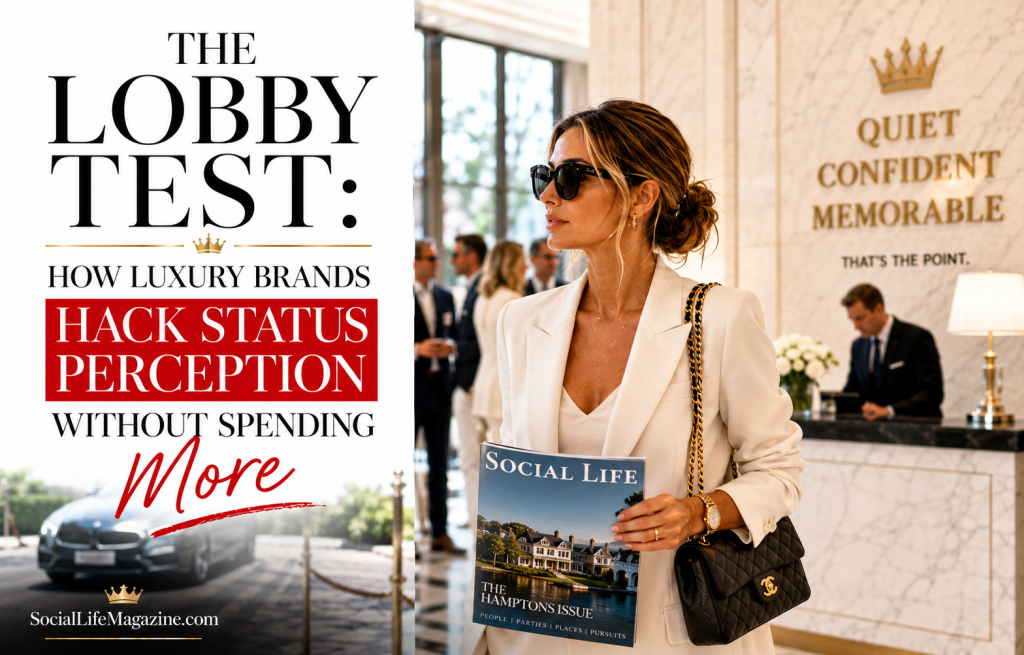
There is a test that every serious luxury brand should run before it commits a dollar to the Hamptons summer. It is informal, takes about four minutes, and is more predictive of brand performance than any media kit metric currently in use.
Walk into the lobby of a hotel in Sag Harbor. Or a boutique on Main Street in East Hampton. Or the waiting room of the most in-demand aesthetics practice in Southampton. Look at what is on the counter, the coffee table, the shelf near the door. Note the other brands in the room. Check the magazines. The objects placed there deliberately, by someone who cares deeply about what her space communicates, are your evidence.
Now ask: does your brand belong in that room? Not in a theoretical sense.
Does it belong there the way the other objects do — because someone with taste and authority decided it earned its place?
That is the lobby test. And it is, in behavioral terms, the most precise diagnostic available for luxury brand status perception in the Hamptons. Because in this market, specifically, where you appear is what you are. Not what your ad says. Not what your packaging claims. Where you show up, and in what company, is the complete communication.
What the Room Is Actually Saying
Every curated environment in the Hamptons is a status declaration. The hotel lobby in Sag Harbor that stocks Social Life Magazine and a single stem of garden roses and nothing else is saying something specific about its positioning. A spa in Southampton that places certain skincare lines in its treatment rooms and not others is making an editorial decision about brand hierarchy. Any boutique that carries a magazine alongside its merchandise is extending its own curatorial authority to every brand that appears in those pages.
Yet these decisions are not made by marketing departments. They are made by owners, managers, and tastemakers who have spent years building the perception environment of their space. They are, in the most literal sense, brand decisions made by people who understand that their space is a brand.
Reading the Room
When a luxury brand earns placement in one of these environments, it is not buying an ad. It is passing an audition, specifically. It is passing an audition. And the audience watching that audition — the reader, the guest, the client in the waiting room — processes the result not as advertising but as editorial. She does not think “this brand has paid to be here.” Instead, she thinks “this brand belongs here.” The distinction, neurologically and behaviorally, is everything.
This is what Rory Sutherland means in Alchemy when he describes the “weed with an advertising budget” principle. A flower, he notes, is simply a weed that evolved to produce petals and scent as a form of costly signaling to pollinators. The signal works because it is genuine. Bees do not respond to fake flowers. They respond to the real investment of energy that a genuine flower represents.
A luxury brand earning genuine placement in a curated Hamptons environment is the flower. A served digital ad in a random scroll is the plastic imitation. The bee always knows the difference.
The Adjacency Effect: Who Else Is in the Room
Status perception in luxury markets is not absolute. It is relational, because consumers assess objects relative to their surroundings. A brand does not have a fixed status level that it carries into every environment. Its perceived status is partially determined by the other brands it appears alongside.
This is why placement strategy in the Hamptons is not just about reaching the right audience. It is about appearing in the right company. A skincare brand that appears in Social Life Magazine alongside editorial coverage of Jean Shafiroff’s philanthropy event, a feature on the new Bridgehampton polo season, and an article on the most sought-after properties on Meadow Lane is borrowing status from every other element in that editorial environment. The reader’s perception of the brand comes not just from the brand’s own communication but by the company it keeps.
Curation as Signal
Behavioral economists call this “context-dependent evaluation.” People do not assess objects in isolation. They assess them relative to the objects around them. A bottle of wine placed next to a superior bottle will be rated lower than the same bottle placed next to an inferior one. A luxury brand placed in a mediocre editorial environment will be perceived as less premium than the identical brand placed in a prestigious one.
The practical implication for Hamptons luxury strategy is direct: the question of which publications, events, and physical spaces your brand chooses to appear in is not a media planning question. It is a positioning question. Every environment your brand enters is a statement about what kind of brand you are. Choose badly, and no amount of creative excellence recovers the perception damage.
Social Life Magazine’s editorial environment, specifically, grew over twenty-three summers to carry a specific status signal. The covers, the features, the distribution points, the event associations — each is a selection decision that has accumulated into a perception architecture of considerable value to any brand that enters it.
The Medspa Case Study: When Placement Does the Work
The medspa and aesthetics category is, at present, one of the most competitive luxury brand environments on the East End. The number of high-quality practices operating between Southampton and Montauk has grown significantly over the past five years. Each of them offers comparable clinical expertise. Each of them serves a comparable client demographic. And yet their perceived status levels vary enormously — not because of clinical outcomes, but because of perception environments.
The practices with the highest perceived status are the ones that have been most deliberate about curation. Their waiting rooms contain specific objects. Branded materials appear in specific contexts. Its practitioners show up at specific events. Their names appear in specific publications.
A medspa featured in Social Life Magazine is not just a medspa with a press clip. It is a medspa curated by an editorial institution with twenty-three years of Hamptons authority. The feature is not advertising. It is an endorsement by association — the most powerful form of status transfer available in the luxury market, and the one that money alone cannot produce.
Because the feature reads as editorial, not advertorial, the reader processes it as a recommendation from a trusted source rather than a paid placement. Her perception of the practice rises not from the practice’s own claims but from the implicit endorsement of the publication that chose to cover it.
This is the lobby test applied at the editorial level. The question is not “did this brand pay for coverage.” The question is “did this brand earn a place in an environment that the reader already trusts?” When the answer is yes, the status transfer is clean and durable. It persists in the reader’s memory long after the issue itself has been recycled.
How to Engineer Placement Without Engineering It
The most common mistake luxury brands make in the Hamptons is attempting to manufacture the feeling of organic placement. They do it through artificial means. They buy display ads that mimic editorial. Sponsored content announces its sponsorship so aggressively that the announcement becomes the content. They activate at events with such visible brand saturation that the activation reads as desperation rather than belonging.
The problem is not the investment. The problem is the signal, because when a brand works too hard to be in the room, the room notices. And the Hamptons room — which is populated by people who have spent their entire adult lives being marketed to by the best agencies in the world — is particularly sensitive to the difference between a brand that belongs and a brand that is trying to look like it belongs.
The alternative is not to spend less. It is to spend on environments that do the work of legitimacy transfer on the brand’s behalf. A full-page in Social Life Magazine does this. A paid feature in the editorial style of the publication does this more completely. An event presence at Polo Hamptons — alongside BMW and Christie Brinkley, in a field in Bridgehampton that has become one of the most photographed summer settings on the East End — does this at the highest available level.
In each case, the brand is not claiming status. It is appearing in environments that have status to transfer. The difference, to the reader and the guest, is not subtle. One feels like advertising. The other feels like belonging.
Submit a paid feature at sociallifemagazine.com/submit-a-paid-feature and pass the lobby test before the summer locks.
Where The Conversation Continues
The lobby test is a diagnostic for placement strategy. The deeper argument about why perception environments determine luxury brand outcomes lives in the hub: The Perception Economy: What Hamptons Luxury Brands Are Really Selling.
For the neuroscience of why print advertising specifically outperforms digital in luxury brand recall, see: Why Your Hamptons Print Ad Outperforms Your Instagram by 300%.
For how quiet luxury brands use cultural capital rather than marketing volume to dominate the Hamptons, see: Why Quiet Luxury Brands Win the Hamptons (FUTURE).
The full pillar: Why Luxury Brands That Ignore Psychology Lose the Hamptons Every Summer.
Author

Written by
Recent Posts

AI for personal finance: where PennyGuard fits
How to Pick a Homecoming Dress for Your Body Type (and Feel Amazing in It)

World Cup Injury Attorney for Vancouver Events
What a 3-Carat Engagement Ring Actually Costs in 2026: The Real Numbers
The Skincare Habits That Make a Real Difference Over Time
Categories
- Art
- Articles
- Business of Luxury
- Celebrities
- Culture
- Entertainment
- Events
- Faces of Summer 2026
- Fashion
- Fashion & Style
- Featured
- Finance
- Food, Spirits, Wine
- Hamptons
- Hamptons Celebrities
- Health
- Health & Beauty
- Lifestyle
- Luxury Lifestyle
- Press
- Profiles
- Real Estate
- Technology
- The Chronicles
- Travel
- Uncategorized
- Weddings