
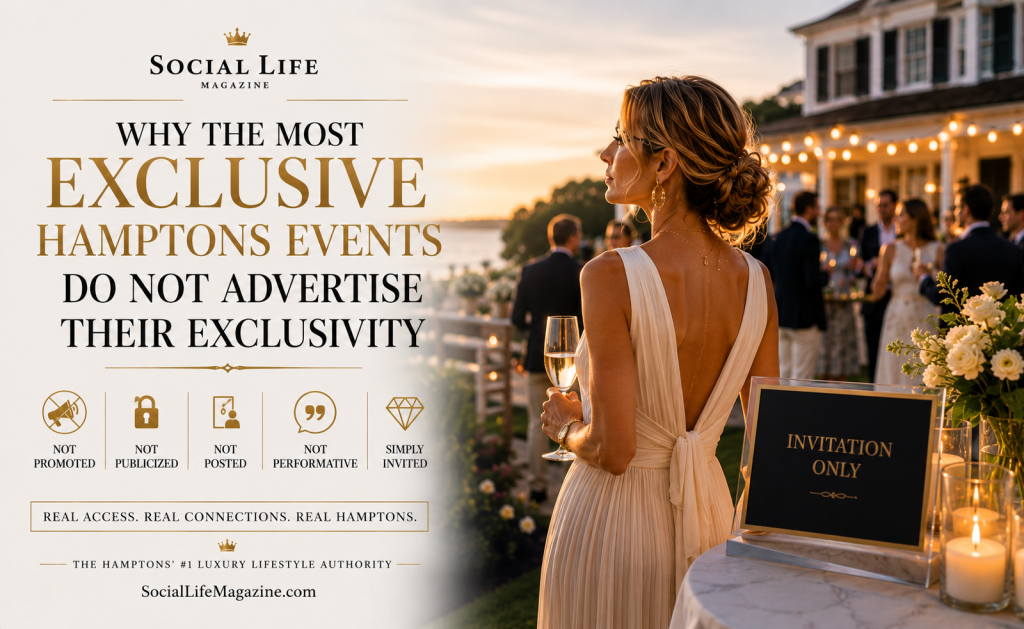
There is a dinner that happens every summer in Southampton. The host is someone you know, or know of. The guests are twenty people whose combined professional accomplishments would require a full paragraph to summarize. Outside, the table sits under open sky. The food is good but not performative. The conversation is the point.
Nobody photographed it for a brand. There were no sponsors. The host sent handwritten notes, not digital invitations. If you were not invited, you probably heard about it in September, from someone who was.
This is the event that every luxury brand in the Hamptons would pay to be associated with. And it is the event that no luxury brand can be associated with, precisely because its exclusivity is genuine. No advertising. No sponsors. It does not have a media partner. It exists entirely as a social fact, transmitted through conversation, and its value comes entirely from its unavailability to anyone who wants to attend it.
This is also the logic that every serious luxury event in the Hamptons is trying to approximate, and that most brand-sponsored events systematically undermine through the very act of branding them.
The Advertising Paradox
The paradox of exclusive events is structural: the act of advertising an event’s exclusivity destroys the exclusivity being advertised. An event that sends press releases about how exclusive it is has already demonstrated that it is not exclusive enough to sustain itself through word of mouth alone. An event that requires visible branding to attract attendees has revealed that its social capital is insufficient to generate attendance through social means.
The Hamptons luxury consumer — particularly the outlier buyer who sets the social agenda for the broader summer market — processes visible event advertising as a signal of insufficient social capital. An event that sends a handwritten save-the-date from a host whose name she recognizes — that event she will attend or decline based on social calculation. The event with billboards on Montauk Highway, she will not attend regardless of the stated lineup.
This dynamic creates an apparent trap for brands that want event association in the Hamptons: the events worth associating with will not accept visible brand association, and the events that accept visible brand association are not worth associating with.
The resolution is not obvious from conventional marketing logic. But Sutherland’s counterintuitive framework makes it legible. The brands that successfully associate themselves with genuine Hamptons exclusivity do so not through sponsorship in the conventional sense but through genuine participation. They are there because they belong there, not because they paid to be there. And the signal value of that genuine presence is precisely what the visible sponsorship destroys.
How Polo Hamptons Gets This Right
Polo Hamptons is a sponsored event. It has a title sponsor, named brand partners, and an explicit commercial relationship with Social Life Magazine. It is, in the most literal sense, not the dinner in Southampton described in the opening of this article.
But its design philosophy incorporates the exclusivity logic in ways that most sponsored events do not.
It sits at a specific address — 900 Lumber Lane, Bridgehampton — that carries its own social meaning in the Hamptons geography. The host, Christie Brinkley, provides a social credential that is genuinely earned rather than purchased. A ticketed structure limits attendance to a number that maintains the event’s feeling of intimacy. Editorial coverage in Social Life Magazine presents the event in the same voice the publication brings to non-sponsored events.
The result is an event that reads, to the Hamptons social consumer, as genuine rather than constructed. It is sponsored, but it does not feel like a marketing event. It feels like a Hamptons summer afternoon that happens to have excellent brand associations — which is the counterintuitive achievement that most sponsored events cannot reach.
For brands evaluating event presence on the East End, the lesson is not that sponsorship is incompatible with genuine exclusivity. It is that the design choices that produce genuine exclusivity are the opposite of the design choices that produce visible marketing. Less branding, not more. Fewer touchpoints, but more considered ones. An event that the right people want to attend, not one that reaches the largest possible audience.
Where The Conversation Continues
The exclusivity paradox is one application of the counterintuitive framework. Full hub: The Counterintuitive Hamptons: Why the Luxury Brands That Break the Rules Win the Season.
Sibling spokes: The Un-Ad: Why Paid Features Outperform Display Ads and The Cheaper Bottle That Sells More (FUTURE).
Pillar: Why Luxury Brands That Ignore Psychology Lose the Hamptons Every Summer.
Author

Written by
Recent Posts
The Skincare Habits That Make a Real Difference Over Time
Hamptons-Ready Beauty: Polished Makeup for Long Summer Days
Is Now a Good Time to Sell a Home in NJ?
The Hidden Work Behind a Seamless Hotel Weekend
Choosing Scratching Furniture for a British Shorthair
Categories
- Art
- Articles
- Business of Luxury
- Celebrities
- Culture
- Entertainment
- Events
- Faces of Summer 2026
- Fashion
- Fashion & Style
- Featured
- Finance
- Food, Spirits, Wine
- Hamptons
- Hamptons Celebrities
- Health
- Health & Beauty
- Lifestyle
- Luxury Lifestyle
- Press
- Profiles
- Real Estate
- Technology
- The Chronicles
- Travel
- Uncategorized
- Weddings