
In 1984, a British rail company hired a consultant to solve a passenger complaint problem. Commuters on the London to Edinburgh line were consistently reporting that the journey felt too long. The consultant’s solution, arrived at after analysis of the route, the trains, and the passenger experience, was expected to involve schedule optimization or rolling stock upgrades.
Instead, he recommended painting the trains.
Not faster trains. No reduction in stops. Not better seats. A different color on the exterior. The repainting happened. Journey time did not change. The complaint rate dropped measurably.
Sutherland tells this story in Alchemy to illustrate a principle he calls the “psycho-logic” of experience: the perception of an experience is often more malleable than the experience itself, and changing perception is frequently cheaper, faster, and more effective than changing reality. The train that felt too long was not actually too long. The feeling was the problem, and the feeling could be addressed without touching the actual journey time.
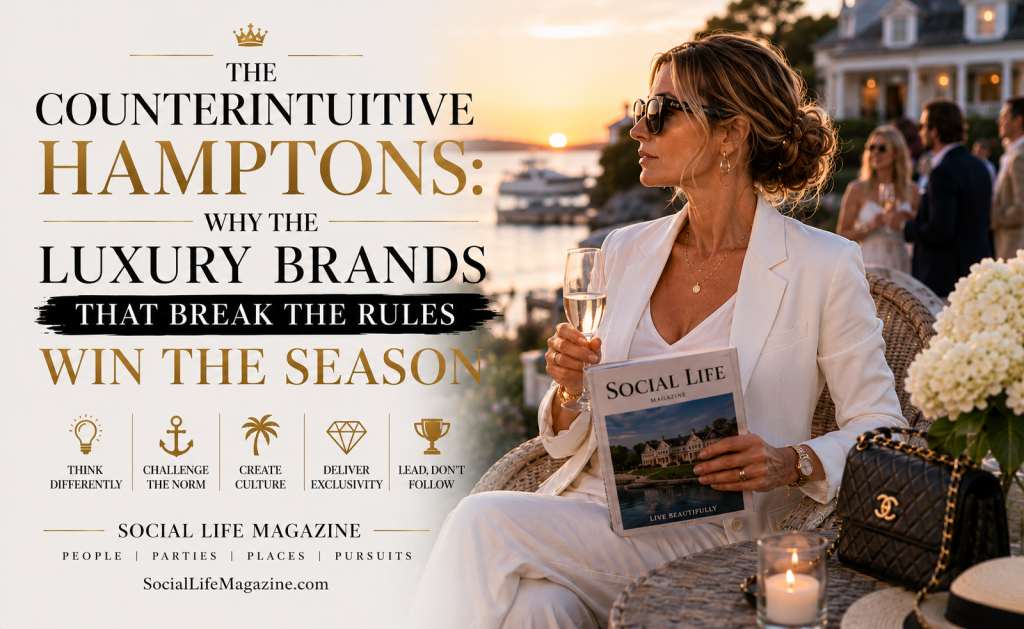
Counterintuitive luxury marketing in the Hamptons operates on exactly this logic. The brands winning the summer are not necessarily the ones with the best products, the largest budgets, or the most sophisticated media plans. They are the ones that understood, at some point, that changing how their brand feels to the right audience is more valuable than changing what it does. And they pursued that change through methods that look, to anyone applying conventional marketing logic, like they should not work.
The Restraint Advantage
In a market where every brand is competing for visibility, restraint creates a paradoxical advantage. The brand that says less stands out in an environment saturated with claims. Fewer but better-chosen contexts create a perception of selectivity. The brand that pulls back when its competitors push forward communicates confidence that no amount of forward pushing can replicate.
This is not a new observation. Behavioral economists have documented the “less is more” effect in luxury positioning for decades. But it is an observation that almost never survives contact with a marketing budget review. The logic of “we should do less, but more deliberately” cannot be expressed as a media plan. It cannot be tracked through impression counts. It does not produce the kind of dashboard evidence that justifies headcount or budget allocation.
Because of this institutional resistance to restraint, the brands that successfully execute it are almost always the ones where someone with sufficient authority decided to trust the psycho-logic over the spreadsheet. Ralph Lauren at his Job’s Lane store. Brunello Cucinelli with its deliberately limited advertising spend. Social Life Magazine choosing to maintain print distribution standards over twenty-three years rather than chase digital scale at the expense of editorial quality.
In each case, the restraint decision looked questionable by conventional metrics and produced results that conventional metrics could not fully explain. That gap — between what the numbers predicted and what the reality delivered — is precisely where the counterintuitive advantage lives.
Why the Ad That Doesn’t Look Like an Ad Wins
The most durable counterintuitive principle in Hamptons luxury marketing is documented in Alchemy as the opposite-of-a-good-idea. In psychology, unlike in physics, the inverse of a conventional approach can work at least as well — and often better.
The conventional approach to brand communication is an ad that announces itself as an ad. Logo prominent. Product featured. Benefits stated. Call to action present. This approach is logical, measurable, and almost universally used. It is also, in a luxury market, the approach that produces the weakest trust transfer.
Editorial as Trust Transfer
The counterintuitive approach is communication that does not announce itself. Editorial coverage that reads as journalism. Event presence that looks like genuine participation rather than marketing. A paid feature in Social Life Magazine that reads with the same voice, the same quality of attention, the same editorial perspective as the pieces surrounding it. These communications are not trying to sell. They are trying to belong. And in a luxury market where the most valuable consumers are specifically trained to distrust selling, the communication that is not trying to sell is the one that produces the most durable brand affinity.
The mechanics are well-documented in behavioral research on native advertising and source monitoring. But practically, every luxury marketer who has tried both approaches in the Hamptons reaches the same conclusion. The feature that reads as editorial outperforms the ad that announces itself, by every metric that matters to long-term brand equity — even when the ad reaches more people.
Social Life Magazine’s paid editorial features are the most efficient available version of this principle in the Hamptons market. A 2,000-word piece in the publication’s editorial voice reaches the right audience in the most trusted format available. It covers a brand with the same quality of attention brought to features on Jean Shafiroff or the Bridgehampton polo season. None of it looks like marketing. It is marketing. That distinction is, for the Hamptons luxury consumer, everything.
The Scarcity Signal
There is a second counterintuitive principle that operates with particular force in the Hamptons luxury market: scarcity increases perceived value, but only when the scarcity is genuine.
Manufactured scarcity — the “limited time offer” that recurs every month, the “exclusive event” that will accept anyone who can pay — is not scarcity in the signal-economic sense. It is the simulation of scarcity, which any luxury consumer with more than two summers on the East End has learned to identify on sight. Simulated scarcity produces the opposite of its intended effect. It signals that the brand does not understand the market it is operating in.
Genuine scarcity carries signal weight because it is real. Two sponsorship positions at Polo Hamptons 2026 because the event’s brand architecture requires it. Limited print distribution because quality over volume is an editorial standard. These forms of scarcity cannot be circumvented by a larger check. Its cost cannot be circumvented by a larger check.
The brands that succeed in the Hamptons by applying genuine scarcity do not do so by accident. They understand that the value of what they are offering is partially constituted by its inaccessibility. Polo Hamptons is worth attending because not everyone who wants to attend can. Social Life Magazine is worth being in because not every brand that wants coverage earns it. A boutique on Jobs Lane is worth entering because not every brand it carries belongs there.
In each case, the scarcity is the product. The event, the feature, the boutique placement — these are the delivery mechanisms for the scarcity signal that communicates genuine value.
The Counterintuitive Activation
The conventional Hamptons brand activation looks roughly the same regardless of brand, budget, or category. A branded tent or station. Staff in branded clothing. Collateral on a table. Product sampling if applicable. Photography for social media. It is a format that signals effort and investment, which is its primary communicative function — and it is a format that every Hamptons guest has encountered enough times to process as background.
The counterintuitive activation looks like something the brand would do anyway, regardless of whether it was generating impressions. A genuine service. Real, specific expertise. A moment of real value offered without visible commercial agenda. The spirits brand that employs an actual sommelier to advise guests rather than pour samples. A skincare brand that offers genuine consultation rather than a product demonstration. The publication that places a curated selection of its best editorial, rather than a stack of promotional materials, in a setting where people will actually read it.
Each of these activations costs something real to execute. That real cost is the signal. And the guest who receives genuine value from a genuine service at a Polo Hamptons activation remembers it differently — categorizes the brand differently — than the guest who receives a sample and a branded tote bag.
The three spokes in this hub examine specific applications of the counterintuitive principle:
– Why paid editorial consistently outperforms display advertising in the Hamptons: The Un-Ad: Why Social Life Magazine’s Paid Features Outperform Display Ads (FUTURE) – Why the most exclusive Hamptons events don’t advertise their exclusivity: Why the Most Exclusive Hamptons Events Don’t Advertise (FUTURE) – Why restraint in branding commands premium prices: The Cheaper Bottle That Sells More (FUTURE)
Submit a paid feature at sociallifemagazine.com/submit-a-paid-feature.
Where The Conversation Continues
The counterintuitive principle is the fourth of six frameworks governing Hamptons luxury brand performance. The pillar: Why Luxury Brands That Ignore Psychology Lose the Hamptons Every Summer.
Earlier hubs: The Perception Economy, The Signal Economy, and The Outlier Buyer.
Author

Written by
Recent Posts
What a 3-Carat Engagement Ring Actually Costs in 2026: The Real Numbers
The Skincare Habits That Make a Real Difference Over Time
Hamptons-Ready Beauty: Polished Makeup for Long Summer Days
Is Now a Good Time to Sell a Home in NJ?
The Hidden Work Behind a Seamless Hotel Weekend
Categories
- Art
- Articles
- Business of Luxury
- Celebrities
- Culture
- Entertainment
- Events
- Faces of Summer 2026
- Fashion
- Fashion & Style
- Featured
- Finance
- Food, Spirits, Wine
- Hamptons
- Hamptons Celebrities
- Health
- Health & Beauty
- Lifestyle
- Luxury Lifestyle
- Press
- Profiles
- Real Estate
- Technology
- The Chronicles
- Travel
- Uncategorized
- Weddings