
In the 1950s, the United States Air Force commissioned a study to determine the ideal dimensions for a fighter jet cockpit. The engineer assigned to the project, Lieutenant Gilbert Daniels, measured 4,163 pilots across ten physical dimensions. He then did something nobody had expected. He looked for pilots who were average across all ten measures simultaneously.
Not one pilot qualified.
Of 4,163 people, not a single individual was average across all ten dimensions. The cockpit designed for the average man fit nobody. Daniels published his findings. The Air Force redesigned its cockpits with adjustable seats. Pilot performance improved measurably.
Sutherland uses this story in Alchemy to make a point about marketing: designing for the average customer is not a safe strategy. It is a guarantee of mediocrity. Because the average customer is a statistical abstraction. She does not exist. The real customers are at the edges of the distribution. Their behaviors look unusual from a median-focused perspective. But they are the ones who actually drive markets.
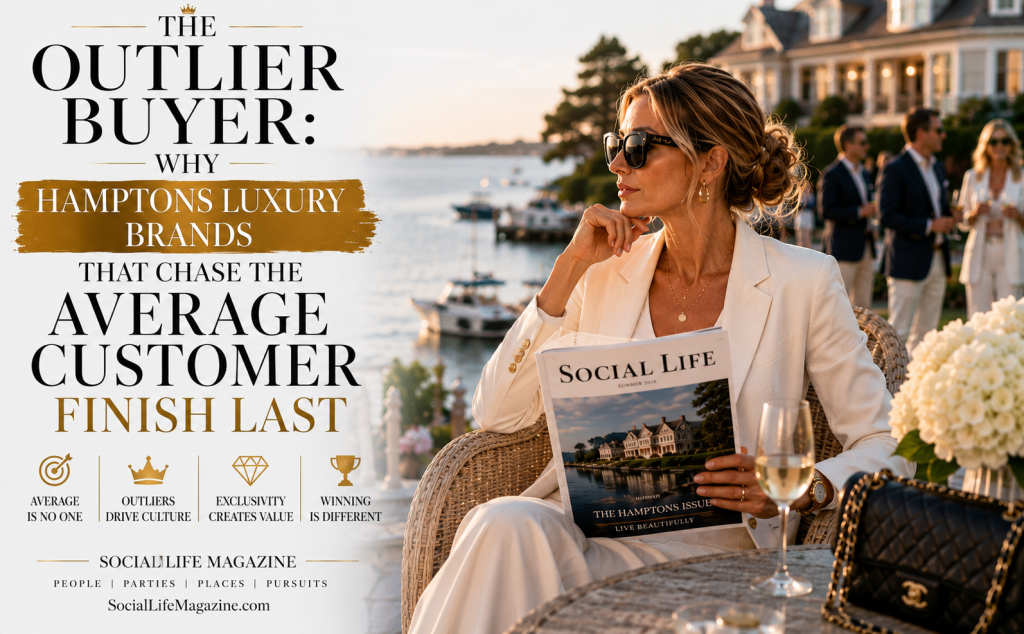
In the Hamptons luxury market, this principle operates with unusual precision. The Hamptons luxury consumer psychology that moves brands is not the psychology of the median summer visitor. It is the psychology of the outlier. She has been coming to the East End for twenty summers. She knows which beach is correct by month and remembers when the restaurant on that corner was something else. Designing for her, specifically, is the only strategy that produces durable brand equity in this geography.
Who the Outlier Actually Is
She is not primarily defined by her income, though her household income is substantial. She is defined by her relationship with the Hamptons as a social and cultural system. Initiation into its hierarchies is a given. Which events to attend, which to skip — she knows without asking. She knows the difference between a publication that has been part of this summer for twenty-three years and one that arrived last season with a distribution deal.
Her consumption decisions are not primarily economic. They are social and cultural. Instead, she is not asking which product is best. She is asking what choosing this product says about how well she understands where she is.
Cultural Capital as Currency
This is Bourdieu’s cultural capital operating at its most efficient. The Hamptons is a dense social system in which cultural knowledge — the specific, accumulated, place-based knowledge of how this geography works — is a form of currency. Specifically, the brands that understand this, that have themselves been part of the system long enough to carry cultural knowledge credentials, are the brands she trusts. The brands that arrive with reach metrics and media plans and no particular investment in understanding where they have arrived are the brands she looks through.
The outlier is also a social multiplier. When she discovers a brand appropriate for her Hamptons self, she communicates that discovery through the social networks that constitute the actual influence architecture of the East End. Sometimes through Instagram. More often through conversation at dinners on Meadow Lane. Through the recommendation she makes when someone asks where to get a particular treatment or what to drink at a particular kind of event. Through the visible choice she makes in the right setting at the right moment.
This social multiplication effect is why designing for the outlier produces returns that reach far beyond the outlier herself. Her endorsement, implicit or explicit, reaches the people whose opinions she shapes. Understanding why Hamptons luxury brands that chase the average customer finish last begins with understanding who actually sets the social agenda in this market.
The Cascade Effect: How Outliers Create Markets
Sutherland’s argument about outlier-driven innovation is not simply that outliers are more interesting than average consumers. It is that outliers create the conditions that allow average consumers to follow. The Earl of Sandwich did not invent the sandwich for mass consumption. He invented it for his specific, obsessive need to eat without leaving the card table. The mass market came later. His product solved a problem millions had not yet named.
In the Hamptons luxury market, the outlier buyer performs exactly this function. She adopts a brand before the broader summer population. Initially, her adoption is visible to the people in her network, who are themselves more influential than average. Their subsequent adoption reaches the next tier. By the time a brand is visibly present across the Hamptons summer, the cascade producing that presence was initiated by a small number of outlier adopters. Their influence was disproportionate to their numbers.
This cascade dynamic means that the most efficient strategy for building Hamptons brand presence is not to reach the largest possible audience simultaneously. It is to reach the right ten people first — the ones at the top of the social cascade — and let the network effect do the distribution work.
Indeed, Social Life Magazine’s audience is concentrated at exactly this level of the cascade. Its print distribution goes to the boutiques, hotels, fitness studios, and event venues where the outlier buyer is already present. Its editorial voice and twenty-three years of institutional authority give it the cultural credibility that the outlier buyer uses as a selection signal. A brand featured in Social Life is not being introduced to a random audience. It is being introduced at the top of the social cascade that drives Hamptons luxury consumption.
The $50,000 Summer Psychographic
The outlier buyer is not primarily defined by spending a specific amount per summer, though fifty thousand dollars is not an unusual figure when you add a rental share, a summer wardrobe, restaurant bills, event tickets, and the specific categories of luxury service that the Hamptons exists to provide.
She is defined by how she spends, not how much. Her decisions are slow for some categories and immediate for others. She is immune to urgency tactics in product categories where she already has established preferences. A new skincare brand cannot reach her through a limited-time offer. But she is immediately responsive to social proof from trusted sources in categories where she is actively curating. A recommendation from the right publication, at the right moment, can produce an immediate trial decision from someone immune to direct marketing for years.
This is the behavioral economics principle Sutherland calls “satisficing” — the tendency to stop searching once a good-enough option has been found. The outlier buyer has already satisficed in most luxury categories. She has her sunscreen, her champagne, her go-to restaurant for certain occasions. But she maintains active curation windows in specific categories. Aesthetics, wellness, emerging fashion, distinctive spirits — where she is genuinely looking for the next right thing.
Specifically, a Social Life Magazine feature lands in these active curation windows with unusual efficiency, specifically because the publication’s editorial authority functions as a pre-filter. She does not need to evaluate the brand from scratch. The publication has done the evaluation. Her job is simply to decide whether its judgment aligns with hers, and twenty-three summers of track record make that alignment determination very fast.
Designing for the Outlier in Practice
Designing for the outlier buyer does not mean ignoring the broader summer audience. It means accepting that the broader audience will follow the outlier. Focus investment on the environments where the outlier actually is, not the ones that reach the largest total number of people.
In practice, specifically, this means: boutique distribution over mass distribution. Editorial voice over advertising claims. Event presence that signals genuine belonging over activation density that signals marketing budget. A full-page in Social Life Magazine over six months of digital retargeting to a lookalike audience.
Each of these choices reaches fewer people by raw count. Each reaches more of the right people by social position. Because the right people cascade their influence downward through the Hamptons summer social networks, the investment in reaching them produces returns that scale well beyond the initial reach.
The brands that understand this have been part of the Hamptons summer for decades. The brands optimizing for reach will be back next year with the same budget, the same metrics, and the same unanswered question.
Submit a paid feature at sociallifemagazine.com/submit-a-paid-feature and reach the top of the cascade before the season locks.
Where The Conversation Continues
This argument is one of six principles governing Hamptons luxury brand performance. Full framework in the pillar: Why Luxury Brands That Ignore Psychology Lose the Hamptons Every Summer.
The perception economy is in Hub A: The Perception Economy: What Hamptons Luxury Brands Are Really Selling.
Costly signals are in Hub B: The Signal Economy: Why the Most Powerful Luxury Marketing Looks Like It Isn’t Marketing.
Three spokes extend the outlier buyer argument. The $50,000 Hamptons Summer examines her spending logic. Why the Best Activations Are Designed for Six People examines the cascade in practice. The Early Adopter Trap examines how trend-setters beat demographics.
Author

Written by
Recent Posts
The Skincare Habits That Make a Real Difference Over Time
Hamptons-Ready Beauty: Polished Makeup for Long Summer Days
Is Now a Good Time to Sell a Home in NJ?
The Hidden Work Behind a Seamless Hotel Weekend
Choosing Scratching Furniture for a British Shorthair
Categories
- Art
- Articles
- Business of Luxury
- Celebrities
- Culture
- Entertainment
- Events
- Faces of Summer 2026
- Fashion
- Fashion & Style
- Featured
- Finance
- Food, Spirits, Wine
- Hamptons
- Hamptons Celebrities
- Health
- Health & Beauty
- Lifestyle
- Luxury Lifestyle
- Press
- Profiles
- Real Estate
- Technology
- The Chronicles
- Travel
- Uncategorized
- Weddings