
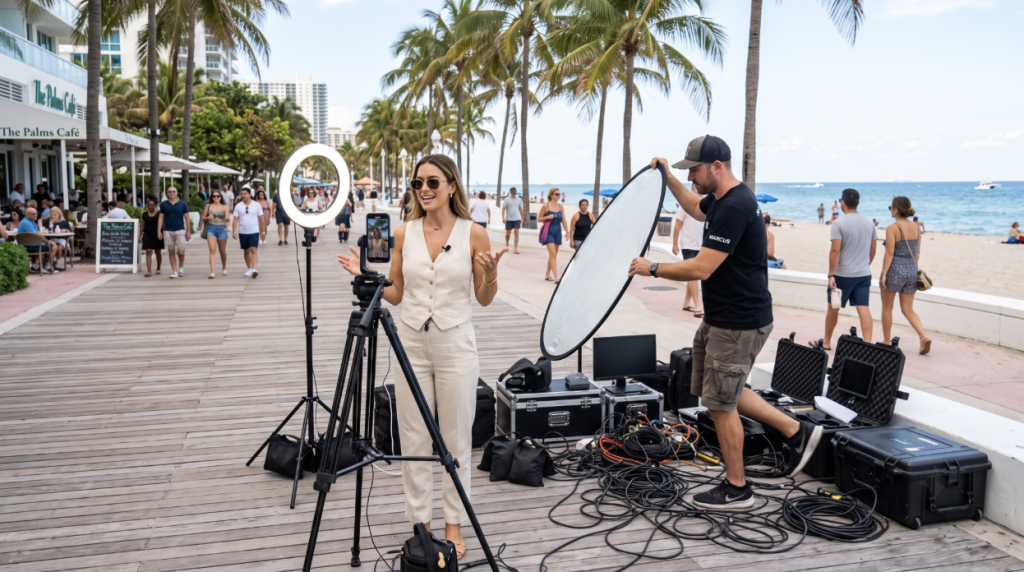
From beachfront brand shoots on Fort Lauderdale Beach to ring-lit apartments in Brickell, Florida has quietly become one of the biggest hubs for TikTok creators, lifestyle influencers, and digital talent in the country. Sponsorship deals, six-figure brand partnerships, and full production crews are now routine for creators with sizable followings. In many ways, the creator economy has started to look a lot like traditional entertainment work, complete with cameras, call sheets, and occasionally, on-set injuries.
That raises a question most influencers never think about until something actually goes wrong: if you’re hurt while filming content, are you covered by workers’ compensation?
The answer is more complicated than a simple yes or no, and it depends far more on how your work is structured than on how many followers you have.
The Creator Economy Blurs the Line Between “Employed” and “Independent”
Traditional workers’ compensation law was written for factory floors and office buildings, not ring lights and content calendars. Most creators operate as independent contractors or sole proprietors, booking their own brand deals and managing their own schedules. Under Florida law, independent contractors generally are not entitled to workers’ compensation benefits, because coverage is designed to protect employees, not self-employed business owners.
But the creator economy rarely fits neatly into one box. A TikTok personality might be a solo entrepreneur one day, and a paid employee of a talent agency, media company, or production house the next, and that distinction can determine whether an injury sustained during a shoot is compensable.
Florida’s Legal Test: Employee vs. Independent Contractor
Florida’s workers’ compensation statute lays out specific factors used to determine whether someone is legally an “employee.” Courts and the state look at who controls the work, who provides the equipment, whether pay is hourly or project-based, and whether the work is a core part of the hiring company’s business. The full statutory definition is available through the Florida Legislature.
This matters enormously for creators. A TikTok influencer filming independently in their own home studio looks nothing like an employee under this test. But a creator hired by a marketing agency, paid a salary, given a script, and required to use company equipment and locations starts to look much more like a traditional employee regardless of the “creator” label on their business card.
When a TikTok Creator Might Actually Be Covered
There are real scenarios where content creators in Florida could qualify for workers’ compensation:
- Agency-employed talent: Creators who are formally employed by a talent management agency, media brand, or marketing firm, rather than operating as freelancers.
- In-house brand content teams: Employees hired specifically to produce TikTok and social content for a company, where filming is a routine job duty.
- Production company staff: Videographers, editors, and on-camera talent hired as W-2 employees for branded content shoots.
The U.S. Department of Labor outlines the broader framework for how workers’ compensation programs are meant to function for employees across industries, which is a helpful starting point for understanding coverage basics.
Don’t Forget the Team Behind the Camera
TikTok creators rarely work alone once their following grows. Videographers, drone operators, lighting techs, editors, and personal assistants are often part of the picture, and their employment status matters just as much as the creator’s own. Misclassifying a crew member as an independent contractor when they function like an employee can create serious liability, and it directly affects whether that person has workers’ compensation protection if they’re injured on set.
The IRS provides detailed guidance on how to distinguish an independent contractor from an employee, which many production teams use as a reference point when structuring these working relationships.
What Creators and Their Teams Should Do Now
If you’re a content creator or you run a team that produces content, it’s worth reviewing exactly how your working relationships are classified before an injury forces the issue. Contracts, payment structures, and day-to-day control over the work all play into whether Florida law would treat someone as an employee entitled to benefits.
Because these cases hinge on fact-specific details, it’s rarely something to sort out alone, especially once real money and medical bills are involved. Fort Lauderdale in particular has seen a surge of media houses, talent agencies, and branded production studios setting up shop to serve South Florida’s growing creator economy, which means more people now technically qualify as employees without realizing it. Consulting with experienced workplace injury lawyers can help creators, agencies, and production teams understand their rights, review existing contracts, and determine whether an injury claim should move forward under Florida’s workers’ compensation system.
South Florida’s creator scene isn’t slowing down, and neither is the legal gray area surrounding it. As more brands, agencies, and production companies build out formal teams around their top TikTok talent, the line between “influencer” and “employee” will only keep shifting. Creators who assume a shoot injury is simply “part of the job” may be leaving real benefits on the table, while agencies that overlook proper classification could be exposed to liability they never saw coming. Either way, it’s worth understanding exactly where you stand before you ever need to find out the hard way.
Author

Written by
Recent Posts

The Renegade Housewives of Pop Art: A Memoir of the 1960s
Nicole Miller
Unlocking the Berkshires

Dalia Forman Design
Alberto Luzzi
Categories
- Art
- Articles
- Business of Luxury
- Celebrities
- Culture
- Entertainment
- Events
- Faces of Summer 2026
- Fashion
- Fashion & Style
- Featured
- Finance
- Food, Spirits, Wine
- Hamptons
- Hamptons Celebrities
- Health
- Health & Beauty
- Lifestyle
- Luxury Lifestyle
- Press
- Profiles
- Real Estate
- Technology
- The Chronicles
- Travel
- Uncategorized
- Weddings