
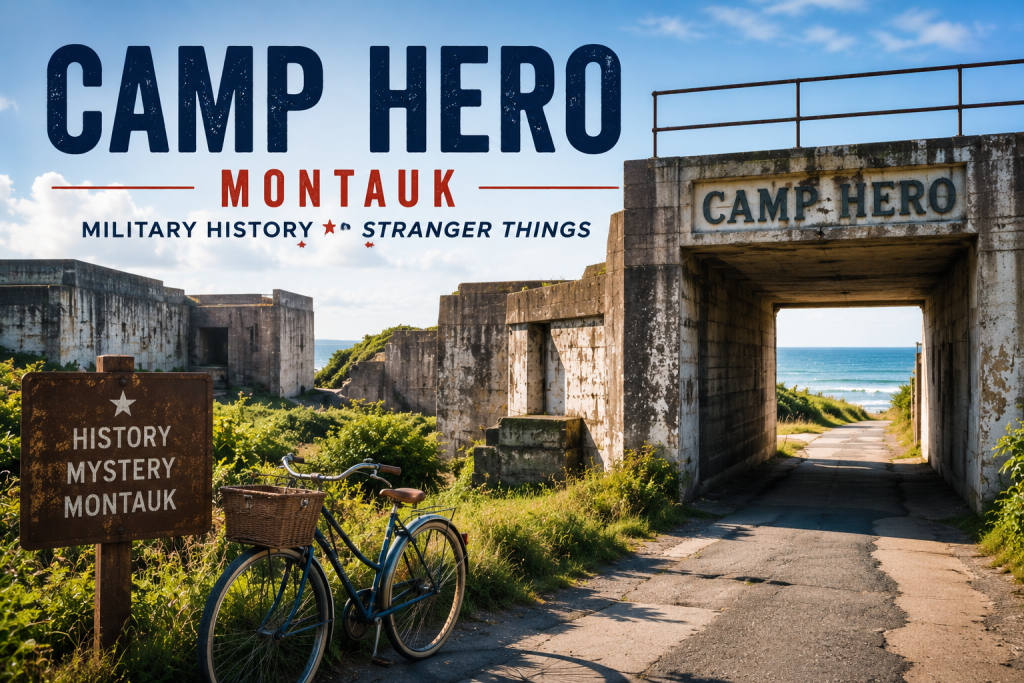
Camp Hero Montauk is a 415-acre state park at the eastern tip of Long Island where you can hike through maritime forest, fish from dramatic bluffs, and stand beneath a rusting 126-foot Cold War radar tower that the government says was decommissioned in 1981 but has never fully explained. The base was commissioned in 1942 to defend New York City from German submarines. It was disguised as a fishing village, with concrete bunkers painted to look like houses and fake church steeples rising from ammunition magazines. At its peak, 600 soldiers and 37 officers manned guns that could fire 23 miles into the Atlantic. None of those guns ever fired in hostility.
Yet the base produced something more durable than any shell: a conspiracy theory that inspired Stranger Things, the most-watched series in Netflix history. This is the story of what actually happened at Montauk‘s strangest landmark, and what people believe happened, and the gap between those two things that nobody has been able to close.
The Fishing Village That Was Not a Fishing Village
In January 1942, one month after Pearl Harbor, the United States Army purchased 468 acres at the eastern tip of Long Island for a purpose so classified that the filing, signed by Secretary of War Henry Stimson, offered only “related military purposes” as an explanation. The court petition was filed in Federal Court in Brooklyn. Officials refused further information. Shortly after, Camp Hero was under construction.
The base was named for Major General Andrew Hero Jr., the Army’s commander of coastal artillery, who had died that same year. Essentially, its mission was straightforward: defend the approaches to New York City from German naval attack. The method, however, was inventive. To conceal the installation from enemy aircraft, the Army designed Camp Hero to resemble a New England fishing village. As historian Henry Osmers wrote in American Gibraltar, “concrete bunkers had windows painted on them and ornamental roofs.” Fake church steeples rose from ammunition storage facilities. A fake town green anchored the layout. From the air, the base looked like a hamlet. From the ground, it was an arsenal.
The Guns Nobody Fired
The Army builds its own bridge to bring them in. Four 16-inch casemate guns, each fifteen feet long, capable of firing shells twenty-three miles into the Atlantic. Two batteries of two guns each: Battery 112 and Battery 113 (officially Battery Dunn). A third battery, Battery 216, holds two 6-inch guns. Seven concrete machine gun nests sit in towers twenty feet above the ground, with slit windows facing the beach. Two additional machine gun positions guard the lighthouse itself. One is embedded in the cliff face below the tower, a concrete clamshell with a slit window facing west. The garrison swells to 600 enlisted men and 37 officers. They wait for an invasion that never comes.
The German armada never materialized. The U-boats that terrorized the Atlantic shipping lanes never attempted a land invasion at Montauk, although they came close enough to keep everyone awake. Even today, locals who lived through the war still remember the test firings of the 16-inch guns, which produced concussive blasts powerful enough to rattle windows in downtown Montauk. But the big guns never fired at an enemy. When the war ended, the Army decommissioned the batteries in 1947, cut up the massive guns for scrap, and left everything else in place. The barracks, the bunkers, the fake steeples, the machine gun towers. All of it simply abandoned, left to rot in the salt air and the vine growth of a peninsula that reclaims everything humans leave behind.
The Cold War Pivot: SAGE Radar and the 30-Minute Warning
In 1951, the U.S. Air Force’s 773rd Air Control and Warning Squadron occupied the base and reopened it as the Montauk Air Force Station. The mission shifted from coastal artillery to radar surveillance. Specifically, the base became part of the Semi-Automatic Ground Environment (SAGE) defense network, a system of interconnected radar stations designed to detect and track Soviet nuclear bombers approaching the East Coast.
The SAGE radar tower, erected in 1958, was 126 feet tall and the largest of its kind in the country. Its antennae emitted signals at up to 425 MHz, strong enough to interfere with neighbors’ television sets. The tower’s purpose was to provide a 30-minute warning in the event of a nuclear attack on New York City, which is the kind of sentence that sounds abstract until you stand beneath the tower and look south toward Manhattan, 120 miles away, and realize that the warning time was calculated based on Soviet bomber speeds and prevailing wind patterns. Radar scanned continuously. The men who operated it worked in shifts. Ed Crasky, a boiler fireman, worked at the Montauk Air Force Station for 35 years. He photographed the base in September 1980, one year before the final decommissioning, producing 37 images that now reside in the Montauk Library Archives.
What They Left Behind
Camp Hero was permanently decommissioned in 1981. The Air Force left. But like the Army before it, the Air Force removed very little. Everything remained: the radar tower, the buildings, the underground infrastructure. In 1984, the National Parks Service transferred 278 acres to New York State. Thirty additional acres went to the Town of East Hampton for moderate-income housing. Camp Hero opened as a state park in 2002. Yet the government retained ownership of everything below the surface. That detail, more than any other, is what keeps the conspiracy alive.
The Montauk Project: What People Believe Happened
He is twenty-four, a junior copywriter at an agency in Bushwick making $62,000. On a Saturday in June, he drove to Montauk on a Saturday specifically to visit Camp Hero because he watched all four seasons of Stranger Things in a single week during a depressive episode in February and the show changed something in him that he cannot articulate. After parking his car ($8), he walks past the radar tower, reads the “Do Not Enter” signs, and feels a chill that he will later describe to friends as “genuinely weird.” The chill is the wind. The wind at the tip of Long Island is always cold, even in July. But he does not know that, because he has never been here before, and the mythology outperforms the meteorology every time.
In 1992, Preston Nichols and Peter Moon published The Montauk Project: Experiments in Time. The book claimed that Camp Hero’s underground laboratories housed government-funded experiments. According to Nichols, these experiments involved mind control, psychic projection, and time travel. According to Nichols, kidnapped children were used as test subjects. The experiments allegedly drew on the theories of Nikola Tesla and connected to the infamous Philadelphia Experiment of 1943, in which the USS Eldridge was supposedly rendered invisible at the Philadelphia Naval Shipyard and reappeared off Montauk through an interdimensional portal.
Of course, none of these claims have been verified. FOIA requests have produced no corroborating documentation. Still, the book sold widely and spawned several sequels.
The Evidence That Will Not Settle
The conspiracy theory grew, absorbed adjacent legends (Men in Black, extraterrestrial contact, Nikola Tesla’s correspondence with advanced beings), and eventually achieved a cultural mass sufficient to attract the attention of Hollywood. Brian Minnick, a Montauk local who explored the base as a teenager, found sealed entrances, food requisition records from the late 1980s (years after the military officially departed), and rooms with brightly painted walls and psychedelic wallpaper. He published his findings in the book Montauk Is Strange. “There were a lot of strange things,” Minnick told investigators. “And the sum total of all those strange things is compelling.”
Stranger Things: How Montauk Went to Hawkins
The Duffer Brothers, Matt and Ross, originally conceived their Netflix series as a show called Montauk, set at Camp Hero. The pilot pitch deck (now a collector’s item among fans and available to view in the Montauk Library Archives) laid out a story about secret government experiments, missing children, and a parallel dimension accessible through the base’s underground tunnels. Subsequently, the brothers relocated the setting to fictional Hawkins, Indiana, and renamed the show Stranger Things.
The reasons were likely practical: Indiana is cheaper to film in than Long Island. A small midwestern town is also more relatable than a specific East End hamlet. But the Montauk DNA remained. The Hawkins National Laboratory is Camp Hero. Eleven is a product of the experiments that Nichols described. The Upside Down is the underground that the government retained ownership of. In 2018, filmmaker Charlie Kessler sued the Duffers, claiming they had stolen the concept from his short film “The Montauk Project.” The lawsuit was dropped in 2019. But the connection between Camp Hero and Stranger Things is acknowledged by everyone involved, even if the legal specifics remain disputed.
Stranger Things debuted in July 2016 and became one of the most-watched series in streaming history. Camp Hero became a pilgrimage site. As a result, the park saw increased traffic. Visitors photographed the radar tower, walked the trails that skirt the bunkers, and read the “Do Not Enter” signs with the same fascinated unease that the show’s audience feels watching Eleven move through the Upside Down. Notably, the state park did not market this connection. It did not need to. The mythology marketed itself.
What You Actually Find at Camp Hero Today
Camp Hero State Park occupies 415 acres of heavily wooded land on the southeastern tip of Montauk. About 415 acres belong to the state park, of which roughly 278 were part of the original military installation. The landscape includes maritime forest, freshwater wetlands, dramatic ocean bluffs, and the remains of the military infrastructure. Visitors can drive, bike, or walk along the paved roads of the former base. Picnic areas sit alongside crumbling structures sealed with boards and covered with “Do Not Enter” warnings.
The radar tower is the dominant feature. It rises above the tree canopy, visible from miles away, and produces a metallic creaking in the wind that sounds exactly like what you would expect a haunted government installation to sound like. The concrete bunkers of Batteries 112, 113, and 216 are visible along the hiking trails. Placards explain the wartime history. The bluffs offer Atlantic views comparable to those at nearby Shadmoor State Park, with the added feature of WWII gun emplacements in the foreground. In addition, fishing access along the bluffs is popular with locals. Parking costs $8 per car seasonally.
The Atmosphere That Earns the Reputation
What you will not find is evidence of time travel, mind control, or interdimensional portals. What you will find is a landscape that earns its reputation through sheer atmosphere. The combination of abandoned military architecture, ocean bluffs, dense forest, and the persistent question of what lies beneath creates a mood that no other state park in New York achieves. It is not Harriman, not the Adirondacks. Instead, this is the place where the government built a fake fishing village to hide guns that could fire 23 miles, and then built a radar tower to detect nuclear bombers, and then left and said nothing about what was underground. Of course people believe something happened here. The silence is the loudest thing at Camp Hero.
Camp Hero and the Montauk Story
Every Hamptons village has layers of history. Southampton has its 1640 English settlement. Sag Harbor has its whaling industry. Bridgehampton has its potato farms turned polo fields. But only Montauk has a military installation that was disguised as a civilian community, operated in secrecy for forty years, generated a conspiracy theory that influenced one of the most popular television series in history. It is also a state park where you can have a picnic next to an artillery bunker. No other village compresses that range of history into a single location.
Camp Hero also illustrates the principle that defines Montauk as a whole: things arrive at the End, do what they came to do, and leave. First the Army arrived, built a fortress, and left. Then the Air Force arrived, built a radar network, and left. Conspiracy theorists arrived, wrote their books, and moved on. Netflix arrived, used the mythology, and set the show in Indiana. Through all of it, the land remained. Bluffs continued eroding. The tower continued creaking. And the fish below the cliffs continued swimming, indifferent to every narrative projected onto the landscape above them.
Adjacent to Camp Hero sits the Montauk Point Lighthouse, which has been operational since 1796. Together, the lighthouse and the base compose a two-site historical complex that spans from the founding of the republic to the Cold War. One building was designed to save lives by guiding ships. The other was designed to end lives by firing shells. Nevertheless, both still stand. The lighthouse still flashes. The radar tower still creaks. And below the surface, whatever is down there remains classified, owned by a government that decommissioned the base forty-four years ago but has never released the keys.
Where the Conversation Continues
Social Life Magazine has covered the East End for 23 years. Some stories are older than that. Some are still being told.
For brands and tastemakers: explore our paid features program.
Polo Hamptons 2026 returns July 18 and 25 at 900 Lumber Lane in Bridgehampton, with BMW North America as title sponsor and Christie Brinkley as host. Details at polohamptons.com.
Subscribe: sociallifemagazine.com/subscription.
The radar tower at Camp Hero creaks in the wind. It has been creaking since 1958. Nobody has explained what is underneath it. That is either a failure of transparency or the beginning of a very good story. Montauk does not distinguish between the two.
Author

Written by
Recent Posts
How to Measure Whether a Hair Loss Treatment Is Working
Is Online Psychiatry Covered by Insurance? What to Know Before Booking
Four Habits of Quietly Successful Entrepreneurs

The Most Common Preventable Health Concerns Doctors See Today
What Affects a Rideshare Injury Settlement?
Categories
- Art
- Articles
- Business of Luxury
- Celebrities
- Culture
- Entertainment
- Events
- Faces of Summer 2026
- Fashion
- Fashion & Style
- Featured
- Finance
- Food, Spirits, Wine
- Hamptons
- Hamptons Celebrities
- Health
- Health & Beauty
- Lifestyle
- Luxury Lifestyle
- Press
- Profiles
- Real Estate
- Technology
- The Chronicles
- Travel
- Uncategorized
- Weddings