
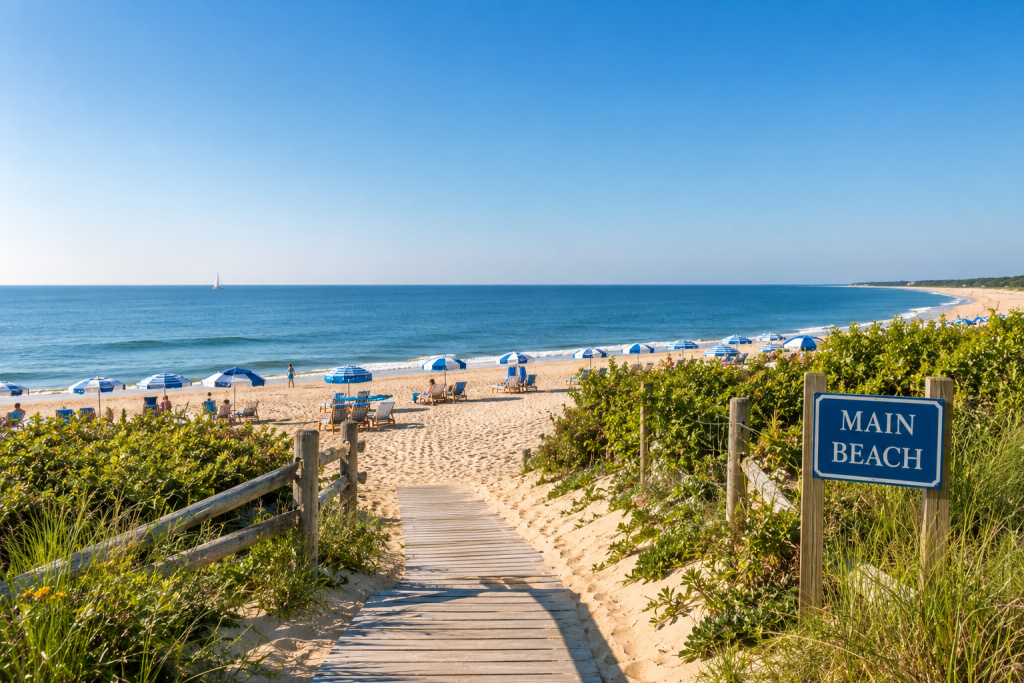
The Beach as Social Autobiography
The East Hampton beaches do not simply offer ocean access. They offer classification. Five village beaches sit within the Incorporated Village of East Hampton: Main Beach, Georgica Beach, Two Mile Hollow, Egypt Beach, and Wiborg Beach. Each one attracts a different crowd, enforces a different energy, and answers a different question about who you are and what you came here for. Indeed, the parking permit alone costs $750 for non-residents (season pass, only 3,100 available, sold out within hours of going on sale each February). Similarly, daily parking runs $50, available Monday through Thursday only, through the ParkMobile app. In East Hampton, access to the beach is not assumed. It is earned, purchased, or inherited.
The Permit Ritual
A creative director from DUMBO (the kind who runs a $15M brand studio and rents a cottage on Dunemere Lane every July) arrives at Main Beach at 10:30 on a Saturday. She has the permit. Her husband bought it in January, driving to East Hampton Village on a freezing Thursday morning to stand in line with hundreds of town residents for the discounted $500 rate. Certainly, this annual ritual (in-person only, one day only, first-come-first-served) functions as its own social event during the village’s sleepy mid-winter months. He waited three hours. The permit is digital, linked to their license plate. No sticker, no windshield display. The scanner reads you before you park.
She sets up her chair facing south. The ocean is absurdly blue.
To her left, a woman in a Zimmermann coverup arranges a matching umbrella.
To her right, a man in a vintage Patagonia hat reads a hardcover he bought at BookHampton.
He will finish it this weekend. He will not discuss it.
Having read it is the credential. Discussing it is the tell.
She opens her own book. It is the same one.
They will not acknowledge this.
Main Beach operates on the principle that coincidence is never mentioned.
Main Beach: The One That Makes Every List
Dr. Beach (Stephen Leatherman, the coastal scientist who publishes America’s annual beach rankings) placed Main Beach fifth nationally in 2025. In fact, it has appeared on the list repeatedly since the rankings began. The powdery white sand stretches wide, backed by dunes, with views that extend unbroken along the East Hampton coastline. Specifically, facilities include a boardwalk, a food shack, restrooms, showers, and lifeguards. In comparison, Cooper’s Beach in Southampton took the number one position that same year. However, Main Beach draws a crowd that Cooper’s Beach does not: the fashion world, the media world, the finance world, and the year-round locals who consider this beach a civic right rather than a seasonal amenity.
The parking lot on a Saturday in July functions as an automotive census. Range Rovers, G-Wagons, Porsche Taycans, and the occasional vintage Land Cruiser that signals the owner has been coming here since before the hedge fund era. Naturally, village residents park free. Town residents pay $500 for the season. Non-residents pay $750, and the allocation sells out almost immediately. Also, the village operates a free shuttle service (the Circuit, formerly the Hamptons Free Ride) from the LIRR station to Main Beach, which means the beach is technically accessible to anyone who can buy a train ticket. Whether the social accessibility matches the physical accessibility is a different question entirely.
Georgica Beach: The Power Address Extension
Georgica Beach sits at the southern edge of Georgica Pond, accessible via Lily Pond Lane, and the crowd reflects the address. Where Main Beach is social, Georgica Beach is quiet. Where Main Beach has a food shack and a boardwalk, Georgica has sand, water, and the implication that if you are here, you do not need amenities because you already have a house within walking distance. The media executives, entertainment industry figures, and dynastic families who populate Lily Pond Lane and Georgica Pond consider this their private extension. Certainly, it is not private. It is public. Still, the atmosphere operates as though everyone present has been vetted by geography.
Notably, Georgica Beach is one of the most pristine stretches on the entire East End. Dune systems remain intact. Sand stays clean. Water clarity surpasses Main Beach because the crowd density is lower. For the hedge fund manager on Georgica Close (the kind whose neighbor is a filmmaker whose last three movies grossed $2 billion), Georgica Beach is not a destination. It is a backyard extension. He walks there. He does not drive. Driving to Georgica Beach from Georgica Pond would be like driving to your own mailbox. The proximity is the luxury. The effort of getting here is what the address already paid for.
Two Mile Hollow: The Beach That Kept Its Own Rules
Two Mile Hollow Beach sits at the eastern edge of East Hampton Village, on Two Mile Hollow Road, and it has operated for decades as the East End’s most LGBTQ+ friendly beach. The East End Gay Organization (EEGO, celebrating its 25th anniversary in the early 2000s) has long identified Two Mile Hollow as a community anchor. Historically, families congregated to the west, women in the center, and men to the east. Certainly, the beach has evolved since then (families now populate all sections, and the strict geographic sorting has softened), but the welcoming energy remains. Two Mile Hollow is less crowded than Main Beach, less curated than Georgica, and more democratic than either.
The beach itself is gorgeous: wide sand, endangered plant species in the dunes, excellent shell collecting, and a quieter atmosphere that rewards those willing to walk the extra distance from the parking area. Daily permits are available for $50 via ParkMobile. For a gallery owner from Chelsea (the Manhattan kind, the one who represents three artists who show at the Parrish and summers in Springs because the address carries curatorial credibility), Two Mile Hollow is the right frequency. Indeed, it asks nothing of you except that you show up and let the ocean do the talking. In contrast to Main Beach’s see-and-be-seen energy, Two Mile Hollow operates on the principle that the best social performance is the absence of performance.
Egypt Beach and Wiborg Beach: The Quiet Positions
Egypt Beach
Egypt Beach serves the Further Lane corridor, situated where the Eastern Plain meets the ocean. The name derives from Egypt Lane, one of the original farm roads laid out during the 1648 settlement. Also, the beach is beautiful, relatively uncrowded, and functions as the default stretch for residents of Further Lane’s western section (the same section that holds the Rosenstein compound at $147 million). Because Further Lane straddles East Hampton and Amagansett, Egypt Beach occupies a geographic boundary. Essentially, it is where East Hampton’s institutional energy begins to fade and Amagansett’s intentional absence takes over.
Wiborg Beach
Wiborg Beach is the smallest and most intimate of the five village beaches, tucked into a residential stretch that discourages casual visitors through sheer inconvenience. Specifically, there is no food shack, no boardwalk, no social infrastructure. The name connects to the Wiborg family, the same ink-manufacturing dynasty whose estate at 43 East Dune Lane (known as Dune Cottage) sold for $72 million in March 2026. For a resident of the surrounding neighborhood, Wiborg Beach offers something that no amount of money can buy at Main Beach: solitude within the village limits. However, that solitude comes with a trade-off. Wiborg lacks the facilities, the lifeguards (seasonal), and the critical mass that makes Main Beach feel like an event. Some people want the event. Others want the absence of it. Wiborg serves the latter.
The Permit System: A Primer on Access as Status
East Hampton Village enforces beach parking permits from May 15 through September 15. Village residents receive free permits. Town residents (people who live in the Town of East Hampton but not within the village boundary) pay $500 for the discounted rate (in-person only, late January) or $750 for the full-price allocation online. Non-residents from Suffolk County pay $125. Only 3,100 non-resident season permits are available annually. Also, 500 monthly permits per month are sold online starting May 1 ($250 for May 15 through June 30, $300 for July, $300 for August 1 through September 15). All permits are digital, linked to license plates, and enforced by automated scanners.
Consequently, this system creates a secondary economy of access. Homeowners rent houses with village addresses partly because the beach permit is included. For example, renters on Egypt Lane or Dunemere Lane receive resident permits that renters on Lumber Lane in Bridgehampton cannot. Consequently, the beach permit is not just a parking pass. It is a residency credential, a proof-of-address document that carries social weight. Still, free parking is available before 9 AM and after 6 PM, which means early risers and sunset swimmers bypass the system entirely. After all, the most exclusive access to East Hampton beaches costs nothing. You just have to know the hours.
East Hampton vs. the Neighbors: Beach by Beach
The Hamptons beach hierarchy is real, and East Hampton holds more positions in it than any other village. Cooper’s Beach in Southampton ranked first nationally in 2025, but Cooper’s draws a different crowd: older, more conservative, aligned with the Southampton private club circuit. Indian Wells in Amagansett offers exceptional surf and a deliberately unpretentious atmosphere. Bridgehampton lacks a signature beach entirely, ceding that territory to Sagaponack. Sag Harbor is a harbor town, not a beach town.
East Hampton’s advantage is range. Main Beach for spectacle. Georgica for power. Two Mile Hollow for authenticity. Egypt for seclusion. Wiborg for invisibility. Five beaches, five social registers. Ultimately, no other village on the East End offers that breadth. Ultimately, the question is not which East Hampton beach is best. The question is which East Hampton beach is best for you. The answer reveals more about the person asking than any real estate listing ever could.
Where the Conversation Continues
Social Life Magazine is distributed at every beach on this list, five summer issues per season, 25,000 copies each, from Westhampton to Montauk. Find a copy at the Main Beach food shack. Pick one up at the restaurants and beach clubs where this audience gathers. The magazine is already in the sand where these conversations happen.
If your brand serves the East Hampton beach audience (swimwear, skincare, suncare, outdoor furniture, luxury automotive, wellness), a paid feature in Social Life Magazine places you in front of the exact consumer who just finished reading this page. Submit a paid feature here.
Polo Hamptons 2026 returns to 900 Lumber Lane in Bridgehampton on July 18 and 25, with BMW North America as title sponsor and Christie Brinkley as host. The crowd at Polo Hamptons is the same crowd at Main Beach, just wearing different shoes. Sponsorship packages at polohamptons.com.
Subscribe to Social Life Magazine for year-round coverage of the beaches, villages, and people that shape the East End.
East Hampton beaches do not compete with each other. They sort you. The sand does not care about your net worth. But everyone else on the beach does.
Author

Written by
Recent Posts
How to Measure Whether a Hair Loss Treatment Is Working
Is Online Psychiatry Covered by Insurance? What to Know Before Booking
Four Habits of Quietly Successful Entrepreneurs

The Most Common Preventable Health Concerns Doctors See Today
What Affects a Rideshare Injury Settlement?
Categories
- Art
- Articles
- Business of Luxury
- Celebrities
- Culture
- Entertainment
- Events
- Faces of Summer 2026
- Fashion
- Fashion & Style
- Featured
- Finance
- Food, Spirits, Wine
- Hamptons
- Hamptons Celebrities
- Health
- Health & Beauty
- Lifestyle
- Luxury Lifestyle
- Press
- Profiles
- Real Estate
- Technology
- The Chronicles
- Travel
- Uncategorized
- Weddings