
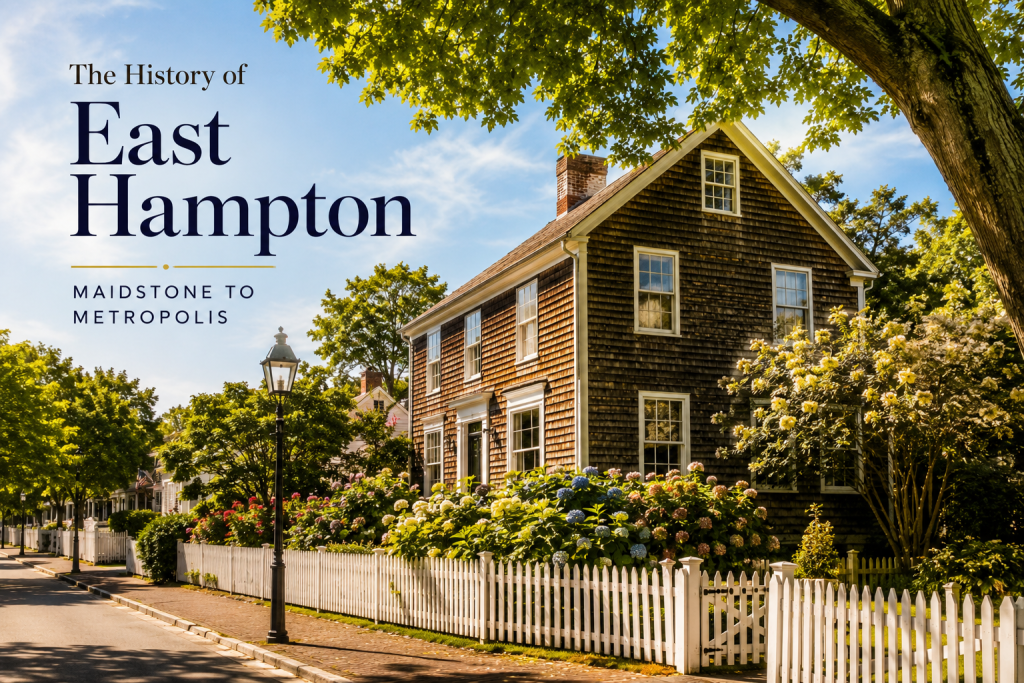
A Village That Remembers Its Own Name
The East Hampton history you think you know starts with celebrity compounds and $70 million estates. The history that actually matters starts with a group of Puritan farmers who crossed Long Island Sound in 1648, looking for fertile soil and religious freedom. They came from Maidstone, a town in Kent, England, by way of Lynn, Massachusetts, and then Connecticut. Rev. Thomas James led the congregation. Indeed, they named the settlement Maidstone after the English town they had left behind, and the name held until 1662, when the community was absorbed under New York colonial administration and rechristened East Hampton. The original name would resurface 229 years later, when the most exclusive private club on the East End chose to call itself the Maidstone Club.
That naming pattern tells you everything about how East Hampton works. The village does not forget where it came from. It layers the present on top of the past and expects you to understand both. A Tribeca documentary producer (the kind who sold a limited series to HBO and summers on Egypt Lane because the address suggests she has been here longer than she has) walks Main Street on a Friday morning. She passes the Village Green, Town Pond, and the South End Burying Ground. Certainly, she does not read the gravestones, but the gravestones read her. They date to the 1600s. Her lease dates to March.
1648: The Broad Common and the Puritan Template
The settlers laid out their village in typical Puritan New England fashion: a broad common flanked on either side by home lots of eight to twelve acres, with outlying lands divided into parcels for crops, livestock, and timber. Today, that common is Main Street. Home lots extended from the common east to Hook Pond and west to what is now Highway Behind the Lots. Farther out, the Eastern Plain was divided into large agricultural lots accessed by three parallel farm roads: Further Lane, Middle Lane, and Hither Lane. Of course, Further Lane is now one of the most expensive residential addresses in America, with the Rosenstein compound transacting at $147 million. The Puritans who named it were farming potatoes.
Town Pond anchored the southern end of the common, functioning as the communal watering hole for livestock. It still sits there, 378 years later, now populated by swans rather than cattle. Similarly, the South End Burying Ground still borders the green, its headstones marking the earliest English settlers. Mulford Farm, one of America’s most intact English Colonial farmsteads, occupies its original home lot on James Lane. Nearby, the Home Sweet Home Museum (birthplace of John Howard Payne, who wrote the lyrics to “Home, Sweet Home”) and the 1804 Gardiner Windmill complete a concentration of colonial architecture that the Southampton and Sag Harbor historic districts cannot match.
1657: The Witchcraft Trial That Predated Salem by 35 Years
In February 1658, sixteen-year-old Elizabeth Gardiner Howell (daughter of Lion Gardiner, the most prominent citizen in East Hampton and the man who had purchased Gardiner’s Island in 1639) fell ill after giving birth. Delirious and feverish, she reported seeing “a black thing” at her bedside. She told her mother that she saw Goody Garlick standing there, sticking her with pins. Elizabeth died shortly after. The East Hampton magistrates, feeling unqualified to try a capital witchcraft case, forwarded the matter to the Particular Court of Connecticut in Hartford. At the time, East Hampton fell under Connecticut jurisdiction.
Goody Davis, a younger woman who had previously worked alongside Elizabeth Garlick on Gardiner’s Island, emerged as the primary accuser. However, the trial took a turn when servants of Lion Gardiner contradicted Davis’s testimony, revealing that her grudge against Garlick was personal rather than supernatural. Connecticut Governor John Winthrop the Younger presided. On May 5, 1658, the court found Elizabeth Garlick not guilty. Her husband Joshua subsequently sued Goody Davis for defamation. They continued living in East Hampton. Goody Garlick was ultimately buried in the South End Burying Ground, the same cemetery where her accuser’s patrons rest. Notably, this trial predated Salem by 35 years, making East Hampton one of the earliest communities in America to prosecute alleged witchcraft.
She walks past the South End Burying Ground on a Thursday morning.
The gravestones are so old the names have worn smooth.
Somewhere in these rows lies Goody Garlick, found innocent and buried among her accusers.
The woman walking past has never heard the name.
She is looking at her phone. She is checking a reservation.
Three hundred and sixty-eight years separate the witchcraft trial from the dinner reservation.
Both involved the same question: who belongs here?
East Hampton has never stopped asking.
Lion Gardiner and the Oldest Family Estate in America
Before the 1648 settlement, Lion Gardiner had already established himself as the most consequential figure on the East End. In 1639, he purchased what is now Gardiner’s Island from the Montaukett people, creating what historians recognize as the longest continuously family-owned estate in the United States. The island sits in Gardiner’s Bay between the North and South Forks, approximately three miles from East Hampton’s coast. It remains privately held by Gardiner descendants to this day. For a family office advisor from the Upper East Side (the type who counsels clients on multigenerational wealth transfer), the Gardiner example is not history. It is a case study in perpetuity.
Gardiner also served as the de facto leader of the early settlement. His daughter Elizabeth married Arthur Howell, whose death triggered the Garlick witchcraft accusation. Consequently, the founding family’s personal tragedies became inseparable from East Hampton’s civic identity. Clinton Academy, chartered in 1784 as the first academy in New York State, stands on Main Street as evidence of a community that valued institutional building from its earliest decades. The 1804 Gardiner Windmill (built by Nathaniel Dominy V) and the Pantigo Windmill still punctuate the landscape. Each structure answers the question of what East Hampton valued before wealth arrived: education, agriculture, and self-sufficiency.
The Tile Club, the Artists, and the Invention of the Summer Colony
For its first 230 years, East Hampton was a farming and fishing village. Whales washed up on the beach and were butchered. Crops grew in the Eastern Plain. The population barely changed. Then, in 1877, a group of New York artists and writers called the Tile Club traveled east, fell in love with the light, and published their impressions in Scribner’s Magazine. The article romanticized East Hampton’s quaintness, its colonial architecture, its proximity to the ocean. Almost overnight, the village acquired a reputation as a destination, and the first summer colonists began arriving.
Thomas Moran, the landscape painter, was among the first artists to establish himself in East Hampton in the 1880s. Childe Hassam and William Merritt Chase followed. The shingled cottages along Ocean Avenue grew. Still, transportation remained a barrier. Before the railroad arrived, reaching East Hampton required a steamship to Sag Harbor and then a stagecoach over dusty roads. The journey was grueling enough to filter out all but the most determined visitors. In a sense, that difficulty was itself a form of exclusivity: the East Hampton summer colony began as a place you had to earn the right to reach.
1895: The Railroad That Changed Everything
On June 1, 1895, the Brooklyn and Montauk Railroad extended the Long Island Rail Road from Bridgehampton to Amagansett, with full service to Montauk by September. East Hampton Station was built on Railroad Avenue between Newtown Lane and Race Lane. The original station house still stands (added to the National Register of Historic Places in 2000). Before 1895, Sag Harbor had been the railroad’s last stop on the South Fork, functioning as the gateway to the East End since 1870. After 1895, the gateway moved. East Hampton was now directly accessible from Manhattan.
The consequences were immediate. Wealthy New York families who had previously vacationed in Newport or the Catskills discovered East Hampton’s beaches, its colonial charm, and its relative isolation. The Maidstone Club was founded in 1891, four years before the railroad arrived, which meant the social infrastructure preceded the transportation infrastructure. Essentially, the club was ready for the crowd before the crowd had a way to get there. After the railroad opened the floodgates, the summer colony grew rapidly. By the turn of the century, East Hampton had transformed from an agricultural village into a resort for the upper class. The Ladies Village Improvement Society (LVIS), founded in 1895, became the women’s civic organization that governed village aesthetics for over a century, ensuring the colonial character survived the influx of money.
The Twentieth Century: From Summer Colony to Power Center
The Village of East Hampton was incorporated in 1920. Guild Hall opened in 1931, giving the community a cultural institution that no other Hamptons village possessed. Jackson Pollock and Lee Krasner moved to Springs in 1945, launching the Abstract Expressionist migration that would permanently link East Hampton to the American art world. The mid-century brought the celebrity era: the Bouvier family summered at “Lasata” on Georgica Pond, where young Jacqueline Bouvier spent childhood summers before becoming First Lady. Lily Pond Lane and Georgica Pond became the addresses that defined East Hampton’s upper tier.
Nick and Toni’s opened in 1988, creating the dining institution that would define how the Hamptons eat. Swifty’s arrived in 2025, connecting East Hampton’s dining scene to Palm Beach’s. The East Hampton Airport became the most controversial piece of infrastructure on the East End, processing over 30,000 operations per year while generating perpetual conflict between the helicopter crowd and the year-round residents. In 2026, Dune Cottage sold for $72 million, the priciest deal of the year on the East End, and the property’s ownership chain (Wiborg family to Sara Murphy to Lee Radziwill to Thomas H. Lee) reads like a compressed history of American wealth itself. After all, East Hampton history is not something that happened. It is something that keeps happening.
The Deep Continuity: What the Walk Still Tells You
The remarkable thing about East Hampton’s historic core is not that it survived. It is that it still functions. Town Pond still anchors the green. The Gardiner Windmill still turns in the wind. Clinton Academy still faces Main Street. The South End Burying Ground still holds its secrets. In comparison, Southampton’s historical landmarks are preserved but often roped off from daily life. Sag Harbor’s whaling history lives primarily in museums. Bridgehampton’s agricultural past has been largely paved over by the event economy. East Hampton is the village where the past is not curated. It is walked through, driven past, and built upon.
This continuity is the asset that no amount of money can manufacture. A family can buy on Lily Pond Lane. However, they cannot buy the 1648 origin. They can only live inside it and hope that some of the village’s 378-year legitimacy transfers to their deed. Ultimately, East Hampton history is not a timeline. It is a credential, and the village issues it to anyone willing to understand that what they are buying is not a house. It is a position in a story that started before their great-great-grandparents were born.
Where the Conversation Continues
Social Life Magazine has covered the East End for 23 years, five summer issues per season, 25,000 copies each, distributed from Westhampton to Montauk. Fall and winter issues (15,000 copies each) reach Upper East Side doorman buildings. If the history on this page resonates, the magazine puts it in your hands every season.
If your brand serves an audience that values heritage, provenance, and institutional credibility (luxury goods, private banking, architecture, interior design, fine art, estate planning), a paid feature in Social Life Magazine positions you inside the oldest editorial conversation on the East End. Submit a paid feature here.
Polo Hamptons 2026 returns to 900 Lumber Lane in Bridgehampton on July 18 and 25, with BMW North America as title sponsor and Christie Brinkley as host. Sponsorship packages at polohamptons.com.
Subscribe to Social Life Magazine for year-round coverage of the villages, people, and stories that built the East End.
East Hampton was founded in 1648. It has been explaining itself ever since. The explanation is the history. The history is the point.
Author

Written by
Recent Posts

Powerful Strategies to Stay Ahead in a Fast-Moving Real Estate Market
How Latino Players Have Helped Shape Modern Basketball Culture
10 Best Designer iPhone 18 Pro Cases to Choose From

AI for personal finance: where PennyGuard fits

How to Pick a Homecoming Dress for Your Body Type (and Feel Amazing in It)
Categories
- Art
- Articles
- Business of Luxury
- Celebrities
- Culture
- Entertainment
- Events
- Faces of Summer 2026
- Fashion
- Fashion & Style
- Featured
- Finance
- Food, Spirits, Wine
- Hamptons
- Hamptons Celebrities
- Health
- Health & Beauty
- Lifestyle
- Luxury Lifestyle
- Press
- Profiles
- Real Estate
- Technology
- The Chronicles
- Travel
- Uncategorized
- Weddings