
Guy Fieri Net Worth 2025: Complete Financial Breakdown
Guy Fieri’s net worth in 2025 stands at approximately $150 million according to Celebrity Net Worth and industry estimates. This figure positions him among the wealthiest celebrity chefs globally, trailing only a handful of culinary media moguls despite having no fine dining pedigree whatsoever.
The composition of Fieri’s fortune reflects a fundamentally different strategy than his peers. Television dominates completely. Restaurant licensing generates substantial passive income. Product lines extend the brand into grocery aisles and home kitchens nationwide.
| Revenue Stream | Estimated Annual Value | Cumulative Lifetime Value |
|---|---|---|
| Food Network Contract (current deal) | $26 million/year | $80+ million total contract |
| Restaurant Licensing (Guy’s American, Flavortown) | $20 million/year | $100+ million lifetime |
| Product Lines (BBQ sauce, cookware, knives) | $8 million/year | $50+ million lifetime |
| Endorsements (Carnival Cruise, Chevrolet) | $5 million/year | Variable |
| Book Royalties | $1 million/year | $10+ million lifetime |
Notice what’s missing from this breakdown: restaurant operating profits. Unlike chefs who sink capital into owned locations, Fieri licenses his name to operators who bear the financial risk. He earns whether individual restaurants succeed or struggle.
The Origin Story: Small Town Outsider to Cable Television King
Guy Fieri grew up in Ferndale, California, population 1,300. No culinary dynasty. Not a single industry connection. Family money never funded early ventures. His first exposure to the food business came from selling pretzels from a cart he built himself at age ten.
This origin matters because it explains Fieri’s brand positioning. He represents the culinary outsider, the guy who never belonged to the establishment and never wanted to. The flame shirts, the bleached spikes, the muscle cars are all signals to his audience: this isn’t pretentious food culture. This is permission to enjoy abundance without apology.
After studying hospitality management at UNLV, Fieri returned to California and opened Johnny Garlic’s in Santa Rosa in 1996. The restaurant succeeded regionally but attracted no national attention. He spent a decade running restaurants in relative obscurity before a single audition changed everything.
The Next Food Network Star: $150 Million Begins with One Casting Call
In 2006, Fieri auditioned for the second season of The Next Food Network Star. The competition sought camera-ready personalities who could translate cooking skill into television entertainment. Technical excellence mattered less than watchability.
Fieri won. The prize included a six-episode series commitment from Food Network. Most winners of such competitions fade quickly, unable to sustain audience interest beyond novelty value. Fieri did the opposite. His initial series became Diners, Drive-Ins and Dives, a format so perfectly suited to his personality that it has now run for more than 900 episodes across forty-five seasons.
The show’s genius lies in its production economics. Traditional cooking shows require elaborate set construction, multiple camera setups, extensive food styling, and complex post-production. Diners, Drive-Ins and Dives requires Fieri to visit existing restaurants, talk to owners, eat their food, and react enthusiastically. Production costs stay minimal. Margins stay extraordinary.
The $80 Million Food Network Deal: Largest in Cable Food History
In 2021, Guy Fieri signed a three-year contract extension with Food Network worth approximately $80 million, the largest deal in the network’s history. The agreement covers his continued hosting of Diners, Drive-Ins and Dives, Guy’s Grocery Games, Tournament of Champions, and various special programming.
Understanding why Food Network paid this premium requires examining what Fieri delivers that other hosts cannot. His shows consistently rank among the network’s highest-rated programming. More importantly, he reaches demographics that other food personalities struggle to access.
The coastal culinary establishment appeals to urban, affluent, food-obsessed viewers. Fieri appeals to everyone else: Middle America, suburban families, blue-collar workers, people who eat at Applebee’s without irony. This audience is vastly larger than the foodie niche. Advertisers pay premium rates to reach it.
Geographic Arbitrage: Claiming Territory Others Ignored
Most celebrity chefs cluster their attention on New York, Los Angeles, San Francisco, and a handful of other metropolitan food capitals. Fieri built his brand celebrating American regional cooking in places no one else bothered to visit. Barbecue joints in Kansas City. Diners in rural Ohio. Taco trucks in Albuquerque.
This geographic positioning created competitive advantage in two ways. First, it gave Fieri authentic claim to “real American food” that resonated with audiences tired of being told their tastes were unsophisticated. Second, it generated virtually unlimited content possibilities. Every town has local restaurants worth featuring. The show never runs out of material.
The contrast with Gordon Ramsay’s approach is instructive. Ramsay built authority through Michelin stars and European training, signaling expertise to audiences who value credentials. Fieri built authority through enthusiastic celebration of populist cooking, signaling solidarity with audiences who feel excluded by credential-based culture.
Guy Fieri’s Restaurant Empire: Licensing Over Ownership
Guy Fieri’s restaurant portfolio includes more than 80 locations operating under various brand names: Guy’s American Kitchen and Bar, Flavortown Kitchen, Guy Fieri’s Vegas Kitchen and Bar, Chicken Guy, and others. The empire spans casino resorts, airports, cruise ships, and standalone locations.
What distinguishes Fieri’s approach from traditional chef-restaurateurs is the ownership structure. Fieri rarely invests his own capital in restaurant locations. Instead, he partners with operators like Robert Earl’s Virtual Dining Concepts and casino companies who provide financing and operational management. Fieri provides brand value and promotional support.
This model generates income regardless of individual restaurant performance. When a location succeeds, Fieri earns fees and royalties. When a location struggles, the operator absorbs the loss. The asymmetric risk profile explains how Fieri can have his name on 80+ restaurants without the operational headaches that plague chef-owners.
Ghost Kitchens and Virtual Brands: The Flavortown Expansion
The COVID-19 pandemic accelerated a transformation in restaurant economics that benefited Fieri’s licensing-based model. Ghost kitchens and virtual brands allowed his partners to launch Flavortown Kitchen and Chicken Guy locations within existing restaurant infrastructure, minimizing capital requirements while maximizing brand distribution.
A traditional restaurant opening might require $1-3 million in buildout costs plus ongoing rent and staffing expenses. A ghost kitchen implementation might require $50,000 in equipment and menu integration. The economics favor rapid scaling with minimal risk.
For Fieri, this meant dramatic expansion of his licensing revenue without corresponding expansion of operational complexity. More locations generated more fees without requiring more of his attention or capital.
Product Lines: Extending the Brand into Every Kitchen
Guy Fieri’s product licensing extends beyond restaurants into consumer goods sold at major retailers nationwide. His BBQ sauces, seasonings, and cooking equipment appear on Walmart shelves. Cookware bearing his name sells through multiple channels. Each product generates royalty income without requiring Fieri’s ongoing involvement.
The grocery store positioning reinforces the populist brand identity. Fieri’s products don’t appear at Williams Sonoma targeting affluent home cooks. They appear at Target and Walmart targeting everyday Americans. The audience alignment between his television content and his product distribution creates marketing efficiency competitors struggle to match.
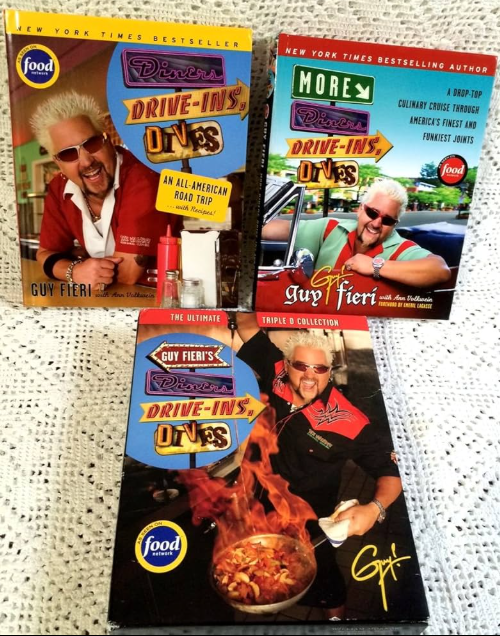
Book publishing adds another revenue stream. Fieri has authored several cookbooks, each reinforcing the accessible, indulgent cooking philosophy that defines his brand. Cookbook economics favor established personalities with built-in audiences, and Fieri’s television platform guarantees launch visibility that most authors could never achieve.
The Philanthropy Factor: COVID Relief and Restaurant Worker Support
An underreported aspect of Guy Fieri’s career involves his charitable work, particularly during the COVID-19 pandemic. He raised more than $25 million for the Restaurant Employee Relief Fund, providing direct assistance to service industry workers displaced by lockdowns and closures.
This philanthropy matters from a brand perspective as well as a humanitarian one. It demonstrated authentic connection to the restaurant community rather than mere extraction from it. Workers and owners featured on Diners, Drive-Ins and Dives saw Fieri advocate for their survival during industry crisis. The goodwill this generated reinforced brand loyalty among audiences who value authenticity.
The contrast with other celebrity chefs who remained relatively quiet during the pandemic was notable. Fieri’s visible advocacy positioned him as industry champion rather than industry exploiter, a distinction that supports premium licensing fees and partnership opportunities.
Why Guy Fieri Net Worth Outpaces Michelin-Starred Competitors
The culinary establishment initially dismissed Guy Fieri as a cartoon character unworthy of serious consideration. Food critics mocked his aesthetic choices. The New York Times published a famously brutal review of his Times Square restaurant. Sophisticated observers assumed his appeal was temporary.
They were wrong, and understanding why reveals important principles about celebrity economics. Fieri optimized for audience size rather than critical approval. He built brand loyalty rather than critical consensus. He created content that costs little to produce and generates enormous ratings rather than content that wins awards and loses money.
Consider the comparison: a chef who earns three Michelin stars might generate $500,000 annually in personal income from restaurant operations after years of grueling work. Fieri generates $26 million annually from television alone, plus another $20+ million from licensing, plus product royalties, plus endorsements. The math isn’t close.
Lessons from Guy Fieri’s Wealth Building
Audience size beats critical approval. Food critics never embraced Fieri. Audiences did. The revenue flows from audience attention, not critical validation.
Production economics matter as much as content quality. Diners, Drive-Ins and Dives succeeds partly because it costs so little to make. High margins enable high talent compensation.
Licensing beats ownership when brand value exceeds operational capability. Fieri’s name on a restaurant attracts customers. His involvement in daily operations adds limited value. The licensing model captures the name value while avoiding operational complexity.
Being underestimated can be strategy. Establishment dismissal freed Fieri to build audience without competitive pressure from chefs who considered his market beneath them.
Guy Fieri Net Worth: The Hamptons Angle
Guy Fieri represents a category of wealth increasingly visible in Hamptons summer communities: successful entertainment entrepreneurs who built fortunes outside traditional establishment paths. Tech founders, entertainment executives, and media personalities who share Fieri’s unpretentious abundance populate East End social scenes.
The anti-snob positioning that coastal critics mock actually resonates with many affluent Americans who earned their wealth through entrepreneurship rather than inheritance. They recognize in Fieri someone who succeeded by ignoring gatekeepers rather than appeasing them. That recognition creates cultural affinity regardless of culinary preferences.
For Social Life Magazine readers evaluating celebrity chef partnerships for events or brand collaborations, Fieri’s audience demographics offer distinct advantages. His reach extends beyond the food-obsessed into mainstream American households, providing exposure that niche culinary personalities cannot match.
Guy Fieri Net Worth 2025: Final Assessment
Guy Fieri’s $150 million net worth in 2025 represents perhaps the most successful rejection of culinary establishment values in industry history. No formal training. Not a single Michelin star. Zero critical approval. Just the largest television contract in food media history and a licensing empire spanning 80+ restaurants.
His strategy optimized for audience size over critical consensus, for production efficiency over content prestige, for brand licensing over operational ownership. Critics who dismissed him as a temporary phenomenon now watch him sign deals worth more than their entire careers will generate.
The flame shirts were never the point. They were a distraction while Fieri built something far more substantial: a brand that resonates with mainstream America deeply enough to command premium rates from every partner who wants access to that audience. Flavortown turned out to be worth $150 million and counting.
Related Articles
- Gordon Ramsay Net Worth 2025: How He Built $220 Million
- Rachael Ray Net Worth 2025: The Pet Food Deal That Paid Her Twice
- Celebrity Chef Net Worth Rankings 2025: Who’s Really Making Money
- How Licensing Deals Create Long-Term Wealth
For coverage inquiries, brand partnerships, and advertising opportunities, contact Social Life Magazine. Experience the Hamptons’ premier lifestyle events at Polo Hamptons.
Author

Written by
Recent Posts

AI for personal finance: where PennyGuard fits

How to Pick a Homecoming Dress for Your Body Type (and Feel Amazing in It)

World Cup Injury Attorney for Vancouver Events
What a 3-Carat Engagement Ring Actually Costs in 2026: The Real Numbers
The Skincare Habits That Make a Real Difference Over Time
Categories
- Art
- Articles
- Business of Luxury
- Celebrities
- Culture
- Entertainment
- Events
- Faces of Summer 2026
- Fashion
- Fashion & Style
- Featured
- Finance
- Food, Spirits, Wine
- Hamptons
- Hamptons Celebrities
- Health
- Health & Beauty
- Lifestyle
- Luxury Lifestyle
- Press
- Profiles
- Real Estate
- Technology
- The Chronicles
- Travel
- Uncategorized
- Weddings