
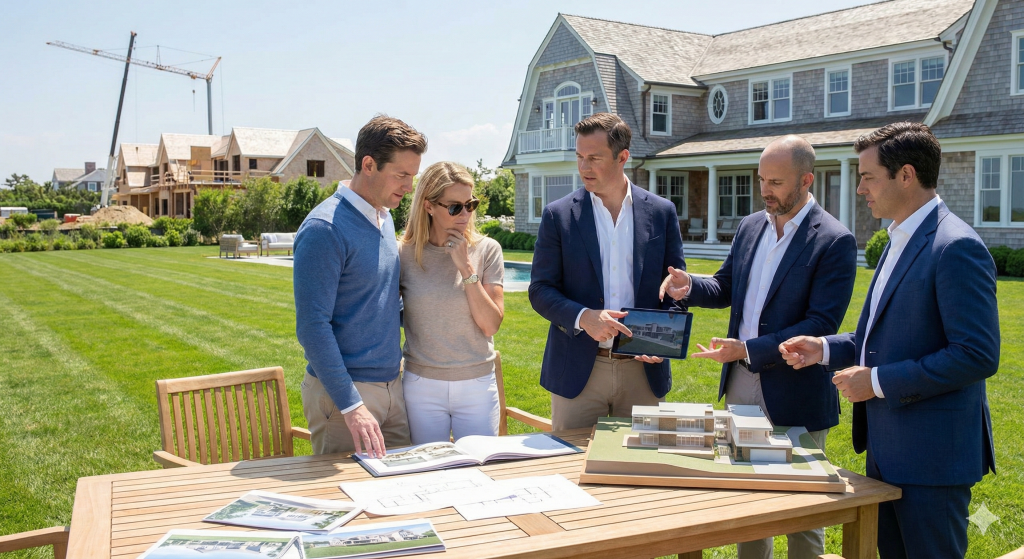
Three architects presented stunning portfolios. All promised to create your dream estate. Two will deliver nightmares. The problem is they look identical on paper. Choosing the right Hamptons estate architect requires reading signals that most homeowners miss entirely. Get this decision right and you’ll build a legacy. Get it wrong and you’ll spend three years learning exactly how much architects can bill for their mistakes.
Why Hamptons Estate Architects Require Different Evaluation
Hamptons estate architects operate in a market unlike anywhere else. The combination of extreme wealth, demanding clients, complex regulations, and concentrated geography creates unique pressures. Architects who thrive in Manhattan or Miami often struggle here. The skills don’t transfer automatically.
Local expertise matters more than pedigree. A Harvard GSD graduate with stunning conceptual work may flounder against East Hampton’s zoning board. Meanwhile, a less credentialed architect with twenty years of village relationships navigates approvals effortlessly. Your evaluation criteria must account for this reality.
The stakes justify rigorous selection. Architectural fees for Hamptons estates typically run $800,000 to $2 million. Construction costs multiply that by ten. Choosing based on portfolio aesthetics alone ignores the operational competencies that determine whether your project succeeds or implodes. [Related: Integrated Design Project: The Complete Guide]
The Portfolio Review: What to Actually Look For
Every architect shows beautiful photographs. The images tell you almost nothing about working with that firm. You need to read portfolios differently than architects expect.
Project Scale Alignment

Examine whether completed projects match your scope. An architect brilliant at 4,000 square foot renovations may lack systems for managing 15,000 square foot new construction. The reverse also applies. Firms scaled for massive estates sometimes neglect smaller projects that don’t justify their overhead.
Ask specifically about projects within 25% of your anticipated size and budget. Request references from those clients, not from the showcase projects featured on the website.
Regulatory Jurisdiction Experience
Each Hamptons village maintains distinct approval processes. Southampton Town operates differently than East Hampton Town. Village overlay districts add complexity. Historic districts impose additional constraints. Wetland adjacency triggers environmental reviews.
Your architect should have completed multiple projects in your specific jurisdiction. Ask how many, which board members they’ve presented to, and which projects required variances and how those were obtained.

Inexperience with local process adds months to timelines and uncertainty to outcomes.
Construction Documentation Quality
Beautiful renderings don’t build houses. Construction documents do. Request sample drawing sets from completed projects. Evaluate their completeness and clarity. Contractors bid more accurately from thorough documents. Incomplete drawings generate change orders.

According to McKinsey research on construction productivity, documentation quality ranks among the strongest predictors of project cost performance. This unsexy competency matters more than design awards.
Fee Structures: Understanding What You’re Actually Paying For
Architectural fees vary dramatically and the variations don’t always correlate with quality. Understanding fee structures helps you compare proposals accurately.
Percentage of Construction Cost
Most Hamptons estate architects charge 8% to 12% of construction cost. This percentage typically covers schematic design through construction administration. Higher percentages sometimes indicate more comprehensive services. Sometimes they indicate inefficiency. You must examine what’s included.
Hourly Rates With Caps
Some firms bill hourly with not-to-exceed limits. This structure works well for uncertain scopes but requires careful monitoring. Without attention, hours accumulate toward caps regardless of progress. Request regular hour reports and compare against deliverable milestones.
What’s Typically Excluded
Standard architectural agreements exclude interior design, landscape architecture, and specialty consultants. They often exclude extensive 3D visualization, physical models, and presentation materials beyond basic requirements. They almost always exclude permit fees, surveys, and geotechnical investigations.
When comparing proposals, list exclusions side by side. A lower fee that excludes construction administration costs more than a higher fee that includes it. The comparison requires normalizing scope. [Related: Integrated Design vs Traditional Build Costs]
The Interview Process: Questions That Reveal Truth
Formal interviews separate serious candidates from impressive presenters. These questions expose capabilities that portfolios hide.
“Walk me through a project that went badly. What happened and what did you learn?”
Every experienced architect has disaster stories. Those who claim otherwise are lying or inexperienced. Listen for accountability versus blame-shifting. Architects who learned from failures make better partners than those who’ve never confronted adversity.
“Who will actually design my house?”
Prominent architects often delegate design to junior staff. The principal presents, wins the commission, then hands off to associates. This isn’t necessarily problematic if the associates are talented. But you deserve to know who’ll actually shape your home. Meet them. Evaluate their capabilities independently.
“How do you handle budget constraints?”
Some architects view budgets as obstacles to vision. They design what they want, then express disappointment when you can’t afford it. Others treat budgets as creative parameters. The latter approach produces better outcomes for clients. Listen for enthusiasm about working within constraints versus resentment about limitations.
“Describe your relationship with contractors.”
Architects and contractors exist in creative tension. Some architects view contractors as adversaries who compromise design intent. Others view them as collaborators who enable realization. Harvard Business Review research on project teams confirms that collaborative orientations produce superior outcomes. Seek architects who respect construction expertise.
Red Flags That Signal Future Problems
Certain patterns predict troubled engagements. Recognizing these signals early prevents expensive mistakes.
Reluctance to Provide References
Quality architects maintain relationships with past clients who gladly recommend them. Hesitation to provide references, or providing only ancient ones, suggests recent client dissatisfaction. Insist on speaking with owners from the past three years.
Vague Answers About Schedule
Ask how long design will take, how long permitting typically requires, and what construction duration looks like for similar projects. Architects who can’t provide specific ranges either lack experience or avoid accountability. Neither serves your interests.
Dismissiveness About Budget
If an architect responds to budget discussion with “let’s not constrain ourselves yet” or “we’ll value engineer later,” expect cost problems. Professional architects establish budget frameworks early and design within them. Deferring budget reality creates painful reconciliations.
Overpromising on Timeline
Hamptons projects face genuine constraints: seasonal weather, limited labor, complex approvals. Architects promising unusually fast delivery either don’t understand local conditions or are telling you what you want to hear. Neither bodes well. [Related: Integrated Project Delivery Guide]
Local Knowledge: The Undervalued Competency
Hamptons construction involves relationships and institutional knowledge that outsiders lack. This soft expertise often matters more than design brilliance.
Building Department Relationships
Experienced local architects know building officials personally. They understand which details trigger scrutiny and which pass without comment. They’ve learned, through years of submissions, how to present projects for efficient approval. This relationship capital accelerates your timeline.
Contractor Networks
The best Hamptons contractors are perpetually booked. They select projects based on relationships as much as compensation. Architects with strong contractor relationships help you access builders who might otherwise be unavailable. Ask which contractors the architect has worked with repeatedly. Those ongoing relationships indicate mutual respect.
Subcontractor Quality Intelligence
Local architects know which roofers do quality work and which cut corners. They know which excavators respect schedules and which create delays. This intelligence, accumulated over decades, protects your project from subcontractor problems that plague newcomers.
Design Philosophy Alignment
Beyond competency, you need philosophical compatibility. Architects have perspectives on residential design. Yours should complement your lifestyle.
The Preservation-Innovation Spectrum
Some architects believe Hamptons homes should honor traditional vernacular. Shingle style, cedar shakes, symmetrical facades. Others push contemporary expression. Glass walls, flat roofs, geometric volumes. Most clients benefit from positioning somewhere between extremes. Ensure your architect’s natural inclination matches your preference.
Indoor-Outdoor Philosophy
Hamptons living emphasizes outdoor connection. How does the architect think about transitional spaces? Covered porches, outdoor rooms, landscape integration. Some architects treat interiors and exteriors as separate problems. Others design them as continuous experience. The latter approach typically serves Hamptons lifestyle better.
Sustainability Orientation
Environmental performance increasingly matters to sophisticated buyers. Some architects lead with sustainability, integrating passive strategies, renewable systems, and healthy materials throughout. Others treat green features as add-ons. If environmental performance matters to you, select an architect whose practice embeds these values.
The Team Beyond the Principal
Architectural firms include project architects, designers, drafters, and administrators. Your experience depends on this entire team, not just the name partner.
Project Architect Evaluation
The project architect manages day-to-day design development. Meet this person before signing. Evaluate their communication style, technical knowledge, and temperament. You’ll interact with them more than the principal. Compatibility matters.
Firm Stability
Staff turnover disrupts projects. Ask about team tenure. Firms with high turnover lose institutional knowledge continuously. The people who developed your design may leave before construction. Stable firms maintain continuity that benefits complex projects.
Bandwidth Assessment
Ask how many active projects the firm manages. Ask specifically about projects in design development, your project’s likely phase. Overcommitted firms stretch resources thin. Your project receives less attention. Response times slow. Quality suffers. According to Bain analysis of professional services, capacity management directly impacts client outcomes.
Contract Provisions That Protect You
Architectural agreements contain provisions that matter more than fees. Review these carefully before signing.
Ownership of Documents
Standard AIA contracts grant architects copyright over drawings. You receive a license to build one instance. If you want to build the design again, or extensively modify it, you need additional rights. Negotiate document ownership if flexibility matters.
Scope Definition
Vague scope descriptions generate disputes. Ensure the contract specifically lists deliverables for each phase. Number of design options. Presentation format. Drawing sheet count. Specification detail level. Specificity protects both parties.
Termination Provisions
Sometimes relationships don’t work. Review termination clauses before problems arise. Understand what you owe if you end the engagement. Understand what deliverables you receive. Fair termination provisions allow graceful exits when necessary.
Schedule Commitments
Include milestone dates with consequences. Architects who miss deadlines should face fee adjustments. This accountability focuses attention and prevents indefinite design phases that delay construction. [Related: Luxury Home Builders East End Guide]
Frequently Asked Questions: Choosing Hamptons Architects
How much do Hamptons estate architects charge?
Hamptons estate architects typically charge 8% to 12% of construction cost for full services from schematic design through construction administration. For a $15 million construction budget, expect architectural fees between $1.2 million and $1.8 million.
Should I hire a local architect or bring someone from Manhattan?
Local expertise significantly benefits Hamptons projects due to complex regulations and important relationships. Manhattan architects can succeed but should partner with local consultants who understand East End jurisdictions and contractor networks.
How long does the design process take for a Hamptons estate?
Design through permit-ready documents typically requires 9 to 14 months for complex estates. Simpler projects may complete in 6 months. Permitting adds 2 to 6 months depending on jurisdiction and project complexity.
What’s the most important quality in a Hamptons architect?
Communication and realistic expectations matter most. Design talent without project management creates beautiful drawings that never get built on budget. Seek architects who combine aesthetic vision with operational excellence and transparent client relationships.
Making Your Final Selection
After interviews and reference calls, you’ll likely have two strong candidates. The final decision often comes down to intangibles. Who communicated more clearly? Whose references spoke with more enthusiasm? Who asked better questions about your lifestyle?
Trust your instincts about personal compatibility. You’ll work with this firm for two to four years. The relationship endures through stress, decisions, and inevitable problems. Select someone you genuinely enjoy engaging with, not just someone with impressive credentials.
The right Hamptons estate architect becomes a trusted advisor who shapes how you live. The wrong one becomes an expensive lesson in due diligence. The evaluation process outlined here maximizes your odds of finding a true partner for creating your legacy estate.
For inquiries regarding RE Development, Funding, Design, contact: Jon Cruz, j.cruz2709@gmail.com
Continue Your Research
• Integrated Design Project: The Hamptons Estate Buyer’s Guide
• What Is Integrated Project Delivery? A Guide for Luxury Homeowners
• Integrated Design vs Traditional Build: Which Costs More?
Connect with Hamptons’ leading architects and developers at Polo Hamptons, where industry relationships are built over world-class sport.
For features, partnerships, and advertising inquiries, contact our team.
—
Subscribe to Social Life print edition | Join our newsletter | Support our journalism ($5)
Author

Written by
Recent Posts

The Ultra-Limited Strawberry Drop Landing Just in Time for Summer

7 Outdoor Thrills Discerning Travelers Actually Love

Why the Simplest Tasks Are Sometimes the Hardest

How to Choose the Right Private Flight From New York for Your Travel Needs
8 Top Platforms Reshaping Check Printing and Direct Mail for Banking and Financial Services
Categories
- Art
- Articles
- Business of Luxury
- Celebrities
- Culture
- Entertainment
- Events
- Faces of Summer 2026
- Fashion
- Fashion & Style
- Featured
- Finance
- Food, Spirits, Wine
- Hamptons
- Hamptons Celebrities
- Health
- Health & Beauty
- Lifestyle
- Luxury Lifestyle
- Press
- Profiles
- Real Estate
- Technology
- The Chronicles
- Travel
- Uncategorized
- Weddings