
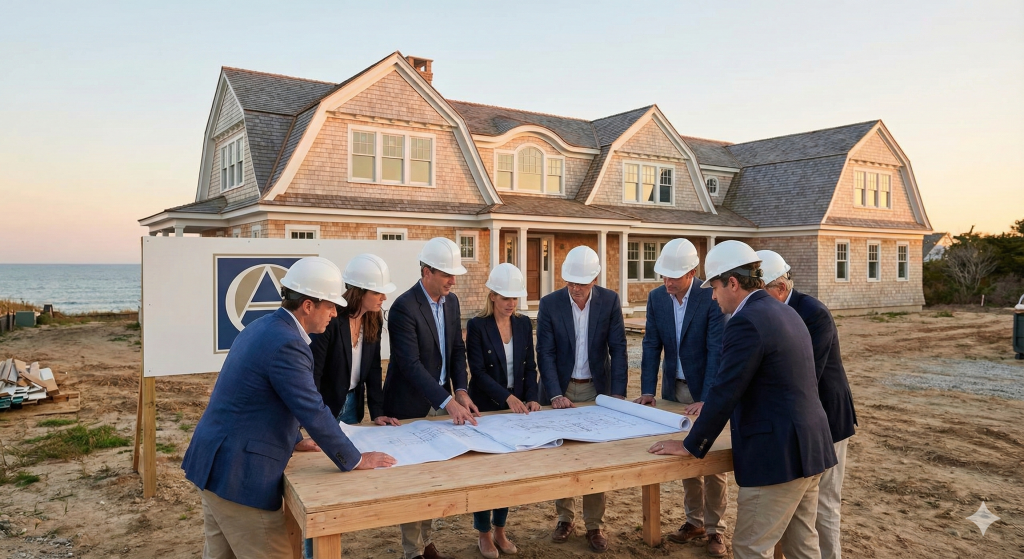
The builder who constructed your friend’s stunning Sagaponack estate just quoted your project at $1,200 per square foot. Meanwhile, another firm came in at $850. Same plans. Same finishes. Same timeline. Clearly, one of them is lying. Figuring out which one determines whether you build a legacy or fund someone else’s retirement.
Why East End Builders Operate Differently
Luxury home builders on the East End face constraints that mainland contractors never encounter. As a result, understanding these pressures helps you evaluate proposals intelligently and set realistic expectations.
First, labor scarcity defines the market. The East End lacks sufficient year-round skilled tradespeople for peak construction demand. Consequently, builders import crews from Connecticut, New Jersey, and beyond. Housing these workers and managing their travel adds complexity that simply doesn’t exist in metropolitan markets.
Additionally, seasonality compounds these labor challenges. Summer traffic makes material deliveries impractical during peak months. Therefore, smart builders front-load intensive work before Memorial Day and schedule finish work for fall.
Finally, the client base amplifies pressure. East End homeowners include finance executives, entrepreneurs, and celebrities accustomed to excellence. Their expectations for quality and communication exceed typical residential standards. [Related: Integrated Design Project: The Complete Guide]
The Tier System: Understanding Builder Categories
East End builders cluster into distinct tiers based on capability, capacity, and pricing. Consequently, matching your project to the appropriate tier prevents both overpaying and under-building.
Tier One: Ultra-Premium Builders
These firms handle $20 million and above projects exclusively. They maintain dedicated project managers for each build and employ quality control specialists. Pricing runs $1,100 to $1,500 per square foot. Notably, they decline smaller projects regardless of profitability because such work dilutes their reputation.
Tier Two: Premium Builders
This tier represents the sweet spot for most estate construction. These builders expertly execute $8 million to $25 million projects with experienced superintendents and proven quality systems. Pricing typically ranges $900 to $1,200 per square foot.
Tier Three: Quality Regional Builders
These capable firms handle $3 million to $10 million projects effectively. However, they may struggle with complexity beyond their experience. Pricing runs $750 to $950 per square foot. For straightforward homes without unusual systems, they offer compelling value.
Tier Four: Standard Residential Contractors
General contractors serving the broader market build competently at $500 to $800 per square foot. Nevertheless, they lack luxury finishing expertise. Custom details and high-end systems challenge their capabilities. They’re appropriate for guest houses, not primary estates.
Vetting Builders: The Due Diligence Process
Selecting an East End builder requires investigation beyond portfolio review. Specifically, these verification steps separate qualified candidates from impressive marketers.
Financial Stability Assessment
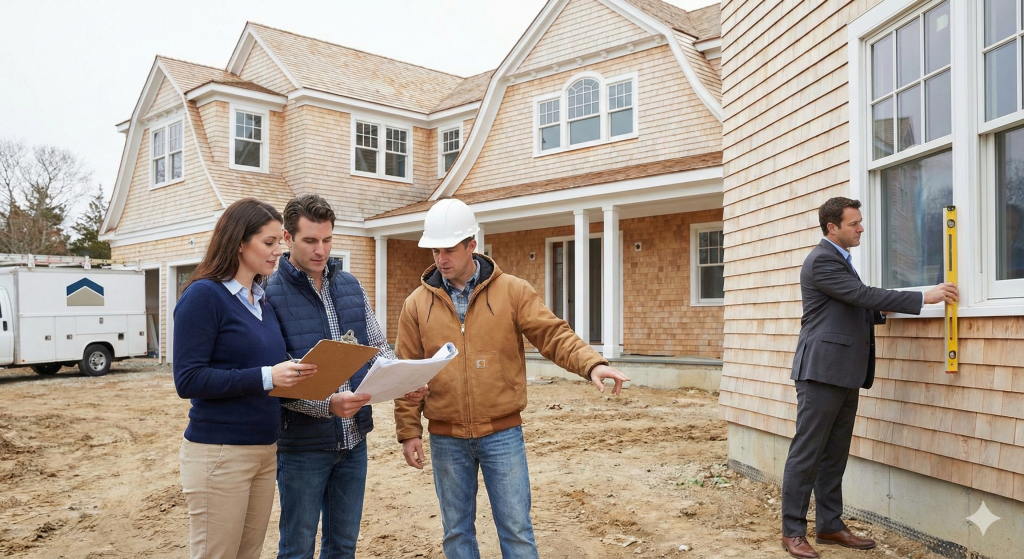
Start by requesting financial references from material suppliers and subcontractors. Builders under financial stress slow-pay vendors, and those vendors then deprioritize that builder’s projects. As a result, your timeline suffers from someone else’s cash flow problems.
Insurance Verification
Luxury projects require substantial coverage. Therefore, verify general liability minimums of $5 million, workers compensation compliance, and builder’s risk capacity matching your project value. Moreover, request certificates directly from insurers rather than accepting photocopies from contractors.
License and Registration Confirmation
New York requires home improvement contractor registration. Verify active status through the Department of State and check for complaints or disciplinary actions. While clean records don’t guarantee performance, problematic histories certainly predict future issues.
Litigation History Review
Search court records for lawsuits involving the builder. Although some litigation is unavoidable in construction, patterns of owner disputes reveal operational problems. A builder constantly in court lacks bandwidth for your project. [Related: How to Choose Hamptons Estate Architects]
Understanding Builder Pricing
East End construction pricing confuses even sophisticated buyers. However, understanding cost components helps you evaluate proposals and negotiate effectively.
Hard Costs vs. Soft Costs
Hard costs include materials, labor, subcontracts, and equipment. In contrast, soft costs include permits, insurance, supervision, and project management. Some builders quote hard costs only, then reveal soft costs later. Therefore, ensure you’re comparing equivalent scopes.
The Markup Structure
Builders apply markup to cover overhead and profit. Typical cost-plus arrangements average 15% to 22% markup on the East End. Fixed-price contracts, on the other hand, build markup into line items, obscuring the actual percentage.
Allowance Manipulation
Competitive builders often minimize allowances to reduce apparent price. For example, the lighting allowance shows $75,000, but your designer specifies $250,000 in fixtures. That $175,000 gap then becomes a change order.
According to McKinsey analysis of construction economics, allowance underestimation accounts for 30% of residential construction cost overruns. Consequently, scrutinize these numbers carefully when comparing proposals.
Contract Structures That Protect You
The construction contract determines how disputes resolve and costs escalate. In fact, these provisions matter more than the price itself.

Cost-Plus With Guaranteed Maximum
This hybrid structure provides both transparency and protection. You see actual costs as they occur, while the guaranteed maximum caps your exposure. Furthermore, savings below the cap typically split between owner and builder, creating shared incentive for efficiency.
Fixed-Price Contracts
With this approach, you know the number upfront, and the builder accepts cost risk. This certainty appeals to many owners. However, fixed-price contractors include substantial contingency for uncertainty, so you pay for risk transfer whether problems materialize or not.
Pure Cost-Plus
This structure offers maximum transparency but no cost ceiling. It’s appropriate when scope remains genuinely uncertain or when trust with the builder is absolute. Without a cap, though, cost discipline depends entirely on builder ethics and owner attention. [Related: Integrated Project Delivery Guide for Homeowners]
The Subcontractor Ecosystem
Builders don’t actually construct homes themselves. Instead, they manage subcontractors who do. Understanding this ecosystem therefore helps you evaluate builder capabilities accurately.
Relationship Quality Matters
Elite subcontractors choose which builders they’ll work with. The best tile setters, finish carpenters, and HVAC technicians stay perpetually booked. As a result, they prioritize builders who treat them fairly and pay promptly.
To evaluate this, ask builders which subcontractors they use for critical trades, then cross-reference with your architect and other owners. When the same excellent names appear repeatedly, it indicates a builder with genuine access to top talent.
Captive vs. Market Subcontractors
Some builders employ certain trades directly, such as in-house framing crews. Others rely entirely on market subcontractors. Neither approach is inherently superior. However, captive crews provide more schedule certainty during peak demand periods.
Subcontractor Payment Terms
How builders pay subcontractors directly affects your project. Builders who stretch payment terms lose priority scheduling because subcontractors serve prompt-paying builders first. Thirty-day terms are reasonable, while sixty or ninety-day terms suggest cash flow problems.
Project Management Capabilities
Construction quality depends on management systems more than individual skill. These capabilities therefore separate professional operations from talented amateurs.

Scheduling Sophistication
Complex estates involve hundreds of coordinated activities. Professional builders use scheduling software that tracks dependencies and anticipates conflicts. When reviewing proposals, ask to see a sample schedule from a comparable project. Gantt charts with logical dependencies indicate systematic thinking, whereas simple task lists suggest ad hoc management.
Documentation Systems
Quality builders maintain comprehensive project records including daily logs, progress photos, and change order documentation. These records protect everyone when disputes arise. Additionally, they enable continuity when personnel changes occur.
Communication Protocols
Consider how you’ll receive information: weekly reports, monthly meetings, or real-time dashboards. Also clarify response time expectations and superintendent access. Harvard Business Review research on major projects identifies communication quality as the strongest predictor of owner satisfaction.
Red Flags in Builder Selection
Certain patterns predict troubled projects. Recognizing these warning signs early therefore prevents expensive commitments.
Dramatically Low Pricing
When one bid comes in 25% below others, something is wrong. Either scope was misunderstood, allowances are unrealistic, or the builder plans to recover margin through change orders. In other words, dramatically low bids rarely produce dramatically low final costs.
Reluctance to Provide References
Quality builders maintain client relationships for years, so they gladly connect prospects with past owners. Hesitation suggests recent problems. Therefore, insist on speaking with owners whose projects completed within the past eighteen months.
Pressure Tactics
Builders claiming they need immediate commitment to hold scheduling slots are often struggling for work. Genuinely busy builders, by contrast, have waiting lists and don’t need pressure tactics. Take the time your decision requires.
Vague Change Order Procedures
Before signing, ask how changes get priced, approved, and documented. Professional builders have clear procedures, while vague answers predict future conflicts. Since change orders cause more construction disputes than any other issue, clarity now prevents litigation later. [Related: Integrated Design vs Traditional Build Costs]
The Interview Process
After initial vetting, interview finalist builders using questions that reveal operational reality.
“Who will be my superintendent, and what other projects will they manage simultaneously?”
The superintendent shapes your daily experience, so meet them before signing. Evaluate their communication style and technical knowledge. Also understand their workload, since a superintendent managing three projects provides different attention than one managing six.
“Walk me through your most challenging project. What went wrong and how did you handle it?”
Every experienced builder has war stories. Listen carefully for accountability versus excuse-making. Builders who acknowledge mistakes and explain lessons learned make better partners than those claiming perfect records.
“How do you handle cost overruns when they’re not caused by owner changes?”
Construction involves unknowns like hidden conditions and material price spikes. Professional builders have frameworks for sharing unexpected costs rather than simply passing everything through. Their answer reveals their partnership orientation.
“What would make you decline this project?”
This question often surprises builders, yet their answer reveals self-awareness about limitations. Builders who claim they can handle anything lack judgment. Those who articulate specific concerns, however, demonstrate thoughtfulness about fit.
Timing and Availability
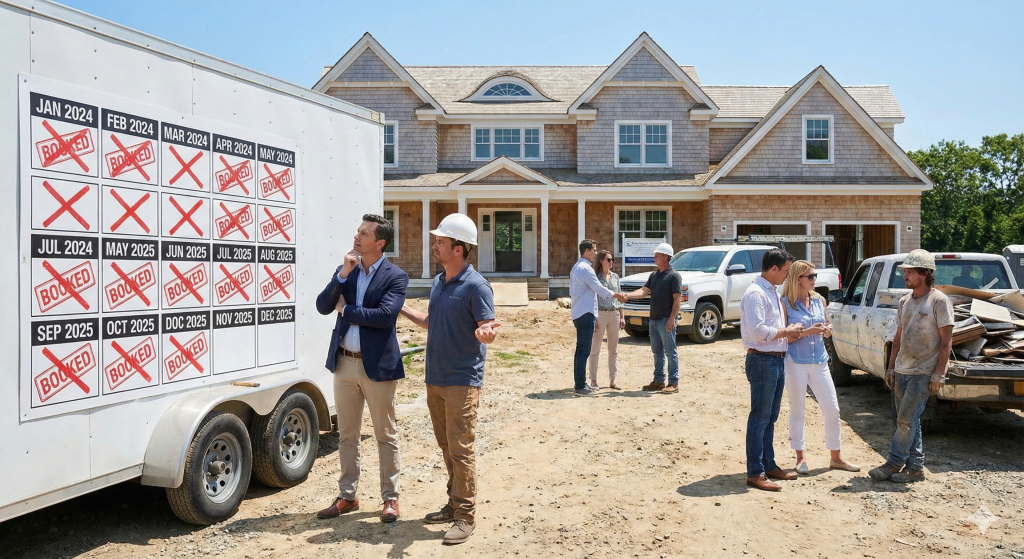
East End builder schedules fill twelve to eighteen months ahead. Starting your search late therefore limits options to whoever happens to have capacity, which often means firms with problems.
The Ideal Timeline
Begin builder selection during schematic design, roughly nine months before construction start. This timing allows thorough vetting and enables preconstruction collaboration. It also secures preferred builders before their calendars fill.
Off-Season Advantages
Projects starting in fall or winter sometimes access better builder availability. Summer starts, by contrast, compete with every other Hamptons project for limited resources. Strategic timing therefore improves your options significantly.
Multi-Year Relationships
The best owner-builder relationships span decades. Families who find excellent builders return for renovations and subsequent properties. Builders value these relationships and prioritize returning clients. According to Bain & Company analysis, repeat client relationships correlate with superior project outcomes across construction sectors.
Frequently Asked Questions: East End Luxury Builders
How much do luxury home builders charge on the East End?
East End luxury construction typically costs $850 to $1,500 per square foot depending on finishes, complexity, and builder tier. Ultra-premium projects can exceed $2,000 per square foot. These figures include hard and soft costs but exclude land, design fees, and furnishings.
How far in advance should I contact builders?
Contact preferred builders twelve to eighteen months before your target construction start. Elite builders maintain waiting lists, so beginning outreach during schematic design ensures access to your preferred choices.
What’s the difference between cost-plus and fixed-price contracts?
Cost-plus contracts charge actual costs plus a markup percentage, providing transparency but cost uncertainty. Fixed-price contracts, in contrast, set a lump sum regardless of actual costs. Cost-plus with guaranteed maximum offers a hybrid approach favored by sophisticated owners.
How can I verify a builder’s quality before hiring them?
Visit completed projects in person rather than relying on photographs. Speak with owners about their construction experience, not just the finished result. Also check references from architects and verify insurance and licensing through official sources.
Making Your Selection
After vetting, interviews, and reference calls, you’ll likely face a choice between two or three qualified builders. At this stage, price differences typically reflect risk allocation rather than quality differences.
Consider the relationship you want. Some builders maintain professional distance, while others become genuine partners invested in your vision. Neither approach is wrong, but your preference matters for a multi-year engagement.
Trust your instincts about communication compatibility. The builder who responded thoughtfully during selection will likely communicate well during construction. Conversely, the one who was hard to reach during courtship won’t improve after signing.
Ultimately, the right luxury home builder transforms construction from an ordeal into an experience. They protect your investment, realize your vision, and deliver an estate worthy of the East End’s most discerning addresses.
For inquiries regarding RE Development, Funding, Design, contact: Jon Cruz, [email protected]
Continue Your Research
• Integrated Design Project: The Hamptons Estate Buyer’s Guide
• What Is Integrated Project Delivery? A Guide for Luxury Homeowners
• Integrated Design vs Traditional Build: Which Costs More?
• Hamptons Estate Architects: How to Choose the Right Firm
Connect with Hamptons’ leading architects and developers at Polo Hamptons, where industry relationships are built over world-class sport.
For features, partnerships, and advertising inquiries, contact our team.
—
Subscribe to Social Life print edition | Join our newsletter | Support our journalism ($5)
Author

Written by
Recent Posts
Sectional Sofa vs. Regular Sofa: Which One is Best for You?

Sober and Injured: How to Manage Pain Treatment After a Massachusetts Slip and Fall
Flexible Liquidity Options Are Reshaping How Modern Professionals Handle Unexpected Expenses
5 Best At-Home Teeth Whitening Kits for a Brighter Smile in 2026

From Spa Retreats to Aesthetic Care, the Luxury Travel Itinerary Is Changing
Categories
- Art
- Articles
- Business of Luxury
- Celebrities
- Culture
- Entertainment
- Events
- Faces of Summer 2026
- Fashion
- Fashion & Style
- Featured
- Finance
- Food, Spirits, Wine
- Hamptons
- Hamptons Celebrities
- Health
- Health & Beauty
- Lifestyle
- Luxury Lifestyle
- Press
- Profiles
- Real Estate
- Technology
- The Chronicles
- Travel
- Uncategorized
- Weddings