

The contract your attorney just sent over mentions “integrated project delivery” and you’re not sure if it’s brilliant or a trap. Here’s what nobody tells luxury homeowners: the contract structure matters as much as the architect you choose. Get this wrong and you’ll spend two years watching professionals blame each other while your budget evaporates. Get it right and you’ll wonder why anyone builds houses any other way.
Integrated Project Delivery Explained
Integrated project delivery (IPD) is a contract structure that legally binds your architect, general contractor, and key engineers into a single agreement with shared risk and shared reward. Unlike traditional contracts where each party protects their own interests, IPD creates one team with aligned incentives.
The concept emerged from frustration with adversarial construction relationships. When your architect’s contract incentivizes design perfection regardless of cost, and your contractor’s contract rewards speed over quality, conflict becomes inevitable. IPD eliminates this tension by making everyone succeed or fail together.
For luxury homeowners investing $10 million or more in custom estates, this alignment transforms the building experience. Problems get solved rather than litigated. Budgets stay controlled because everyone shares the pain of overruns. Timelines accelerate because coordination happens naturally rather than through confrontation. [Related: Integrated Design Project: The Complete Guide]
How IPD Differs From Traditional Construction Contracts
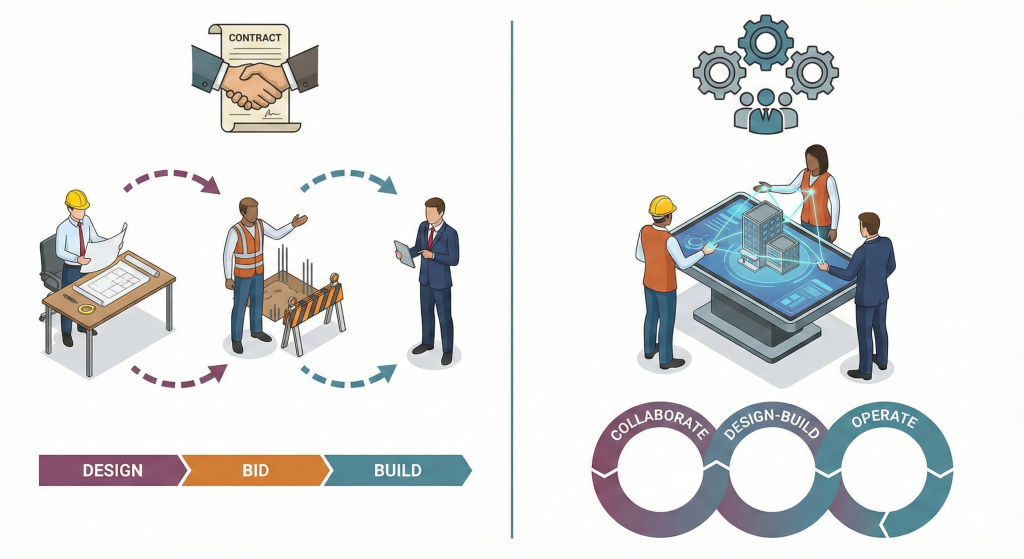
Traditional construction uses separate contracts for each professional. Your architect works under one agreement, your contractor under another, your engineers under several more. Each contract protects that party’s interests, often at your expense.
When problems arise in traditional structures, professionals point fingers. The architect blames the contractor for poor execution. The contractor blames the architect for impractical designs. The engineer blames both for ignoring their recommendations. You pay lawyers to sort it out.
Integrated project delivery creates a multi-party agreement where key players share a profit pool. If the project comes in under budget, everyone earns more. If it runs over, everyone earns less. This structure makes collaboration economically rational rather than merely aspirational.
A McKinsey analysis of construction performance found that projects using integrated approaches achieved 25% faster delivery and significantly fewer disputes than traditionally contracted work.
The Three Core Principles of IPD
Principle 1: Early Involvement of Key Participants
IPD requires bringing your contractor and major subcontractors into the process during design, not after. This early involvement catches constructability issues before they become expensive change orders. Your framing contractor reviews structural drawings while changes still cost nothing. Your mechanical contractor coordinates ductwork routes before walls get framed.
Principle 2: Shared Risk and Reward
The financial structure of IPD distributes both upside and downside across the team. Typically, each party receives their direct costs plus a portion of a shared profit pool. The pool grows when the project performs well and shrinks when it doesn’t. Nobody profits from problems.
Principle 3: Collaborative Decision-Making
Major decisions require consensus rather than hierarchy. Your architect cannot unilaterally specify materials that blow the budget. Your contractor cannot value-engineer away design intent without team agreement. This forces real dialogue and genuine problem-solving. [Related: How to Choose Hamptons Estate Architects]
Why Luxury Projects Benefit Most From IPD

Custom estates involve complexity that amplifies the value of integrated delivery. When you’re installing a museum-quality climate control system, a commercial-grade kitchen, and a pool house with full living quarters, coordination becomes exponentially harder.
Traditional contracts handle this complexity poorly. Each specialty contractor works from their own drawings, often discovering conflicts during installation. Your wine cellar’s cooling system conflicts with the home theater’s soundproofing. Your elevator shaft intersects with your HVAC chase. These discoveries cost six figures to resolve in the field.
IPD addresses complexity through continuous coordination. Weekly team meetings include all major trades. Building information modeling (BIM) reveals conflicts digitally before construction begins. Problems get solved in conference rooms where solutions cost hours, not on job sites where they cost months.
According to Bain & Company research on construction efficiency, complex projects see the greatest performance improvement from integrated delivery methods, with some achieving 30% reductions in total project duration.
IPD vs Design-Build: Understanding the Difference
Many homeowners confuse integrated project delivery with design-build. Both promise coordination, but they work differently. Understanding the distinction helps you choose the right approach for your project.
Design-build combines architecture and construction under one company. You sign a single contract with a firm that handles both. This simplifies your life but concentrates power. If the design-build firm makes mistakes, they also control the narrative about what went wrong.
IPD maintains separate companies with independent perspectives, united by shared economics. Your architect still advocates for design excellence. Your contractor still pushes for practical solutions. The contract structure channels this creative tension toward better outcomes rather than litigation.
For estates exceeding $15 million, IPD typically outperforms design-build. The complexity justifies having independent voices at the table. The shared profit pool keeps those voices constructive. You get advocacy without adversity. [Related: Luxury Home Builders East End Guide]
What an IPD Contract Actually Contains
IPD agreements look different from traditional construction contracts. Understanding the key provisions helps you evaluate whether a proposed agreement truly delivers integrated benefits.
The Core Team Definition
The contract identifies which parties share risk and reward. Typically this includes the owner, architect, and general contractor. Some agreements extend to major subcontractors or specialty consultants. Broader inclusion creates more alignment but requires more complex profit-sharing calculations.
Profit Pool Mechanics
The agreement establishes how savings and overruns affect compensation. A common structure sets a target cost with contingency. Finishing under target increases the profit pool. Exceeding target reduces it. The contract specifies how the pool divides among participants.
Decision-Making Protocols
IPD contracts define how the team makes choices. Most require unanimous consent from core parties for significant decisions. Some establish a project management team with specific authorities. Dispute resolution typically emphasizes mediation over litigation.
Liability Waivers
Many IPD agreements include mutual waivers of consequential damages among core team members. This reduces defensive behavior and encourages honest problem-solving. Your attorney should carefully review these provisions to ensure your interests remain protected.
Finding IPD-Experienced Professionals in the Hamptons
Not every architect or contractor has genuine IPD experience. The approach requires different skills than traditional practice. Collaborative problem-solving matters more than individual brilliance. Transparent communication matters more than protecting information advantages.
Ask potential team members about their IPD history. How many integrated projects have they completed? What challenges did they encounter? How did the team resolve disputes? Genuine practitioners speak specifically about lessons learned. Inexperienced firms offer vague assurances.
Request references from other IPD project owners, not just the professionals. Owners provide candid assessments of how collaboration actually functioned. Did the team genuinely share information? Did the profit pool mechanics create intended behaviors? Would they use IPD again?
The American Institute of Architects maintains resources on integrated project delivery that can help you evaluate practitioner claims and understand best practices.
Common Objections to IPD and How to Address Them
“It’s too complicated for residential projects.”
Luxury estates rival commercial buildings in complexity. If your project includes smart home automation, security systems, backup power, and specialty installations, you have commercial-level coordination needs. IPD scales appropriately.
“We can’t find enough experienced practitioners.”
True in some markets, but Hamptons builders increasingly embrace integrated methods. The solution often involves pairing experienced architects with contractors willing to learn collaborative approaches. One seasoned IPD practitioner can guide the team.
“The liability waivers expose me to risk.”
Carefully structured IPD agreements protect owners while encouraging team collaboration. Your construction attorney should review proposed language and negotiate appropriate safeguards. The waivers apply among professionals, not to owner protections. Harvard Business Review research on collaborative teams confirms that reduced adversarial dynamics improve outcomes.
“I lose control over my own project.”
You retain all meaningful control. Consensus requirements apply to core team members, not the owner. You can still make final decisions about design direction, material selection, and project priorities. IPD structures how professionals work together, not how they serve you.
Is Integrated Project Delivery Right for Your Estate?

IPD works best for projects with significant complexity, substantial budgets, and owners who value collaboration over control. If you want to micromanage every subcontractor decision, traditional contracts provide more direct authority. If you want the best possible outcome and trust your team to achieve it, IPD delivers.
Consider your own disposition honestly. IPD requires participating in coordination meetings, making timely decisions, and trusting professional judgment. Owners who struggle with delegation often frustrate integrated teams. Those who embrace partnership find the process remarkably smooth.
Budget also matters. IPD transaction costs, including more complex contracts and more intensive coordination, make sense for projects exceeding $8 million. Below that threshold, simpler structures often suffice. Above $20 million, IPD becomes almost essential for managing complexity.
Frequently Asked Questions About Integrated Project Delivery
What does integrated project delivery mean?
Integrated project delivery is a contract structure that binds architects, contractors, and engineers into a single agreement with shared financial incentives. All parties succeed or fail together, eliminating adversarial dynamics common in traditional construction.
How is IPD different from design-build?
Design-build combines architecture and construction under one company. IPD maintains separate companies united by shared economics. IPD preserves independent perspectives while creating collaborative incentives, while design-build concentrates control.
What are the main benefits of IPD for homeowners?
IPD reduces disputes, controls costs, accelerates schedules, and improves quality. The shared profit pool makes everyone invested in project success rather than individual protection.
Is IPD more expensive than traditional contracts?
IPD involves higher upfront legal and coordination costs but typically delivers lower total project costs. Savings from reduced change orders, faster completion, and eliminated disputes more than offset administrative expenses.
Taking the Next Step Toward Integrated Project Delivery
If integrated project delivery sounds right for your Hamptons estate, start by identifying an architect or contractor with genuine IPD experience. One experienced practitioner can guide team assembly and contract negotiation. They understand which provisions matter and which create unnecessary complexity.
Your construction attorney should have IPD contract experience as well. Standard residential agreements don’t translate directly to multi-party integrated structures. An attorney who has negotiated IPD terms protects your interests while preserving collaborative dynamics.
The investment in finding the right team pays returns throughout construction. Integrated project delivery transforms building from a battle into a partnership. For those creating legacy estates, that transformation makes all the difference.
For inquiries regarding RE Development, Funding, Design, contact: Jon Cruz, j.cruz2709@gmail.com
Continue Your Research
• Integrated Design Project: The Hamptons Estate Buyer’s Guide
• Hamptons Estate Architects: How to Choose the Right Firm
• Luxury Home Builders East End: The Definitive Guide
Connect with Hamptons’ leading architects and developers at Polo Hamptons, where industry relationships are built over world-class sport.
For features, partnerships, and advertising inquiries, contact our team.
—
Subscribe to Social Life print edition | Join our newsletter | Support our journalism ($5)
Author

Written by
Recent Posts

The Cabana Is a Status Machine: The Social Architecture of a Sponsor Tent

The Guest List Is the Product: Why the Invitation Outvalues the Ticket

The Hamptons House as Social Infrastructure: How a Deed Becomes a Network

Why the Richest Person at the Party Isn’t the Most Important One

Why Polo Beats Golf: What BMW Is Actually Sponsoring in Bridgehampton
Categories
- Art
- Articles
- Business of Luxury
- Celebrities
- Culture
- Entertainment
- Events
- Faces of Summer 2026
- Fashion
- Fashion & Style
- Featured
- Finance
- Food, Spirits, Wine
- Hamptons
- Hamptons Celebrities
- Health
- Health & Beauty
- Lifestyle
- Luxury Lifestyle
- Press
- Profiles
- Real Estate
- Technology
- The Chronicles
- Travel
- Uncategorized
- Weddings