
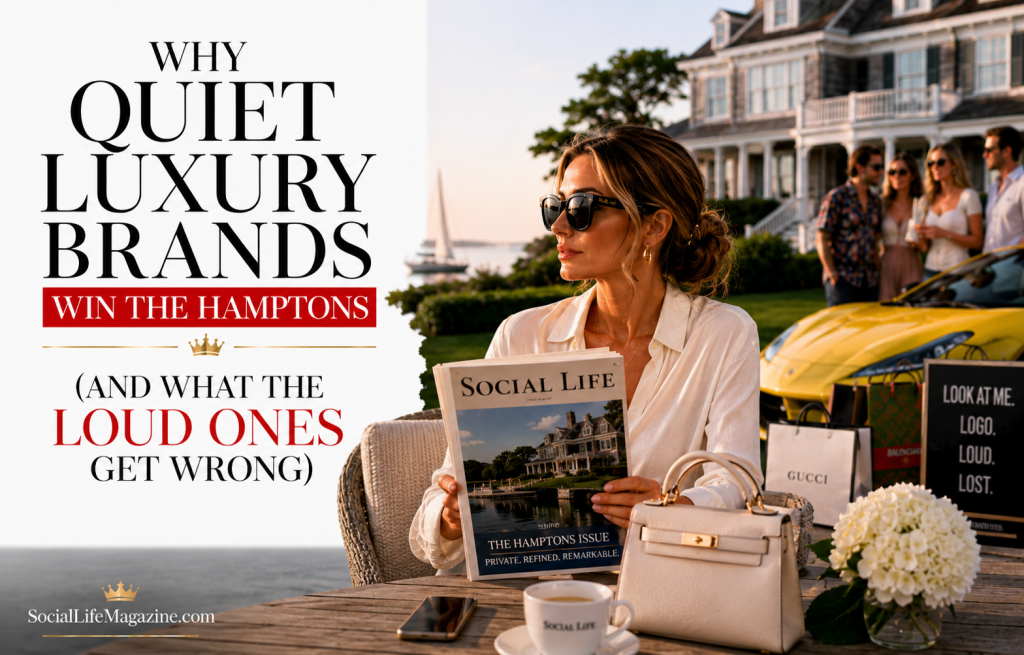
You can tell exactly how long someone has been coming to the Hamptons by how visibly branded their bag is.
This is not a cruel observation. It is a precise one. The woman in her third summer carries a logo. The woman in her thirteenth carries a tote from a Sag Harbor bookshop that closed four years ago, which communicates more about her position in the social geography of the East End than any logo currently in production could.
This is cultural capital in its purest form. Pierre Bourdieu spent his career mapping the invisible hierarchies of taste. He would have found the Hamptons a particularly efficient laboratory, in fact. Nowhere in the continental United States is that distinction more legible, more scrutinized, or more consequential for brand positioning.
Quiet luxury brands win the Hamptons summer not because they have better products than their louder competitors. In many cases they do, but that is not the reason. They win because they understand what this market actually rewards. And what it rewards is not visibility. What it rewards is recognition. Specifically, the pleasure a certain kind of consumer takes in seeing a brand that trusts her to know it.
That is, in fact, a fundamentally different marketing proposition than reach. And it is the one that quiet luxury brands in the Hamptons have been executing, mostly without realizing it, for decades.
What Bourdieu Gets Right About the Hamptons
Bourdieu identified three forms of capital that operate alongside economic capital in determining social position: cultural capital (knowledge, taste, education), social capital (networks, relationships, associations), and symbolic capital (prestige, recognition, authority). In the Hamptons luxury market, all three are constantly in play. The brands that navigate them most skillfully are the ones that accumulate symbolic capital without appearing to try.
Brunello Cucinelli, for example, does not advertise in the conventional sense. Its marketing is its product: the quality of the cashmere, the restraint of the silhouette, the specific shade of greige that requires a trained eye to appreciate. A woman who knows Brunello Cucinelli has cultural capital. If she is seen in it, she acquires symbolic capital. The brand does not need to tell either story. The person who recognizes it tells it for them.
Cultural Capital in Practice
A more extreme version of this logic is what The Row operates on. Founded by Mary-Kate and Ashley Olsen, it became one of the defining luxury brands of the quiet luxury era not by marketing its celebrity provenance but by systematically refusing to. Instead, the brand communicates through product alone. Its prices exclude. The designs reward knowledge. Its presence in the Hamptons ecosystem is strong enough that it became a cultural reference point without a single billboard.
Loro Piana, perhaps the most Hamptons-legible brand in existence, has been selling cashmere boat shoes and unstructured blazers to people with property on Further Lane since before most of its current competitors existed. Its advertising budget, relative to its position in the market, is negligible. Its cultural capital, built through decades of product consistency and deliberate distribution restraint, is enormous.
Still, what all three have in common is a precise understanding of how the Hamptons luxury consumer processes brand status. She does not respond to loud. She responds to recognition. And recognition requires restraint.
The Loud Brand Mistake
The brands that lose the Hamptons — the ones that spend heavily, activate aggressively, and still find that the market’s most valuable consumers look through them — are almost always making the same structural error. They are optimizing for visibility when the market rewards legibility.
Visibility means being seen. Legibility, by contrast, means being understood. In a market where the most influential consumers are actively skeptical of brands that work too hard for their attention, the louder you are, the less you communicate about your actual position.
This dynamic produces a counterintuitive result. A brand can increase its marketing spend in the Hamptons and simultaneously decrease its perceived status. More billboards on Montauk Highway. Sponsored posts multiply across accounts with large followings. More activation stations appear at every event from Memorial Day to Labor Day. And at the end of the summer, the brand has been seen by more people than ever before and recognized by fewer of the people who matter.
Rory Sutherland identifies this failure mode in Alchemy when he notes that in psychology, unlike in physics, more input does not always produce more output. The relationship between marketing investment and brand perception in a luxury market is not linear. Past a certain threshold of visibility, additional investment produces diminishing returns. In a status-sensitive environment like the Hamptons, it can produce negative ones.
The reason is what behavioral economists call “signaling cost.” A signal is credible when it costs something genuine to produce. When a signal is cheap — when anyone with a marketing budget can produce it — it carries no information about the brand’s actual position. Logo saturation is a cheap signal. Editorial restraint is an expensive one.
Cultural Capital as Strategy
The practical implication is direct: build cultural capital first, and let symbolic capital follow.
Cultural capital, in brand terms, is the depth of the brand’s relationship with the specific knowledge systems that your target audience values. In the Hamptons, those knowledge systems are specific. They involve knowing which beach is correct by month, which restaurant requires a table booked three weeks in advance, which event is worth attending and which is a simulacrum of the real thing. Brands that demonstrate fluency in these knowledge systems earn insider credibility. Specifically, that is a credibility no advertising budget can purchase outright.
Social Life Magazine is, in fact, a repository of this cultural capital. Twenty-three summers of editorial decisions about what belongs in the Hamptons summer — which events, which brands, which people — have produced an institutional knowledge base that its readers trust precisely because it has been consistent over time. A brand that appears in its pages is not just buying reach. It is demonstrating cultural fluency by choosing the right editorial environment. That demonstration is itself a form of cultural capital.
The brands that understand this treat a Social Life Magazine feature as a positioning statement, not a media buy. The feature says: we know what the Hamptons is, we know what this publication represents, and we believe our brand belongs in this conversation. For the reader who agrees with that assessment, the trust transfer is immediate and durable.
The Restraint Premium in a Noisy Market
There is a specific opportunity in the 2026 Hamptons luxury market that the quiet luxury framework makes visible, and it is a favorable one. As more brands compete for attention on the East End, the relative scarcity of genuine restraint increases. More activations, more sponsored events, more influencer placements: all of it makes restraint rarer and, as a result, more valuable. The cost of appearing loud stays constant. The premium for appearing restrained goes up.
This is, in purely economic terms, a favorable moment to be a quiet luxury brand in the Hamptons. Or to adopt the posture of one.
For brands that have historically operated on high-visibility strategies, the shift is not about spending less. It is about spending differently. Less saturation, more precision. Fewer placements — more considered ones. Because perception is the product, an editorial feature in Social Life Magazine that reads as genuine press coverage is worth more, in the Hamptons cultural economy, than six times the investment in digital impressions served to the same demographic.
The reader of this market does not count impressions. She counts encounters that felt like they meant something. A brand that produces one meaningful encounter in the right environment will outperform a brand that produces a hundred forgettable ones in mediocre environments. Quiet luxury is not about silence. It is about saying the right thing, once, in a room that amplifies it. That room is available, specifically, at Social Life Magazine.
Submit a paid feature at sociallifemagazine.com/submit-a-paid-feature. One issue. The right room. The summer does the rest.
Where The Conversation Continues
The quiet luxury argument is one lens on a larger framework about perception, cultural capital, and what Hamptons luxury consumers actually respond to. The full hub: The Perception Economy: What Hamptons Luxury Brands Are Really Selling.
For how placement environment — not creative quality — determines brand status in the Hamptons, see: The Lobby Test: How Luxury Brands Hack Status Perception Without Spending More.
For the neuroscience of why print outperforms digital for luxury brand recall, see: Why Your Hamptons Print Ad Outperforms Your Instagram by 300%.
The full pillar: Why Luxury Brands That Ignore Psychology Lose the Hamptons Every Summer.
Author

Written by
Recent Posts

AI for personal finance: where PennyGuard fits
How to Pick a Homecoming Dress for Your Body Type (and Feel Amazing in It)

World Cup Injury Attorney for Vancouver Events
What a 3-Carat Engagement Ring Actually Costs in 2026: The Real Numbers
The Skincare Habits That Make a Real Difference Over Time
Categories
- Art
- Articles
- Business of Luxury
- Celebrities
- Culture
- Entertainment
- Events
- Faces of Summer 2026
- Fashion
- Fashion & Style
- Featured
- Finance
- Food, Spirits, Wine
- Hamptons
- Hamptons Celebrities
- Health
- Health & Beauty
- Lifestyle
- Luxury Lifestyle
- Press
- Profiles
- Real Estate
- Technology
- The Chronicles
- Travel
- Uncategorized
- Weddings