
Twelve Minutes That Rebuilt Paris
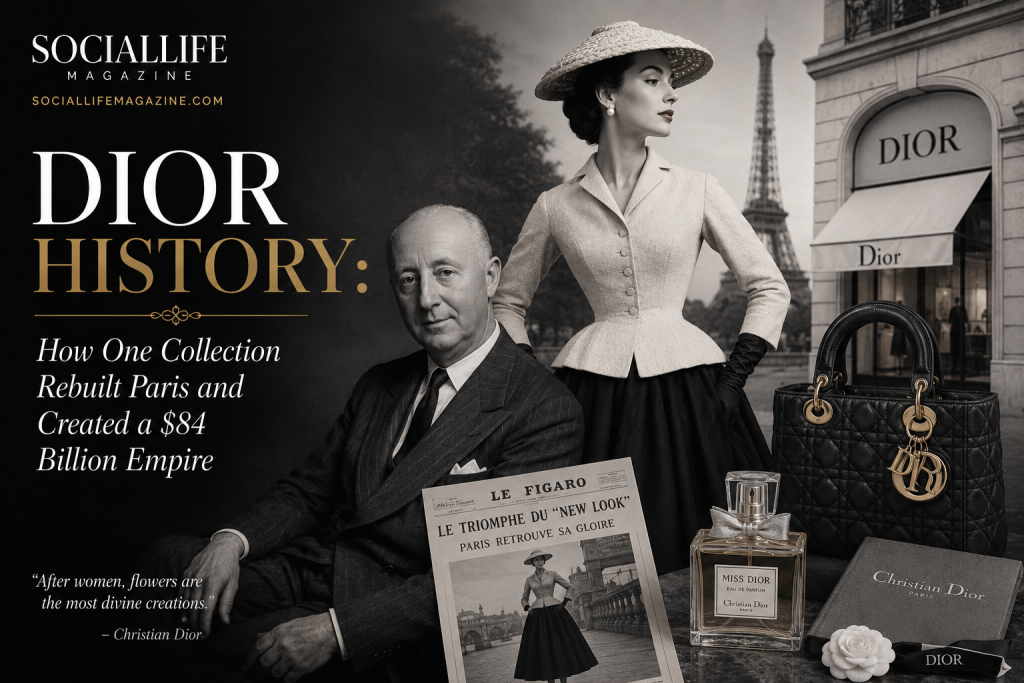
On February 12, 1947, a 42-year-old designer who had never shown a collection under his own name sent models down a runway at 30 Avenue Montaigne. The cinched waists, padded hips, and full skirts used up to twenty yards of fabric per dress. Wartime rationing was barely over. Women’s fashion had been utilitarian for nearly a decade. The audience gasped. Then they wept. Harper’s Bazaar editor Carmel Snow turned to the designer and said the words that would define Dior history forever: “It’s quite a revolution, dear Christian. Your dresses have such a new look.”
The New Look was not just a collection. It was a declaration of intent. Paris had lost its fashion capital status during the occupation. American sportswear was ascendant. The French fashion houses needed someone to prove that couture still mattered. Christian Dior, a quiet man who believed in fortune tellers and named his company after a star his mother wished upon, delivered that proof in twelve minutes.
Today, the house he founded occupies the center of the largest luxury conglomerate on earth. The Christian Dior Group recorded €84.7 billion in revenue for 2024. That figure reflects not just Dior Couture, but the entire LVMH empire that Dior’s corporate structure controls. The man who believed in destiny created something that now feels inevitable.
The Superstitious Founder
Christian Dior was born in 1905 in Granville, a seaside town in Normandy. His family was wealthy (his father made a fortune in fertilizer manufacturing) and cultured. Young Christian wanted to be an architect. His parents wanted him to be a diplomat. He enrolled at Sciences Po in Paris, dropped out, and opened an art gallery in 1928 that showed work by Dalí, Giacometti, and Calder.
The Depression wiped out his family’s fortune. His mother died. His brother was institutionalized. Dior found himself broke in Paris in the early 1930s, selling fashion sketches on the street for ten francs each. He eventually landed work designing for Robert Piguet and Lucien Lelong, learning the mechanics of couture from the inside. At Lelong’s atelier, he absorbed the business of fashion: how fabric was sourced, how fittings were managed, how wealthy clients were courted and retained. These were not glamorous skills, but they would prove essential.
By 1946, textile magnate Marcel Boussac offered to finance Dior’s own house. Boussac put up 60 million francs (roughly $6 million in today’s currency). Dior found the townhouse at 30 Avenue Montaigne, a quiet address in the 8th arrondissement that he chose for its proximity to the Champs-Élysées without the commercial noise. He hired a staff of 85 and decorated the salons in his signature palette of grey and white. Six months later, he showed the New Look and changed the history of fashion permanently.
What the New Look Actually Sold
Feminist critics at the time accused Dior of putting women back in corsets. They were not entirely wrong. The Bar jacket, with its structured bust and impossibly narrow waist, required padding and boning. Skirts ate fabric during a period of genuine material scarcity. British politician Bessie Braddock called the collection an insult to working women.
But Dior was selling something beyond silhouette. He was selling optimism in material form. After six years of war, occupation, and deprivation, the New Look said: the worst is over. You are allowed to want beautiful things again. That emotional proposition proved more powerful than any political objection. Within a year, department stores from New York to Buenos Aires were copying the silhouette.
Dior understood licensing before licensing was a strategy. He sold his name for stockings, handbags, ties, and scarves. By 1949, the house generated $12 million in exports, representing 75 percent of French couture revenue. One house, one designer, three quarters of the entire French fashion export market.
The Licensing Blueprint
What Dior invented was not just a silhouette. It was a business model that every luxury house would eventually copy. Before Dior, couture houses made money exclusively from custom garments for individual clients. Each dress was a one-off commission. Revenue scaled linearly with the number of seamstresses you could employ. Dior realized that the name on the label was worth more than the thread holding it together.
His licensing agreements spread across 16 countries within three years of the New Look debut. A woman in São Paulo could buy Dior stockings without ever visiting Paris. A man in Tokyo could wear a Dior tie without knowing who Marcel Boussac was. The license fee was pure margin. Dior supplied the name, the licensee supplied the manufacturing, and both parties profited from the cultural capital that the couture shows generated every season.
This model had a flaw that would take decades to become visible: overexposure. By the 1980s, the Dior name appeared on so many products (some of questionable quality) that the brand’s prestige eroded. Bernard Arnault’s first major strategic decision after acquiring Dior was to begin clawing back licenses. The process took twenty years and cost hundreds of millions in buyback fees. But it restored Dior’s exclusivity, which restored its pricing power, which restored its profitability.
The Unexpected Death
Dior history took its sharpest turn on October 24, 1957. Christian Dior died of a heart attack in Montecatini Terme, Italy. He was 52 years old. He had run his house for exactly ten years and six collections. His chosen successor, a 21-year-old Algerian-born assistant named Yves Saint Laurent, took over immediately.
Saint Laurent’s first collection for Dior (Spring 1958, the Trapeze line) was a critical triumph. His second was controversial. His third was a disaster in commercial terms. The house fired him in 1960 while he was serving in the French military. Saint Laurent sued, won, and used the settlement money to start his own label. That departure created two rival empires from a single inheritance.
Dior cycled through creative directors at a pace that would define the house for decades. Marc Bohan held the role for 28 years (1960-1989), stabilizing the brand through commercial excellence if not critical fireworks. Gianfranco Ferré brought Italian drama. John Galliano, appointed in 1996, brought a theatrical genius that produced some of the most spectacular runway moments in fashion history.
The Galliano Years and the Fall
John Galliano’s fifteen-year tenure at Dior (1996 to 2011) produced some of the most extraordinary runway spectacles in Dior history. His haute couture shows were theatrical productions. Geishas, Edwardian duchesses, newspaper-print dresses, and a model emerging from a giant Dior perfume bottle. Each show cost millions to stage and generated press coverage worth many multiples of the investment.
Commercially, Galliano transformed Dior from a respected heritage house into a revenue machine. The Saddle bag, introduced in 1999, became one of the first “It bags” of the early 2000s. Celebrity endorsements multiplied. Dior became the label that every actress wanted to wear on the red carpet.
It ended abruptly. In February 2011, Galliano was filmed making antisemitic remarks at a Paris café. Dior fired him within days. Raf Simons took over, bringing a minimalist Belgian sensibility that stripped away Galliano’s maximalism. Simons lasted three years before citing exhaustion from the pace of fashion’s calendar. His departure underlined a structural truth about Dior: the house demands creative output at a velocity that few designers can sustain.
The Arnault Acquisition
Bernard Arnault’s arrival is the inflection point that separates old Dior history from the modern empire. In 1984, Arnault acquired the Boussac Group (which owned Dior) for one franc through a leveraged buyout. He was 35 years old, a real estate developer’s son from Roubaix with an engineering degree from Polytechnique. Fashion insiders dismissed him as a corporate raider who would strip the assets and move on.
Instead, Arnault used Dior as the foundation for what would become LVMH. He acquired a controlling stake in Moët Hennessy Louis Vuitton in 1988 through a series of maneuvers so aggressive that the French business press called it a hostile takeover. By 2017, he had fully merged Christian Dior SE into LVMH, creating a single vertically integrated luxury conglomerate.
The merger was a financial masterstroke. Before 2017, Arnault controlled LVMH through a complicated holding structure where Christian Dior SE owned a controlling stake in LVMH, but LVMH also controlled Dior Couture. Outside investors constantly complained about the opacity. When Arnault finally simplified the structure by buying out minority shareholders in Christian Dior SE for €12.1 billion, he achieved three things simultaneously. He eliminated the discount that analysts applied to the convoluted holding structure. He brought Dior Couture fully under LVMH’s operational umbrella. And he silenced the corporate governance critics who had questioned the arrangement for years.
LVMH now owns 75 luxury houses, posted €80.8 billion in revenue for 2025, and makes Arnault one of the three richest people on the planet (his net worth fluctuates around $200 billion depending on the stock price). All of it traces back to a one-franc deal for a bankrupt textile group that happened to own the name Dior.
30 Montaigne and the Modern House
Dior Couture today operates as a distinct entity within LVMH’s Fashion and Leather Goods division, which generated over €41 billion in revenue in 2024 with an operating margin of 35 percent. Maria Grazia Chiuri leads women’s collections (she became the first woman to hold the role when appointed in 2016). Kim Jones leads menswear and couture. Together they have pushed Dior’s visibility to record levels, with fashion show livestreams drawing over 390 million views for a single collection.
Chiuri’s Dior is explicitly feminist. Her debut collection featured a T-shirt reading “We Should All Be Feminists,” a reference to Chimamanda Ngozi Adichie’s essay. Critics called it performative. Consumers called it with their credit cards. Under Chiuri, Dior’s women’s ready-to-wear and accessories business has grown substantially, driven by the Book Tote (a canvas bag embroidered with the Dior Oblique pattern that became one of the most recognizable accessories of the 2020s) and a revived Saddle bag that recaptured the Y2K nostalgia market.
The 30 Montaigne flagship in Paris, reopened after a two-year renovation, functions as both a store and a cultural institution. It houses a museum, a restaurant by Jean Imbert, a private apartment for VIP clients, and the atelier where haute couture orders are still finished by hand. Entry is free. The message is clear: Dior is not just a brand. It is a destination.
Globally, Dior has expanded into jewelry (the My Dior line reinterpreting the house’s cannage quilting), cosmetics (Dior Beauty ranks among the top three prestige beauty brands worldwide), and experiential retail. The Dior Gold House in Bangkok, the L’Or de Dior exhibition in Beijing, and spectacular holiday window installations at 30 Montaigne all serve the same function. They convert shopping into ceremony.
The Beauty Machine
Dior Beauty deserves its own chapter in Dior history because it operates as a stealth revenue engine that most fashion commentary ignores. Miss Dior, the house’s original fragrance (launched the same year as the New Look), established the template: attach a fragrance to a fashion moment, and the fragrance sells long after the runway lights go dark. Sauvage, the men’s fragrance featuring Johnny Depp in its advertising campaigns, became one of the best-selling men’s fragrances globally, moving an estimated $3 billion in retail sales since its 2015 launch.
The cosmetics division operates with similar efficiency. Dior Addict Lip Maximizer, Backstage Face and Body Foundation, and the Rouge Dior lipstick range compete for counter space with Chanel, Tom Ford, and Charlotte Tilbury. Unlike fashion, where seasonal collections require constant reinvention, beauty products generate recurring revenue. A woman who finds her perfect foundation shade returns for the same product year after year. That recurring purchase pattern is why beauty margins routinely exceed 85 percent and why LVMH invests heavily in the Perfumes and Cosmetics division even when fashion revenue softens.
Dior Beauty also functions as a customer acquisition funnel. A 22-year-old who buys a $40 Dior lip gloss today is a potential handbag customer at 32 and a haute couture client at 52. An entry-point purchase is affordable. The lifetime value is enormous.
The East End Equation
Dior does not operate a freestanding boutique in the Hamptons. Like Chanel, it exercises restraint by design. But the brand’s presence saturates the summer. The Lady Dior bag, the Book Tote (personalized with embroidered initials at select locations), and the Dior Saddle bag appear at every benefit, every polo match, every dinner reservation from Topping Rose to Nick & Toni’s.
What separates Dior from its rivals in the Hamptons is the personalization play. The Book Tote, available with custom embroidery of initials or names, transforms a mass-produced luxury good into a bespoke-feeling object. For a woman attending a benefit at the Parrish Art Museum, a personalized Dior tote communicates something beyond wealth. It communicates taste, specificity, and the particular effort of having commissioned something just for her.
For the woman who carries a Dior Book Tote to the Bridgehampton Farmers Market, the bag communicates something specific. It says she is literate in fashion history. It says she understands the reference. Among the French fashion houses, Dior occupies a particular register: more romantic than Louis Vuitton, less austere than Chanel, more emotionally available than Hermès. That positioning is precise and profitable.
The Next Hundred Years
Christian Dior believed in astrology, tarot cards, and the number 8 (his lucky number, which is why so many Dior products come in groups of eight). He also believed that fashion had a moral obligation to make people feel beautiful in difficult times. That conviction, expressed in yards of fabric during an era of rationing, remains the emotional core of the brand.
The house he built is now approaching 80 years old. It survived its founder’s premature death, a revolving door of creative directors, a public scandal that ended its most celebrated designer’s career, a hostile takeover, and integration into the largest luxury conglomerate in human history. Through all of it, the core proposition has never changed. When the world feels uncertain, Dior offers certainty in the form of a perfectly cut jacket, an impeccably structured bag, and the quiet confidence that comes from knowing exactly who made it and why.
If Christian Dior were alive today, he would probably consult his fortune teller before making any strategic decisions. But the fortune teller would not need tarot cards to read the spread. A $84 billion empire built on a single February afternoon in 1947. The stars, as Dior always believed, were aligned from the beginning.
Where the Conversation Continues
Social Life Magazine covers the brands, families, and power plays that shape luxury culture from Manhattan to Montauk. Reach our editorial team to discuss features, partnerships, or story leads. Explore Polo Hamptons 2026 for the summer’s defining luxury event. Subscribe to the print edition for coverage delivered to your door. Join the email list for weekly insider intelligence. And if this piece sharpened your understanding of how luxury actually works, a $5 contribution keeps independent journalism alive.
Author

Written by
Recent Posts

Planning an Arizona Road Trip? Practical Details to Handle Before You Leave

Short Homecoming Dresses That Feel Polished, Not Overdone
Men’s Health After 40: Important Changes to Pay Attention To
What You Need to Know About Spray Tanning

Simple Ways to Upgrade Your Summer Drink Routine
Categories
- Art
- Articles
- Business of Luxury
- Celebrities
- Culture
- Entertainment
- Events
- Faces of Summer 2026
- Fashion
- Fashion & Style
- Featured
- Finance
- Food, Spirits, Wine
- Hamptons
- Hamptons Celebrities
- Health
- Health & Beauty
- Lifestyle
- Luxury Lifestyle
- Press
- Profiles
- Real Estate
- Technology
- The Chronicles
- Travel
- Uncategorized
- Weddings