
The Waiting List as Social Architecture
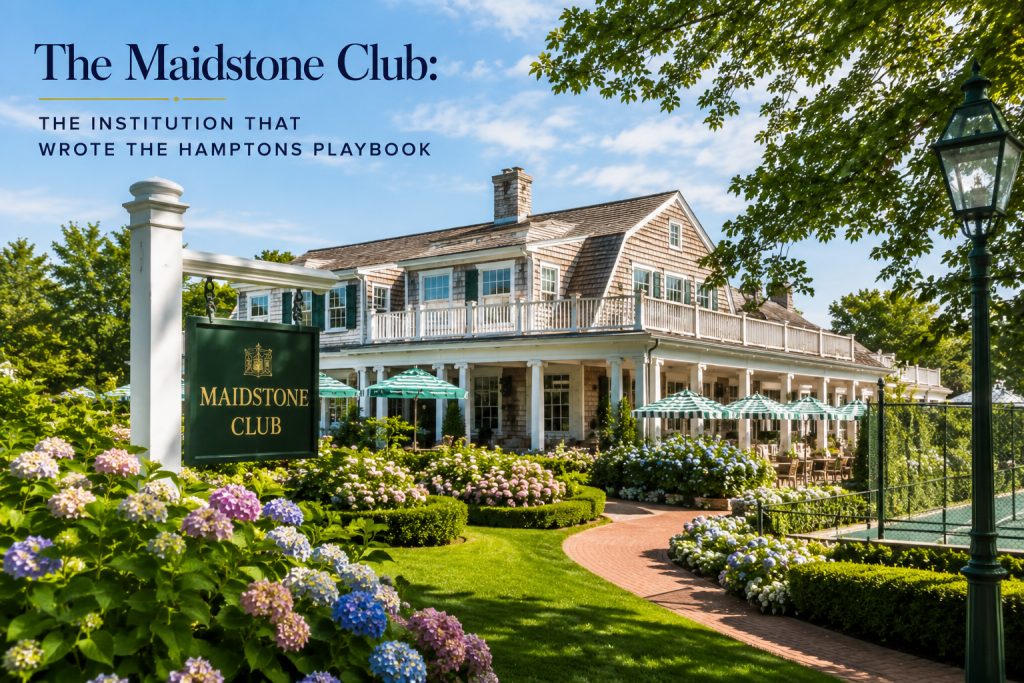
The Maidstone Club does not have a website you can visit. Instead, it has a website you cannot access without a membership and a password. That single design choice tells you everything about the institution: it does not exist for the people who want to join. It exists for the people who already belong. Specifically, founded in 1891 by a group of wealthy summer residents in East Hampton, the club named itself after the English town from which the village’s original 1648 settlers had emigrated. Indeed, that naming decision linked the club’s identity to East Hampton’s founding mythology, a move so deliberate it could only have been made by people who understood that exclusivity is not about what you own. It is about what you remember.
Initiation fees are estimated between $500,000 and $1 million. The club does not confirm this. Prospective members require existing member sponsorship, committee vetting, and (most importantly) legacy connections that reach back generations. Certainly, your great-grandfather’s membership carries more weight than your hedge fund’s performance last quarter. A financial advisor from the Upper East Side (the kind who manages $500M in family office capital and has been visiting East Hampton since childhood) has been on the waiting list for eleven years. His net worth crossed $200 million four years ago. It made no difference. The Maidstone understood, from its founding, that the waiting list is not a queue. It is a social instrument, and the instrument’s purpose is to make rejection feel like a credential.
The Course That Willie Park Built on Sand and Salt
The golf at the Maidstone Club is not incidental to the institution. It is the institution’s physical expression. Willie Dunn laid out a rudimentary seven-hole course in 1894, three years after the club’s founding. Also, William Tucker designed the original nine-hole layout. Naturally, by 1899, the course had expanded to eighteen. However, the Maidstone’s course truly came of age in the 1920s, when the club acquired 80 acres on the Gardiner Peninsula and commissioned Willie Park Jr. and his brother Jack to design what would become one of America’s finest links layouts. Park, a Scottish architect whose work at Sunningdale Old and Huntercombe had already influenced a generation of designers, considered the Maidstone his crowning achievement.
The Coore and Crenshaw Restoration
Park never saw the finished product. He passed away shortly after the design was completed, and his brother John built the course, which was ready for play in 1924. The West Course sits on a majestic seaside plot along the Atlantic, featuring oceanside holes at the par-3 8th, par-4 9th, and par-3 14th. Also, Hook Pond borders several other holes. In true links fashion, the layout is largely treeless, with prolific bunkering and sandy waste areas. Still, the Hurricane of 1938 destroyed enough of the property to reduce the club from two eighteen-hole courses to the current 27-hole layout (18-hole West Course plus 9-hole East Course). In 2012, Bill Coore and Ben Crenshaw completed a restoration designed to “unclutter” the course and return it to the strategic links character Park had originally intended.
He stands on the 9th tee, facing south. The Atlantic is fifty yards away.
His playing partner is a third-generation member. They met at a benefit in the city.
The invitation to play took fourteen months to materialize.
He has not been invited to apply for membership. He has been invited to play.
These are different things.
Playing is an audition. Membership is a verdict.
He hits a four-iron into the wind. It holds the green.
The third-generation member says nothing. Approval here is silence.
The Rejections That Became More Famous Than Any Acceptance
Groucho Marx played the Maidstone course as a guest in the 1950s. He was denied membership. The story became one of his best-known anecdotes, folded into the broader mythology of a man who famously refused to join any club that would have him. Likewise, George Plimpton was shunned. Diana Ross was rejected despite being married to Arne Naess Jr., a Norwegian shipping billionaire and existing Maidstone member. Naess subsequently resigned in protest. Donald Trump held a temporary membership in the early 1980s but was turned down for permanent status. Notably, each rejection added to the Maidstone’s legend rather than diminishing it. Of course, that is exactly how exclusivity works: the more famous the person you reject, the more valuable the membership becomes.
Through the 1990s and early 2000s, journalists reported that the club had no Black members. The historical exclusion of Jewish applicants was also documented. Certainly, these patterns reflected broader practices across Hamptons private clubs during the same period, but the Maidstone’s profile made the scrutiny more intense. Consequently, the club has evolved, though the specific terms of that evolution remain as private as the membership list itself. What has not changed is the fundamental operating principle: the Maidstone does not explain itself. It does not defend itself. It simply persists, and persistence, on the East End, is its own kind of power.
Beyond Golf: Tennis, Beach, and the Social Calendar
The Maidstone Club was not founded as a golf club. It was founded as a social club that happened to add golf. Indeed, tennis arrived first. Swimming and beach access followed. Croquet and other lawn sports occupied the grounds. The clubhouse (designed in the Colonial Revival style, expanded and renovated multiple times across the twentieth century) overlooks the ocean with a formality that the club’s more casual competitors on the East End do not attempt. Also, dining options include a formal room and weekend buffet dinners. Notably, the social calendar extends through the summer season with member events, tournaments, and gatherings that function as the connective tissue of East Hampton’s upper tier.
For a venture partner from Greenwich Village (the kind who runs a $200M fund and summers on Middle Lane because the address is three minutes from the club but does not presume membership), the Maidstone’s social infrastructure is aspirational architecture. Naturally, he eats at Nick and Toni’s with members. At Main Beach, he sees them. Guild Hall openings bring further encounters. However, the club itself remains a space he has not entered. Proximity is not access. Familiarity is not membership. In East Hampton, the distance between knowing someone at the Maidstone and belonging to the Maidstone can span a decade. Sometimes it spans a lifetime.
The Competitive Landscape: Five Clubs, Five Philosophies
The Southampton Institutions
The Hamptons private club hierarchy is real, and the Maidstone sits at or near the top depending on which axis you measure. Southampton’s Meadow Club (founded 1887, four years before the Maidstone) offers tennis and beach with a social register that skews toward old money and establishment families. Similarly, the Bathing Corporation of Southampton provides cabana-and-ocean access with an exclusivity that rivals the Maidstone’s in intensity if not in breadth. Shinnecock Hills Golf Club (founded 1891, the same year as the Maidstone) is one of only five clubs to have hosted the U.S. Open five times, with the 2026 tournament drawing global attention. National Golf Links of America, designed by Charles Blair Macdonald in 1911, occupies adjacent land and operates with a membership so selective it makes the Maidstone look permissive.
What the Maidstone Has That the Others Do Not
The Maidstone’s advantage is not golf (Shinnecock and National Golf Links both rank higher on most course lists). It is not age (the Meadow Club predates it by four years). It is not even exclusivity (National Golf Links is arguably more restrictive). Instead, the Maidstone’s advantage is centrality. The club sits within the Village of East Hampton, connected to the village’s power geography in a way the Southampton clubs cannot replicate. Dune Cottage ($72M, March 2026) is situated between the Atlantic and the Maidstone’s golf course. Lily Pond Lane is within walking distance. Georgica Pond estates border the club’s perimeter. Essentially, the Maidstone is embedded in the village’s DNA rather than adjacent to it.
134 Years and Counting: Why the Maidstone Endures
The Maidstone Club endures because it understood, from the beginning, that real exclusivity cannot be purchased. It can only be inherited or earned through patient cultivation of the right relationships. Salt wind still bites across the Gardiner Peninsula. Fescue still ripples in the onshore breeze. Park’s West Course still plays firm and bouncy, with a sandy richness that golf architecture critics call “virtually unmatched in world golf.” After all, institutions die when they stop believing in their own mythology. The Maidstone has never stopped.
For anyone studying East Hampton, the Maidstone Club is not optional reading. It is the institution that wrote the playbook every other Hamptons club follows or reacts against. Southampton’s clubs codified the rules the Maidstone originated. Sag Harbor defined itself in opposition to the entire model. Bridgehampton chose events over institutions. Amagansett chose institutional absence. Ultimately, every thesis in the Modern Culture Hamptons Bible is a response to the Maidstone Club, which means the Maidstone’s thesis must be the question itself: who belongs here? Answers are still being written. Waiting lists remain open. Passwords stay protected.
Where the Conversation Continues
Social Life Magazine has covered the East End’s private club culture for 23 years, five summer issues per season, 25,000 copies each. If the institutional dynamics on this page interest you, the magazine delivers them to your door every season.
If your brand serves the audience that reads about (and applies to) clubs like the Maidstone (luxury goods, private banking, fine art, estate planning, bespoke travel), a paid feature in Social Life Magazine positions you in the conversation. Submit a paid feature here.
Polo Hamptons 2026 returns to 900 Lumber Lane in Bridgehampton on July 18 and 25. BMW North America is the title sponsor. Christie Brinkley is the host. Sponsorship at polohamptons.com.
Subscribe to Social Life Magazine for year-round coverage of the institutions, addresses, and power dynamics that shape the East End.
The Maidstone Club was founded in 1891. It has been saying no ever since. The no is the institution. The institution is the point.
Author

Written by
Recent Posts
The New York Women’s Foundation’s 2026 Neighborhood Dinner

Marco Maranghello
The Baker House 1650
MvVO ART Show
Casita Maria Center for Arts and Education
Categories
- Art
- Articles
- Business of Luxury
- Celebrities
- Culture
- Entertainment
- Events
- Faces of Summer 2026
- Fashion
- Fashion & Style
- Featured
- Finance
- Food, Spirits, Wine
- Hamptons
- Hamptons Celebrities
- Health
- Health & Beauty
- Lifestyle
- Luxury Lifestyle
- Press
- Profiles
- Real Estate
- Technology
- The Chronicles
- Travel
- Uncategorized
- Weddings