
The Base Was There Before Everything Else
Long before Andy Warhol, the Rolling Stones, Jackie Kennedy, Preston Nichols, the Montauk Monster, or Stranger Things, there was a military base at the end of the road. And the military history of Montauk is, in every meaningful sense, the foundation on which every subsequent layer of the town’s identity was built.
In fact, the base normalized government secrecy in a civilian community. It put hundreds of military personnel in a fishing village that had previously supported a few hundred year-round residents. It built the infrastructure, including the radar tower, the bunkers, and the underground tunnels, that would later become the physical setting for the Montauk Project conspiracy. And when the base was decommissioned in 1981, it left behind a landscape of sealed buildings and unanswered questions that would take on mythological dimensions within a decade.
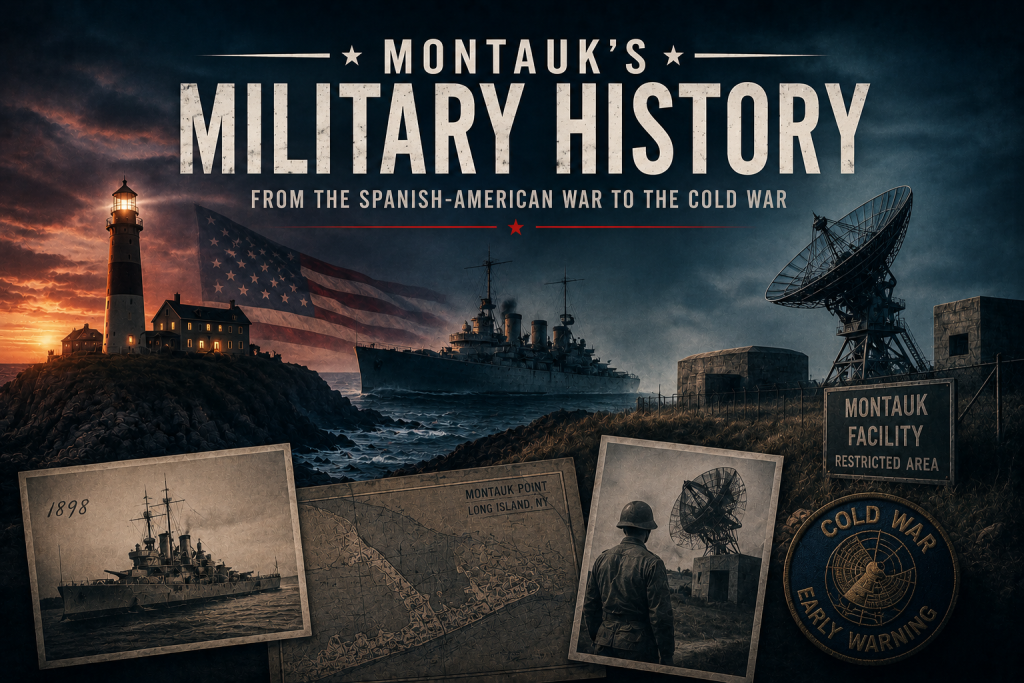
This is the chronological record of Montauk’s military history, from the quarantine camps of the Spanish-American War to the state park that exists today.
Camp Wikoff: 1898
The U.S. military’s presence in Montauk begins with disease. In 1898, during the Spanish-American War, approximately 30,000 American soldiers were transported from Cuba to Montauk for quarantine. The troops had been exposed to malaria, yellow fever, and typhoid during the campaign. Montauk’s remote location at the tip of Long Island made it an ideal quarantine site: far enough from New York City and other population centers to reduce the risk of epidemic, close enough to the coast for easy transport by ship.
Camp Wikoff: The First Test
Camp Wikoff, as the facility was designated, was hastily constructed across several hundred acres of Montauk moorland. Conditions were, by all accounts, grim. Sanitation was poor. And medical resources were insufficient for the number of sick troops. An estimated 260 soldiers died there during the roughly two months it operated. Theodore Roosevelt and his Rough Riders passed through the camp. Roosevelt later described the conditions as inadequate and used his experience at Montauk to advocate for military reform.
Still, Camp Wikoff was dismantled within months of the war’s conclusion. But it established a precedent that would persist for over a century: Montauk’s geographic isolation made it useful for operations that required distance from observation. The quarantine camp needed separation from civilians. Later, the World War II base needed concealment from aerial surveillance. And the Cold War radar station needed an unobstructed view of the Atlantic. And the alleged Montauk Project, if it existed, needed underground facilities in a location where unusual activity could be attributed to routine military operations. Notably, in each case, the same geographic quality was exploited for a different purpose. Isolation is versatile.
Fort Hero: World War II
In the early 1940s, the military returned with a more permanent plan. Fort Hero was constructed as a coastal defense installation designed to protect the approaches to New York Harbor and Long Island Sound from German submarine and surface attack. The base included gun emplacements, ammunition bunkers, and barracks. A mess hall and supporting infrastructure completed the complex. Battery 113 sat on the Atlantic bluffs. Its 16-inch guns could engage targets at sea up to 25 miles away.
The base’s most unusual feature was its disguise. In an era before satellite surveillance, aerial reconnaissance was the primary method for identifying military targets. To counter this threat, Fort Hero was designed to look, from the air, like a fishing village. Buildings were designed to look like civilian homes. Streets mimicked a small town layout. From altitude, the base was intended to be indistinguishable from the surrounding Montauk community. This deception, which now seems quaint in the age of spy satellites and Google Earth, was considered essential to the base’s defensive mission.
Of course, the disguise is worth dwelling on because it established a specific relationship between the military installation and the community around it. Fort Hero was not simply located near Montauk. It was designed to look like Montauk. The base was, architecturally, a fiction: a military installation pretending to be a fishing village. And when the Montauk Project conspiracy later alleged that secret experiments were hidden beneath a state park, the allegation drew (whether consciously or not) on the documented precedent of a military base that had been designed to hide in plain sight. If the government disguised the base once, the reasoning goes, why wouldn’t it disguise something else?
Montauk Air Force Station: The Cold War
After World War II, Fort Hero was deactivated and its coastal defense mission was retired. But the military’s presence at Montauk continued. In the early 1950s, the base was reactivated and redesignated as the Montauk Air Force Station. Its new mission was Cold War radar surveillance.
The Radar Tower
The AN/FPS-35 radar tower, the structure that now defines Camp Hero‘s visual identity, was constructed during this period. It stands roughly 90 feet tall with a 40-foot steel dish. Its purpose was to scan the Atlantic for Soviet aircraft and incoming threats. It was part of a radar network along the East Coast. Each installation watched a segment of the ocean and relayed data to Continental Air Defense Command.
Of the 12 such towers built across the country during the Cold War, Camp Hero’s is the only one still standing. It became a National Historic Landmark. And its persistence, long after the other 11 were demolished, has contributed to its mythological status. A radar tower that was one of 12 is an artifact. A radar tower that is the last of its kind is a symbol. Symbols attract stories. And the stories that have attached themselves to Camp Hero’s tower are, at this point, more famous than the military mission it was originally built to perform.
The Conspiracy Window
The Montauk Air Force Station operated through the 1960s and 1970s. During this period, according to Preston Nichols, the radar tower was allegedly modified to operate at 410-420 MHz frequencies for the purpose of influencing human consciousness. The Montauk Boys were supposedly brought to underground laboratories beneath the tower during this era. The Stargate Project, the CIA’s real psychic research program, was also operational during this period. And MKUltra, while officially terminated in 1973, had established the documented precedent for government experimentation on unwitting subjects that the Montauk mythology draws upon.
Ultimately, whether any of Nichols’ claims are true remains unverified, what is verifiable is that the Montauk Air Force Station was a classified facility operating in a civilian community for approximately three decades. Over the decades, the town grew accustomed to the base’s presence. Fences became part of the landscape. The radar tower became part of the skyline. And secrecy became part of the social contract. When the base was decommissioned, the physical infrastructure remained but the institutional context disappeared. Sealed buildings and “Do Not Enter” signs persisted without the military personnel who had given them meaning. Into that vacuum, the conspiracy flowed.
Decommissioning and the State Park: 1981-Present
In 1981, the Montauk Air Force Station was officially decommissioned. The land was transferred to New York State through the General Services Administration. Camp Hero State Park opened on the former military grounds, encompassing 755 acres of which 415 were from the original base. The remaining acreage included adjacent natural areas with freshwater wetlands, maritime grasslands, and Atlantic bluffs rising 75 feet above the ocean.
New York State Parks inherited a property unlike any other in its system. Dozens of above-ground buildings (barracks, mess hall, bowling alley, administrative structures) were sealed but not demolished. Below-grade infrastructure, including bunker corridors, ammunition storage, and the radar tower’s operational shaft, was fenced off and posted with warning signs. No comprehensive engineering survey of the underground infrastructure was published. State Parks showed no interest in exploring what lay beneath the surface. After all, their mandate was recreation and conservation, not archaeological investigation.
The Vacuum
Still, this administrative indifference, likely driven by budget constraints and liability concerns rather than any desire to conceal secrets, created the conditions for the Montauk Project conspiracy to flourish. Sealed buildings became evidence of concealment. “Do Not Enter” signs became invitations to speculate. And underground spaces, whose extent and configuration were never publicly documented, became the alleged site of 12-level laboratories, cement-filled corridors, and erased memories. The State of New York, by choosing not to answer the question of what was underground, allowed the question to be answered by Preston Nichols, the internet, and eventually Netflix.
In 2026, New York State Parks announced a request for proposals to develop camping and glamping facilities at Camp Hero. The initiative represents the first significant commercial development on the former military grounds since decommissioning. Whether the glamping operation will address or ignore the site’s conspiracy mythology remains to be seen. But the fact that the state is soliciting private-sector investment at Camp Hero confirms that the park’s cultural identity has evolved beyond simple recreation. Camp Hero is now a destination. And the military history that created its physical infrastructure is the foundation of the mythology that makes it one.
Montauk’s Military History
The most striking thing about Montauk’s military history is how legible it remains. You can still walk the roads that were laid out to look like a fishing village from the air, and still see the gun emplacements that pointed toward the Atlantic. You can still stand beneath the radar tower that scanned for Soviet threats. And you can still read the “Do Not Enter” signs that were posted when the base was decommissioned in 1981 and have not been updated since. The military left, but its infrastructure stayed. And the infrastructure, which was designed to be invisible from altitude, has become, through Preston Nichols and Stranger Things and the accumulated weight of 40 years of conspiracy mythology, the most visible thing in Montauk.
Every visitor to Camp Hero State Park is, whether they know it or not, walking through 128 years of classified operations. The ground they stand on is quarantined, with soldiers dying of tropical disease. The buildings they photograph housed radar technicians scanning for nuclear threats. And the underground spaces they speculate about are, according to one self-published author from Long Island, the site of experiments so extreme that they required sealing with cement and erasing from memory. The military history of Montauk is not background. It is the story. Everything else, the conspiracy, the show, the tourism, the real estate premium, is commentary on what the military built and what it left behind.
Where the Conversation Continues
Montauk’s military history spans 128 years, from the quarantine camps of 1898 to the glamping proposals of 2026. Social Life Magazine has covered the East End for 23 years. The stories that define this place land here before they land anywhere else.
If you have a story, a brand, or a project that belongs in these pages, reach out at sociallifemagazine.com/contact.
For brands looking for premium editorial placement, our paid feature submission portal is open at sociallifemagazine.com/submit-a-paid-feature/.
Stay in the loop with our weekly email blast covering events, openings, and who’s doing what Out East. Sign up at enflyer.sociallifemagazine.com.
Polo Hamptons 2026 returns to Bridgehampton on July 18 and July 25 with BMW as title sponsor. For event details and sponsorship opportunities, visit polohamptons.com.
Never miss a feature, a profile, or a party recap. Subscribe to Social Life Magazine at sociallifemagazine.com/subscription.
If the work we do matters to you, you can support independent East End journalism directly via PayPal.
Author

Written by
Recent Posts
How to Measure Whether a Hair Loss Treatment Is Working
Is Online Psychiatry Covered by Insurance? What to Know Before Booking
Four Habits of Quietly Successful Entrepreneurs

The Most Common Preventable Health Concerns Doctors See Today
What Affects a Rideshare Injury Settlement?
Categories
- Art
- Articles
- Business of Luxury
- Celebrities
- Culture
- Entertainment
- Events
- Faces of Summer 2026
- Fashion
- Fashion & Style
- Featured
- Finance
- Food, Spirits, Wine
- Hamptons
- Hamptons Celebrities
- Health
- Health & Beauty
- Lifestyle
- Luxury Lifestyle
- Press
- Profiles
- Real Estate
- Technology
- The Chronicles
- Travel
- Uncategorized
- Weddings