
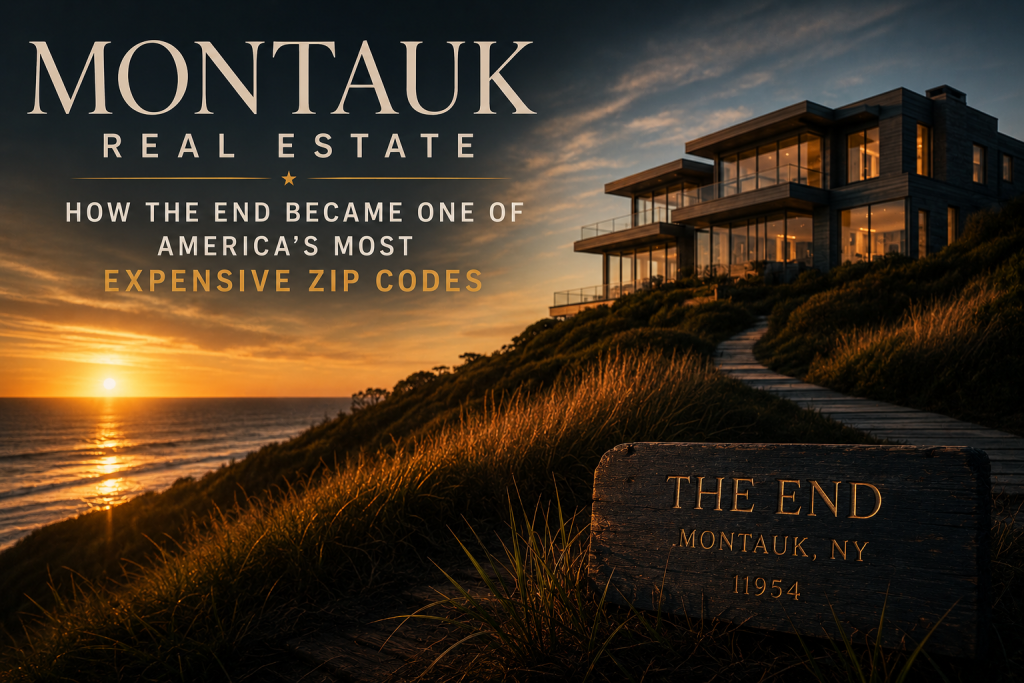
From $225,000 to $85 Million: How the End Became Unaffordable
In 1972, Andy Warhol purchased a 20-acre oceanfront compound in Montauk for $225,000. The property, Eothen, comprised five white clapboard cottages on a stretch of cliff that the Arm and Hammer heirs had used as a fishing camp. Today, the compound is valued at approximately $85 million. That represents a return of roughly 37,700% over 54 years. The annualized appreciation rate of approximately 11.5% is considerably better than the S&P 500 over the same period. It is also, in a very specific way, a measure of how thoroughly Montauk has been transformed.
Montauk real estate is, by any conventional metric, extraordinary. The median home sale price reached approximately $1.9 million in early 2026, up roughly 13.6% year over year. On average, homes spend 113 days on the market. The sale-to-list price ratio hovers around 95%, indicating that sellers are pricing competitively but still achieving prices that would have been inconceivable a generation ago. Redfin classifies the market as “not very competitive,” which means, in practice, that buyers have enough inventory to negotiate but not enough to find a genuine bargain. The cheapest way to own property in Montauk is to have bought it 30 years ago.
But the numbers alone don’t explain why Montauk real estate commands what it commands. For that, you need to understand the narrative. And the narrative, in 2026, is inseparable from the conspiracy mythology, the celebrity history, and the Netflix franchise. Together, these forces have made Montauk one of the most culturally loaded ZIP codes in America.
The Trajectory
In fact, Montauk’s transformation from fishing village to luxury destination occurred in waves, each driven by a different force. The first wave was military. During World War II, the U.S. government expanded Camp Hero into a full coastal defense installation, bringing hundreds of personnel and their families to a community that had previously supported itself through fishing, farming, and summer tourism. The military presence put Montauk on the map. It also put a radar tower at the end of the road that would, decades later, become the most photographed structure in the town’s conspiracy-fueled mythology.
The second wave was cultural. Andy Warhol’s 1972 purchase of Eothen introduced Montauk to a stratum of New York society that had previously considered the South Fork to end at East Hampton. Jackie Onassis spent a summer there. The Rolling Stones rehearsed in the main house. Truman Capote drank on the porch. Dick Cavett was the neighbor. Still, these visitors didn’t buy property in Montauk (Warhol’s $225,000 purchase was, at the time, considered a curiosity rather than an investment thesis), but they established Montauk’s cultural credentials. The town was no longer just a fishing village. It was a fishing village where famous people went to be invisible. That distinction, it turns out, is worth quite a lot per square foot.
The Commercial Wave
The third wave was commercial. In the 2000s and 2010s, hospitality developers recognized what Warhol’s guests had discovered organically: Montauk’s isolation was a feature, not a bug. Gurney’s transformed a motor inn into an oceanfront luxury property. The Surf Lodge became a sunset destination. It generated social media content at industrial scale. Duryea’s turned a working dock into an Instagram phenomenon. As a result, each new venue attracted visitors who, having experienced Montauk’s particular combination of natural beauty and cultivated cool, began looking at real estate listings on the drive home.
The Conspiracy Premium
Of course, there is no line item on a Montauk property appraisal that reads “proximity to conspiracy mythology.” No appraiser has ever added value for being within walking distance of sealed government bunkers. But the conspiracy has, nonetheless, also contributed to Montauk’s real estate appreciation in ways that are real even if they are not directly quantifiable.
Specifically, the mechanism works like this. The Montauk Project conspiracy generated cultural interest in the town beginning in the 1990s. Preston Nichols’ book put Camp Hero on the conspiracy tourism map. The Montauk Monster in 2008 generated international news coverage. Stranger Things, which premiered in 2016 and concluded in 2025, put the word “Montauk” in front of hundreds of millions of streaming subscribers worldwide. Each cultural event increased name recognition. In turn, name recognition drives visitation. Visitation drives demand. Demand drives prices.
For instance, consider the timing. Stranger Things premiered in July 2016. Between 2016 and 2026, In fact, Montauk’s median home prices approximately doubled. Of course, correlation is not causation. But a show that generates 20 million monthly searches and that was originally titled “Montauk” and that ended with its protagonist choosing to move there is not irrelevant to the cultural forces that drive luxury real estate demand. People buy in places they’ve heard of. And they’ve heard of Montauk.
The Marquee Properties
Eothen is the most famous property in Montauk, but it is not the only one that has achieved marquee status. The broader Montauk real estate market is anchored by several categories of property that each tell a different story about what the town has become.
Naturally, oceanfront estates on the bluffs between Ditch Plains and Camp Hero command the highest premiums. These properties offer unobstructed Atlantic views and direct beach access. Those closest to the park also offer proximity to the radar tower and the sealed buildings. In recent years, a handful of these homes have traded above $20 million.
By contrast, lake-front properties on Fort Pond and Lake Montauk represent a different value proposition: water access without the salt corrosion and erosion risk of oceanfront. Duryea’s Lobster Deck sits on Fort Pond Bay. Its commercial waterfront supports marinas, fishing charters, and restaurants. Properties here trade between $2 million and $8 million.
Meanwhile, downtown Montauk (such as it is, given that “downtown” comprises roughly four blocks of mixed-use buildings along Main Street and the highway) has seen significant commercial turnover. Retail spaces that once housed fishing supply stores now accommodate boutiques and juice bars. Real estate offices display listings with seven-figure asking prices. The commercial transformation mirrors the residential trajectory: practical infrastructure replaced by amenity infrastructure, the economy of a working town replaced by the economy of a destination.
The Camp Hero Factor
Camp Hero State Park occupies 755 acres at the eastern tip of Montauk. Indeed, that is 755 acres of oceanfront land that will never be developed. The park’s permanent conservation status functions, in real estate terms, as a guaranteed amenity for surrounding properties. The hiking trails, ocean bluffs, and natural landscape will remain intact regardless of what happens to the rest of the South Fork’s buildable inventory.
New York State Parks has recently announced a request for proposals to develop camping and glamping facilities on the Camp Hero grounds. If implemented, this would add a new tourism use to the park that could increase visitation (and by extension, awareness of the surrounding real estate market) significantly. A glamping operation at Camp Hero would be unique in North America. Guests would sleep on the grounds of a former military base. That base inspired both a global conspiracy theory and one of the most successful streaming franchises in history. That is a marketing proposition that sells itself.
Still, for property owners adjacent to Camp Hero, the glamping proposal represents potential upside and potential concern in roughly equal measure. Increased visitation means increased demand for the broader Montauk experience. It also means increased traffic on roads that are already congested during peak summer weekends. Whether the net effect is positive depends on details not yet finalized. But the conversation itself confirms that the conspiracy mythology and the real estate market are no longer separate categories. They are, at this point, the same story told in different currencies.
What Buyers Are Actually Buying
Ultimately, when someone purchases a $3 million house in Montauk, they are not buying a house in a fishing village. They are buying a position in a cultural narrative, including proximity to Eothen and Camp Hero and Ditch Plains and the Montauk Lighthouse. They are buying the sunset and the surfing. And they are buying the right to say “Montauk” when someone asks where their summer house is, and to watch the recognition register on the listener’s face.
The Recognition Premium
In other words, that recognition is the conspiracy’s real estate contribution. Twenty years ago, saying “I have a place in Montauk” would have required a follow-up explanation (“it’s at the very end of Long Island”). Today, the name carries its own weight. Everyone knows Montauk. Everyone has a reference point, whether it comes from Stranger Things or the Montauk Monster or a friend’s Instagram post from Ditch Plains at sunset. The name is the brand. The brand is the premium. And the premium, at $1.9 million median and climbing, is not insignificant.
The most interesting thing about Montauk real estate in 2026 is not the prices, which are extraordinary but not unique among luxury East End markets. It is the nature of the premium. In Southampton, the premium is for proximity to other wealthy people. East Hampton charges for institutional prestige. But in Montauk, the premium is for narrative. You are buying a location that contains, within its boundaries, a decommissioned military base, a conspiracy theory, a Netflix franchise, a Warhol compound, a surf break where a monster washed ashore, and a lighthouse commissioned by George Washington. Indeed, no other real estate market on the East Coast offers that density of storyline per acre. After all, storylines, unlike beaches and ocean views, appreciate in value every time someone searches for them.
The Numbers
The Stranger Things franchise generates 20 million searches per month. The Montauk Monster generates fresh interest every time a strange carcass washes up anywhere on the Atlantic coast. Camp Hero draws conspiracy tourists year-round. Eothen draws art world visitors. Ditch Plains draws surfers. Each visitor is a potential buyer. In turn, each buyer is a potential client for the agents, architects, designers, and contractors who service the Montauk market. In effect, the conspiracy premium is not a metaphor. It is a market force. And it is compounding.
Where the Conversation Continues
Montauk real estate tells the story of a place that went from the end of the road to one of the most coveted addresses on the East Coast. Social Life Magazine has covered this transformation for 23 years. The stories that define the South Fork land here first.
If you have a story, a brand, or a project that belongs in these pages, reach out at sociallifemagazine.com/contact.
For brands looking for premium editorial placement, our paid feature submission portal is open at sociallifemagazine.com/submit-a-paid-feature/.
Stay in the loop with our weekly email blast covering events, openings, and who’s doing what Out East. Sign up at enflyer.sociallifemagazine.com.
Polo Hamptons 2026 returns to Bridgehampton on July 18 and July 25 with BMW as title sponsor. For event details and sponsorship opportunities, visit polohamptons.com.
Never miss a feature, a profile, or a party recap. Subscribe to Social Life Magazine at sociallifemagazine.com/subscription.
If the work we do matters to you, you can support independent East End journalism directly via PayPal.
Author

Written by
Recent Posts
Sectional Sofa vs. Regular Sofa: Which One is Best for You?

Sober and Injured: How to Manage Pain Treatment After a Massachusetts Slip and Fall
Flexible Liquidity Options Are Reshaping How Modern Professionals Handle Unexpected Expenses
5 Best At-Home Teeth Whitening Kits for a Brighter Smile in 2026

From Spa Retreats to Aesthetic Care, the Luxury Travel Itinerary Is Changing
Categories
- Art
- Articles
- Business of Luxury
- Celebrities
- Culture
- Entertainment
- Events
- Faces of Summer 2026
- Fashion
- Fashion & Style
- Featured
- Finance
- Food, Spirits, Wine
- Hamptons
- Hamptons Celebrities
- Health
- Health & Beauty
- Lifestyle
- Luxury Lifestyle
- Press
- Profiles
- Real Estate
- Technology
- The Chronicles
- Travel
- Uncategorized
- Weddings