
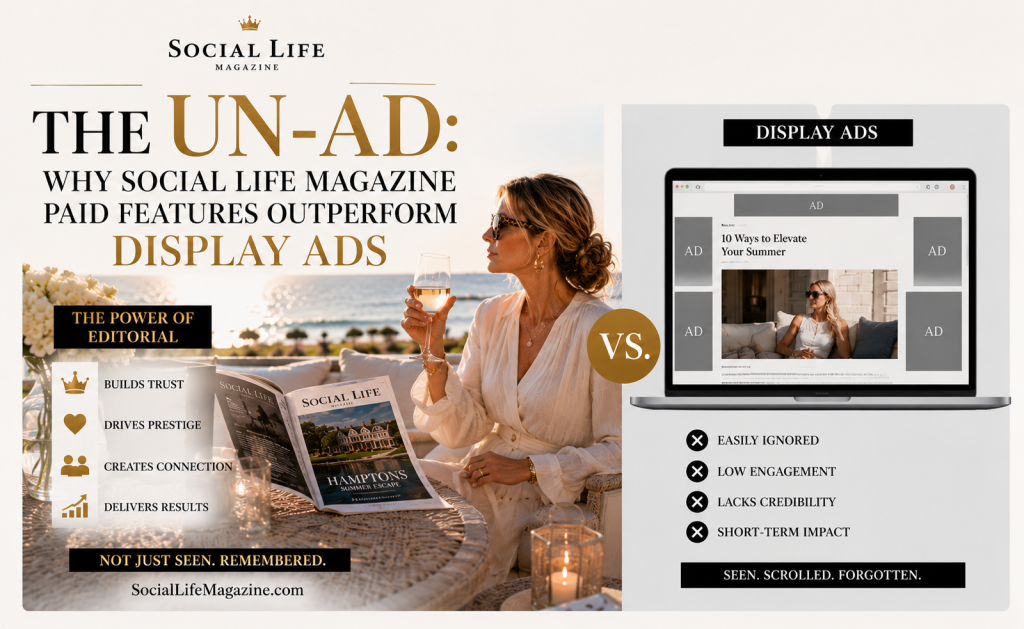
The brief arrives at the agency and it contains a familiar tension. The client wants “something that doesn’t feel like advertising.” The creative team develops something that genuinely doesn’t feel like advertising. Legal reviews it. The brand safety team reviews it. The compliance review adds three disclosures. What ships looks, to any reader, like advertising that tried not to look like advertising — worse than advertising that simply is advertising.
The tension is real. The client is correct that something which doesn’t feel like advertising performs better. But the conventional production process for advertising cannot produce something that doesn’t feel like advertising, because the process itself — the approvals, the brand guidelines, the legal overlays — systematically reintroduces the signals that the reader’s brain uses to categorize content as commercial.
Social Life Magazine’s paid editorial feature solves this problem by removing the brand from the production process at the point where brand involvement most reliably destroys editorial credibility. The feature is written by the publication’s editorial team, in the publication’s voice, to the publication’s standards. Brand direction is provided. The publication produces the product. The result is a piece of content that the reader processes as editorial because it is editorial — produced by an editorial institution, in an editorial voice, to an editorial standard — that happens to focus on a brand.
This is not native advertising in the conventional sense. Paid editorial features in luxury brand marketing are the full application of the counterintuitive principle: the ad that doesn’t look like an ad, because it genuinely isn’t one.
What Behavioral Research Shows About Editorial vs Display
The research on editorial versus display advertising in luxury contexts is consistent across a decade of studies. Readers who encounter brand information in an editorial format assign significantly higher credibility to the information, retain it at higher rates, and are more likely to act on it than readers who encounter identical information in a display ad format.
The specific mechanisms are documented. Editorial formats activate the source monitoring pathways associated with trusted information sources. Display formats activate the skepticism pathways associated with commercial communication. These are different cognitive modes, and they produce measurably different outcomes.
But the behavioral research tells only part of the story. The other part is experiential, and it is specific to the Social Life Magazine format. A reader who picks up the magazine in a boutique on Jobs Lane in Southampton and reads a feature on a skincare brand is reading it in a physical environment she chose, in a publication she trusts, in a cognitive state associated with leisure and curiosity. That combination of format, environment, and state is not reproducible by any digital channel.
The display ad in her social media feed is competing with everything else in her feed. The editorial feature in her hand has her full attention, in the most favorable perceptual context available.
Why Paid Features Convert Longer
Display ads have a documented lifecycle. They generate highest response in the first days of exposure, decay rapidly as ad fatigue sets in, and produce negligible returns after two to three weeks of sustained delivery to the same audience.
A Social Life Magazine paid feature has a different lifecycle entirely. It peaks at publication, but it does not decay. For a summer issue distributed across the South Fork, it lives in print for months. It lives in the digital archive indefinitely, indexed by Google, discoverable through organic search for as long as the archive remains active.
The medspa that runs a display campaign in June generates peak response in June. The medspa that runs a paid editorial feature in Social Life Magazine’s Memorial Day issue is still being discovered by new readers in August, and still receiving organic search traffic the following June when the next summer’s audience begins its pre-season research.
This durability is the counterintuitive advantage that makes paid editorial features a structurally different investment than display advertising. The display ad is an expense. The paid feature is an asset. Its value does not depreciate with time. It compounds.
Submit a paid feature at sociallifemagazine.com/submit-a-paid-feature.
Where The Conversation Continues
The un-ad principle is one application of the counterintuitive framework. Full hub: The Counterintuitive Hamptons: Why the Luxury Brands That Break the Rules Win the Season.
Sibling spokes: Why the Most Exclusive Hamptons Events Don’t Advertise (FUTURE) and The Cheaper Bottle That Sells More (FUTURE).
Pillar: Why Luxury Brands That Ignore Psychology Lose the Hamptons Every Summer.
Author

Written by
Recent Posts
The Skincare Habits That Make a Real Difference Over Time
Hamptons-Ready Beauty: Polished Makeup for Long Summer Days
Is Now a Good Time to Sell a Home in NJ?

The Hidden Work Behind a Seamless Hotel Weekend
Choosing Scratching Furniture for a British Shorthair
Categories
- Art
- Articles
- Business of Luxury
- Celebrities
- Culture
- Entertainment
- Events
- Faces of Summer 2026
- Fashion
- Fashion & Style
- Featured
- Finance
- Food, Spirits, Wine
- Hamptons
- Hamptons Celebrities
- Health
- Health & Beauty
- Lifestyle
- Luxury Lifestyle
- Press
- Profiles
- Real Estate
- Technology
- The Chronicles
- Travel
- Uncategorized
- Weddings