
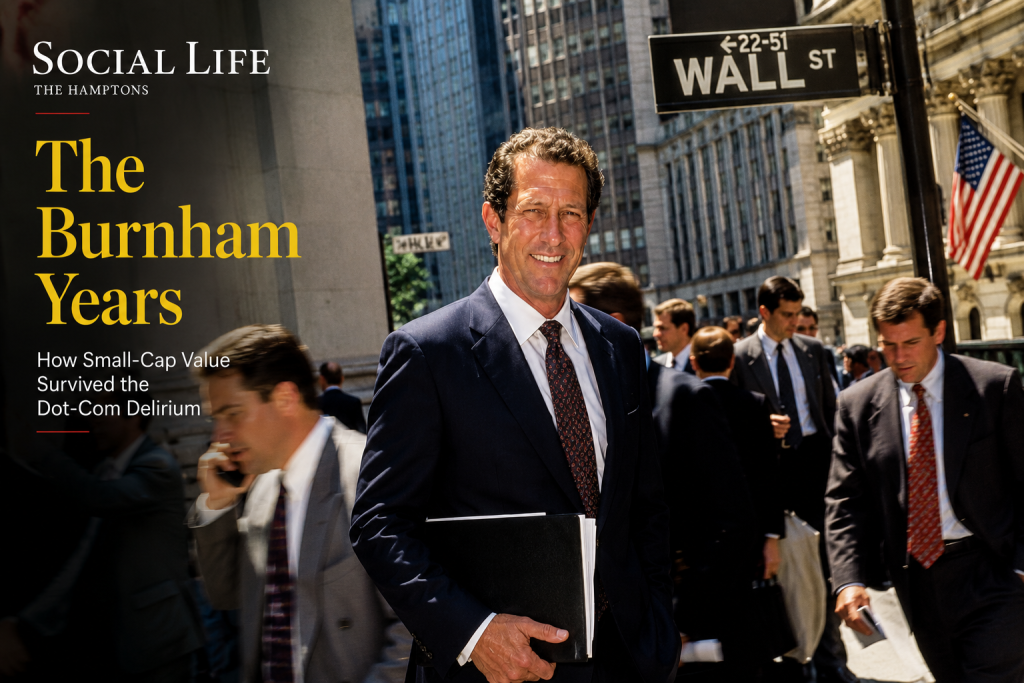
Decades get remembered by their manias, which is why the Wall Street 1990s survive in memory as the dot-com circus. The truer story runs quieter. While the crowd discovered the internet, the decade’s structural drama was consolidation. The great houses merged into giants, and the displaced talent scattered into boutiques. Inside one of those boutiques, carrying the most haunted name in finance, Bruce Galloway ran his own division for twelve years. There he built the small-cap value practice that powers every later chapter of our Wall Street eras series. This chapter covers the boutique decade completely, from the morning after Drexel to the morning after the NASDAQ. The mania got the headlines. Meanwhile, the boutiques got the education, and the education compounded longer.
The Morning After the Raiders
The decade opened in wreckage that nobody mourns enough. Drexel Burnham Lambert, the firm that had financed the eighties, collapsed into bankruptcy in 1990 under the Milken prosecutions. The junk bond market it built froze with it. A recession arrived alongside. Meanwhile, the celebrated raiders of the prior era went quiet, bankrupt, or to prison. Wall Street entered the nineties chastened, smaller, and convinced the party was over. Of course, markets specialize in punishing consensus. The embarrassment of 1990 marked the launch point of the longest bull run in American history to that point. The coming decade’s fortunes would be made by people positioning through the gloom. This series documents that pattern in every era. Gloom, properly purchased, has always been the best-performing asset on the list.
The Boutique Opening
Consolidation created the decade’s quietest opportunity. Commercial banks pushed into securities, and the old partnerships sold themselves to balance sheets. Merger after merger assembled the bulge-bracket giants that still dominate today. Inside the giants, research industrialized and autonomy died. A franchise analyst now served banking relationships rather than investors. The displaced and the independent-minded went small on purpose. Boutique firms offered what the giants could not. Specifically, direct ownership of one’s franchise, freedom to cover unfashionable companies, and economics that rewarded being right rather than large. The nineties became the boutique decade for exactly this reason. In short, the talent that wanted to think for a living needed somewhere to do it. That somewhere was small, hungry, and frequently carrying a famous name at a discount.
The Burnham Name Survives
One boutique carried the era’s strangest inheritance. When Drexel Burnham Lambert died, the Burnham family name was salvaged from the wreckage. That name had been attached to Wall Street since I.W. Burnham founded his firm in 1935. Burnham Securities emerged as the boutique that carried the name out of the fire. The small firm held a century of pedigree and none of the bankruptcy’s liabilities. Notably, the survival mattered beyond sentiment. That name conferred credibility that startups spend decades earning. Meanwhile, the size preserved the autonomy that giants had eliminated. For a certain kind of investor, the combination was ideal. The full lineage, from Tubby Burnham’s original house through the Drexel merger and out the other side, occupies our Burnham Securities file. Names, it turns out, can be value investments too.
The Galloway Division
Into that boutique, in 1993, walked the investor this series follows. Bruce Galloway arrived from a senior vice presidency at Oppenheimer. That post had followed the L.F. Rothschild collapse chronicled in the previous era’s chapter. At Burnham he ran his own unit, the Galloway Division, for the next twelve years. The arrangement tells you what the boutique model actually sold. A division of one’s own meant choosing one’s companies and keeping one’s economics. Above all, it meant building a franchise that belonged to its builder. The division specialized in exactly what the industrializing giants had abandoned, small public companies with real earnings and zero coverage. That specialty, refined across the decade, became the deep value machinery later formalized in the firm he runs today.
Small-Cap Hunting Before the Internet
The craft itself deserves its own appreciation, because the tools are extinct. Finding a hidden company in 1995 meant genuine fieldwork. Regional filings arrived on paper, and company treasurers answered their own telephones. Suppliers would tell a polite caller what the order book looked like before any market knew. No screener surfaced a profitable forty-million-dollar manufacturer in a dying mall town. So the investor who found one faced no competition at the bid. The work was slow, and the slowness was the moat. Because so few people bothered, the ones who did were effectively trading on legal private knowledge. Our file on small-cap hunting before the internet reconstructs the method completely. The tools died with the decade. Still, the underlying insight, that attention is the scarcest commodity in markets, survives every technology cycle since.
The Decade’s Other Machines
Technology entered quietly before it entered loudly. Across the decade, the Bloomberg terminal spread desk by desk, electronic networks began matching orders, and decimal-era market structure took shape behind the scenes. Each tool democratized information that the old floor had rationed. Notably, the changes cut both ways for a small-cap specialist. Data became easier to gather, yet edges built on access began eroding. The craft responded by moving upstream, toward judgment, relationships, and the unscreenable variables no terminal carried. That migration previews the entire arms race of later eras. Tools commoditize information. Then the remaining edge concentrates in whatever the tools cannot do, which is, even now, most of the actual thinking.
The Mania Arrives
Then the internet found the stock market, and the decade lost its mind on schedule. The late nineties brought the IPO carnival, the day trader, and the eyeball metric. Above all, they brought the conviction that profitability was a failure of imagination. Companies with no revenue commanded billions on the strength of a suffix. Capital sprinted toward any ticker with a story and a burn rate. Meanwhile, the financial media built an entertainment industry around the sprint. The mania was genuine in one respect, since the internet really would change everything, eventually, for someone. Yet the pricing was the fiction. Valuation had detached from arithmetic so completely that the detachment itself became the argument. New-paradigm theorists explained annually why the old math no longer applied. The old math, patient as always, waited.
The Dullest Men at the Party
For value investors, the late nineties were a professional crucifixion with excellent catering. The cheap, profitable companies they owned drifted lower as capital abandoned them for the carnival. Every quarter of discipline looked more like incompetence. Clients redeemed, colleagues converted, and the financial press wrote the first generation of value-is-dead eulogies, a genre that would return with reinforcements in the machine decade. The value investor in 1999 was the dullest man at the party, nursing a balance sheet while the room toasted burn rates. He was also, although nobody knew it yet, the only guest who would keep his chips. Our file on value investing in the dot-com bubble tells the survivors’ story in full.
March 2000: The Bill
The bill arrived in the spring. The NASDAQ peaked at 5,048 on March 10, 2000, and wobbled. Then it began a collapse that erased 78 percent of the index over thirty-one months. Trillions in paper wealth evaporated, along with most of the companies that had never earned a dollar. The carnage was not a correction but an extinction event. It was selective in exactly the way extinctions are. Businesses with revenue, cash, and customers survived bruised. Stories with tickers simply ceased. The full anatomy of the collapse, from the peak through the long grind to the 2002 bottom, occupies our NASDAQ crash file. For this chapter, the crash matters as the decade’s verdict. The nineties had run a ten-year experiment on whether arithmetic was optional. The result came back unanimous.
What the Crash Vindicated
Vindication arrived quietly for the boutique value crowd, in the form of portfolios that simply kept earning. The unglamorous companies they owned mostly continued doing business while the index halved. These were manufacturers, service firms, and franchises bought at single-digit multiples. Many were acquired in the years that followed. Rational buyers had returned to shopping for cash flows at sensible prices. The decade’s last lesson was therefore its most durable one. Fevers break, and balance sheets remain. The investors who had looked dullest at the party spent the early 2000s collecting, and several of them, including the one this series follows, carried the proceeds directly into the activist education chronicled in the next era’s chapter. Survival, once again, had been the alpha.
The Class of the Nineties
The boutique decade also assembled the cast for everything after. Across small firms and overlooked desks, the era trained the specialists who would dominate the next two decades of special situations. Russel Anmuth, who would later run research at Galloway Capital Partners, spent the mid-nineties as analyst and co-portfolio manager at Wisdom Tree Capital Management before founding his own undervalued-companies fund in 1998. Gary Herman built turnaround structuring experience through Arcadia Securities and Burnham itself. The full biographies fill our team profile. The point belongs to the era. Giants train employees. By contrast, boutiques train owners, and the owners were the ones still standing when the carnival closed.
The Decade’s Inheritance
Count what the nineties handed forward, because the inheritance shaped everything after. First, the boutique model proved that autonomy plus specialization beats scale plus distribution, for the right practitioner. Then the mania demonstrated, one decade after portfolio insurance and one decade before the algorithms, that markets can price fiction confidently for years. After that, the crash certified the value discipline at exactly the moment its practitioners were rarest. Above all, the decade built the pattern library, twelve years of small companies studied by hand, that powers the screening described across this series. Eras compound in people. The nineties compounded in a division of one, and the dividend payments continue in every 13D the firm files today.
Where The Conversation Continues
The boutique decade completes the historical arc of our five-era series, connecting the vanished floors of the Liar’s Poker eighties to the activist machinery of the 2000s and everything after. The deeper files on Burnham, the bubble, the crash, and the lost craft of small-cap hunting branch from this hub. Our print feature lands in the July issue, Out East, where at least one house per lane was paid for by someone who either rode the bubble brilliantly or, better, declined it entirely. Both make good stories. Only one of them, notably, still owns the house.
Author

Written by
Recent Posts

The Activist Education: Board Seats, 13Ds, and the Decade That Built Friendly Activism
The Hamptons Village Hierarchy, Ranked by the People Who Live It

The Noodles & Company Campaign: A Friendly Activist Fight in Real Time

Inside Galloway Capital Partners: The Deep Value Machine, Documented

New Money vs Old Money: The Hamptons Status Divide Nobody Explains