

Every fortune in America belongs to an era, and every era eventually ends. The Wall Street eras of the last fifty years each minted a different kind of rich person, then quietly retired the mold. Initially, the 1980s made bond traders into folk villains. After that, the 1990s made boutique men rich while the crowd chased dot-coms off a cliff. Then the 2000s built the activist playbook. Eventually the 2010s handed the whole market to machines. Now the 2020s are hosting a rematch between man and algorithm, and the man is winning rounds. Yet one investor worked all five of those eras without changing his religion. His name is Bruce Galloway, he runs Galloway Capital Partners, and his career is the cleanest narrative thread through a half century of American money. In fact, this is the master map. Five eras, one through line, and a duel that is still live.
The Five Wall Street Eras, Mapped
Here is the architecture of the series, because a fifty-year story deserves a table of contents with stakes. Each era below gets its own full chapter on this site, and each chapter opens into deeper pieces on the firms, crashes, and characters that defined it. So think of this page as the trading floor map. Specifically, the tour runs in five stops.
First comes the Liar’s Poker decade, when trading floors ran on cigarettes and conviction. Then the story moves to the boutique 1990s, where small firms hunted value while the herd chased anything with a dot-com suffix. After that comes the activist 2000s, the decade that turned shareholder letters into weapons. The fourth stop is the machine takeover of the 2010s, when algorithms and index funds rewired the entire market. Ultimately everything converges on Man vs. Machine, the current era and the thesis Galloway built a firm around. Five doors. One man walks through all of them.
The 1980s: The Liar’s Poker Apprenticeship
Bruce Galloway entered the business the old way. Economics degree from Hobart in 1979, research analyst desk at Prudential Insurance, then the NYU Stern MBA in 1983, earned while the city around him was inventing modern greed. Of course, research in that era meant paper, phone calls, and shoe leather. An analyst learned a company by reading every filing and calling everyone who would pick up. Notably, that apprenticeship is extinct now, replaced by terminals and screeners. Yet the pattern recognition it built is not.
By the middle of the decade he held a vice presidency at L.F. Rothschild, a serious firm with a ninety-year name. Michael Lewis was across town at Salomon Brothers taking the notes that became Liar’s Poker. Same jungle, different cage. The floors of that era ran on a food chain so explicit it would embarrass wolves, and Oliver Stone filmed its cathedral version in 1987. Readers who want the cinematic register can start with our profile of the director who built Gordon Gekko. The real thing was less quotable and more Darwinian.
The Culture That Money Built
It is hard to overstate how physical the business was then. Capital moved through telephone handsets and shouted orders, so proximity was power and the seating chart was the org chart. Status announced itself in suspenders, steakhouses, and the precise brand of one’s watch, because nothing else on the floor was private. New hires were hazed, ranked, and occasionally rich by thirty. Above all, the decade established a rule that has never been repealed. Wall Street pays for nerve first and analysis second, although it pretends otherwise in public. The full anthropology of that world, from the trading desks to the dining rooms, fills our companion file on the real culture of the 1985 trading floor. Galloway absorbed the nerve and kept the analysis. That combination turned out to be rare.
Black Monday Kills a 90-Year-Old Firm
Then came October 19, 1987. The Dow lost 22.6 percent in a single session, still the worst one-day percentage drop in its history. L.F. Rothschild did not survive the aftermath. A firm that had outlasted two world wars and the Depression was broken by one quarter of portfolio insurance and panic. Galloway watched it happen from inside, and the full autopsy gets its own chapter in the Black Monday story. The lesson a young analyst takes from that kind of funeral is not subtle. Price and value are different animals, and only one of them can kill you. Every position he has taken since carries that scar tissue. In fact, the entire deep value discipline is Black Monday turned into a process.
The 1990s: The Boutique Decade
The nineties carried Galloway to Oppenheimer as a senior vice president, and then to the firm that defined his middle career. In 1993 he joined Burnham Securities, the boutique that kept the Burnham name alive after Drexel Burnham Lambert collapsed under the Milken indictments. He ran his own unit there, the Galloway Division, for twelve years. While bulge-bracket Wall Street consolidated into giants, the boutiques became the natural habitat for stock pickers who wanted autonomy. Small firms, small companies, big information edges.
His hunting ground was the overlooked small cap. Companies with real earnings, clean balance sheets, and zero analyst coverage, priced as if nobody would ever notice them. Of course, in the late nineties nobody wanted to notice them. The market had discovered the internet, and capital was sprinting toward any ticker with a story and a burn rate. The value investor in 1999 looked like the dullest man at the party. He was also, although nobody knew it yet, the only guest who would keep his chips.
The Craft of the Overlooked
Finding hidden companies before the internet was genuine fieldwork, and the craft deserves its own description. There was no screener that surfaced a profitable forty-million-dollar manufacturer in a dying mall town. Instead, the work meant reading regional filings, calling company treasurers directly, and talking to suppliers who knew the order book before the market did. Because so few people bothered, the ones who did were effectively trading on legal private knowledge. Galloway built his nineties record on exactly that asymmetry, including turnarounds in businesses as unfashionable as restaurant franchises. Our deeper file on small-cap hunting before the internet reconstructs the method in full. The tools have since died. Still, the underlying insight survives every technology cycle. Attention is the scarcest commodity in markets, and its absence is where returns hide.
The Dot-Com Fever Breaks
Then March 2000 arrived. The NASDAQ peaked at 5,048 and proceeded to lose 78 percent of its value over the following thirty-one months. Trillions in paper wealth evaporated, along with most of the companies that had never earned a dollar. By contrast, the unglamorous businesses the value crowd owned mostly kept earning. The full story of that decade, including how the Burnham boutique model worked and why the crash vindicated it, lives in the Burnham Years chapter. The short version is simple. Fevers break. Balance sheets remain.
The 2000s: The Activist Education
Owning cheap stock, it turns out, is only half the job. The other half is showing up. The 2000s taught Galloway that lesson in full. Through Strategic Turnaround Equity Partners, the fund he founded and ran, he learned the activist trade from the inside. Board seats at small public companies. Letters to management written with the patience of a man who has read the filings more carefully than the CFO. The slow, deliberate pressure of a large shareholder who is not going away.
This was the decade the 13D filing became a genre of American literature. A 13D is the disclosure an investor must file after crossing five percent ownership of a public company, and it is the closest thing modern finance has to a duel challenge. Our full explainer on how a 13D filing actually works breaks down the mechanics. The strategic culture around it gets the full treatment in the activist decade chapter.
The Friendly Menace
Galloway’s version of activism acquired a name that sounds like an oxymoron until you sit with it. Friendly activism. The sequence is courteous and relentless. Accumulate the stake, file the 13D, present management with a specific list of actions, and escalate only if the board stonewalls. Asset sales and special dividends in the short term. Board changes in the middle distance. Buybacks and capital structure repair over the long haul. The friendliness is real, but so is the implication underneath it. A shareholder with five percent and a plan does not need to shout. He needs to wait.
2008 and the Wilderness
The financial crisis then complicated everything. Value investing assumes the market eventually prices businesses on their merits, and 2008 suspended that assumption for years. Cheap stocks got cheaper, then got cheaper again. Survivorship in that stretch was its own credential. Still, the deeper damage was structural rather than emotional. The crisis triggered the regulatory and technological shifts that would hand the next decade to the machines, and almost nobody saw that handoff coming.
The 2010s: The Machines Take the Floor
For roughly a hundred years, value stocks beat growth stocks over time. That was not an opinion. It was the most documented pattern in market history, the academic bedrock under every Buffett pilgrimage to Omaha. Then the pattern broke. Across the thirteen years that followed the crisis, growth outran value by more than 300 percent, and the eulogies for value investing became a financial media genre of their own.
Galloway’s explanation for the break is the thesis his current firm is built on. The market’s buyers changed species. Algorithms, ETFs, and passive index flows came to dominate daily volume, and those buyers do not read balance sheets. They buy what is going up, because that is what the code says, which pushes the same large-cap growth names higher in a self-reinforcing loop. Meanwhile the same machinery mechanically shorts the cheap, ignored, profitable small companies that value investors live on. The full anatomy of this rewiring fills the machine takeover chapter.
The Feedback Loop Nobody Voted For
Consider what this did to price discovery. A stock outside the indexes, with no analyst coverage and a falling chart, becomes invisible to nearly every pool of capital on earth. Its cheapness attracts no buyers, because the buyers are programs, and the programs read cheapness as weakness. Most value managers responded to this regime by retiring, capitulating, or quietly buying Microsoft. Galloway read the same data and reached the opposite conclusion. A market that systematically mispriced an entire category of company was not a broken hunting ground. It was a stocked pond.
The 2020s: Man vs. Machine
Galloway Capital Partners, the firm he now runs with co-founder Gary Herman and research director Russel Anmuth, is the weaponized version of that conclusion. The strategy has a name that belongs on a fight card. Man vs. Machine. The method is to identify what the algorithms are punishing, buy it at the bottom of the bots’ contempt, then introduce a catalyst the code cannot ignore. A 13D filing. A board change. An asset sale, a buyback, a strategic review. The machines that crushed the stock on the way down become the machines that chase it on the way up. The deep mechanics live in the Man vs. Machine chapter, the hub of this era.
The Architecture of Discipline
The firm’s structure is deliberately unexciting, because discipline is the entire moat. The portfolio holds roughly forty to fifty positions, with no single name above ten percent of assets and no sector above thirty-five percent. Holding periods run twelve to thirty-six months, long enough for a catalyst to detonate and for gains to turn long-term for tax purposes. Margin stays under twenty percent, and total long exposure is capped at 120 percent. None of this is glamorous. Indeed, that is the point. The flamboyant version of this business died several times across the previous four eras, usually in October. What survived was process, position limits, and the patience to let a 13D do its slow work. Restraint, in this corner of finance, is the truest luxury good.
The Live Duels
The current portfolio reads like a contrarian’s fever chart, and several positions are live fights. In May 2026 the firm disclosed an 8.42 percent stake in WW International, the company the world knows as Weight Watchers, arguing that a globally recognized brand with a freshly repaired balance sheet should not trade below a $100 million market cap. Our breakdown of the WW International bet covers the GLP-1 angle that makes it timely.
The Noodles & Company campaign is the other duel worth watching in real time. Galloway disclosed a 6.01 percent stake in December 2025 and pushed the fast-casual chain to sell roughly 200 company-owned restaurants to retire expensive debt. By February 2026 the position had grown to 8.78 percent, the company had executed a reverse stock split, and the letters had turned encouraging. Notably, he ran the same deleveraging play at Regis Corporation, the salon giant, before the equity recovered dramatically. Babcock & Wilcox, Chegg, and the rest of the 13D roster each get their own files in this cluster. Every position is the same wager wearing a different ticker. Fifty years of pattern recognition against silicon.
The Screening Machine
What does the firm actually look for? Specifically, it hunts catalysts hiding inside cheap companies. New management. A recapitalization. A regulatory shift, a technology turn, or a change in market sentiment that the algorithms have not priced. The screening runs through a professional network of directors, lawyers, and industry consultants, then through hard fundamentals on solvency, asset value, and governance. Our full profile of the deep value operation inside Galloway Capital Partners walks through the whole apparatus.
The most entertaining artifact of the process is public, in fact. The firm publishes fifteen anonymized opportunity sketches, each one a riddle describing a real target by its numbers alone. A franchise system at a $14 million valuation, down from $1.6 billion. A pipeline operator at $28 per share against a $100 book value. Readers can play detective with the fifteen anonymized targets in their own file. Wall Street rarely shows its homework. Here, unusually, it does.
The Team Behind the Number
No fifty-year operation is a solo act, of course. Gary Herman, the co-founder and chief operating officer, came up through Arcadia Securities and Burnham, structured turnaround investments for decades, and sat on boards from public companies to the New York City Industrial Development Agency. He is also a licensed commercial pilot with an instrument rating, which feels thematically correct for a firm that flies against prevailing winds. Russel Anmuth, the research director, ran his own fund focused on undervalued public companies for over a decade before joining. Together they form the institutional memory around Galloway’s pattern library. Their full story, including the 13D campaigns each one shaped, sits in our profile of the team.
The Scoreboard, Read Carefully
Numbers deserve attribution, so here they are with their sources attached. By the firm’s own accounting, cumulative returns exceed 2,000 percent, with average annualized returns above 50 percent, calculated on a pro forma basis net of standard fees. Those are the house’s figures. The third-party number is the one that travels. In 2020, Eurekahedge, the largest global hedge fund database, ranked Galloway the number one value investor in the world, with annual returns of 164.44 percent that year. The same ranking placed him sixth among all North American fund managers across every asset class outside crypto.
Read both sets of numbers like an adult. Self-reported pro forma returns are a claim. By contrast, a first-place finish in an independent global database is a fact with a referee. Together they describe the same underlying reality, because a track record this loud is also a status instrument. On Wall Street, the compounded number is the title, the trophy, and the table at the front of the room, all at once.
What the Sixth Era Looks Like
Every era in this story ended the same way, with the smart money of one regime becoming the dumb money of the next. Bond kings of the eighties did not see the boutiques coming. Likewise, the dot-com visionaries never saw the cash-flow reckoning. The machines, in turn, may not see the men coming back. Artificial intelligence is already writing the next chapter, flooding the market with new algorithmic buyers while simultaneously gutting the business models of companies the old code still scores as healthy. So whoever maps those mispricings first inherits the decade.
The geography of the business is shifting along with the code, also worth noting. Galloway now operates from Miami Beach, part of the broader migration that moved billions in managed money from Midtown to Florida over the past five years. The signal there is cultural as much as fiscal. The old eras required a seat on a specific island. By contrast, the new one requires only a filing agent, a thesis, and the nerve to publish it. Power in this business used to be an address. Now it is a track record with a wire connection.
Galloway’s wager is that the mapper will be human, seventy-something, and armed with a 13D. History does not guarantee him the win. It does, after all, give him the better record against regime change than anyone currently betting against him. Five eras in, the last value man is still filing.
Where The Conversation Continues
This pillar is the front door. Behind it sit five era chapters and more than twenty deeper files, from the crash that killed L.F. Rothschild to the fifteen anonymized targets in Galloway’s current opportunity set. The series rolls out across the summer, and the print feature runs in our July issue, the one that lands in every serious living room from Southampton to Montauk. Out East, the season’s real conversation is always about money, specifically who understood the game one move earlier than the room. Readers who want that move start here. After all, the rest of the cluster is waiting.
Author

Written by
Recent Posts

The WW International Bet: Why Galloway Thinks Weight Watchers Is Worth Multiples

Wall Street Eras: 50 Years of Money, Machines, and the Last Value Man
Inside the Liar’s Poker Decade: When Wall Street Ran on Cigarettes and Conviction
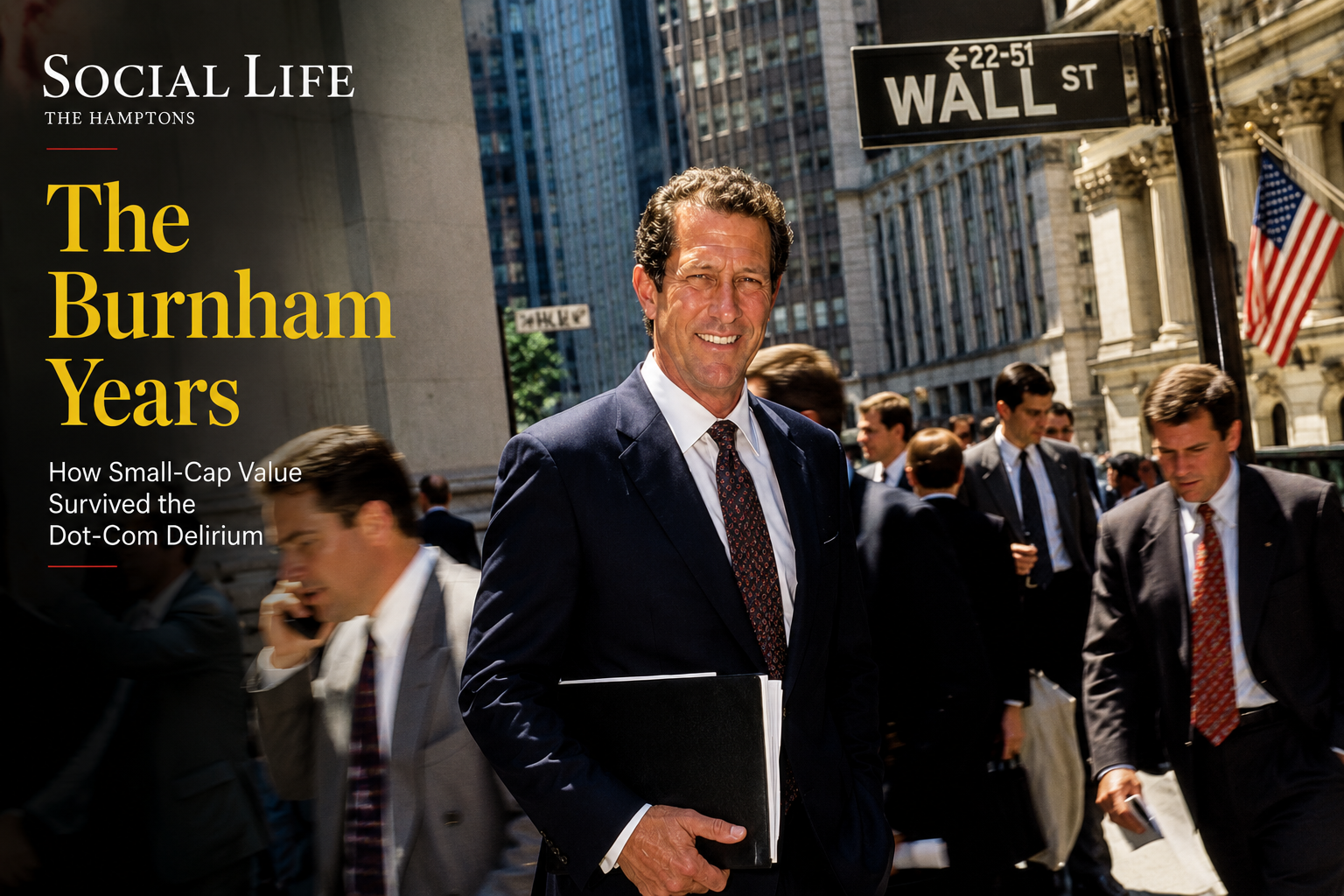
The Burnham Years: How Small-Cap Value Survived the Dot-Com Delirium
When the Machines Took Wall Street: ETFs, Algorithms, and the Death Notices for Value