
The Before: Sioux Falls, South Dakota, and the Name That Came From a Novel
Where She Started
January Kristen Jones was born January 5, 1978, in Sioux Falls, South Dakota. Her mother, Karen, managed a sporting goods store. Her father, Marvin, worked as an exercise physiologist. She was named after January Wayne — a fictional character in Jacqueline Susann’s 1973 novel Once Is Not Enough. Her two sisters were also given names beginning with J: Jina and Jacey. When Jones was one year old, the family relocated to Hecla, South Dakota. She grew up there. In 1996, she returned to Sioux Falls to complete her senior year at Roosevelt High School.
South Dakota is not a launching pad for television careers. Nevertheless, Jones launched from it. The distance between Hecla and a Golden Globe nomination is not a straight line. In her case, it ran through a modeling scout, a New York agency, a debt dispute, and Los Angeles — in that order. Each step was more contingent than it appeared afterward.
The Modeling Scout and the Decision That Followed

A talent scout expressed interest while Jones was still in high school. At eighteen, she moved to New York City to model. She later described modeling as something she never took seriously — a means rather than an end. Her first agency claimed she owed them money when she decided to leave for Los Angeles. The dispute was resolved. She left anyway. In New York, she modeled for Versace, Abercrombie and Fitch, Clearasil, and Kerastase. Across both markets, she appeared on the covers of Allure, Rolling Stone, Town and Country, and GQ in the United States. British editions of Harper’s Bazaar, Marie Claire, and Tatler followed. The modeling career served its purpose. It opened the door to Los Angeles and then stepped aside.
Los Angeles and the Industry’s First Verdict

Jones moved to Los Angeles and began auditioning. The industry’s initial assessment was direct: she could not act. That verdict was delivered with the casual authority that casting offices apply to people they have not yet seen do the thing they are being evaluated on. Jones did not agree with it. She also did not argue with it. She kept auditioning. In time, small roles accumulated. She appeared in Anger Management (2003), Love Actually (2003), and Dirty Dancing: Havana Nights (2004). None of them changed the room’s mind. Nevertheless, they changed her preparation.
The Pivot: The Three Burials, We Are Marshall, and the Slow Build
Tommy Lee Jones and the Creative Education
In 2005, Jones appeared as a border guard’s wife in The Three Burials of Melquiades Estrada. Tommy Lee Jones directed and starred in the film. Jones later described it as one of the most creatively significant experiences of her career. The film received strong critical reviews. Working inside a project of that quality, at a supporting level, offered a different kind of education than auditioning had. It taught her what serious dramatic work felt like from the inside.
In 2006, she played Carol Dawson in We Are Marshall — wife of football coach William “Red” Dawson. The film received mixed reviews and underperformed commercially. However, it gave Jones broader exposure. That exposure led to the audition that mattered. Matthew Weiner’s Mad Men pilot was in development at AMC. The role of Betty Draper was looking for an actress. Betty was a suburban wife, former model, and Bryn Mawr graduate. Her entire life had been organized around a performance she had never consented to.
The Audition Nobody Expected Her to Win

Jones auditioned for Betty Draper without the industry’s confidence behind her. The casting office’s earlier verdict had not been widely revised. She got the role anyway. Mad Men premiered July 19, 2007. Within its first season, it became clear that the show had assembled something unusual. Jones’s performance was at its center. Betty Draper was not the kind of role that generates immediate awards attention. She was the kind of role that reveals itself over seasons — whose full meaning only becomes legible once you understand what the show is actually about.
The Mad Men Chapter: Betty Draper and the Performance Nobody Understood in Real Time
Who Betty Actually Was
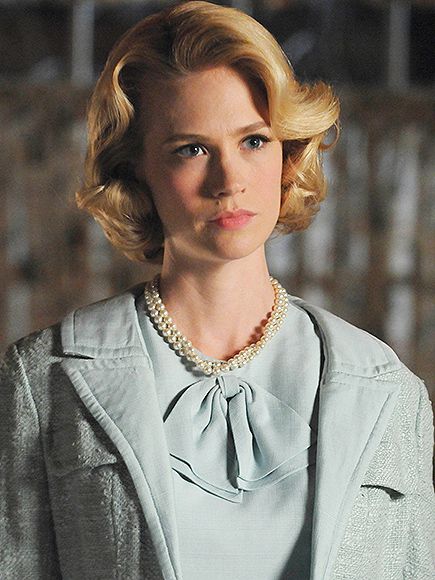
Betty Draper holds a Bryn Mawr education and speaks fluent Italian. She was a professional model before her marriage. She is perceptive, politically observant, and emotionally precise. The show places her in a colonial house in Ossining with two children and a psychiatrist she does not know is reporting to her husband. Her domestic life has exactly one official use for her intelligence. That use is invisibility. Betty is not cold. She is a woman whose entire authorized existence has been organized around the suppression of everything she actually is. The coldness is the container. It is not the content.
Jones played this with a surface so controlled that most viewers, for most of the show’s run, took the surface at face value. That was the point. The show constructed Betty to be misread by its characters. Jones understood that the audience would misread her too. She played into that misreading with precision — maintaining the exterior while trusting the attentive viewer to see what it was costing. That is a specific and demanding technical choice. Furthermore, it requires the actor to resist every instinct to signal the interior in ways that would provide relief. Jones never provided the relief.
The Weight Gain Storyline and What It Required
In Season Five, the show ran a storyline in which Betty gains significant weight. Jones wore a fat suit for several episodes. The production gained attention. Some of the coverage was not kind. Jones addressed it with the same equanimity she brought to the role itself — without performing either sensitivity or indifference. The storyline required her to play Betty’s relationship with her own body under scrutiny from every character around her. In a show about surfaces and their maintenance, that arc demanded considerable technical discipline. Jones delivered it without breaking the character’s internal logic at any point.
Two Golden Globes, One Emmy, Zero Wins
The awards nominations reflected the performance’s quality. Jones received two Golden Globe nominations for Best Actress in a Television Series Drama and one Emmy nomination for Outstanding Lead Actress in a Drama Series. John Slattery accumulated four Emmy nominations for Roger Sterling across the same run — two actors whose nomination records the industry kept building and declining to resolve. She did not win any of them. That record places her in the same category as Jon Hamm before his 2015 Emmy win — recognized repeatedly, unrewarded consistently. The nominations were also, in a specific sense, against the grain of how the character was publicly received. Betty was not universally loved. Consequently, nominating the performance required the awards bodies to separate their response to the character from their assessment of the craft. They made that separation three times. They simply declined to go further.
The Climb: X-Men, The Last Man on Earth, and the Range Beyond Betty
Emma Frost and the Franchise Entry

In 2011, Jones played Emma Frost in X-Men: First Class. The film grossed $353 million worldwide. That role demonstrated range the Betty Draper years had never required — something colder and more overtly stylized, a villain who operates through aesthetic authority rather than suppressed feeling. It worked. It also expanded her public profile beyond the Mad Men audience in ways that supported her post-show trajectory.
During the Mad Men years, she additionally appeared in The Boat That Rocked (2009), Unknown (2011) opposite Liam Neeson, and Seeking Justice (2011). None of these were career-defining. Together, they built the working record of a serious actress who was not limiting herself to one register while carrying a lead role in the defining drama of her era.
The Last Man on Earth
After Mad Men ended in 2015, Jones joined the Fox comedy series The Last Man on Earth as Melissa Chartres. She appeared in 63 episodes across four seasons, through 2018. The role was a direct inversion of Betty Draper — comedic, physical, broadly drawn, and played entirely for warmth. That performance demonstrated what years of playing Betty had obscured: Jones had considerable comic range. Previously, the industry had simply not had occasion to see it.
Subsequently, she appeared in Netflix’s The Politician (2019) and Spinning Out (2020). Both projects were cancelled or concluded after limited runs. In 2023, she appeared in God Is a Bullet alongside Jamie Foxx and Nikolaj Coster-Waldau. The film was a crime thriller set in Southern California. It added further to a post-Mad Men record that, while uneven, consistently demonstrated a working actress building rather than coasting.
Xander and the Deliberately Private Chapter
On September 13, 2011, Jones gave birth to a son, Xander Dane Jones. She has never publicly identified his father. The decision to maintain that privacy was her own, stated without apology and maintained consistently. In 2025, she disclosed that she has experienced misophonia — a condition causing strong reactions to specific sounds — since she was a teenager, and that the condition has worsened over time. She has remained single. Her public presence is selective and her social media presence is occasional. Both reflect a relationship to celebrity consistent with the pattern of her entire career: she does the work on her own terms and does not perform the surrounding expectations.
The Numbers and the Argument They Make
The $10 Million Figure
Her January Jones net worth stands at approximately $10 million as of 2025. The figure reflects a consistent salary of $100,000 per episode across Mad Men‘s run — a rate she held throughout, unlike some cast members whose fees rose substantially in later seasons. It also includes earnings from The Last Man on Earth, the Netflix projects, film work including the X-Men franchise, and a modeling and endorsement portfolio spanning two decades. The number is modest relative to the cultural footprint of the role that built it. Nevertheless, it reflects a career of deliberate, consistent work rather than a single windfall.
The Performance the Industry Still Owes a Proper Accounting
Betty Draper was the most widely misread performance in Mad Men‘s cast. She was also among the most precisely constructed. Jones played a woman whose intelligence and emotional acuity were systematically made invisible. Every institution around her — her marriage, her psychiatrist’s arrangement, the suburban architecture of her daily life — participated in that erasure. She played all of it from the inside, without signaling to the audience that there was an inside to find. That restraint is the performance. It is also, perhaps, the reason the awards bodies kept nominating the work and stopping short of full recognition. Rewarding Betty Draper required agreeing, officially, with what the show was saying about the world Betty lived in. That is a more uncomfortable conclusion than it appears. Jones understood this. She played the discomfort into the performance and left the audience to find it at their own pace.
The coldness was never indifference. It was discipline. It was the correct response to a world that had decided, before she opened her mouth, what she was for. January Jones played that world’s most honest observer for seven seasons and made it look, to the people who weren’t paying close enough attention, like nothing at all. That is the hardest thing an actor can do. It is also, in the end, the most accurate description of the role itself.
Return to the full Mad Men complete guide for the show’s seven-season breakdown. Read Jon Hamm, Elisabeth Moss, and Christina Hendricks in the full cast series. Visit our Culture and Power hub for the complete landscape.
Related Reading
- Mad Men: The Complete Guide to Every Season and Character
- Christina Hendricks Net Worth: The $10M Joan Holloway Story
- John Slattery Net Worth: The $10M Roger Sterling Story
Some performances are recognized immediately. Others take longer — because the audience needs to sit with what the work is actually saying before they can hear it. Social Life Magazine has covered culture, wealth, and the people who shape both for 23 years. You read us because you prefer the second kind of conversation.
If your brand, business, or story belongs in this conversation, we want to hear from you. Editorial features, strategic placements, and partnerships begin at sociallifemagazine.com/contact.
Ready to control your own narrative? Submit a paid feature and reach 25,000 print readers per summer issue at sociallifemagazine.com/submit-a-paid-feature.
Our email list reaches 82,000 subscribers — the people who understand that the most important performances are often the ones the room almost missed. Join the list here.
Polo Hamptons returns for summer 2026. Two dates. A room that already knows what it is. Sponsorship packages at polohamptons.com.
Five summer issues. Placed where the conversation actually happens. Print subscriptions at sociallifemagazine.com/subscription.
Independent editorial takes real resources. If this kind of journalism matters to you, a $5 contribution keeps Social Life in print and online. Donate here.
Author

Written by
Recent Posts

Galina Breslav: From Pension Fund to Executive Presence

Hermès Fake Authenticator: A Monopoly Mistaken for Expertise

A Real Gift: How La Scala Found Its Community in New York Through the Teatro alla Scala Association of America (TASAA)

He Sold His Company, Got Everything He Wanted, but Lost His Purpose

OUT OF LINE
Categories
- Art
- Articles
- Business of Luxury
- Celebrities
- Culture
- Entertainment
- Events
- Faces of Summer 2026
- Fashion
- Fashion & Style
- Featured
- Finance
- Food, Spirits, Wine
- Hamptons
- Hamptons Celebrities
- Health
- Health & Beauty
- Lifestyle
- Luxury Lifestyle
- Press
- Profiles
- Real Estate
- Technology
- The Chronicles
- Travel
- Uncategorized
- Weddings