
Before the Bridge: 1656 and the Settlement Called Bullhead
Bridgehampton history begins with a pond, a homestead, and a name that nobody uses anymore. In 1656, Josiah Stanborough, an original settler of Southampton, built a house on Sagg Pond in the area the Shinnecock called Sagaponack, meaning “the land of the big ground nuts.” English colonists had arrived on Long Island in 1640, obtaining land from the Shinnecock. Sixteen years later, Stanborough moved east from the Southampton settlement and established what would become Bridgehampton.
The Bridge That Named the Village
The settlement’s first name was Bullhead. Nobody is entirely sure why. In 1686, Ezekiel Sandford built a bridge across Sagg Pond, linking the communities of Mecox to the west and Sagaponack to the east. The lane that crossed the bridge became Bridge Street. The hamlet became Bridge Hampton. Eventually the two words merged into one. A pond, a bridge, and a name: that is the entire founding mythology of a village where the median home price now exceeds $3 million.
Most founding families connected to the whaling industry, which was the East End’s most profitable pursuit in colonial times. But once Sag Harbor was settled around 1730, whaling moved there. Sag Harbor had the deeper harbor. Bridgehampton had the richer soil. That division of labor, harbor versus field, established a dynamic that persists today. Sag Harbor became a port town. Bridgehampton became a farm town. Each village’s identity grew from what the geography made possible.
The Agricultural Century: Potatoes, Polish Families, and 5 A.M. Coffee
For roughly two centuries, Bridgehampton history is agricultural history. Potato fields extended in every direction from the four-block Main Street. Polish families, mostly of farming extraction, ran the operations. Duck farms dotted the landscape. Migrant workers from the South arrived every fall to work the five large potato packing barns. Six gas stations on Main Street serviced farm equipment rather than summer visitors.
The Candy Kitchen at Dawn
At 5 a.m., before the fields needed tending, the farmers met at the Candy Kitchen for coffee and yesterday’s potato prices. The Candy Kitchen opened in 1925, the same year Fitzgerald published The Great Gatsby. George Stavropoulos, a Greek immigrant, started it. The Parash family ran it for decades. Gus Laggis bought it in 1981, and three generations of the Laggis family operate it today.
Consider what has not changed in 101 years: the terrazzo floor, the Formica countertops, the swivel stools, the homemade ice cream, the cash-only policy. Consider what has changed around it: every potato field within a mile is now either a vineyard, an estate, or an agricultural reserve. The Candy Kitchen is the one institution in Bridgehampton that predates the luxury economy and has refused to participate in it. A chocolate malt costs $8.50. The experience of sitting at the counter has not been renovated, reimagined, or repositioned.
The Wall Street Journal reporter drove out in 2023 to write about the Candy Kitchen’s addition to the National Register of Historic Places. She sat at the counter and ordered the grilled cheese. Then she watched a landscaper in work boots eat beside a woman in Celine sunglasses, both of them reading the same newspaper, neither of them performing anything for anyone. The reporter wrote 1,200 words. HBO’s Succession had already name-dropped the place in its series finale, when Kendall Roy recalled a childhood promise made “at the Candy Kitchen in Bridgehampton.” The Laggis family did not seek the attention. Attention found them.
The Railroad and the First Transformation
The Long Island Rail Road reached Bridgehampton in 1870. Before the railroad, the village was accessible only by road or water. After the railroad, it was accessible from Brooklyn in a few hours. This connectivity changed Bridgehampton slowly at first, then rapidly. Summer boardinghouses opened. The Hampton Library, founded in 1876, used the railroad as a selling point: the LIRR shipped the lumber for the library’s construction for free, and the existence of a library was marketed to potential summer visitors as evidence of civilization.
The Boardinghouse Era
Cottagers and boarders could join the library for one year for $1, or purchase a part-year subscription: three months for 75 cents. Many boardinghouses bought the library catalog for summer guests to browse. This was Bridgehampton’s first iteration as a destination: come for the fresh air, stay for the books, eat at the farms. The audience was middle-class New Yorkers escaping the city heat. Luxury had not arrived yet. It would take another century.
Meanwhile, Southampton was building its Gilded Age institutions. The Bathing Corporation opened in 1891. The Meadow Club followed. Old money from Manhattan constructed estates on Gin Lane and Meadow Lane. Bridgehampton had no equivalent. No wealthy patron built an institution here. No social register codified the hierarchy. Bridgehampton remained a farm town while its neighbors became resort towns. This absence of inherited institutional wealth is the single most important fact in understanding how the village works today.
Bobby Van’s and the Writers’ Bar: 1969 to 1979
In 1969, a Vietnam veteran named Bobby Van bought a bar on the north side of Montauk Highway, put his name on the front, and started playing piano. The regulars who showed up were not the potato farmers. James Jones came. Peter Matthiessen. George Plimpton. Irwin Shaw. Truman Capote, who may or may not have finished In Cold Blood in a booth. Willie Morris, William Styron, Wilfrid Sheed, Charles Addams, John Knowles. Sometimes Kurt Vonnegut, when the mood struck.
The Steinway and the Map
Bobby played his Steinway baby grand in the middle of the room. On the wall leading to the bathrooms hung a floor-to-ceiling map of the world, because arguments about Indian port cities required visual confirmation. The writers drank, argued, smoked, flirted, and stayed late. For ten years, Bobby Van’s was their clubhouse. Then the lease expired. Bobby moved across the street. By 1986, he had lost the restaurant entirely, spectacularly in debt.
New owners kept the name. Time changed the atmosphere. Willie Morris had left. Many of the writers had died. What remained was a steakhouse with photographs of the literary era on the walls and a porterhouse that attracts Manhattan’s financial class every Saturday night. Bobby Van’s today is a monument to a specific kind of conversion: cultural capital replaced by economic capital, the writers’ bar reborn as the bankers’ steakhouse. The room is the same room. What happens inside it is entirely different.
The Bridgehampton Race Circuit: 1957 to 1998
In 1953, a group of racing enthusiasts formed the Bridgehampton Road Races Corporation to finance a permanent circuit. They purchased 550 acres of sandy hills overlooking Peconic Bay and hired Grumman engineers to design a 2.85-mile, 13-turn road course. The track opened in 1957, the same year as Lime Rock Park and Laguna Seca.
The Most Challenging Course in America
Stirling Moss called the first combination of turns the most challenging in North America. Mario Andretti said Turn One could “scare the bejesus out of anybody.” NASCAR ran here. Can-Am ran here. The Vanderbilt Cup, which had been raced on Long Island from 1904 to 1910, was revived at Bridgehampton in 1965. For four decades, the roar of engines across the fields was part of the village’s identity.
The track closed in 1998. Some sources say 1999. By then, the major series had long since moved on and the circuit served mostly amateur events. But the track’s legacy did not disappear. It was converted.
From Racetrack to Golf Club
Robert Rubin, a former commodities trader, bought the land and hired Rees Jones to design a golf course over the ruins. The Bridge opened in 2002. Initiation fee: reportedly approaching $1.5 million. Annual dues: approximately $20,000. The clubhouse is glass-walled and aggressively futuristic. Guardrails and flag stations from the old racetrack pop up around the fairways. Discarded tires line cart paths. The dress code is deliberately casual: jeans, cargo shorts, backward caps.
Southampton’s Bathing Corporation has existed since 1891. The Bridge has existed since 2002 and costs more to join. This is Bridgehampton history in a single comparison: the village that built nothing in the Gilded Age now hosts one of the most expensive private clubs in the Hamptons, and it was built on the ruins of a racetrack that was built on farmland. Every layer converts from the layer beneath it.
The Equestrian Turn: Polo and the Hampton Classic
In 1971, the Topping Riding Club in Sagaponack organized a one-day horse show. By 1982, that show had grown into the Hampton Classic, permanently relocated to 240 Snake Hollow Road in Bridgehampton. It has not left since. Over 1,500 horses now compete for more than $1 million in prize money across 200-plus classes. Grand Prix Sunday closes Hamptons summer with a $400,000 Longines-sponsored finale.
Peter Brant and Two Trees Farm
In the 1990s, Peter Brant founded the Bridgehampton Polo Club at Two Trees Farm. Publisher of Interview magazine, collector of Warhol and Basquiat, Brant brought the Mercedes-Benz Polo Challenge to Bridgehampton for fifteen consecutive years. The matches ran six Saturdays between July and August, drawing the art-world-meets-finance crowd that Brant himself embodied.
Then the land at Two Trees sold. Polo fields became ranch homes. Bridgehampton lost its social centerpiece. Justin Mitchell, publisher of Social Life Magazine, saw opportunity. By summer 2016, the first Polo Hamptons event filled the gap at 900 Lumber Lane. Porsche signed as inaugural title sponsor. BMW North America took over in 2019. Ten consecutive years of sellouts followed. Christie Brinkley hosts. Two polo operations in one village, then one, then a new one. Bridgehampton does not mourn what closes. It builds what opens next.
Conversions: The Pattern That Defines Everything
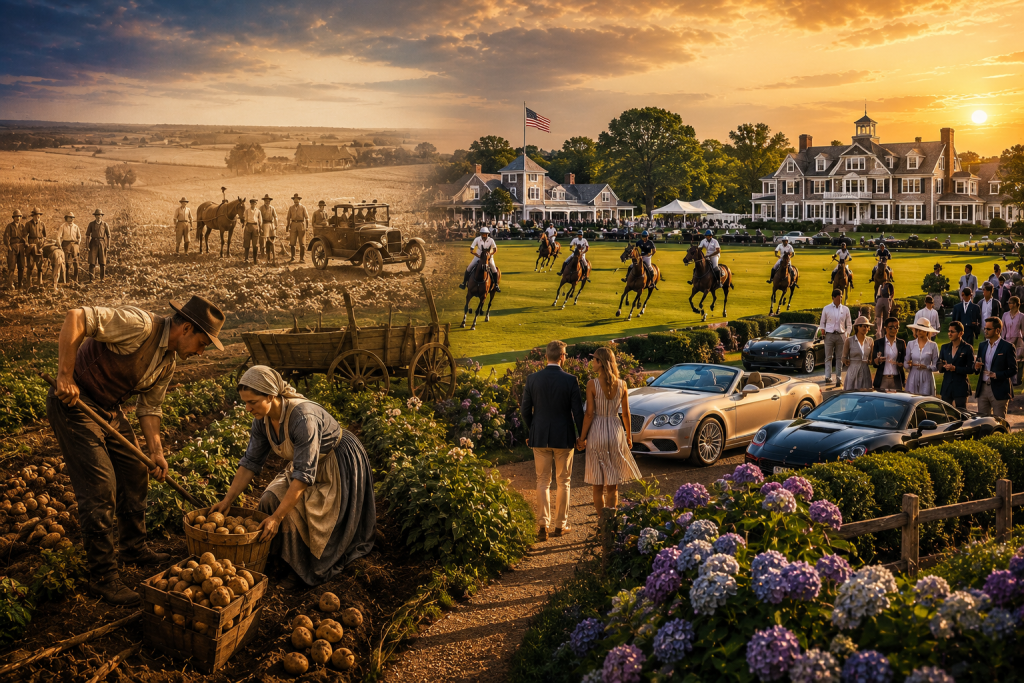
If there is a single thread running through Bridgehampton history, it is conversion. Not demolition. Not replacement. Conversion. Every significant institution in the village exists because something else was there first, and someone decided to make it into something new.
The Conversion Ledger
Potato fields became the 55 sustainably farmed acres of Wolffer Estate Vineyard, planted in 1988 on Bridgehampton loam soil. A firehouse built in 1909 became an African American Baptist church in 1924, which became Dia Bridgehampton in 1983, housing nine permanent works by Dan Flavin in fluorescent light. Judge Abraham Topping Rose’s 1842 Greek Revival mansion became the Bull’s Head Inn, which became Topping Rose House in 2013, the Hamptons’ only year-round luxury hotel, now with a Jean-Georges restaurant and a one-acre farm.
A racetrack became a golf club. A writers’ bar became a steakhouse. Farm stands became luxury provisions shops. Agricultural reserves became the mechanism that guarantees the most expensive zip code in New York maintains its views. Even Sagaponack itself converted: from a hamlet within Southampton to an incorporated village in 2005, formalizing what everyone already knew, which is that Sagaponack operates by its own rules.
The Tribeca architect who bought on Hayground Road in 2021 understood the pattern immediately. He bought a potato barn. He is converting it into a studio. His neighbors converted a dairy barn into a guest house and a chicken coop into a pool house. Nobody in Bridgehampton tears anything down. They convert. Barns become studios. Fields become vineyards. Villages become something new without ceasing to be something old. That is the trick, and the history, and the reason this place works.
The Timeline
1656: Josiah Stanborough builds homestead on Sagg Pond. Settlement called Bullhead.
1686: Ezekiel Sandford builds bridge across Sagg Pond. Village becomes Bridge Hampton.
1730: Whaling industry moves to Sag Harbor. Bridgehampton commits to farming.
1842: Judge Abraham Topping Rose builds Greek Revival mansion on Main Street.
1870: Long Island Rail Road reaches Bridgehampton. Summer boardinghouses open.
1909: Firehouse built at 23 Corwith Avenue (future home of Dia Bridgehampton).
1925: Candy Kitchen opens on Main Street. Cash only. Still cash only.
1957: Bridgehampton Race Circuit opens. NASCAR, Can-Am, Vanderbilt Cup follow.
1969: Bobby Van opens restaurant. Writers arrive. Piano plays nightly.
1971: Topping Riding Club holds one-day horse show in Sagaponack.
1982: Hampton Classic moves to Snake Hollow Road. Permanent home established.
1983: Dia Art Foundation opens Dan Flavin Art Institute at 23 Corwith Avenue.
1988: Christian Wolffer plants 55 acres of vines on former potato farm.
1992: Atlantic Golf Club opens on Scuttle Hole Road. Rees Jones design.
1998: Bridgehampton Race Circuit closes after four decades.
2001: Almond opens at 1 Ocean Road. Still there. Still dimly lit.
2002: The Bridge golf club opens on former racetrack. Initiation: ~$1.5 million.
2005: Sagaponack incorporates as a village.
2013: Topping Rose House opens as Hamptons’ first year-round luxury hotel.
2016: Polo Hamptons launches at 900 Lumber Lane. Porsche as title sponsor.
2019: BMW North America assumes Polo Hamptons title sponsorship.
2023: Candy Kitchen added to National Register of Historic Places.
2026: Polo Hamptons July 18 and 25. Hampton Classic August 23 through 30. The field is still the field.
Where the Conversation Continues
Social Life Magazine has chronicled Hamptons history for 23 years. Five summer issues, 25,000 copies each, distributed from Westhampton to Montauk. Our coverage of Bridgehampton is part of the Modern Culture Hamptons Bible, a multi-chapter narrative guide to the villages that run New York summer.
If your brand connects to the history, culture, or luxury landscape of the East End, editorial positioning in Social Life Magazine puts you in front of the audience that lives it. Submit a Paid Feature here.
Polo Hamptons 2026 runs July 18 and July 25 at 900 Lumber Lane. BMW North America is title sponsor. Christie Brinkley hosts. Cabanas and sponsorship packages at polohamptons.com.
Subscribe to Social Life Magazine here.
Bridgehampton was settled in 1656. It was named for a bridge. It grew potatoes for two centuries. Then it converted the potatoes into vineyards, the racetrack into a golf club, the firehouse into a museum, and the farmland into the most watched stage on the South Fork. Three hundred and seventy years of Bridgehampton history in one sentence: everything here becomes something else, and nothing here disappears.
Related Reading
- Bridgehampton: The Village That Turned Farmland Into a Stage
- Polo Hamptons 2026: The Field Where Manhattan Sorts Itself Out
- Best Restaurants in Bridgehampton 2026
- Hampton Classic 2026: The Grand Finale of Hamptons Summer
- Sagaponack: The Most Expensive Zip Code in America
- Bridgehampton Wineries and the East End Wine Trail
- The Art and Gallery Scene: Dia Bridgehampton to the Studios
- Sag Harbor History
- Southampton History
Author
Written by
Recent Posts

Powerful Strategies to Stay Ahead in a Fast-Moving Real Estate Market
How Latino Players Have Helped Shape Modern Basketball Culture
10 Best Designer iPhone 18 Pro Cases to Choose From

AI for personal finance: where PennyGuard fits

How to Pick a Homecoming Dress for Your Body Type (and Feel Amazing in It)
Categories
- Art
- Articles
- Business of Luxury
- Celebrities
- Culture
- Entertainment
- Events
- Faces of Summer 2026
- Fashion
- Fashion & Style
- Featured
- Finance
- Food, Spirits, Wine
- Hamptons
- Hamptons Celebrities
- Health
- Health & Beauty
- Lifestyle
- Luxury Lifestyle
- Press
- Profiles
- Real Estate
- Technology
- The Chronicles
- Travel
- Uncategorized
- Weddings