
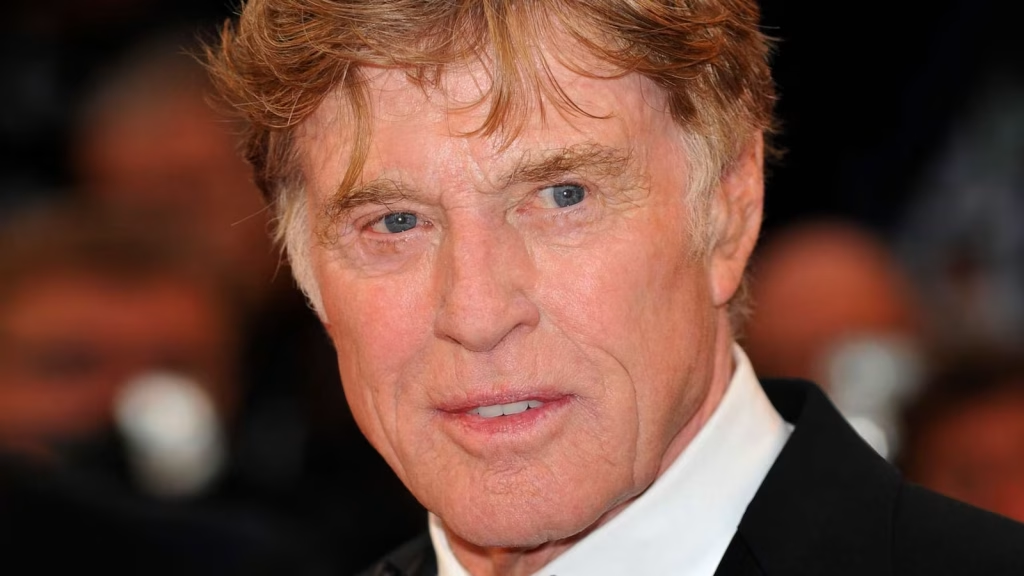
September 16, 2025. Sundance, Utah. Robert Redford died at 89 in the home he had been engineering since 1969, the mountain compound that gave a film festival its name and a generation of independent directors their first real shot at oxygen. Robert Redford net worth at the time of his death was $200 million, a figure that registered as both staggering and somehow modest given the reverence. That gap between what people thought he had and what he actually had is the whole story.
He was the last of a category that no longer renews itself. Blond, squint, slow charm. Paul Newman once called him the most beautiful man he had ever seen, and the line was a joke and not a joke. Redford turned a face into a brand and the brand into a film festival, then walked the festival back into the woods when it started smelling like vodka sponsorships.
The fortune is real. The films are louder. Sundance Institute, founded in 1981 with $300,000 of his own money, is the cultural capital that no Bezos check can buy and no hedge fund can replicate. Brad Pitt can carry a Tarantino. Pierce Brosnan can play Bond. Only one American actor of the postwar era built a parallel ecosystem for the films Hollywood would not greenlight, then watched that ecosystem birth Steven Soderbergh, Quentin Tarantino, and a thousand others. That is symbolic capital at industrial scale.
What follows is the architecture of a $200 million life. Eight defining films. One film festival. A long second marriage conducted entirely in private. And the very specific, very American story of a kid from Van Nuys who refused to play the studio game, and kept winning anyway.
The $200 Million Question
The headline number on Robert Redford net worth is $200 million. The texture is more interesting.
Redford peaked financially in the 1990s, when his per-film quote hit $11 million for The Last Castle and $4 million for Indecent Proposal. When Captain America: The Winter Soldier called him in 2014, his quote was reportedly closer to $4 million as Alexander Pierce. Smaller money than peers, but enough to lock his face into the Marvel pantheon for kids who had never seen Three Days of the Condor.
The actual fortune was built less in front of the camera than around it. When Rainbow Media bought the Sundance Channel in 2008 for $496 million, his 6 percent stake netted him roughly $29.76 million pretax. He sold the Sundance Catalog in 2002 after it had crossed $200 million in annual revenue. In 2020, he sold his stake in Sundance Resort itself to Broadreach Capital and Cedar Capital, framed publicly as legacy planning and privately as a sensible exit.
He took losses too. Sundance Cinemas, the planned theater chain meant to rival Landmark, collapsed in 2000 when his partner declared bankruptcy protection. Zoom, his Park City restaurant, closed in 2017. New York Times reporting after his death described a man who had spent down meaningfully on properties and on the Institute itself, which he subsidized for decades before it found donor footing.
The Redford economic logic ran like this: maximize the art, optimize for legacy, accept the fortune that follows. Most of his peers ran the inverse equation. Most of those peers also did not get a $496 million exit on a brand they founded with $300,000 of their own money.
From Van Nuys to The Sundance Kid
Charles Robert Redford Jr. was born August 18, 1936, in Santa Monica. The childhood was Van Nuys High School, a dead mother at 18, a year at the University of Colorado on a baseball scholarship that he drank his way out of. He bummed around Europe selling sketches in Paris and Florence, came home, enrolled at Pratt Institute to study painting, then pivoted to the American Academy of Dramatic Arts in 1959. The painter became an actor because the painting wasn’t paying.
His first credited screen role was the 1962 Korean War drama War Hunt, which paid $500. By 1963 he was on Broadway in Barefoot in the Park, the Neil Simon comedy that ran 1,530 performances and made him a name. The film version, opposite Jane Fonda, came in 1967. Hollywood had a leading man.
Then George Roy Hill cast him as the Sundance Kid in 1969, opposite Paul Newman. Redford reportedly fought for the role against Steve McQueen, Marlon Brando, and Warren Beatty. His salary was $750,000, equivalent to roughly $6.5 million in 2025 dollars. The film grossed $102 million worldwide on a $6 million budget. That character name, Sundance, would become the brand for the next 56 years.
The economic data point is the $750,000. The narrative data point is the brand transfer. Redford bought a piece of land in Provo Canyon, Utah, with the Butch Cassidy paycheck. He named it Sundance. He never sold it back to the studio system.
The Eight Films That Built The Brand
Redford made over 50 films across 60 years. Eight of them did the heavy lifting on the brand. These are the canonical anchors of the Robert Redford net worth story, the projects that converted a face into a fortune and the fortune into the Sundance Institute. Each one became its own gravitational field for the actors and directors who orbited it.
Butch Cassidy and the Sundance Kid (1969)
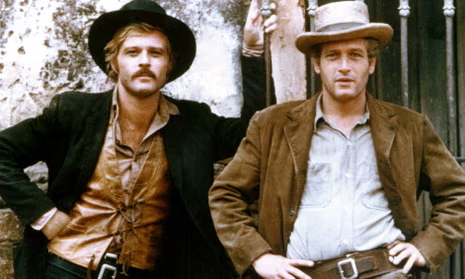
Hill directs Newman and Redford as outlaws on the run from the Pinkertons. Katharine Ross plays the schoolteacher between them. The film won four Oscars, including Best Original Screenplay (William Goldman) and Best Original Song (“Raindrops Keep Fallin’ on My Head”). It made Redford a $750,000 leading man. He bought Provo Canyon land with the paycheck and named it Sundance. The Newman partnership, sealed here, became the most photographed friendship in postwar Hollywood.
The Sting (1973)
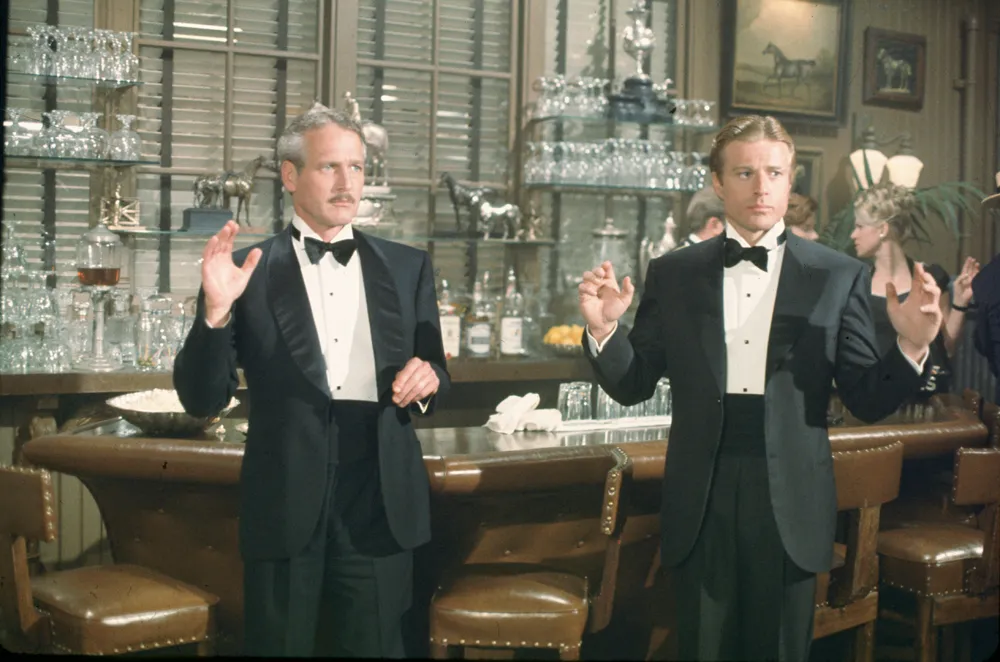
Newman and Redford reunited under George Roy Hill for the Depression-era con-man caper that won Best Picture, Best Director, and gave Redford his only acting Oscar nomination. Scott Joplin’s “The Entertainer” went platinum behind the closing credits. The film grossed $156 million on a $5.5 million budget, making it Universal’s highest-grossing release of the decade. Robert Shaw played Doyle Lonnegan. Eileen Brennan and Charles Durning rounded out a cast that has produced more “you remember that face” reactions in 2026 than any other Redford ensemble.
The Way We Were (1973)
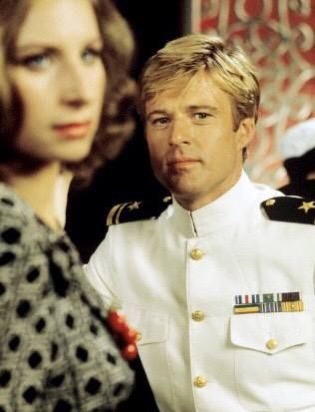
Sydney Pollack directs Redford and Barbra Streisand as a WASP novelist and a Jewish activist whose love survives Hollywood and the McCarthy era and not their own politics. The Marvin Hamlisch theme won Best Original Song and became the most-played wedding-reception ballad of the late 1970s. That pairing made Streisand a movie star and gave Redford his romantic-lead permanent file. For Redford, the role haunted his career trajectory in the way only an unrepeatable chemistry pairing can.
All the President’s Men (1976)
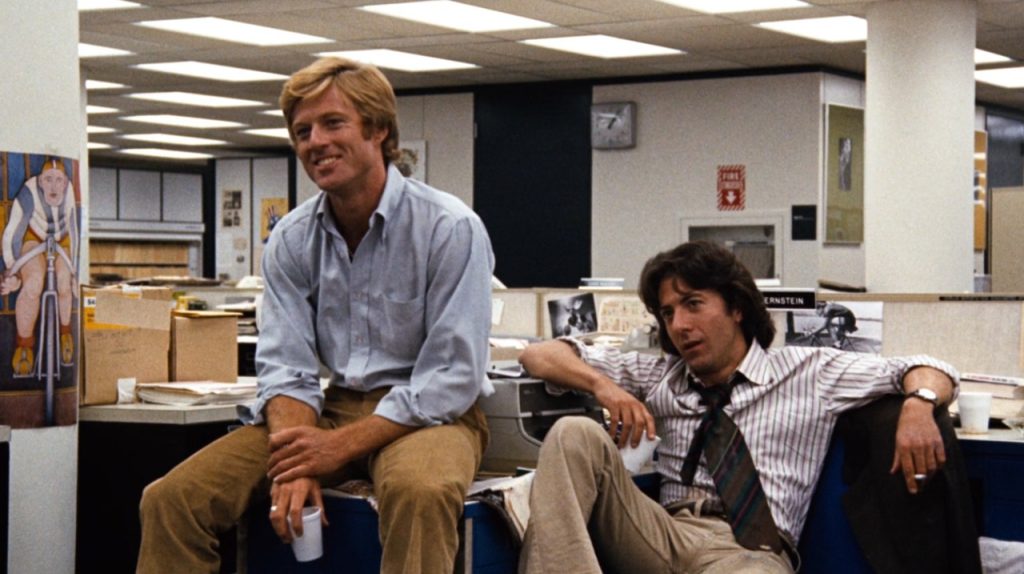
Alan J. Pakula directs Redford and Dustin Hoffman as Bob Woodward and Carl Bernstein, the Washington Post reporters who broke Watergate. Redford produced the film himself, optioning the book before Nixon resigned. The film won four Oscars, including Best Adapted Screenplay (William Goldman again). Jason Robards won Best Supporting Actor as Ben Bradlee. Jane Alexander earned a Best Supporting Actress nomination. The film turned investigative journalism into a Hollywood archetype that still runs the genre today.
Ordinary People (1980)
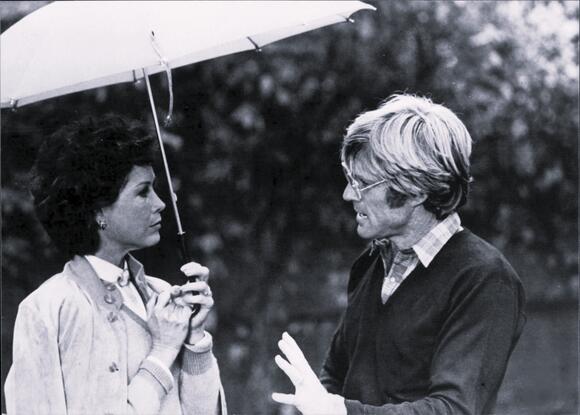
Redford’s directorial debut. Donald Sutherland, Mary Tyler Moore, Timothy Hutton, and Judd Hirsch unspool the Conrad family in Lake Forest, Illinois, after the eldest son drowns. The film won Best Picture, Best Director (Redford), Best Adapted Screenplay, and Best Supporting Actor (Hutton). It famously beat Raging Bull. The directorial career was launched on a single film, an outcome that reverses the usual order of operations in Hollywood and has not been repeated.
Out of Africa (1985)
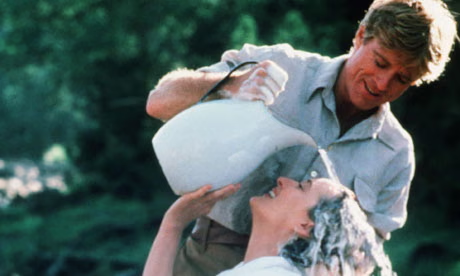
Pollack again. Redford as Denys Finch Hatton opposite Meryl Streep as Karen Blixen. The Kenya colonial romance won seven Oscars, including Best Picture and Best Director. It is the most expensive film Redford ever made and the only one in which he refused to use a British accent because he didn’t want to compete with Streep on her own terms. The Streep Empire, already a multi-spoke cluster, traces a clean line from this film forward.
A River Runs Through It (1992)
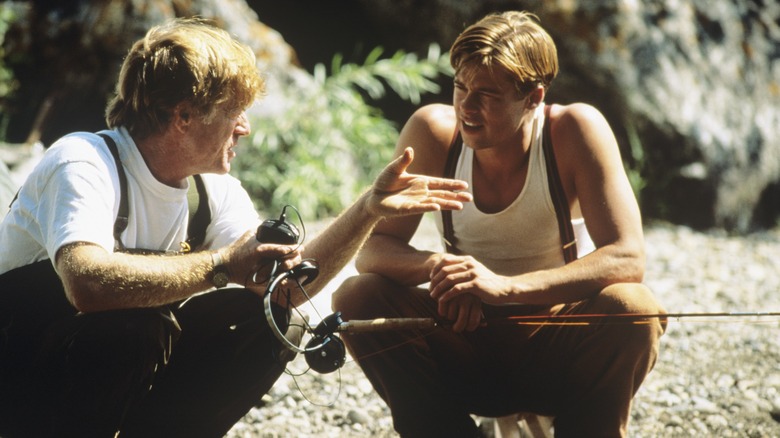
Redford directed and narrated Norman Maclean’s Montana fly-fishing memoir. He cast a 28-year-old Brad Pitt as the wild brother Paul, launching the next leading man in American cinema. The film won the Best Cinematography Oscar and grossed $66 million on a $12 million budget. Pitt later credited Redford with the career, on the record, multiple times. The Montana fly-fishing aesthetic that drives current Ralph Lauren and Brunello Cucinelli campaigns starts here.
The Horse Whisperer (1998)
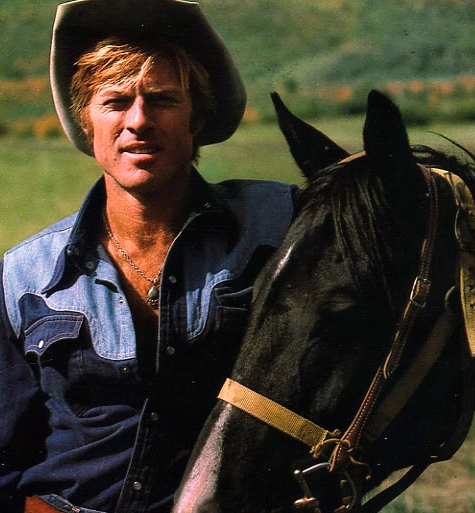
Redford produced, directed, and starred. Kristin Scott Thomas, Sam Neill, and a 14-year-old Scarlett Johansson in her breakout role. He demanded the production shoot on a working Montana ranch and that Johansson be paid a real adult-supporting-actress quote. The film grossed $187 million worldwide on a $60 million budget. It was the last time Redford commanded a $15 million quote. Johansson would, within fifteen years, command more.
The Sundance Engine
Redford founded the Sundance Institute in 1981 with $300,000 of his own money and a stretch of Provo Canyon. The first lab convened ten directors in summer 1981. By the late 1990s, Sundance had become the discovery system for American independent film, the place where Steven Soderbergh, Quentin Tarantino, Darren Aronofsky, Ryan Coogler, and Damien Chazelle found their first audiences.
The economics ran on a parallel track to Hollywood. Sundance Resort hosted skiers and writers’ workshops. The Sundance Catalog sold $200 million a year in artisanal goods at peak before he sold it in 2002. Sundance Channel reached 56 million homes before Rainbow Media wrote the $496 million check.
The Institute itself never paid Redford a salary. He covered shortfalls personally for years, a fact that did not appear in the public record until well after the Institute had stabilized. The cultural ROI was incalculable and largely uncashable, which is the entire point. Anyone who has built a private foundation knows the math. Anyone who has tried understands the patience.
What Redford understood that his peers did not: a film festival that finds a generation of new voices outlasts the films of the founder, even when the founder is the Sundance Kid himself. The Institute is the answer to the question of what a movie star does with the second half of a life. Most of them golf. He built a system.
Why The Sundance Math Outperformed The Studio Math
The standard movie star wealth-building playbook is straightforward. Take the quote. Take the back-end points when you can. Buy real estate in Malibu and Aspen. Endorse a watch. Wait for the IP-driven cameo at 70. Redford ran the inverse playbook.
The Bourdieu Move
He took the quote, yes. He bought real estate, yes. But the capital he optimized for was not economic. It was symbolic. The Sundance Institute traffics in cultural capital (the kind academics like Pierre Bourdieu spent careers measuring). It generates social capital, since every actor and director who has ever workshopped at the Lab owes the Institute a favor. And the prestige spillover protects the economic capital downstream. This is why $200 million at death, with significant late-career property sales and three failed business ventures, still reads as a triumph. The quote-and-real-estate movie stars from his era had higher liquidation numbers and lower cultural ones. Their estates will be carved up and forgotten by 2040. Sundance will be running its January festival in Park City (or its new home in Boulder, where it relocated in 2026) until the next century.
The Move That Cannot Be Replicated
It is the move that cannot be replicated by anyone whose primary capital is a Marvel contract. The window for building a Sundance closed somewhere around the financial crisis. The artists who could have founded their own equivalent (Tom Hanks, George Clooney, Reese Witherspoon, Brad Pitt with Plan B) chose other forms. None of them is now sitting on a 40-year cultural institution that prints filmmakers. The Robert Redford net worth conversation is, in the end, a measurement problem. The metric most people are using is the wrong metric.
The Properties, The Marriages, The Quiet
Redford married Lola Van Wagenen in 1958. They had four children. Their firstborn, Scott, died of SIDS at two and a half months. Their son James died of bile duct cancer in 2020 at 58. The marriage ended in 1985 after 27 years. He married German painter Sibylle Szaggars in 2009 at a Hamburg hotel, no press, no photographs released.
The properties read like the index of a discrete man. Sundance Resort in Provo Canyon went to Broadreach Capital and Cedar Capital in 2020. An 1820s farmhouse in Tiburon, California, sold for $7.5 million the same year. Pacific Palisades, Manhattan, Santa Fe, and Napa rounded out a portfolio he had spent 50 years assembling. Most of these were liquidated between 2018 and 2024, an estate-planning sequence the financial press read as deliberate preparation.
The discretion was total. He gave perhaps three on-the-record interviews about his second wife in 16 years of marriage. There were no red carpet appearances after 2018. From a desk in Utah, he executive-produced AMC’s Dark Winds through 2024 and otherwise stayed gone. Hollywood retirement is usually performative. Redford’s actually was retirement.
What The Last Real Movie Star Means
The category Redford occupied is now empty.
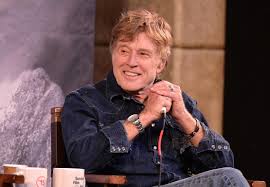
A real movie star, in the postwar American sense, was a person who could open a film without IP, without a franchise, without a previously branded character. The opening weekend was the face. Newman could do it. McQueen could do it. Streisand could do it. Redford did it for 30 straight years.
The economic reality that produced that category is gone. Marvel is the IP now. Streaming algorithms reward franchises and dispense with stars. The mid-budget adult drama, the genre Redford made his second act inside (Three Days of the Condor, Indecent Proposal, Out of Africa), is functionally extinct.
This is why $200 million understates the legacy and exactly captures the legacy at the same time. He could have multiplied the fortune. He chose Sundance instead. The Robert Redford net worth ledger reads small only if you ignore the cultural balance sheet running underneath it. His own quote, given to Esquire UK: when he started having enough success, he could start something like Sundance. It was non-profit. He was never going to benefit from it personally. But it would create opportunities for new filmmakers whose voices couldn’t otherwise be heard.
The fortune is the floor. Sundance is the ceiling. Eight films are the structure that held both up.
He was 89. He died at home. The light on the Wasatch had already started to change.
Where The Conversation Continues
For the medspa queens, the VC barons, the brand directors trying to figure out which Redford-coded prestige reference still hits in 2026: the answer is all of them. Out of Africa is still the reference for safari-luxe. A River Runs Through It is still the reference for the soft-masculine Montana aesthetic that is currently driving every menswear campaign from Ralph Lauren to Brunello Cucinelli. The Way We Were is still the reference every wedding planner reaches for when the bride wants something that reads as literary without being read.
Social Life Magazine has been writing about luxury legacy since 2003. Polo Hamptons sponsorships for July 18 and 25 in Bridgehampton are filling now. If your brand belongs in the Redford-coded universe (heritage, restraint, symbolic capital that doesn’t broadcast), the conversation about Polo Hamptons activation, magazine feature, or property partnership starts at sponsorships@sociallifemagazine.com.
The yacht has a finite manifest. Cabana sales are tracking ahead of last year. Categories already locked are auto (BMW), Hermès, and one real estate sponsor. The rest is open until it isn’t.
Author

Written by
Recent Posts
Beat the Summer Heat Safely: 5 Practical Styling Hacks for Boat Trips and Lake Days
First Date Outfit Ideas: Flattering and Budget-Friendly Dresses to Wear Tonight
Biomechanical Tattoo in LA: When Futuristic Body Art Becomes Personal Style
Choosing the Right Patio Door Style for Your Home’s Architecture
The Ultimate Guide to Hermès: How Buyers Compare Condition, Style, and Long-Term Value
Categories
- Art
- Articles
- Business of Luxury
- Celebrities
- Entertainment
- Events
- Faces of Summer 2026
- Fashion
- Fashion & Style
- Featured
- Finance
- Food, Spirits, Wine
- Hamptons
- Hamptons Celebrities
- Health
- Health & Beauty
- Lifestyle
- Luxury Lifestyle
- Press
- Profiles
- Real Estate
- Technology
- The Chronicles
- Travel
- Uncategorized
- Weddings