
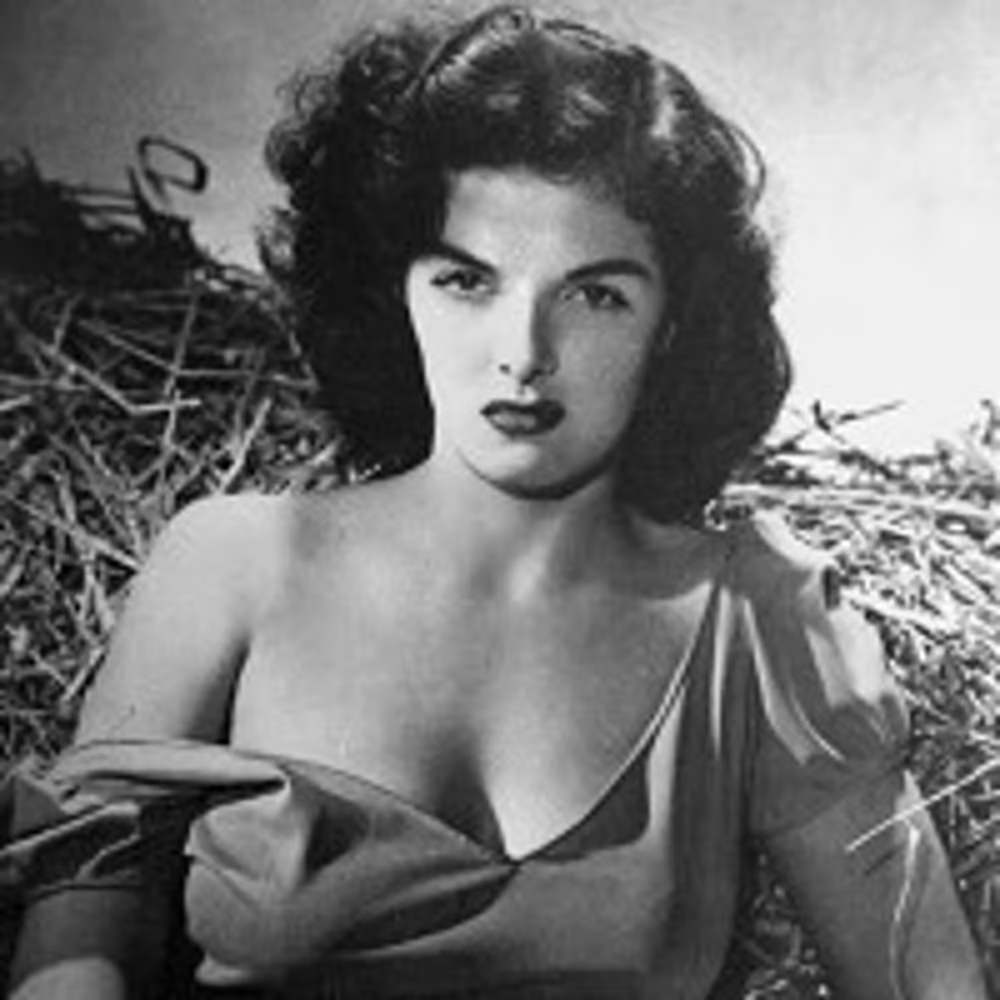
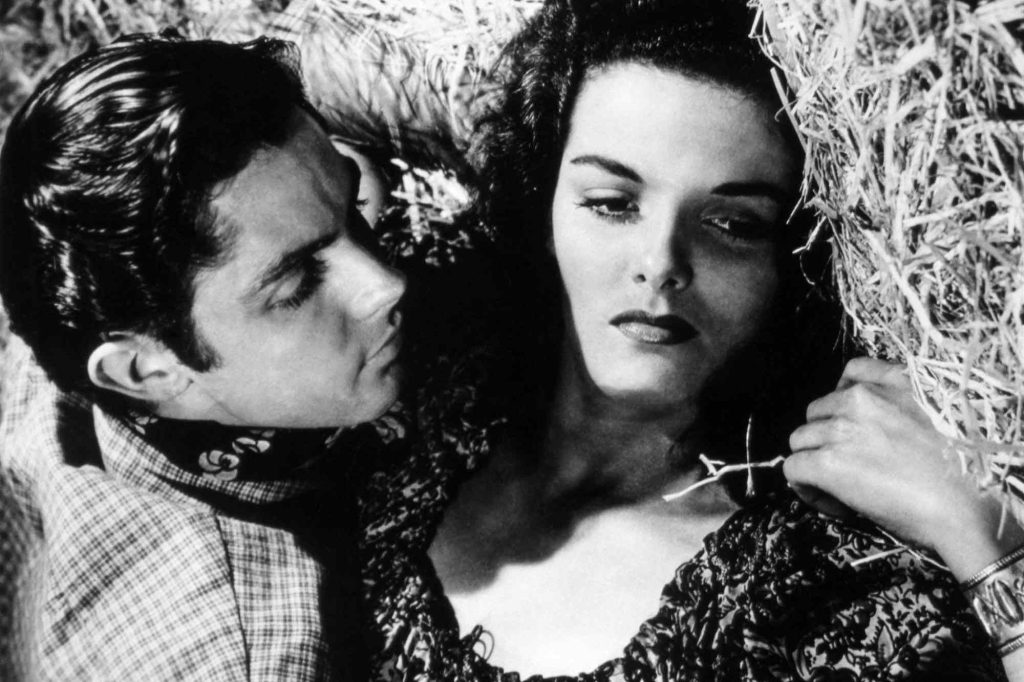
Howard Hughes paid $120,000 in 1941 to have aerospace engineers design a cantilevered bra for Jane Russell to wear in The Outlaw. He spent more on her underwear than he paid her for the film. That ratio explains everything about how Hollywood valued women in the studio era. Jane Russell net worth at her death on February 28, 2011 totaled approximately $12 million, modest by movie star standards but substantial relative to her generation of contract players. Russell earned $100,000 for Gentlemen Prefer Blondes (1953). Marilyn Monroe, her costar on the same picture, earned $18,000. Russell was the bigger star at the time. Monroe was the bigger star by the end of the premiere. As an entry in the Movie Star Legends cluster, Russell is the case study in symbolic capital that peaks during the lifetime and does not transfer to the estate. She survived the system. She did not transcend it.
Jane Russell Net Worth at a Glance
| Birth Name | Ernestine Jane Geraldine Russell (born June 21, 1921) |
|---|---|
| Net Worth | Approximately $12 million at death (February 28, 2011) |
| Primary Income Source | Howard Hughes contract 1940-1956 (varying terms); independent film salaries 1956-1970 ($200K to $500K per picture); WAIF royalties; San Fernando Valley real estate; Christian speaking engagements |
| Career Span | 1943 (The Outlaw) to 1970 (Darker than Amber); occasional appearances through 2003 |
| Key Credits | The Outlaw, Gentlemen Prefer Blondes, The French Line, Macao, His Kind of Woman, The Tall Men, Underwater |
| Notable Achievements | Founded World Adoption International Fund (WAIF) 1955; first celebrity to lobby Congress for international adoption reform; broke from Hughes contract 1956 |
| Residence at Death | Santa Maria, California (final years); Reno, Nevada (1960s residence); San Fernando Valley (peak career) |
Before the Money: Bemidji, The Drama School, And The First Hughes Contract
Ernestine Jane Geraldine Russell arrived June 21, 1921 in Bemidji, Minnesota, the oldest of five children. Her father Roy Russell worked as an office manager. Her mother Geraldine Russell had trained as an actress before marriage. The family moved to Los Angeles in 1929. Roy died unexpectedly in 1937 when Jane was 16, leaving Geraldine to support five children through Depression-era California. Jane worked as a receptionist at a chiropodist’s office during high school. She enrolled at Max Reinhardt’s Theatrical Workshop in Hollywood at 18.
Howard Hughes signed Russell to a seven-year personal-services contract in 1940 at $50 a week. She was 19 years old. Russell had not appeared in a single major production. Hughes had built a fortune from his father’s Hughes Tool Company and was running RKO Pictures plus Trans World Airlines simultaneously. He had a habit of personally contracting young actresses to long-term exclusive deals. The Russell contract gave Hughes total control over her career, her image, her schedule, and her romantic life for the next sixteen years. Terms like that were not unusual for the era. The duration was.
The Outlaw: $120,000 For The Bra, $50 A Week For The Star
How Howard Hughes Spent The Marketing Budget On Russell’s Body
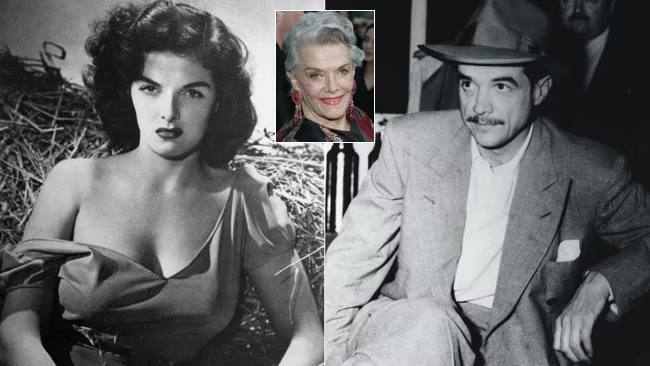
The Outlaw began production in 1940 with Howard Hawks as director. Hawks quit after creative disputes with Hughes. Hughes took over directing himself. Production stretched across 1941. Hughes spent an estimated $3.4 million on the film, a massive budget for the era. The expenditure included $120,000 to have aerospace engineers from his aircraft companies design a cantilevered underwire bra for Russell to wear in promotional photos and certain scenes. Russell later stated she never actually wore the engineered garment, finding it uncomfortable and unflattering. The mythology generated by the engineering project did more for the film’s box office than the film itself.
The Hays Office banned The Outlaw for two years over the costume controversy and the implied content. Limited release came in 1943, followed by a wider 1946 re-release that Hughes pushed through with political connections. The Outlaw grossed an estimated $20 million across all releases, returning roughly six times its production budget. Russell received her $50-a-week contract salary throughout. She earned approximately $2,600 a year from Hughes during the entire two-year production-and-release window. The bra cost roughly forty-six times what Russell earned for the same period.
Hughes positioned Russell as the next major Hollywood sex symbol while withholding her from competing productions. He refused to loan her out, even when MGM and Warner Bros. offered $250,000 per loan-out fee. Russell sat unused for years while her market value compounded. Hughes was running the most extractive contract Hollywood had ever seen. Russell knew it. She had no legal recourse until Olivia de Havilland’s 1944 ruling against Warner Bros. set the seven-year ceiling on personal-services contracts. By then Russell had already lost prime career years to the Hughes vault.
Gentlemen Prefer Blondes: $100K For Russell, $18K For Monroe
The Pay Gap That Defined The Studio System’s Final Decade
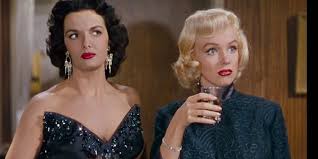
Twentieth Century Fox cast Russell as Dorothy Shaw opposite Monroe’s Lorelei Lee in Gentlemen Prefer Blondes (1953). Russell was on loan from RKO. Her salary for the picture: $100,000 cash plus a percentage participation that paid an additional $50,000 over the next two years. Monroe was on a Fox staff contract at $500 a week. Her total salary for the same picture came to approximately $18,000 in straight wages plus a wardrobe allowance. The pay gap was eleven-to-one.
The film grossed $5.3 million in 1953 against a $2.3 million budget. Russell and Monroe together captured roughly 2 percent of the gross between them. Fox booked the rest. Russell carried first billing in the contract because she was the bigger star at the time. Monroe stole the picture during production with the “Diamonds Are a Girl’s Best Friend” number. Russell later told interviewers Monroe was the most frightened person she ever met. The dynamic on set was older sister and younger sister, professional and ingenue. The dynamic at the box office was different. Monroe’s star eclipsed Russell’s within eighteen months of the film’s release.
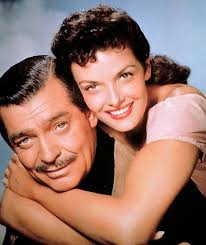
Russell continued working on RKO Hughes contracts through The French Line (1953), Underwater (1955), and Foxfire (1955). She finally broke from Hughes’ contract in 1956 after the seven-year ceiling allowed it. Independent picture deals through the late 1950s paid her $200,000 to $500,000 per film at peak. The Tall Men (1955) opposite Clark Gable was her most commercially successful late-career role. Russell invested aggressively in San Fernando Valley real estate during this period when land was cheap. The investments compounded over the next forty years and formed the foundation of her eventual estate.
WAIF: The Adoption Crusade As Cultural Capital Conversion
How A 1955 Lobbying Effort Outlasted The Film Career
Russell married NFL quarterback Bob Waterfield in 1943. Three miscarriages followed across the next decade. Russell and Waterfield adopted three children between 1952 and 1956: Tracy, Thomas, and Buck. The adoption process exposed Russell to American restrictions on international adoption and the broader bureaucratic infrastructure that kept war orphans in foreign institutions. She founded the World Adoption International Fund (WAIF) in 1955 specifically to address those barriers.
WAIF lobbied Congress for the Refugee Relief Act of 1953 amendments and helped draft the legislation that became the 1957 Refugee-Escapee Act. Russell personally testified before Senate subcommittees in 1957 and 1959. She raised an estimated $5 million for WAIF across her active years with the organization. The fund helped place approximately 51,000 international children with American adoptive families through the 1960s and 1970s. WAIF was the first celebrity-led international adoption advocacy organization in American history. Russell was the original template for what would become Audrey Hepburn’s UNICEF work and Elizabeth Taylor’s AIDS activism.
The WAIF work consumed Russell’s public identity more than any film role after 1960. She became known to a generation as the adoption-rights activist before they ever saw her on screen. Cultural capital generated by the cause did not convert into economic capital. Russell spent rather than earned on the WAIF mission. The trade was deliberate. She had concluded by the mid-1960s that her film career had peaked and her continuing brand value would compound through cause-related work. Compare to Elizabeth Taylor, who ran the same maneuver through White Diamonds plus AIDS activism. Russell ran the version without the fragrance line attached.
The Quiet Years: Reno, Santa Maria, And $12M At Death
Why The Estate Looks Modest Against The Posthumous Brand
Russell divorced Bob Waterfield in 1968 after 25 years. She married actor Roger Barrett in August 1968. Barrett died of a heart attack three months into the marriage. Russell married real estate broker John Calvin Peoples in 1974. Peoples died in 1999. Russell moved to Santa Maria, California after his death and lived quietly through her final decade. She continued to give talks at Christian conferences and conservative political events through the 2000s. She published a memoir titled My Path and My Detours in 1985.
Real estate investments compounded across the period. Russell had bought a Mediterranean-style home in the San Fernando Valley in 1948 for approximately $35,000. The property appreciated through the postwar Valley boom. She invested additional proceeds into Nevada and California rental properties during the 1960s and 1970s. Final estate appraisals at her February 28, 2011 death set the total at approximately $12 million. The figure was roughly seven times what Monroe died with in adjusted dollars, but a fraction of what Elizabeth Taylor and Audrey Hepburn accumulated.
Russell’s posthumous brand value is negligible compared to Monroe’s $13 million per year, Taylor’s $25 to 35 million per year, or Hepburn’s $8 to 10 million. The estate operates quietly through her family without major licensing campaigns. No fragrance line. No cosmetics partnership. Warhol painted no Jane Russell to sell for $195 million. Russell is the cluster’s control case: same era as Monroe, similar level of fame at peak, same studio system contract pressure, but without the mythology machine that makes posthumous licensing valuable. Survival is not the same as immortality. In the celebrity economy, immortality is where the real money lives.
How Jane Russell’s $12M Estate Compounded On Real Estate And Refusal
Stack the assets at death. San Fernando Valley primary residence: approximately $2 million in 2011 dollars. Rental real estate portfolio in California and Nevada: estimated $4 to 5 million. Personal property, memorabilia, and Hughes-era contracts archive: roughly $500,000 to $1 million across multiple lots. Investment portfolio in mutual funds and conservative equities: approximately $4 million. Cumulative film income across the active career: estimated $4 to 6 million in nominal dollars (roughly $50 million inflation-adjusted), of which Russell preserved a substantial percentage through disciplined spending. WAIF contributions consumed an estimated $5 million across her lifetime.
The estate compares cleanly to Russell’s contemporaries when you adjust for posthumous brand activity. Monroe died with $1.6 million but generates $13 million per year now. Russell died with $12 million and generates almost nothing posthumously. The accumulated wealth was real; the long-tail brand asset never materialized. Russell’s choice to retreat into Christian-conservative cultural work in the 1970s and 1980s further insulated the estate from the celebrity-licensing economy that grew through the 1990s and 2000s. She made decisions consistent with her values. The decisions worked while she was alive. The estate has not compounded the way her peers’ estates have because Russell never built the secondary licensing machine.
Where Jane Russell’s Money Stands Now
The Russell estate operates through her three adopted children and their families. WAIF was reorganized in the 1990s and merged into International Social Service-USA. Russell’s image-rights licensing happens occasionally through standard agency channels but generates modest annual revenue, estimated at less than $200,000 per year. The Santa Maria home was sold after her death. Her papers, photographs, and personal archive remained with family. Christian organizations and adoption-rights nonprofits continue to invoke her name in fundraising materials but do not pay royalties on the use.
Russell sits inside the Movie Star Legends cluster as the case study in symbolic capital that does not transfer. Marilyn Monroe burned bright and was consumed but became myth. Elizabeth Taylor accumulated aggressively and built an empire. Audrey Hepburn withdrew strategically and became an icon. Russell lived a full life, did meaningful work, and faded from the cultural register. Her net worth at death was roughly seven times Monroe’s adjusted, but her posthumous earning power runs roughly one-hundredth. The cluster needs this case to show what the alternative outcomes really look like. Cleverness about money during life is one strategy. Building a brand the world keeps borrowing forever is another. Russell mastered the first. She did not pursue the second.
Jane Russell Net Worth FAQ
What was Jane Russell’s net worth at death?
Jane Russell net worth at her death on February 28, 2011 totaled approximately $12 million. The estate included her San Fernando Valley residence, rental properties in California and Nevada, an investment portfolio, and personal property. Russell was modest in her spending and disciplined in her investing across a sixty-year career. Her estate compares to roughly seven times Marilyn Monroe’s at death in adjusted dollars but generates minimal posthumous licensing revenue compared to her Movie Star Legends cluster peers.
How much did Jane Russell earn for Gentlemen Prefer Blondes?
Russell earned $100,000 cash plus a percentage participation that paid an additional $50,000 over two years for Gentlemen Prefer Blondes (1953). Marilyn Monroe, her costar on the same picture, earned approximately $18,000 in straight Fox contract wages. The eleven-to-one pay gap reflected Russell’s RKO loan-out status versus Monroe’s Fox staff contract. The film grossed $5.3 million on a $2.3 million budget.
What was Howard Hughes’ contract with Jane Russell?
Howard Hughes signed Russell to a seven-year personal-services contract in 1940 at $50 a week. The contract gave Hughes total control over her career, image, schedule, and romantic life. The original deal extended through 1956. Hughes refused to loan her out even when major studios offered $250,000 per loan-out fee. Russell finally broke from the Hughes contract structure in 1956 after the de Havilland precedent established a seven-year ceiling on personal-services contracts.
What is WAIF and what did Jane Russell do for adoption?
Russell founded the World Adoption International Fund (WAIF) in 1955 after adopting three children herself. WAIF lobbied Congress for amendments to the Refugee Relief Act and helped draft the 1957 Refugee-Escapee Act legislation. Russell raised an estimated $5 million for WAIF across her active years and helped place approximately 51,000 international children with American adoptive families through the 1960s and 1970s. WAIF was the first celebrity-led international adoption advocacy organization in American history.
Where The Conversation Continues
Social Life Magazine covers the intersection of wealth, culture, and influence from the Hamptons to Manhattan. Our celebrity net worth coverage traces the economics, the leverage, and the decisions that built the fortune.
Our readers are family office principals, exit founders, fashion executives, and the advisors who serve them. For premium editorial placement and integrated advertising across print and digital, submit a paid feature or contact our business development team.
Want insider access to the events, launches, and gatherings that define the Hamptons social calendar? Sign up for Event Invites & Specials and never miss a moment.
Social Life Magazine. Twenty-three years of covering the people and places that define luxury in America.
Author

Written by
Recent Posts

Jetsetter Style: Castello del Sole

The First Decision After a Collision Can Be the Most Important One
Two Weeks in Rome and Beyond: Turkish Airlines Itineraries from Boston, Chicago and Onward to India

Top 10 Hair Transplant Clinics in Turkey 2026

Artist Alley to Online Store: How Convention Artists Can Keep Selling After the Event
Categories
- Art
- Articles
- Business of Luxury
- Celebrities
- Culture
- Entertainment
- Events
- Faces of Summer 2026
- Fashion
- Fashion & Style
- Featured
- Finance
- Food, Spirits, Wine
- Hamptons
- Hamptons Celebrities
- Health
- Health & Beauty
- Lifestyle
- Luxury Lifestyle
- Press
- Profiles
- Real Estate
- Technology
- The Chronicles
- Travel
- Uncategorized
- Weddings