
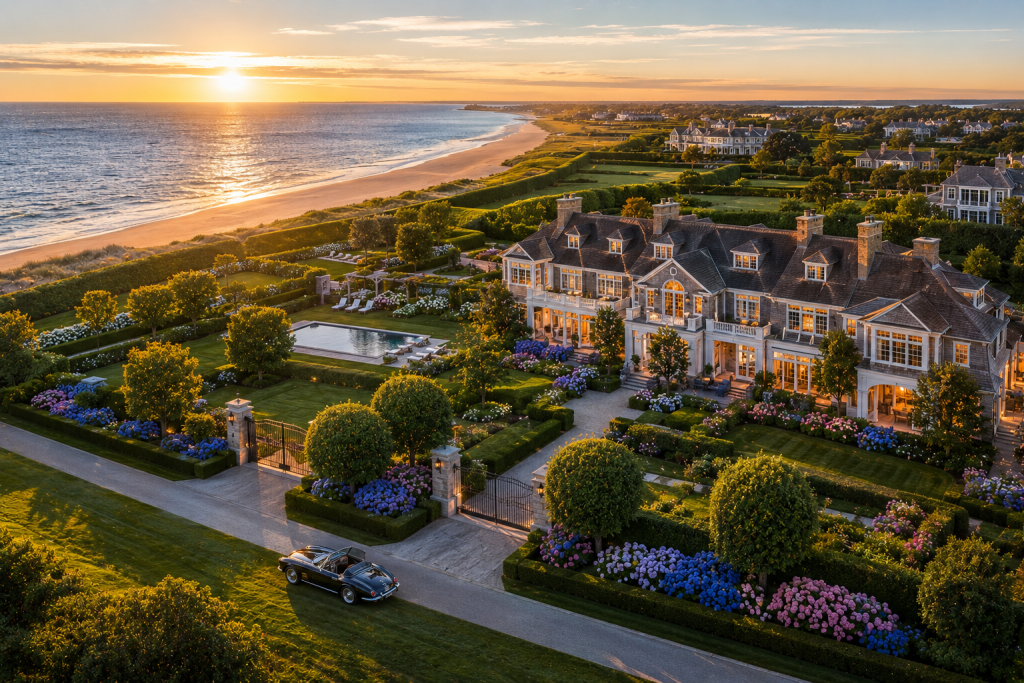
The Zip Code That Costs More Than Most Careers
Sagaponack is a village of approximately 450 year-round residents, one operational schoolhouse, no commercial district, and a median home sale price that has ranked among the three most expensive zip codes in the United States for over a decade. In 2025, PropertyShark placed 11962 at number three nationally, just below Atherton, California, with a median sale price approaching $6 million. Zillow’s home value index pegs the average at $5.96 million. Redfin reported a $7.5 million median in mid-2025. Depending on which dataset you trust, Sagaponack is either the second or third most expensive zip code in America and the most expensive in New York State for ten consecutive years.
None of that tells you what Sagaponack actually is. Numbers describe a market. They do not describe a place where potato fields still grow next to $15 million estates, where a one-room schoolhouse educates children through third grade, and where the agricultural reserve overlay that protects farmland from development paradoxically increases the value of everything adjacent to it. Understanding Sagaponack requires understanding that contradiction.
Where Sagaponack Sits
Technically, Sagaponack is within the Town of Southampton. Culturally, it belongs to Bridgehampton. The village incorporated in 2005, when residents voted to separate from the surrounding township. Before that, it was a hamlet known simply as Sagg, a name still reflected in Sagg Main Street, Sagg Main Beach, and Sagg Pond. The Shinnecock described the area as “the land of the big ground nuts,” which meant potatoes. For three centuries, that description was literal. Potatoes grew here. Farmers worked the fields. Polish families met at 5 a.m. at the Candy Kitchen in Bridgehampton before heading to the rows.
Now the potato fields are either estates, agricultural reserves, or the 55 sustainably farmed acres of Wolffer Estate Vineyard. What remained consistent is the soil: Bridgehampton loam, the same earth that grew potatoes for two centuries and now grows Merlot, Chardonnay, and Cabernet Franc at a quality level that critics have compared to Bordeaux.
The Agricultural Reserve Paradox
Many acres of Sagaponack’s original potato farms are protected as agricultural reserves. These overlays prevent development, maintaining the field views and open landscape that define the village. A preserved 23-acre reserve, for example, sits adjacent to oceanfront estates on Sagg Pond Court, providing unobstructed views across open land to the water.
How Protection Increases Value
Here is the paradox: the same regulation that prevents development makes the existing properties more valuable. If you buy a $13 million house on two acres in Sagaponack, the agricultural reserve next door guarantees that nobody will ever build a spec mansion within your sightline. You are not paying for your land alone. You are paying for the permanent emptiness beside it.
The Tribeca hedge fund founder understood this immediately. His real estate broker, a woman who wears Hermes scarves to closings and drives a black G-Wagon, explained the overlay on their second visit. By the third visit, he had made an offer. He is paying for the view, the privacy, and the assurance that the field will still be a field in 2050. His neighbors are doing the same math. Nobody in Sagaponack buys land without buying the absence of what will never be built next to it.
This dynamic explains why Sagaponack consistently outprices nearby Bridgehampton ($3.05 million median) and even Water Mill ($5.5 million), despite having no restaurants, no shops, and no commercial activity. Sagaponack sells negative space. In a region where every other village is filling in, Sagaponack charges a premium for staying empty.
The Little Red Schoolhouse: Tuition Is Free, Admission Costs $6 Million
Sagaponack School, known locally as the Little Red Schoolhouse, is one of the few remaining public one-room schoolhouses in the country. It educates children from Pre-K through third grade with a student-teacher ratio that private schools in Manhattan charge $60,000 a year to approximate. Curriculum meets New York State standards. Class sizes are intimate. Multiple grade levels share the same room, which means a kindergartner learns beside a third-grader, which is either a pedagogical innovation or the oldest educational model in America, depending on your framing.
The Real Entrance Exam
Tuition is free (it is a public school). Admission requires living in Sagaponack. Living in Sagaponack requires buying or renting at a price point that begins around $2 million and climbs quickly past $10 million. The Little Red Schoolhouse is, in practice, the most exclusive elementary school on the East End, and the entrance exam is a closing statement.
The Park Avenue couple moved to Sagaponack when their daughter turned four. He runs a family office from a glass-walled study overlooking the reserve. She left a VP role at a fashion house to raise their children and run a ceramics studio from the barn. Their daughter walks to school. Walks. In New York, their friends spend $55,000 a year on kindergarten and sit in traffic for forty-five minutes each way. In Sagaponack, the school is three hundred yards from their front door. This is the arbitrage that nobody talks about: the most expensive zip code in New York has the cheapest elite education, and the only people who can access it are the ones who can afford the zip code.
Sagg Main Beach: The Sand That Sorts
Sagg Main Beach sits at the end of Sagg Main Street. Dunes run high. Crowds stay thin. Parking requires a Southampton Town resident permit, which functions as a soft velvet rope. Unlike Cooper’s Beach in Southampton (ranked among the best in the country, accessible with a $50 daily parking fee), Sagg Main filters by residency rather than willingness to pay.
Morning at the Dunes
The beach approach is one of the most dramatic on the South Fork. You park in a small lot, walk a sandy path through high dunes, and emerge onto a wide Atlantic beach that extends in both directions with almost nobody on it. In July. On a Saturday. This is the privilege that the $6 million median buys: a beach experience that feels private without technically being private.
The West Village art advisor who bought a cottage on Sagg Main Street in 2019 for $2.8 million walks to this beach every morning. She has watched her equity grow by 60 percent without lifting a paintbrush. Afternoons, she works from the porch. Evenings, she hosts dinner parties at which the only acceptable conversation topic is which Dia Bridgehampton exhibition is currently worth seeing. Her social currency is not money (everyone in Sagaponack has money). It is proximity to the beach and the willingness to live here year-round, which most of her neighbors do not.
Wolffer Estate: The Vineyard on the Potato Farm
At 139 Sagg Road sits the single most important conversion story in Sagaponack. Christian Wolffer, born in Hamburg, bought a potato farm in 1988 and planted 55 acres of vines. The soil was Bridgehampton loam. Atlantic breezes from 2.6 miles away provided a maritime microclimate. Winemaker Roman Roth has been crafting the wines for three decades. Today, Wolffer produces over 50,000 cases annually and Summer in a Bottle rose accounts for over 70 percent of production.
Horses and Wine on the Same Parcel
The 175-acre estate also includes boarding stables, 30 paddocks, an indoor jumping ring, and a Grand Prix field. Horses and wine, on former potato fields. This is the Sagaponack story compressed into a single address: agricultural land converted into cultural capital without losing the agricultural character.
The Wine Stand on Montauk Highway (3312 Montauk Highway, technically in Sagaponack) draws the pre-dinner crowd every summer evening. Walk-in pours of Summer in a Bottle rose, charcuterie boards, sunset views across the vines. Bottles start at $34. The Cobble Hill couple who rented a house on Parsonage Lane for two weeks last July went to the Wine Stand on their first Friday and returned six times. By their second week, they were calling a broker.
Who Buys in Sagaponack: The NYC Decoder
The Greenwich Street Family Office
He manages $400 million and bought on Fairfield Pond Lane for $10.5 million. Nine bedrooms. Eleven bathrooms. South of the highway with reserve views. His calculus: the house is where he hosts LPs for the annual summer meeting, which replaced the annual winter dinner at a Midtown steakhouse because nobody wants to put on a suit in February anymore. The house pays for itself in relationships maintained. His accountant disagrees. His returns support his position.
The Dumbo Creative Director Who Bought Early
She bought a three-bedroom cottage north of the highway in 2017 for $1.8 million. Market value today: approximately $2.9 million. She works remotely from May through October, walks to the general store, bikes to Wolffer, and drives to Almond on Wednesdays. Her Sagaponack is not the Sagaponack of the $10 million estates. It is the Sagaponack of the cottage, the garden, and the quiet. Both Sagaponacks exist simultaneously, separated by the highway and about $8 million.
The Upper East Side Downsizer
Sold the five-bedroom on Park Avenue for $7.2 million. Bought in Sagaponack for $6.8 million. Net difference: $400,000 in the pocket and a complete lifestyle inversion. In Manhattan, she had a doorman, a dry cleaner on the corner, and three restaurants within a block. In Sagaponack, she has a field, a beach, and a ten-minute drive to Bobby Van’s. She considers this an upgrade. Her children, who are in their thirties and live in Brooklyn, consider it a crisis. She does not care. For the first time since 1994, she can see the sky from her bedroom window without craning her neck.
The Price Architecture: What $6 Million Looks Like
Sagaponack’s market sorts into three tiers.
Under $4 Million: The Entry Point
Cottages and older homes north of the highway. Two to three bedrooms. Modest lots by Sagaponack standards. Buyers tend to be creatives, remote workers, and year-round residents who bought before 2020 and are holding. New inventory at this price point is essentially nonexistent. When something lists under $4 million, it moves fast.
$4 Million to $10 Million: The Core Market
Renovated or newer construction. Four to six bedrooms. Pools. Reserve views. South of the highway if you’re lucky. This is where the median sits. Buyers are typically finance professionals, founders who have had a liquidity event, and Manhattan families making the full-time move. Properties at this tier spend an average of 40 days on market before going under contract.
Above $10 Million: The Trophy Tier
Compounds. Multi-acre parcels. Oceanfront or reserve-adjacent. Nine bedrooms, eleven bathrooms, 10,000 square feet. Listings at $25 million and $34.95 million have appeared in recent years. Peter Brant’s estate anchors the top of the market. Buyers at this level are not comparing Sagaponack to other Hamptons villages. They are comparing Sagaponack to Aspen, Palm Beach, and the Cote d’Azur. The decision often comes down to summer proximity to New York.
The Two Sagaponacks: Summer Money and Year-Round Quiet
From Memorial Day through Labor Day, Sagaponack operates as an extension of Manhattan’s wealth infrastructure. Family offices hold meetings on Fairfield Pond Lane. Porsche Cayennes line Sagg Road on the way to Wolffer. The Wine Stand buzzes. Real estate brokers in linen blazers drive clients through the village at 15 miles per hour, pointing at hedgerows and quoting price-per-acre figures that would make a Midtown developer choke.
September Through May
After Labor Day, the village empties. Sagg Main Beach is yours alone. Wolffer’s tasting room stays open but reservations are unnecessary. The Little Red Schoolhouse runs its full academic year to a student body that could fit in a large living room. Year-round residents, roughly 450 of them, know each other by first name. They share a volunteer fire department with Bridgehampton. Community board meetings draw perhaps twelve people. This is not the Hamptons that magazines photograph. This is the Hamptons that actually lives here when the cameras leave.
She bought here in 2016 when nobody she knew could find Sagaponack on a map. A former documentary filmmaker from the West Village, she converted the barn behind her cottage into an editing studio. In winter, she walks the beach at 7 a.m. and sees no footprints. Her Manhattan friends visit in July and ask how she survives the isolation. She does not experience isolation. She experiences a two-mile stretch of Atlantic coastline that belongs to her and the plovers. Survival is not the word she would use. Privilege is closer.
The Art World Connection
Peter Brant’s presence in Sagaponack connects the village to a network that extends from the polo field to the auction house. Publisher of Interview magazine, collector of Warhol and Basquiat, founder of the Brant Foundation Art Study Center in Greenwich, Connecticut, Brant operates at the intersection of media, art, and equestrian sport. His Sagaponack estate anchors the trophy tier of the market. His Bridgehampton Polo Club at Two Trees Farm brought Mercedes-Benz sponsorship and international attention to the area for fifteen years.
Studios on Hayground Road
Along Hayground Road, which connects Sagaponack to Bridgehampton, artists’ studios and small galleries cluster in converted barns and agricultural buildings. Dan Flavin lived in nearby Wainscott and chose to place his permanent installation at Dia Bridgehampton, five minutes north. The proximity is not accidental. Sagaponack’s landscape, with its flat fields and dramatic light, has attracted painters, sculptors, and photographers since the abstract expressionists discovered the East End in the 1950s.
The NoHo gallery director who rents on Hayground Road every summer understands this geography. Her artists sell to the collectors who live on Fairfield Pond Lane. The collectors attend Polo Hamptons in July, where the gallery director photographs every match while telling everyone she finds polo derivative. By August, she has converted three casual conversations into studio visits. By September, she has closed two sales. Sagaponack is small enough that proximity does the work that networking events attempt and usually fail to accomplish.
Sagaponack vs. the Rest of the South Fork
Water Mill (11976), immediately west, posted a $5.5 million median in 2025, making it the second most expensive zip code in the Northeast. Bridgehampton (11932) sits at $3.05 million. Wainscott (11975) came in at $4.5 million. Together, this corridor represents the most expensive residential real estate concentration outside of California in the United States.
Why Sagaponack Wins
Bridgehampton has the restaurants, the events, and the Main Street. Southampton has the institutions, the beach clubs, and the social hierarchy. Sag Harbor has the harbor, the theater, and the literary credibility. Sagaponack has none of these things and charges more than all of them. What Sagaponack sells is subtraction. Zero commercial district. No nightlife. Not a single sidewalk. Silence is the product. The price premium is for the absence of everything that makes other villages vibrant. In Sagaponack, vibrancy is what you drive to. Quiet is what you pay for.
For a comprehensive look at how Hamptons real estate works across the South Fork, see our 2026 real estate guide and power rankings.
Where the Conversation Continues
Social Life Magazine has covered Hamptons real estate for 23 years. Five summer issues, 25,000 copies each, distributed from Westhampton to Montauk. Fall and winter issues reach 15,000 Upper East Side doorman buildings. We are in the restaurants, the hotels, the beach clubs, and the events that define the East End.
If your brand serves the Sagaponack audience (luxury real estate, interior design, landscape architecture, wealth management, or fine art), editorial positioning in Social Life Magazine puts you in front of the buyers, brokers, and builders who shape this market. Submit a Paid Feature here.
Polo Hamptons 2026 runs July 18 and July 25 at 900 Lumber Lane in Bridgehampton, five minutes from Sagaponack. BMW North America is title sponsor. Christie Brinkley hosts. Cabanas, VIP tables, and sponsorship packages at polohamptons.com.
Subscribe to Social Life Magazine here.
Sagaponack is the most expensive zip code in New York because it sells the one thing that cannot be manufactured in Manhattan: permanent, protected, guaranteed emptiness. The field next to your house will be a field next summer. And the summer after that. And every summer after that. In a region defined by constant reinvention, Sagaponack charges a premium for staying exactly the same.
Related Reading
- Bridgehampton: The Village That Turned Farmland Into a Stage
- Polo Hamptons 2026: The Field Where Manhattan Sorts Itself Out
- Best Restaurants in Bridgehampton 2026
- Bridgehampton Real Estate: The Farm-to-Fortune Market
- Bridgehampton Wineries and the East End Wine Trail
- Hamptons Real Estate Guide 2026
- Hamptons Real Estate Power Rankings 2026
- Gin Lane and Meadow Lane Southampton
- Southampton Village Dossier
- Sag Harbor Village Dossier
Author

Written by
Recent Posts
Getting the Size Right on a Valley Dreams Zip Hoodie
The Traffic Patterns Hiding Inside the Accident Data
The Smart Way to Give Your Unused Jewelry a Second Life

Katsuya Brentwood and Haute Living Honor NBA Star Kawhi Leonard at Private Dinner

The Accountability System Quietly Protecting Your Parents’ Care
Categories
- Art
- Articles
- Business of Luxury
- Celebrities
- Culture
- Entertainment
- Events
- Faces of Summer 2026
- Fashion
- Fashion & Style
- Featured
- Finance
- Food, Spirits, Wine
- Hamptons
- Hamptons Celebrities
- Health
- Health & Beauty
- Lifestyle
- Luxury Lifestyle
- Press
- Profiles
- Real Estate
- Technology
- The Chronicles
- Travel
- Uncategorized
- Weddings