
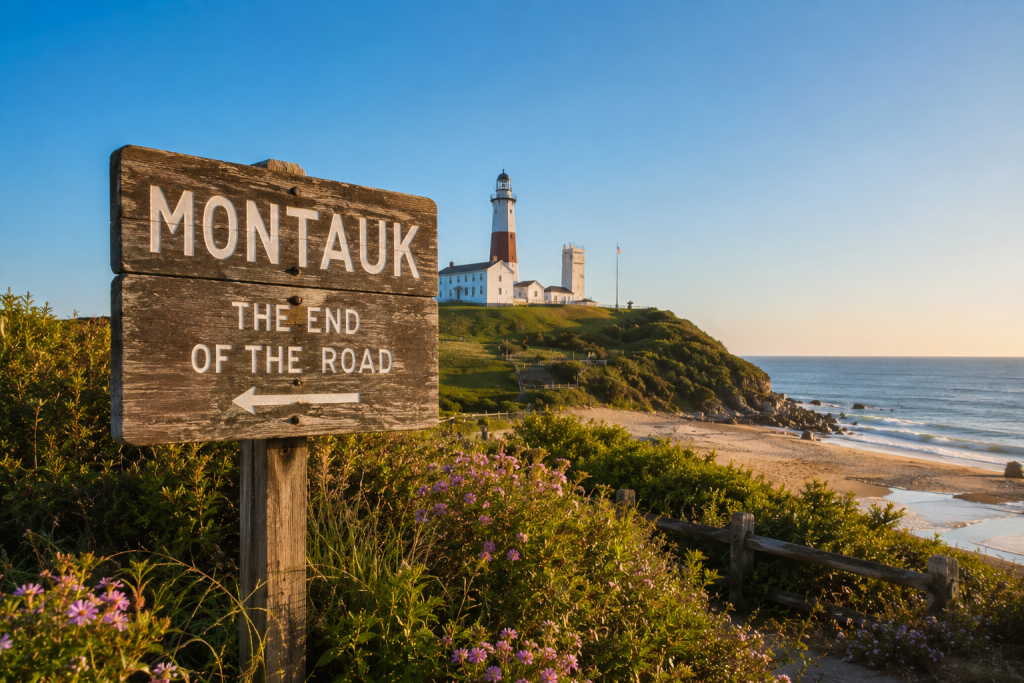
Montauk is where the road stops asking questions. Route 27 narrows past Napeague, crosses the sand bridge that technically makes this a barrier island, and deposits you at a place locals have called “the End” since before the phrase carried any metaphorical weight. They mean it literally. Pavement runs out. The lighthouse blinks. Atlantic water wraps around three sides of a peninsula that has been here since the last glacier retreated 10,000 years ago, and the Montaukett people who named it were here for most of that.
In fact, every major chapter of American ambition has left a mark here. George Washington commissioned the lighthouse in 1792. Carl Fisher tried to build Miami Beach on these bluffs in 1927. Andy Warhol bought a compound on the cliffs in 1971 and invited the Rolling Stones. Meanwhile, the military disguised an Air Force base as a fishing village and pointed a Cold War radar tower at the Soviet Union. Surfers colonized a stretch of beach called Ditch Plains in the 1960s and never left. None of these stories resolved. Yet all of them coexist in a hamlet of 3,500 year-round residents that swells past 30,000 every summer, where a $98 lobster cobb salad at Duryea’s and a $4 breakfast burrito from the Ditch Witch food truck exist three blocks apart.
This is Chapter 5 of The Modern Culture Hamptons Bible, and it is the last. Sag Harbor was the harbor that made powerful people quiet down. Southampton was the hedgerow that wrote the rules. Bridgehampton was the field that became a stage. Amagansett was the good water that refused to choose sides. Montauk is the end. And at the end, everyone stops pretending.
Thursday: The Arrival Nobody Rehearses
She is thirty-four and runs content strategy for a DTC skincare brand that just closed a Series B at a $120 million valuation. Her apartment is a one-bedroom in Fort Greene with a lease renewal she cannot think about right now. She left the BQE at 3:47 p.m. on a Thursday because her therapist told her to stop performing productivity. She has never been east of Amagansett. Montauk is, in her mind, “the one with the lighthouse.” She will learn that it is significantly more complicated than that. She will also learn that the Ditch Witch closes at 2 p.m.
The drive past Napeague is the part nobody warns you about. For roughly two miles, Long Island becomes a sandbar. Dunes on both sides. No houses, no hedgerows. No restaurants except the Clam Bar, which sits at the Amagansett border like a checkpoint. After that, the elevation drops, the vegetation shifts from manicured to wild, and you are in Montauk. There is no grand entrance. The village just begins.
What registers first is scale. Southampton has the hedgerows and the setbacks, the architecture of concealment. Sag Harbor has the harbor and the steeples, the architecture of community performance. Montauk has the sky. Specifically, the sky at 6 p.m. in July, when the sun makes Fort Pond Bay look like a Rothko painting that a FiDi quant making $1.2 million in total comp would buy at auction. He does not understand color. But he understands Montauk, which is why he books Navy Beach every Thursday for twelve consecutive weeks and shows up alone for nine of them.
Before the Road: The Montaukett and the Lighthouse
Every Hamptons village has a founding mythology. Southampton’s involves English settlers from Massachusetts in 1640 who chose the right side of a pond. Sag Harbor involves whaling captains who built Greek Revival mansions with their whale oil money. Bridgehampton’s involves potato farms that became polo fields. Montauk’s founding mythology predates all of them by several thousand years, and nobody talks about it at dinner.
The Montaukett people were part of a confederation of four Long Island tribes. Linked by blood (the chiefs were brothers who inherited authority from their father), these tribes sustained themselves through fishing, farming, and a relationship to the land that European settlement would systematically dismantle. Chief Wyandanch, who governed during the mid-1600s, brokered alliances with English settlers that temporarily preserved Montaukett sovereignty. Yet the arrangements did not hold. By the early 1900s, a fraudulent land sale and court decisions stripped the Montaukett of official recognition. The New York State courts declared the tribe “extinct” in 1910, although the Montaukett Nation has contested that ruling for over a century. They remain here. The land remembers even when the courts pretend to forget.
Washington’s Promise, Jefferson’s Signature
In 1792, Congress authorized a lighthouse at the eastern tip of Long Island. George Washington approved the expenditure. Thomas Jefferson signed the authorization. The lighthouse was completed in 1796. It is the oldest in New York State and the fourth oldest in the nation. Washington reportedly promised it would stand for 200 years. Of course, he was wrong by at least 30 and counting. The Montauk Point Lighthouse has survived 228 years of nor’easters, hurricanes, erosion, and a $44 million Army Corps of Engineers coastal resiliency project completed in 2023 that reinforced the bluffs with a stone revetment designed to buy another century.
Stand at the base and you are standing where Montaukett signal fires once guided canoes home. You are standing near where the Amistad came ashore. Where soldiers watched for German U-boats. Where Cold War radar operators tracked Soviet bombers. The lighthouse is 110 feet of sandstone defiance, and the view from the top is the only place in the Hamptons where you can see Connecticut, Rhode Island, and the full sweep of the Atlantic simultaneously. It costs $14 for adults. The parking is $8. The lesson is free: everything else on the East End is temporary. This building predates every institution in every other village.
The Man Who Tried to Build Miami Beach on the Bluffs
Carl Fisher was born in Indiana in 1874 and made his first fortune from a patent on sealed automobile headlights. After co-founding the Indianapolis Motor Speedway, he championed the Lincoln Highway. He turned a mangrove swamp into Miami Beach, the single most successful real estate development in American history. By 1925, he was worth somewhere between $50 million and $100 million (roughly $900 million to $1.8 billion today). Then a hurricane flattened Miami Beach in 1926, and Fisher needed a Plan B.
Ten Thousand Acres and a Slogan
Plan B was Montauk. Fisher bought approximately 10,000 acres at the tip of Long Island for $2.5 million (about $315 million today) and announced the slogan: “Miami Beach in the winter, Montauk Point in the summer.” Between 1925 and 1927, he hired 800 laborers and built everything simultaneously. The 200-room Montauk Manor hotel (Tudor Revival, on a hilltop, still standing and now a condominium). The Montauk Yacht Club on Star Island. A polo field. A golf course (now Montauk Downs State Park). Indoor and outdoor tennis courts. A Grand Prix race track. A boardwalk with cabanas and an Olympic-size pool. Most dramatically, he dynamited an inlet to connect the freshwater lake to Block Island Sound. Previously called Lake Wyandanch, it had been the largest freshwater body on Long Island. After the blast, it became the harbor that now houses the largest commercial and recreational fishing fleet in New York State.
Fisher also built the seven-story office tower downtown that was, at the time, the tallest building on Long Island. In addition, he built roads, churches, shops, employee housing, a school, and his own residence at 44 Foxboro Road. That house is now the Carl Fisher House. The Town of East Hampton purchased it in 2021 for $5.5 million in community preservation funds. He built Montauk. And then the stock market crashed in 1929. The Great Depression annihilated his holdings. His wife divorced him. Alcoholism consumed what remained. He died in 1939 in a Miami Beach hospital room with roughly $40,000 to his name. Structures remain. The vision evaporated. But the lesson is the same one Montauk always teaches: the land outlasts the ambition.
Eothen: Warhol, the Stones, and the 1970s Revolution
The compound sits on sixteen acres of oceanfront cliff at the absolute eastern edge of Long Island. Five white clapboard cottages built in 1931 for the Church family, heirs to the Arm & Hammer fortune. Andy Warhol and Paul Morrissey bought it in 1971 for $225,000. They named it Eothen, ancient Greek for “at first light.” By the time Warhol died in 1987, the guest list read like a fever dream: Jackie Kennedy, Lee Radziwill, Mick Jagger, John Lennon, Elizabeth Taylor, Liza Minnelli, Halston, Catherine Deneuve, Truman Capote, Keith Haring, Peter Beard. The fish market in town did not care. It remained a fish market.
Warhol put Montauk on the cultural map, though “map” is generous. In essence, he created a parallel universe at the tip of Long Island where Manhattan celebrity rules dissolved into salt air. The compound operated on discretion. As a result, famous guests could relax knowing the nearest tabloid photographer was 120 miles west. Warhol created his “Sunset” print series from the view off the bluffs. He also photographed Mick Jagger’s hips for the Sticky Fingers album cover. During that first summer, he rented the main house to Princess Caroline and Lee Radziwill, establishing a precedent of loaning out the property to people whose presence elevated the mythology.
The Rolling Stones Spring of 1975
In the spring of 1975, the Rolling Stones rented Eothen for $5,000 while preparing for their Black and Blue tour. Charlie Watts, Mick Jagger, Keith Richards, Ronnie Wood, and Bill Wyman rehearsed in the main house. As Warhol later wrote: “Mick Jagger really put Montauk on the map. All the motels were overflowing with groupies. When Mick went into town everything stopped. Surfers chased him from White’s Drug Store to White’s Liquor Store.”
Beyond the compound, the band’s presence reshaped the village. Bianca Jagger rolled up the sleeves of her Yves Saint Laurent dresses and opened clams at Shagwong Tavern. Dick Cavett, their neighbor, walked the beach in nothing but a cap, a scarf, and shoes. At night, the Memory Motel, the only bar in town with a piano and a pool table, hosted the band when they needed something grittier than the compound. Jagger wrote the song “Memory Motel” about a woman he met there. The motel still exists. The woman remains a mystery.
J. Crew CEO Mickey Drexler bought Eothen in 2007 for $27 million and gave it a catalog-ready renovation. Subsequently, in 2023, billionaire art collector Adam Lindemann went into contract at $85 million (it ultimately sold for approximately $50 million). Lindemann told the New York Post: “I knew Andy in the early 1980s as a very young man, and I’m a collector of his work. I’m very lucky to have this opportunity.” The compound has changed hands and price points, but the cultural residue is permanent. Every time a Tribeca filmmaker rents a house in Montauk and tells friends he needs to “get away from the scene,” he is quoting, consciously or not, the Warhol playbook.
Camp Hero: From Coastal Defense to Conspiracy Theory
The United States Army commissioned Camp Hero in May 1942, five months after Pearl Harbor, as a coastal defense station to protect against German submarine attacks. The base was disguised as a fishing village, with Cape Cod-style houses concealing artillery bunkers. Then in 1951, the Air Force took over and erected a 126-foot SAGE radar tower, the largest of its kind. Specifically, it was designed to provide a 30-minute warning in the event of a nuclear attack on New York City. The antennae reportedly emitted frequencies strong enough to interfere with neighbors’ television sets. Camp Hero was ultimately decommissioned in 1981.
What happened next depends on whom you ask. Preston Nichols published The Montauk Project: Experiments in Time in 1992, claiming the base housed underground laboratories for mind control and time travel. The conspiracy theory grew and mutated, eventually catching the attention of the Duffer Brothers. Initially, they titled their Netflix series Montauk and set it at Camp Hero. Later, they relocated to fictional Hawkins, Indiana, and renamed it Stranger Things. The show debuted in 2016 and became one of the most-watched series in streaming history. As a result, Camp Hero became a pilgrimage site. Today, the 755-acre state park features hiking trails, dramatic bluffs, and the rusting radar tower, which creaks in the wind. Admission is $8 per car. The government still retains ownership of everything below the surface. Nobody explains why.
Friday: Where Everyone Actually Eats
The dining scene in Montauk operates on a different frequency than the rest of the East End. Southampton has Le Bilboquet and the club dining rooms, institutions designed to confirm your position in a hierarchy you already understand. Sag Harbor has the harbor-view tables where media executives perform casual friendship over $38 pasta. Bridgehampton has Bobby Van’s and the farm-to-table circuit. Montauk has a lobster dock, a beach bar, a surf motel restaurant, and a shack on the highway. Nobody is performing anything. The sunset is doing all the work.
Duryea’s Lobster Dock
Duryea’s operated as a fish market on Fort Pond Bay for a century before a 2016 renovation transformed it into one of the most photographed dining destinations in America. Walk-in only. No reservations. The lobster cobb salad is $98 and meant to be shared, although a Chelsea gallerist making $340,000 plus carried interest will not share it because she believes the salad is a unit of cultural currency that loses value when divided. She is not wrong. The 300-foot dock accommodates boats. Yachts anchor in the bay and dinghy ashore. The sunset view across Fort Pond Bay is genuinely extraordinary, and saying so is not hyperbole, which is itself unusual for the Hamptons.
Navy Beach and the Floating Dining Room
Navy Beach occupies a 200-foot private beach at 16 Navy Road on Fort Pond Bay, positioned on the site of a former US Navy installation where two Navy piers still frame the waterscape. Tables sit directly on the sand. The menu runs toward sustainable seafood and seasonal produce (local clam and corn chowder, seared Atlantic salmon, long-line swordfish). Large yachts anchor in the protected waters, and then guests dinghy ashore for dinner, which sounds like a scene from a Bond film but happens routinely on Friday evenings in July. A West Village music journalist will describe this place to friends as “the anti-Hamptons restaurant” while sitting in the Hamptons eating a $42 swordfish entree. The contradiction does not register because the sunset is making everyone feel like a better version of themselves.
The Surf Lodge, Gurney’s, and the Rest
At the Surf Lodge restaurant on Fort Pond, the crowd is younger, louder, and more deliberately underdressed than anywhere else on the East End. Shagwong Tavern on Main Street is the year-round institution, no-frills and unapologetic, where commercial fishermen and hedge fund managers occupy adjacent barstools without acknowledging the absurdity. Harvest on Fort Pond at 11 South Emery Street delivers fine dining that earns the description without performing it.
For first-timers, Gosman’s Dock is the tourist anchor: clam bar, fish market, restaurant, gift shop, the whole waterfront package for the Murray Hill visitor who Googled “Montauk things to do” on the LIRR. Westlake Fish House sits on the commercial dock and serves working waterfront dining with marina views. The full Montauk restaurant guide covers the rest, including Gigi’s at Gurney’s (the resort’s flagship New American coastal restaurant, launched summer 2025), Sel Rrose for oysters and cocktails, and Montauk Brewing Company for the craft beer crowd.
Saturday: Salt, Sand, and the Ditch Plains Question
Every Hamptons village has a beach identity. Cooper’s Beach in Southampton is the manicured sand palace where the right cabana signals the right tax bracket. The beaches of Bridgehampton serve the equestrian set. Amagansett’s beaches are wide, beautiful, and populated by people who believe they discovered them. Montauk’s beaches are categorically different. Waves here surf. Campsites line the shore. Bluffs crumble into the Atlantic. Nobody is performing relaxation. Relaxation is a byproduct of exhaustion, usually from paddling.
Ditch Plains: The Surf Break That Built a Village
He is twenty-seven, a software engineer at a Series A startup in Williamsburg making $165,000 base plus equity that may or may not vest. He surfs Ditch Plains every weekend from May through October, arriving at 6 a.m. in a Subaru Outback with a wetsuit draped over the passenger seat and a coffee from the gas station in Amagansett. Nothing in Montauk belongs to him. No rental, no share house. He drives 2.5 hours from Brooklyn, surfs for four hours, eats a breakfast burrito from the Ditch Witch, and drives home. This has been his pattern every weekend for three years. He does not care about your cap table.
Ditch Plains is the most famous surf break on the East Coast and the geographic heart of Montauk’s identity. Surfing arrived here in the 1960s, initially imported by a small community of wave riders who recognized the consistent breaks, the lack of crowds, and the total absence of the social architecture that governed the rest of the Hamptons. A cottage economy grew around the beach. The Ditch Witch food truck has served breakfast and lunch since 1994, operating directly on the sand. Surfers, families, and sunbathers coexist in a space that feels less like a Hamptons beach and more like a Northern California coastal town that accidentally landed on Long Island.
The Cottages and the $14 Million Lots
The real estate tells the story of the contradiction. Three blocks from the Ditch Witch, on DeForest Road, oceanfront lots designed by architect David Adjaye have listed for $14 million. Modest Ditch Plains cottages (two bedrooms, outdoor shower, no pool) trade between $2 million and $3 million. The 2026 Montauk market shows a median listing price around $2.25 million, though the range spans from $460,000 Montauk Manor condos to $17.5 million oceanfront estates. The median sold price hovers near $1.7 million to $1.9 million, depending on the data source and the month. This is significantly less than Southampton or Bridgehampton, and that gap is the point. In Montauk, the money buys proximity to the ocean, not proximity to the social calendar.
Hither Hills and the Bluffs
Hither Hills State Park offers the only oceanfront camping in the Hamptons. There are 190 sites. Reservations open nine months in advance and sell out within hours. A UES family of four (finance, private school, third-generation co-op) will attempt Hither Hills camping exactly once. The father will call it “rustic.” The mother will call a car service. The children will remember it as the best weekend of their lives.
Shadmoor State Park features dramatic bluffs that drop to the Atlantic, with WWII bunkers still visible in the landscape. Kirk Park is the village beach, most accessible, closest to downtown. Gin Beach is the calm bayside option for families and kayakers. The walking dunes at Hither Hills are a geological curiosity. These parabolic sand formations shift westward at roughly 3.5 feet per year. Every beach in Montauk faces a direction that no other Hamptons beach faces. Every beach in Montauk has a personality that no other Hamptons beach shares. The village is, geographically and spiritually, surrounded.
The Surf Lodge: How a Motel Became a Cultural Institution
In 2008, Jayma Cardoso, a Brazilian-born nightlife entrepreneur who had worked her way from coat check at a SoHo restaurant to co-ownership of CAIN in Chelsea and partnerships with the Tao Group, purchased a 1967 motor inn on Edgemere Street overlooking Fort Pond. She spent $400,000 on renovations and opened the Surf Lodge with a booking that nobody expected: Stephen and Julian Marley performed during a freezing rainstorm on opening weekend. Since that rainstorm, the Surf Lodge has become the single most consequential cultural venue in the modern Hamptons.
The summer concert series has featured John Legend, Jimmy Buffett, Willie Nelson, Wyclef Jean, Rufus Du Sol, Halsey, Diplo, and, for Summer 2026, headliners including Snoop Dogg, Teddy Swims, and the Martinez Brothers. A 2017 Architectural Digest renovation added a large outdoor stage. The property now operates as a 20-room boutique hotel with waterfront suites, a restaurant, a poolside bar, and a programming calendar that runs from Memorial Day through Labor Day. The Surf Lodge proved that Montauk could support a venue model that had nothing to do with the private club architecture that governed Southampton and the rest of the East End. No membership. No waitlist. Just show up, or try to.
Gurney’s: The Resort That Predates Everything
Gurney’s Montauk Resort and Seawater Spa has operated since 1926, making it older than the Montauk Manor, older than the Surf Lodge by 82 years, and the only oceanfront resort in the Hamptons with a 2,000-foot private beach. The seawater spa draws heated ocean water directly from the Atlantic. The Beach Club redefined the concept of Hamptons daylife: hundreds of chairs and umbrellas, walk-up bar, daybeds, lounge sofas. Firepit operates as an outdoor lounge with ocean views and specialty cocktails. Gigi’s, the flagship restaurant launched in 2025, serves New American coastal cuisine with both indoor and outdoor oceanside seating.
Gurney’s also operates a second property on Star Island (the Montauk Yacht Club campus), where Showfish serves lobster kimchi fried rice with marina views. In contrast, the two properties represent different Montauk constituencies. Gurney’s on the ocean is old-guard luxury reconsidered. Star Island draws the boating crowd and the fishing tournament crowd. These are people who understand Lake Montauk as a functional harbor rather than a scenic backdrop. Both properties together confirm something essential about Montauk: you can have the $600-a-night oceanfront suite and the 5 a.m. fishing charter departure, and neither one thinks it’s better than the other.
The Fleet That Still Works
Montauk Harbor is home to the largest commercial and recreational fishing fleet in New York State, and possibly the most underappreciated working waterfront on the Eastern Seaboard. Viking Fleet has operated since 1936, when Carl Forsberg started the business in Freeport. His son Paul moved the operation to Montauk in 1951 because, as he explained to his skeptical wife, “at the Point the fish were a lot closer.” Today, the fleet runs three party boats, a high-speed ferry (seasonal service to Block Island and New London), and a luxury charter vessel. Year-round. This is not seasonal theater. This is an economic engine.
Lake Montauk, the 900-acre artificial embayment that Carl Fisher blasted into existence in 1927, now connects to Block Island Sound and functions as the harbor, marina, and fishing base that sustains the fleet. Charter boats run deep-sea trips for tuna, shark, striped bass, fluke, and wreckfish. Annual tournaments (the Montauk Shark Tournament, fall run events) draw competitive anglers from across the Northeast. Gosman’s Dock operates at the intersection of commercial fishing and tourism. It is a working dock that also sells clam chowder to visitors in flip-flops. Montauk holds more saltwater fishing records than any other port in the world. That fact lives in the same village as the Surf Lodge’s chicken tender tower. Montauk does not edit for consistency.
Sunday: Where to Sleep, and What Sleep Means Here
Not surprisingly, the hotel landscape in Montauk maps directly onto the village’s identity crisis (a crisis it resolved decades ago by refusing to choose). Gurney’s is the oceanfront resort for the couple celebrating an anniversary who want a seawater spa treatment at 10 a.m. and a Firepit cocktail at sunset. The Surf Lodge is the 20-room boutique for the couple who want to hear Snoop Dogg from their private deck while watching the sun drop behind Fort Pond. Montauk Manor is the 1927 Tudor Revival hilltop hotel, now a condominium operation, National Register of Historic Places, entry-level price point, and a direct line to Carl Fisher’s ghost.
The Boutique and the Wild
Hero Beach Club is the design-forward boutique with a pool and the vaguely aspirational energy of a Kinfolk photo shoot. Haven Montauk is a Montauk Highway boutique born from the motel-to-hotel renovation pipeline that has reshaped the village’s hospitality profile over the past decade. Duryea’s recently launched sunset cottages on Fort Pond Bay with Frette linens and private dockage, a product aimed at the guest who wants the Duryea’s experience without the 45-minute walk-in wait. The Crow’s Nest on Fort Pond operates as both inn and restaurant. Montauk Yacht Club on Star Island offers marina access, a pool, and rooms that look out at the harbor Fisher created. And then there is Hither Hills: 190 campsites, oceanfront, no concierge, no Wi-Fi, no room service. Just sand and stars and the sound of the Atlantic reminding you that all of the above is optional.
The Real Estate Equation Nobody Explains
Montauk’s real estate market operates on rules that confuse buyers accustomed to the rest of the East End. In the broader Hamptons market, price correlates with proximity to institutions: private clubs, specific roads (Gin Lane, Meadow Lane, Further Lane), schools, and the social architecture that converts square footage into status. In Montauk, by contrast, price correlates almost exclusively with proximity to water. Which water, and from which angle, determines everything.
Ditch Plains cottages: $2 million to $3 million. DeForest Road oceanfront: $14 million and up. Old Montauk Highway bluffs: $4 million to $10 million. Lake Montauk waterfront: $3 million to $7 million. Hither Hills: $1.8 million to $5 million. Inland: $1.6 million to $3 million. Montauk Manor condos: the entry point, the place where a 28-year-old product manager from Bushwick buys a studio with a terrace and tells herself it’s an investment. She is correct, but not for the reasons she thinks. The investment is in proximity to a village that does not require her to be anyone other than who she already is, which is a form of capital that no other Hamptons village offers at any price.
Deep Hollow, Stephen Talkhouse, and the Memory That Remains
Deep Hollow Ranch, established in 1658, is the oldest cattle ranch in America. Even today, trail rides leave from the property along paths that the Montaukett once used for grazing. It sits within view of the lighthouse, connecting three centuries of land use in a single sightline. Stephen Talkhouse, the live music venue on Main Street, is named for a Montaukett man who was famous in the 19th century for walking 35 miles per day between Montauk and East Hampton, covering the distance that now takes 45 minutes by car. Acts range from emerging indie bands to legacy performers who want a room small enough to see faces.
Memory Motel still exists. The Rolling Stones song still plays. That piano Jagger allegedly used is gone, but the bar remains, and on summer weekends, live music returns to the room where “Memory Motel” was conceived. Montauk Brewing Company operates a taproom that serves as the third place between the surf and the sunset. Together, these venues compose a nightlife circuit that owes nothing to the bottle-service architecture of Manhattan or the private club model of Southampton. In Montauk, nightlife means a band, a beer, and the knowledge that the lighthouse is blinking two miles to the east whether you are watching or not.
The Montauk Thesis: Why the End Is the Point
Sag Harbor operates on cultural capital: the right conversation, the right bookstore, the right harbor view from the right restaurant. Southampton operates on inherited capital: the right family, the right club, the right side of the hedgerow. Bridgehampton operates on performative capital: the right event, the right field, the right photograph. Amagansett operates on contradictory capital: the farm stand beside the mansion, the refusal to resolve. Montauk operates on the absence of all four.
This is not anti-establishment posturing. After all, Montauk has Gurney’s, which costs $600 a night. It has DeForest Road, where oceanfront lots list for $14 million. And it has the Surf Lodge, which is covered by every fashion publication on the planet every summer. But none of these institutions require you to pretend. A surfer at Ditch Plains does not perform authenticity. The fisherman at Gosman’s Dock does not perform working-class charm. No billionaire at Eothen (or wherever Eothen’s legacy currently lives) does not perform modesty. Everyone is simply here, at the end, where the road stops and the ocean begins and the lighthouse blinks regardless of your net worth, your cap table, your Series B, your carried interest, your Gin Lane address, or your opinion about rosé.
The fish do not care. They never have. That is the thesis of Montauk, and it is the thesis of this entire five-chapter project. Sag Harbor taught us to listen. Southampton taught us the rules. Bridgehampton taught us the stage. Amagansett taught us the contradiction. Montauk teaches us to stop. At the end, the road gives out. A lighthouse blinks. Fish were here before the money, and they will be here after the money leaves.
The Montauk Village Dossier: Spoke Map
This pillar connects to the following spokes, each exploring a single dimension of Montauk with the depth the village demands:
- Best Restaurants in Montauk 2026: Duryea’s, Navy Beach, Gurney’s Gigi’s, Surf Lodge, Shagwong, Harvest, Gosman’s, Clam Bar, Westlake, and more
- Montauk Real Estate 2026: The End of the Road Market: Ditch Plains, DeForest Road, Old Montauk Highway bluffs, Lake Montauk, Hither Hills, inland
- The History of Montauk: From Lighthouse to Surf Lodge: Montaukett, Washington, Fisher, Warhol, Camp Hero, surfing, the full timeline
- Montauk Beaches: Ditch Plains, Hither Hills, and the Bluffs: surf culture, camping, Shadmoor, Kirk Park, Gin Beach, the walking dunes
- Montauk Point Lighthouse: The Oldest Light in New York: Washington, Jefferson, erosion, the museum, Camp Hero adjacent, the end of the world
- Ditch Plains: The Surf Break That Built a Village: 1960s surfing history, cottage economy, Ditch Witch, DeForest Road, David Adjaye lots
- Gurney’s Montauk: The Resort That Rewrote the Rules: 2,000-foot beach, seawater spa, Gigi’s, Firepit, Beach Club, old guard meets new money
- The Surf Lodge: How a Motel Became a Cultural Institution: Jayma Cardoso, Fort Pond, live music, fashion, the Instagram effect, 18 years
- Montauk Fishing: The Fleet That Still Works: commercial docks, charter boats, Viking Fleet, Gosman’s, Lake Montauk, tournament calendar
History, Culture, and Comparisons
- Andy Warhol’s Montauk: Eothen and the 1970s Revolution: the compound, Rolling Stones, Lennon, Elizabeth Taylor, Peter Beard, the legacy
- Camp Hero and the Montauk Project: Military History to Conspiracy Theory: WWII, Cold War radar, the Nichols book, Stranger Things, the state park
- 72 Hours in Montauk: A Weekend Itinerary: Thursday through Sunday, every persona, every spoke cross-linked, the capstone
- Where to Stay in Montauk: Gurney’s, Surf Lodge, and Beyond: Gurney’s, Surf Lodge, Manor, Duryea’s cottages, Hero Beach Club, Hither Hills camping
- Montauk vs Amagansett vs East Hampton: The End vs the Hamlet vs the Village: three-way comparison, persona sorting, the cultural continuum
Where the Conversation Continues
Social Life Magazine has covered the East End for 23 years, five summer issues and 25,000 copies per run from Memorial Day through Labor Day, Westhampton to Montauk. We have been here longer than the Instagram algorithm, longer than the Surf Lodge, and almost as long as Gurney’s. If you are reading this, you are already part of the conversation.
For brands, practitioners, and tastemakers who want to be featured in the publication that the East End actually reads: explore our paid features program. This is how you become part of the record.
Polo Hamptons 2026 returns July 18 and 25 at 900 Lumber Lane in Bridgehampton, 40 minutes west of Montauk, with BMW North America as title sponsor and Christie Brinkley as host. Sponsorship and partnership inquiries: polohamptons.com.
Subscribe to Social Life Magazine for delivery to your door, your doorman building, or your Ditch Plains cottage: sociallifemagazine.com/subscription.
At Montauk, the road ends. A lighthouse blinks. But the conversation does not.
Author

Written by
Recent Posts
The Renegade Housewives of Pop Art: A Memoir of the 1960s
Nicole Miller
Unlocking the Berkshires
Dalia Forman Design
Alberto Luzzi
Categories
- Art
- Articles
- Business of Luxury
- Celebrities
- Culture
- Entertainment
- Events
- Faces of Summer 2026
- Fashion
- Fashion & Style
- Featured
- Finance
- Food, Spirits, Wine
- Hamptons
- Hamptons Celebrities
- Health
- Health & Beauty
- Lifestyle
- Luxury Lifestyle
- Press
- Profiles
- Real Estate
- Technology
- The Chronicles
- Travel
- Uncategorized
- Weddings